
Capital, Interest & Rent
4. Interest Theories, Old and New (1914)
Interest Theories, Old and New
Abstract theory, always of fundamental importance, has, as truly as practical policy, its “topics of the day,” and just now discussion of the interest problem is especially active. Notable among recent articles are those by Professors H. R. Seager, Irving Fisher, and H. G. Brown.1 Mere individual differences of opinion concern us little; but certain impersonal equities which other students of economics have in the interest problem, are involved; for in recent discussion is fairly presented the issue between the old and the new conception of the interest problem.2 And yet the case for the newer view might seem to be on the point of being lost before the bar of economic opinion. It is a duty, therefore, to attempt a more adequate statement of the neglected truths.
The rival views may be characterized as the technological3 and the psychological interest theories. For more than a decade, the psychological theory has been gaining adherents in America. There has not been lacking adverse criticism in scattered book reviews and in occasional footnotes; but in the main, the opposition has been of a merely negative sort, in that most economists have failed to reckon with it and have adhered to the older theory.
1. PROFESSOR IRVING FISHER AS A PRODUCTIVITY THEORIST
Seager’s paper, just cited, is the first systematic attempt that has been made to disprove any version of the newer theory (for Fisher’s “impatience theory,” which Seager attacks, has been generally supposed to be a psychological theory). The discussion started by Seager necessarily follows in large part the lines determined by Fisher’s treatment. Let us first, therefore, try to get our bearings as to that. My own position on the general question involved in this discussion has in the past been with Fisher so far and so long as he adhered to a psychological explanation. And yet, I must recognize the merit of Seager’s argument in several respects, and, as a psychological theorist, I find myself more disquieted by Fisher’s reply than by Seager’s direct attack. Particularly regrettable is the impression of confession and avoidance which Fisher gives. He seems to capitulate on the main issue. To the charge that he failed “to take account of the elements of productivity or the technique of production,” Fisher enters a denial4 in terms which seem to imply that he is a good productivity theorist. This reply comes as a surprise even to those who were aware of certain ambiguous expressions on this point in Fisher’s writings. For if he has not meant to deny, in his previous writings, the validity of productivity theories, one knows not what to believe. Here are some significant passages:
There are many who, consciously or unconsciously, ascribe the phenomena of interest to the productivity of capital in general. . . . Yet a very slight examination will suffice to show the inadequacy of this explanation.5
To raise the rate of interest by raising the productivity of capital is, therefore, like trying to raise oneself by one’s boot-straps.6
Absence of interest is quite compatible with the presence of physical-productivity, and ... therefore whatever element is responsible for the existence of interest in the actual world, that element cannot be physical-productivity.7
The conclusion, therefore, from our study of the various forms of the productivity theory is that physical-productivity, of itself, has no such direct relation to the rate of interest as is usually ascribed to it; and in the theories which we have examined, the rate of interest is always surreptitiously introduced.8
“Interest is due to the productivity of capital” . . . This proposition looks attractive, but it is superficial . . . the superior productiveness of roundabout processes of production . . . has no power whatever to create interest.9
Now, however, instead of meeting the question directly, and re-affirming his disbelief in the productivity theory, he seems to surrender his position as the easiest way of ridding himself of criticism. He says that he pleads “not guilty to the charge of neglecting the ‘productivity’ or ‘technique’ element.” He speaks of “the true way in which the ‘technique of production’ enters into the determination of the rate of interest;”10 he says, “ ‘the productivity’ or ‘technique’ element, so far from being lacking in my theory, is one of its cardinal features;”11 and, again, “Productivity has not been neglected in my treatment of interest.”
Now it is true that these somewhat general expressions alone merely raise the reader’s doubts. For to say that he does not neglect “productivity” or that it is not lacking in his theory does not positively commit Fisher to belief in a productivity explanation of interest as distinct from an essentially psychological explanation. But other expressions deepen the reader’s doubts, and suggest strongly that Fisher objects only to certain formulations of a productivity theory, not to productivity theories on principle.
He admits12 that in his book he has criticized “the ordinary13 productivity theories,” but says that he then “explained to the reader that later in the book I would rebuild the ‘technical’ feature which, in the theories of others, I sought to destroy.” Again14 he speaks of his strictures on “the ordinary productivity theories,” implying that some productivity theory or theories may be tenable. Again he reproaches Professor Seager with being “open to the charge of regarding all productivity theories as alike sound in principle” (implying that some are sound?). And he expresses the belief that “every one who has read Böhm-Bawerk should believe that the ordinary, or as Böhm-Bawerk calls them, the ‘naive’ productivity theories are snares and delusions.”15
These passages taken by themselves give the impression that the author is at heart as good a productivity theorist as any one; indeed, he collates them himself, seemingly, for the purpose of producing just this impression. This clearly is out of accord with the spirit and letter of much else that Fisher has said in denying productivity as a causal explanation of interest. The most lenient interpretation is that Fisher is here speaking in the spirit of an earlier statement:16
If after all has been said and understood, any one still prefers to call such a loan “productive,” no objection is offered, provided always that it is made wholly clear what is meant by the term “productive.”
Here it seems clear that Fisher did not think the term productive, which he carefully enclosed in quotation marks each time, was a fitting adjective for such loans, made by borrowers for the purpose of gaining a profit. In his reply to Seager, however, Fisher’s mood is all for so emphasizing any earlier statement of the tolerant sort as to make it appear that he does not deny the productivity theory of interest. He cites several passages in his earlier writings in which he has used such expressions as “the elements of truth contained in the claims of the productivity theories.”17 He says: “It was through mathematics that I saw the nature and importance of productivity in relation to interest,” giving the impression that he at one time disbelieved in productivity as a causal explanation but had come to see his mistake. He says that his book “was written expressly for that purpose” (rendering of the technique element).18 Despite his ability to adduce these evidences of his innocence of the charge of disbelief in the productivity interest theory, Fisher is penitent for not having made his position clearer. He declares that he has himself “to blame” “for the mistakes he (Seager) has made.” He concludes this recantation:19
I ought, I doubt not, to have put forward the productivity element more prominently and with less avoidance of the term “productivity.” I remember consciously avoiding this term so far as possible lest the reader should associate my theory too much with the many false theories of productivity.20
The most clear-cut evidence that he cites from his writings to prove that he never intended to deny the validity of the productivity theory per se is this:21 “Again I specifically stated (The Rate of Interest, p. 186): ‘But while the slowness of Nature is a sufficient cause for interest, her productivity is an additional cause.’” A phrase which might have been deemed an oversight when taken in connection with other earlier statements, is here deliberately reaffirmed, and casts doubt upon the meaning of much of Fisher’s previous writings. Just what is his position on the productivity theory? His recent apology, appearing at the same time that his colleague, Dr. H. G. Brown, publishes an elaborate defense of an eclectic productivity theory, is most disappointing to the group of true psychological interest theorists in America who a few years ago welcomed Professor Fisher as an accession to their ranks, and who still cherish the hope that, after he has fed for a time on the husks of the productivity theory, they may greet him again as a returning prodigal.
2. ORIGIN OF THE CAPITALIZATION THEORY
As a basis for further discussion, a brief review must be given of the origin and main features of “the capitalization theory” of interest as I had developed it several years before the publication of Professor Fisher’s theory of interest in 1907. My attention was drawn to the subject repeatedly between the years 1895 and 1900 while I was studying the theory of distribution; and in an article on the capital concept, in 1900, I said:
I would not exaggerate the significance of the change here proposed in the capital concept, yet it would be folly to ignore the consequences its acceptance would involve for economic theory . . . The current theories of land value, of rent, of interest, to a greater or less extent rest on the unsound ideas which have been criticized throughout this paper. On another occasion the writer will attempt to state the outlines of an economic system of thought in harmony with the capital concept here presented.22
Again, in a paper presented the same year at a meeting of the American Economic Association, it was said among other statements pointing in the same direction:
With this change [of the capital concept] must go a change in the whole conception of interest, which likewise is connected in the still current treatment with a factor that has been produced by labor. The multitudinous and naive inconsistencies of the older treatment became apparent when viewed in the light of the later value theory.
The doctrines of rent and interest as currently taught are hopelessly entangled in these old and illogical distinctions. The two forms of return for material goods must be considered as differing in modes of calculation, not as to kinds of agents and as kinds of return. The object of this paper may now be restated . . . to show the necessity of rewriting the theory of distribution along radically new lines . . . and the acceptance of doctrines, the readjustment of which is shown to be in-evitable.23
More than a year later, in reviewing some essays by Böhm-Bawerk,24 I said:
Great as have been the services of our author in stimulating to clearer and deeper thinking in economic theory, his presentation of a Capitalstheorie evidently is not destined to be a finality. Some development it is sure to undergo, and is undergoing. And that development lies along the lines of a value concept as opposed to a cost-of-production concept.
Again in the same year, at the conclusion of a critical article on Böhm-Bawerk’s theory:25
Let us venture an opinion as to the nature of the difficulty and the direction that must be taken to reach a correct solution. . . . Let us suggest the view that rent and interest are very dissimilar aspects of the value of goods. Rent26 has to do with “production” of scarce and desirable uses of things. To the interest theorist this is in the nature, one might almost say, of an ultimate fact. The interest theory begins with the valuation of these different rents or incomes, distributed through different periods of time. The ‘productiveness’ of a material agent is merely its quality of giving a scarce and desirable service to men. To explain this service of goods is the essence of the theory of rent. Given this and a prospective series of future services, however, the problem of interest arises, which is essentially that of explaining the valuation set on the future uses contained in goods. Interest thus expressing the exchange ratio of present and future services or uses is not and cannot be confined to any class of goods; it exists wherever there is a future service. It is not dependent on the roundaboutness of the process; for it exists where there is no process whatever, if there be merely a postponement of the use for the briefest period. A good interest theory must develop the fertile suggestion of Böhm-Bawerk that the interest problem is not one of product, but of the exchange of product,—a suggestion he has not himself heeded. It must give a simple and unified explanation of time value, wherever it is manifest. It must set in their true relation the theory of rent as the income from the use of goods in any given period, and interest as the agio or discount on goods of whatever sort, when compared throughout successive periods.
A year later, in 1903, I outlined the same conception of a thoroughgoing psychological analysis, and for the first time gave the name of “a theory of capitalization” to the proposed treatment of what usually is called “economic interest.”27
Another solution may be found by combining into a logical system the three typical modes in which goods appeal to wants. First, goods appeal directly as want-gratifiers immediately available. Here is required a theory of wants and enjoyable goods, and the technical analysis of marginal utility. The mental process here examined is chronologically the first stage of evaluation, in the history both of the individual and of the race. Secondly, goods appear as more or less durable, and may be made comparable by being considered, through repairs, to be lasting use-bearers, yielding in a given short period a group of uses. Here is the place for the theory of rents. This is chronologically the second stage of evaluation, when durable goods are thought of and expressed in terms of their usufructs. Thirdly, whenever two non-synchronous gratifications, rents or series of rents, are exchanged, they must be discounted to their present worth to be made comparable. Here is required a theory of capitalization, that is, of economic interest. This is historically as well as logically the latest stage of evaluation, characteristic of a developed money economy and of a “capitalistic” era. These three phases must be observed in every complete analysis of value.
In an elementary textbook published in 1904 (The Principles of Economics) this conception of the interest theory was embodied, not as a thing apart from, but as an integral part of, a general theory of value. This mode of treatment, though new,28 was not labeled with a distinctive name, and, being presented in an elementary text, has doubtless remained unread by many economists, and its true import unrecognized by some who have read it.
As is shown in the passages cited above, my conception long has been that in the analysis of the value problem the value of enjoyable goods must be first considered; that this should be followed by the valuation connected with the physical productivity of agents; and that only after full consideration of income expressed in psychic terms, in physical terms, and in monetary terms, is it in order to take up the theory of time value, which is then to be developed as the basis of capitalization of incomes and of a resulting rate of contract interest.
3. POSITIVE STATEMENT OF THE CAPITALIZATION THEORY
Accordingly, in my text, the first forty pages are devoted to psychic income and to the process of valuation which results in a price of things considered as directly enjoyable objects of choice. In the next division, comprising nearly sixty pages, is taken up the physical productivity of wealth, the uses of goods, and the valuation of those uses. Contract rent is here based upon the valuation, to individuals, of the productive uses of durable agents, just as contract-price is based upon the valuation of enjoyable goods. A hundred pages were thus given to explaining as well as I was able to do it in a first sketch of the theory of distribution for elementary students, what income is, and how income arises, so that it may be the object of choice and of exchange. In the next division (Capitalization and Time-value) I discussed, in seventy pages, the various problems of value that arise from a comparison of goods in point of time. I treated capitalization as the problem of valuation of durable agents, and developed a theory of the rate of interest on contract loans based on this conception of capitalization.
For the reader unacquainted with the capitalization theory, its essential features may be here outlined. At the outset let us seek to avoid the confusion caused by the use of the word interest in two senses, first, of a payment for contract loans made in terms of money, and, secondly, of the difference in value between like goods available at different times. Economists have of late generally recognized these two meanings, and have sought to distinguish them by the terms contract and economic interest.29 Though such a terminology is an improvement upon the old, it leaves an ambiguity that continually reappears in the discussion. I therefore used the word interest solely in its original and still almost universal commercial sense of contract-interest, and I used the term time-value to designate the other problem of “economic” or “implicit” interest.30
Seeing the two problems as in large measure distinguishable, and seeking for the logical starting point in the study, I asked: Which of these two questions was prior in history and which is primary in logic? In both cases the answer was time-value. The canon of priority in economic reasoning applied here: whichever of two interrelated problems or mutually acting forces can be thought of as existing without the other, must be primary in the explanation. A rate of interest on money loans would be unthinkable if there were no differences relative to time in the estimates men placed on some goods available at different points of time. On the other hand, the use of money and the practice of borrowing and lending in terms of money are of comparatively recent origin; and the estimate of time-value today is thinkable, and is actually made, apart from the use of money or from any act of borrowing or exchange between persons. It must always have been found, as it now is in countless cases, in an impersonal relation between man and objects. Further, I applied the same test to determine the priority of capitalization and the rate of interest on loans (taking capitalization to mean simply putting a valuation, a present worth, upon a more or less durable group or source of incomes). The usual view has been that capitalization is subsequent to a rate of interest. But capitalization, as the process of putting a present worth upon any durable source of wealth and thus discounting its future uses by the act of exchanging it for other things, must have occurred many times before a rate of contract interest existed. This process surely occurs now in many cases without previous reference to such a rate. If, however, the less crude view be taken, that the interest problem studied is economic interest (time-discount) rather than contract interest, it is clear that this also is an aspect of the capitalization rather than antecedent to it. This rate of discount: (“implicit” or “economic interest”) is in itself nothing but an arithmetic reflection, in no sense causal, of the preference implied in the valuation of goods. Robinson Crusoe, in his individual economy, must, by his choice of goods which embody uses maturing at different periods, wrap up a scale of time-values which only later, if ever, except in a very vague form, appear as an arithmetic rate. The primitive economy in its choice of enjoyable goods of different epochs of maturity, in its wars for the possession of hunting grounds and pastures, in its slow accumulation of a store of valuable durable tools, weapons, houses, boats, ornaments, flocks and herds, first appropriated from nature, and then carefully guarded and added to by patient effort—in all this and in much else the primitive economy, even though it were quite patriarchal and communistic, without money, without formal trade, without definite arithmetic calculations, was nevertheless capitalizing, and therefore embodying in its economic environment a rate of premium and discount as between present and future.
This, then, is the essence of the capitalization theory of interest as nearly as we can put it in a proposition: The rate of interest (contractual) is the reflection, in a market price on money loans, of a rate of capitalization involved in the prices of the goods in the community. The price of durable agents is a capitalization which involves a discount of their future uses, and this is logically prior to the rate of contract interest. The logical order of explanation is from numberless separate acts of choice of goods with reference to time, to the value (and prices) of durable goods embodying future incomes, and finally to the market rate of interest.31 This interest theory was new in its order of development from elementary choice; in the priority it assigned to capitalization above contract interest; in its unified psychological explanation of all the phenomena of the surplus that emerges when undervalued expected incomes approach maturity, the surplus all being derived from the value of enjoyable (direct) goods, not by two separate theories, for consumption and production goods respectively; in the integration of the interest theory with the whole theory of distribution; and in a number of details necessarily related to these features.
A just opinion of the newer theory is possible only to those who are willing to re-think the fundamental economic concepts. The change in the interest theory is only a part of the general reformulation of distributive theory which has been under way for a third of a century. It is to be understood only in that light.
4. SOME DIFFICULTIES IN FISHER’S IMPATIENCE THEORY
From the standpoint of the capitalization theory, the various questions raised in the discussion between Seager and Fisher and in Professor Brown’s paper, appear from a new angle. It seems to be a different standpoint from that of Fisher, although at times he may appear to hold it. It is true that in his work The Rate of Interest (1907), in which his theory was first presented, he introduced his “first approximation” with a chapter on time-preference, which he declares to be “the central fact in the theory of interest,” giving in a footnote without comment at this point32 a page reference to my text. He says that “the income concept plays the central role.”33 But he treats capitalization as subsequent to a rate of interest, saying:34
When any other goods than enjoyment incomes are considered their values already imply a rate of interest. When we say that interest is the premium on the value of a present house over that of a future house we are apt to forget that the value of each is itself based on a rate of interest. We have seen that the price of a house is a discounted value of its future income. In the process of discounting there lurks a rate of interest. The value of houses will rise or fall as the rate of interest falls or rises. Hence, when we compare the values of present and future houses, both terms of the comparison involve the rate of interest. If, therefore, we undertake to make the rate of interest depend on the relative preference for present over future houses, we are making it to depend on two elements in each of which it already enters.
And again he says:35 “The value of the capital is found by taking the income which it yields and capitalizing it by means of the rate of interest.” Still later he writes:36 “Capital value is merely the present or discounted value of income. But whenever we discount income we have to assume a rate of interest.”
From the moment Fisher begins his first approximation37 he takes his standpoint in the money market and supposes an existing rate of interest to which rates of time-preference of individuals are later brought into conformity. His treatment throughout is of the actuarial, mathematical type, concerned with the explaining and equalizing of incomes which are assumed to be present. I feel as strongly as does Professor Seager the neglect, in this treatment, of the element of productivity in accounting for the existence of the incomes.38 From my point of view the difficulty appears to inhere in Fisher’s general conception of the problem.39 I differ from the productivity theorist, however, in looking upon the interest problem as that of explaining not the existence nor yet the magnitude of those incomes, but the rate of their valuation to the valuation of the capital sum (principal) to which the contract rate (percentage) refers.
I share with Seager the opinion that there is no “sovereign virtue in mathematical modes of thought” which safeguards the mathematical economist from error. Indeed, there seem to be characteristic mathematical illusions.
I share Seager’s doubt of the aptness of the proposition that impatience is “a fundamental attribute of human nature” or is “the essence of interest,” though my doubts are for a different reason.40 It is interesting to notice that Fisher himself did not seem to hold this view when he wrote The Rate of Interest, in 1907. He said:41
It shows also that the preference for present over future goods of like kind and number is not, as some writers seem to assume, a necessary attribute of human nature, but that it depends always on the relative provisioning of the present and future.
In an article in 1911,42 he for the first time used the term impatience in this connection, which he confesses is but a “catchword” in place of time-preference. With this change of name has gone a change in the conception of the thing designated.
In my own book, The Rate of Interest, for instance, this term was unused because unthought of, and the clumsier and less explanatory term “time-preference” was employed instead. The proposal to employ the term “impatience” is here made for the first time. . . . Impatience is a fundamental attribute of human nature.
In 1912,43 he restates the same view: “It [impatience] is a fundamental attribute of human nature. . . . Interest is, as it were, human impatience crystallized into a market rate.”
My objection to this change of terms is that if the new word is more “catchy” it is less fitting than the word it displaces. Impatience is freighted with suggestions of “eagerness for change, restlessness, chafing of spirit, fretfulness, passion” (Webster). Time-valuation or time-preference better expresses the complex of motives which at one time impels men to get goods earlier, and again leads them to postpone use by storing goods and by working for the future in many ways. A prevailing rate of interest is the resultant of all kinds and degrees of time-preference in a community, preference for goods in the future in some cases as well as preference for goods in the present, and it seems a great straining of words to attribute the resulting rate of interest to impatience alone. Patience, self-denial, the quality expressed in the old term abstinence, have a no less important part in the explanation.
Let us pass with brief mention the question which takes up a goodly space in Seager’s criticism and Fisher’s reply—whether individuals are able to, and actually do, bring their “rate of impatience” (time-preference) into exact accord with that implied in the market rate of interest. Seager did well to question the statement, and Fisher’s concessions on this point do not leave very much in dispute. The individual brings his rate of time-preference into accord with the market rate, so long as that adjustment yields him an advantage, and so far as he has something to exchange, can furnish security, or is not hindered by friction in other ways. Within the larger national economy, there are many imperfectly connected, provincial, class and family groups living in diverse economic conditions, and having diverse capitalization rates. In the central credit-market, as in the simplest typical price problem of the sale of commodities, we may always conceive of some excluded would-be buyers, and likewise sellers, who remain outside the limits of actual trading because valuing their purchasing power and the sale-goods in a ratio which gives no margin of advantage at the market price.
5. PHYSICAL-AND VALUE-PRODUCTIVITY DISTINGUISHED
The more serious theoretical issue involved here is the ground of Seager’s objection, which Fisher does not touch in his reply. It is that the technical productivity of agents is the cause of the impatience. Seager says:44
So far as I can see, with the technical superiority of present over future goods, or the productivity of capital, absent, the question as to whether interest would continue or not is an entirely open one . . . Is it [time-preference] not rather a result of the present industrial organization of society arising chiefly from the fact that capital plays such a tremendously important role in production and that, under the system of private property in the instruments of production and free competition, capitalists can secure a return corresponding, at least roughly, to the part of the value-product that is economically imputable to the assistance which their capital renders? That is the view of the productivity theorists.
Whereupon Seager enters into a defense of the productivity theory, via a direct denial of Böhm-Bawerk’s criticism of it as adopted by Fisher.45
Seager’s argument at this point seems, indeed, to imply, as Fisher says,46 that Seager regards “all productivity theories as alike sound in principle.” Seager’s opinion has, however, an element of progressiveness in it, for he says that nothing has shaken his “confidence in the essential soundness of the productivity-theory explanation of interest, when presented not as the complete explanation but as the necessary supplement to the discount theory.”47 He suggests in his explanation (also eclectic) of the way in which expenses of production and prices are related, that it is “nearer the truth to say that prices . . . determine the expense of production than the reverse.” Yet he concludes,48 “the chain of causation is not straight, but it turns upon itself in a circle.” He seems about to avow the same doctrine of coordinate rank and mutual influence as between technical productivity and time-preference, but he turns to the view that the part of productivity is in a fuller sense causal and primary, and that time-discount is the resultant of this.49 He declares that it is borrowers’ “demand for capital growing out of” the productivity which is “the positive, active influence determining interest.”
The capitalization theorist is compelled regretfully to reject the compromise involved in this enlightened eclecticism. For this is the way Seager begins his indication of what his theory “does and what it does not involve:”50
It starts out with the proposition that entrepreneurs desirous of making profits by supplying goods at current prices compete against one another for control of the factors necessary to production. This competition tends to keep their own profits down to a large or small “wages-of-management” and to force them to pass along as the remuneration of the factors which they hire, subject to this deduction and to a deduction for the replacement fund, the total price which they receive for the things which they sell. It is, therefore, contended that it is the part these factors play in production as compared and measured by the entrepreneurs that determines the shares of this total price that are assigned to them. The part that capital plays presents two aspects: that of capital goods available at a given instant of time, and that of the purchasing power tied-up in these capital goods during the period that they are performing their productive function. In relation to the first aspect, entrepreneurs appear as buyers. Normally, under conditions of free competition, the prices which they must pay for capital goods conform to their expenses of production. In relation to the second aspect, entrepreneurs appear as users of capital. How much interest they can afford to pay for such use, entrepreneurs estimate through comparing the productive services of capital goods at current prices with the productive services of workers, who at some points are interchangeable with capital goods, at current rates of wages. Through these comparisons the general rate of interest, so far as it depends upon the demand for capital for use in production, is determined.
Space does not permit of detailed comment to show that almost every sentence of this argument clashes with the physical productivity theory.
The productivity of which use is made when the explanation is really begun is not technical or physical productivity at all, but is the capacity which goods bought with judgmental current prices have in the hands of enterprisers, of yielding a net surplus, sufficient not only to remunerate them, but to pay contract interest to lenders. The amount of interest which “enterprisers estimate” they can afford to pay (i.e., the maximum amount) is the difference between the discounted, or present, worth of products imputable to these agents and their worth at the time they are expected to mature. The prices of the agents, which are the costs, involve (not presuppose) a rate of discount. As was said in my text:51
When the agent is bought outright, the very concluding of the bargain fixes a relation between the expected value of the income and the value of the capital invested. In other words, the exchange of durable agents virtually wraps up in them a net income which it is expected will unfold year by year when rents mature and are secured.
Undoubtedly, at this point is the crucial test of the competing theories. Is it productivity of agents that makes business men willing to borrow and pay interest? Could they afford to pay interest varying with the time element, if the value of the productivity, however large or small, were not discounted in the price of the agents they borrow (or buy with borrowed money)? I think not. Seager says:52
It is their [the business men’s] demand for the savings of others for use in business enterprises that causes the balance always to be on the side of a positive rate of interest.
But this demand cannot reasonably begin unless there is already a balance on the side of a discount of values of the future uses of agents. Viewed from the standpoint of the capitalization theory, the causal order is the reverse of that of the productivity theory. Of course, there must be future expected uses (in-comes), that is, productivity, as there must be men, if there is to be a valuation process, and as there must be some social organization if there are to be markets and prices. But if the future value of the products were not discounted, there could be no rate of interest. It varies with the magnitude of the time-discount at which borrowers, on the whole, are able to buy the title to the future products; and time-discount varies with changes in the whole complex economic situation, of which technical productivity is but one element, others being forethought, provision for needs in accordance with a prevailing standard (itself a complex thing), social and moral ideals, political conditions, etc., etc. It is the opportunity which the possession of ready money gives to the enterpriser to buy goods at a price involving a discount proportional to the futurity of the expected returns, that makes him willing to contract to pay interest. When these expected returns (the products) do appear in the course of time, their value-magnitude is, or should be, greater than was their investment magnitude, and it is out of this value-surplus, directly conditioned on an antecedent discount of the value-productivity, that contract interest is paid.
Before leaving this phase of our subject, let us look at it from one more angle, in the hope that some reader may find this a more helpful point of view. My contention throughout has been that the productivity theory in any of the versions known to me, and, specifically, in the entrepreneur version, defended by Seager, involves a confusion between physical-productivity and value-productivity; that in the course of the reasoning there is a shift from the one idea to the other. Seager admits that this confusion “has sometimes occurred,”53 but he believes that there is a “necessary or logical connection between physical-productivity as a general phenomenon of capitalistic production and value-productivity.” To bridge this logical gap seems to him, however, to be so simple a task that express proof of it may be assumed “to be superfluous,” for he thinks it is merely “an obvious deduction from the accepted principles in regard to the determination of exchange values and prices.” His proposition, therefore, is substantially this:54 The capital (agents) by virtue of its technical productivity here and now, produces more goods, and these goods have (when commodities generally are considered, and not some exceptional commodity) a greater value than the goods which would have been obtained without the capital. Hence, Seager concludes:
Admitting the physical-productivity of capital . . . the value-productivity . . . or more accurately an increase in the total value-product as a consequence of the assistance which capital renders to production seems to me to follow as a logically necessary consequence.
Here, where Seager would expect dissent, I readily agree; but hasten to add that this value-productivity is not at all that of which the productivity theorist speaks in his interest theory. Here we are saying merely: If agents used at this moment produce more, the products (speaking of the general and usual result) have more value here and now than the products that could have been obtained without the help of the productive agents. But the value-productivity which furnishes the motive to the enterpriser to borrow and gives him the power, regularly, to pay contract interest, is due, not to the fact that these products will have value when they come into existence, but to the fact that their expected value is discounted in the price of the agents bought at an earlier point of time. The two relations are in different planes. It is a problem of two dimensions which may be represented as follows:
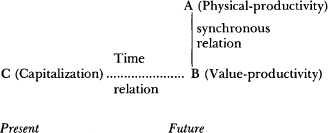
The modern productivity theorist assumes as quite obvious the value-productivity B, as derived synchronously from the physical productivity A, but he ignores the problem of the discount relation in time between B and C. The pseudo-value-productivity assumed in the productivity theory of interest is all, however, involved in the unexplained discount relation between B and C, not in the identity relation between A and B. This is the petitio principii of the theory.
The value-surplus referred to is that part, imputable to, and varying with, the time element, and not that due to the peculiar commercial skill, or to the luck, of the enterpriser, in finding unusually low valued agents in one place, or unusually high valued products in another. If one did not bear in mind the complex character of the gross income “profits,” one might be tempted to exclaim: If the enterpriser must pay as interest the whole amount involved in time-discount, he never would have a motive to borrow. It is just here that appears so plainly the middleman’s character of the productive borrower. The rate of interest is a market price at which (security, etc., equalized) the individual borrows; but those with superior knowledge and superior foresight are able to buy in one economic group and to sell their products in another, to buy “underestimated” goods and to find a favorable market for highly esteemed products. They are merchants, buying when they can in a cheaper and selling in a dearer capitalization market,55 acting as the equalizers of rates and prices. It is the mercantile function everywhere to do this. So we must dissent again when Seager says:56
And it is this demand for capital growing out of the important role capital plays as a factor in production, that is the positive, active influence determining interest, in the same sense that utility may be said to be the positive, active influence determining value.
Rather, this demand for capital determines interest in the same sense that the merchant’s demand determines the wholesale price of merchandise, he merely judging and transmitting to the wholesaler and manufacturer the ultimate consumer’s demand for various goods. In this case, the middleman’s demand for capital (that is, for loans) is a reflection of the time-valuation of consumers as embodied in the prices prevailing in the markets for goods.
Professor Seager seems so near at times to abandoning the cost-of-production theory of prices with which the productivity theory of interest is related, and has contributed such valuable and needed criticism to the present discussion, that it is to be hoped that he may yet bring his powerful aid to the capitalization camp.
6. THE CAPITAL CONCEPT IN THE INTEREST THEORY
The difficulty of seeing the capitalization problem in a broad way, as something touching all sources and groups of income, is, however, insurmountable so long as one adheres to the old concept of capital. Seager uses capital57 “in the sense of the produced means of further production,” and distinguishes land and capital as two groups of concrete objects, one of which owes its value to nature, and the other to labor. It is, of course, futile to attempt here a restatement of the reasons, negative and positive, against this view. They have been pretty fully stated elsewhere. Seager seems still to conceive of the interest problem as connected only with produced means of production, as did the older English economists, and as all productivity theorists incline to do. This inclination is found along with a treatment limited mainly, if not entirely, to contract interest.
But how can the “economic interest” aspect of the problem be limited to the income yielded by tools and machines? Why is not this problem presented in the case of incomes from land (or from an orchard, to which example Seager objects as not being typical of all forms of capital)? How account for the capitalization of this land and of this orchard? By applying a rate of interest derived from the money market as Fisher would seem to do, or a rate taken from the market for the loan of purely “produced” capital goods (whatever that may mean)? Cannot unproduced agents be capitalized unless the rate of discount is first discovered by making produced goods? Is not a capitalization rate conceivable in a community where land is the only form of wealth that is bought and sold? If so, then the thought is not avoidable that a rate of interest on contract loans to purchase land may prevail, reflecting this implied rate of capitalization—the chance for profit operating as a motive for the loan just as it does in manufacturing and commerce. Is interest not connected with a loan of money to buy “natural” agents as fully as with that to buy “artificial” agents? An answer to these questions inevitably carries one into the atmosphere of the capitalization theory, where the arbitrary limitation of the interest problem to loans made to buy “produced” agents becomes unthinkable.
But there is still the old question, how account for the tendency of profits (in the old broad sense of the term, including interest) toward equality; how explain the fact that on the average, though with many exceptions and fluctuations, the rates of profit to be had by productive borrowers in the various industries do not get so very far apart? There is the old explanation of cost-of-production of capital, upon which the latest productivity theorists still rely, and there is the capitalization theory. Both of these concede a place to the enterpriser. In the older view, the place is worthy to be called causal, in that, when any agent yields an abnormal return, he produces more agents, by incurring “costs” (which are either assumed to be fixed or are left quite unexplained), putting the price of more labor and materials into them and thus bringing their price into conformity with other agents of the same cost. The citadel where the productivity theorist feels his position to be impregnable is just here, in the thought that the amount and the value of “capital” (produced agents) is “brought into conformity with the expense of producing them,” thus regulating the interest rate. Seager is on familiar ground when he says:
Since there is nothing in the assumption that the productivity of all instruments is doubled that involves any serious change in the expense of producing the instruments.58
We must dissent. The doubling of the productivity of all agents alike would have very diverse effects upon the prices of the various enjoyable goods, and these prices would be reflected in the valuation process to the prices of the different natural sources and of all other agents, thus altering greatly the whole scale of costs in “producing” more agents.
But is this not a recognition that technical productivity has some influence upon the comparison of present and future gratifications, and hence upon the rate of interest? Surely, some influence it has, but the causal order of explanation is very different from that of the productivity theory. Technical productivity is one of the facts, physical, moral, intellectual, which go to make up the whole economic situation in which time-preference is exercised. That this, however, is not going over to the productivity theory of interest is shown by the fact that it points to an opposite conclusion as regards the resulting rate. The greater provision for present desires thus made possible leads us to expect a reduction of the preference for present goods and a lowering of their valuation in terms of future goods. This (other things being equal) would be reflected in a lower rate of time discount and a lower, not a higher, rate of interest, as the productivity theorist believes.59
May we not then conclude that the cost-of-production-of-capital explanation of interest is a partial glimpse of an intermediate and subordinate process of the adjustment of prices, in part a mistaking of effect for cause? It assumes a dual theory of investment prices; some prices are explained as due to demand and others as due to cost. The prices of the factors (materials, tools, labor) are taken as a basis from which to calculate the rate of interest, a sort of turtle’s-back (as in the ancient theory of the universe) on which the giant, Entrepreneur, stands while carrying on his back the burden of interest.
The capitalization theory views the causal order very differently. First, time-valuation being embodied in durable agents with incomes extending over a period of time, becomes the capitalization of agents containing future uses, this involving a rate of time-discount. This, in a market with exchange, becomes price, which is cost to the enterpriser seeking a profit by buying these factors, combining them more or less with his own services, and selling them. This process is constantly levelling down inequalities in capitalization as between different commodities and markets. All men together are helping to evaluate all of the economic goods in the community. Within this larger circle of explanation, the part of the enterpriser is secondary and intermediate. He does not represent any additional “technical productivity” cause, coming in alongside of the psychological explanation of interest. The chance of income for himself exists before he makes a move, partly because the future incomes have already been discounted (the pure capital-income aspect), and partly because all agents are not discounted at any moment at exactly the same, or exactly the right, rate (the commercial profit aspect). It is because of the chance of private profit already inherent in the situation that the producer is led to act in his intermediary capacity.
7. THE SAME DIFFICULTIES AGAIN
The article by Professor H. G. Brown,60 a former pupil and present colleague of Fisher, appeared almost simultaneously with Fisher’s concessions to the productivity theory. Professor Brown, agreeing almost completely with Seager, formulates an eclectic theory.
The position taken by the present writer is, that productivity and impatience are coördinate determinants, i.e., that productivity is as direct a determinant of interest as is impatience, and that productivity may be, in a modern community, the more important determinant.61
At every point where Professor Fisher is at his best, and rejects productivity “as a direct acting cause,” Professor Brown disagrees with him, and accepts productivity. Yet the article is marked by a number of just observations and seems at one point to touch upon the truth of the capitalization theory:62
We may say that a person’s valuation of capital, along with the valuations of other persons in like situation, is less the direct result of the previously existing market rate of interest, than it is, by affecting his and their attitude towards the market, a determinant of the rate of interest.
But the argument on the whole is on the plane of that conception of productivity criticized above. Every feature of the old argument is reproduced. The explanation is hardly begun until the productivity is assumed to be a five per cent, a ten per cent, or a twenty per cent productivity. Per cent of what? Of the capital valuation, or the prices at which the borrower can buy the agents. Productivity in what way? In that the present prices, being the discounted value of the incomes that are expected, emerge at their maturing value as time elapses. The discount-rate involved in the capitalization is the “rate of productivity” which appears again and again in the argument. The borrower pays contract interest of five per cent only when he thinks he sees the opportunity to get this increment and something more for his trouble. Simple and true as an explanation of why men borrow at a rate of contract interest related to the prevailing rate of time-discount, but no proof whatever that the rate of interest is due to technical productivity.
Here, as always, the productivity theorist looks at the proximate influence, not at that one step removed; examines the middleman’s motive, and ignores the ultimate consumer. The productive borrower is but the intermediary, transmitting to the market of consumers through the agency of prices, the effects of time-preference. Forgetting the motives and influences of the really determining group of minds, Professor Brown looks only at the “productive” borrower and says: “In what possible sense can it be said that he borrows only because he is impatient?”63 “All question of impatience aside”;64 “For even those [productive borrowers] who are not by nature impatient” etc.65 Professor Brown shows well66 the inaptness of the word “impatience,” but his argument is futile as a refutation of a true psychological theory, for he is quite overlooking the substance, while he chases the shadow, of time-preference.
This motive to borrow exists as well when the agent to be bought with borrowed money is land, as when it is another agent. But just here67 Professor Brown withdraws to the citadel, the cost-of-production of capital, as that which tends “to fix the rate of interest and of discount.” He reaffirms the
importance of the distinction which Professor Seager has recently emphasized, between land and made capital, between original natural resources and “the produced means to further production.” Land is already present. For the most part, there is no balancing of choice as to whether or not we shall produce it.
What is the force of “already present”? Does “for the most part there is no balancing of choice” etc., mean that the way we use land has not affected its quantity in the past, and does not affect it for the future, either as acres or as productive power? In this day of the conservation and reclamation movements, are we to forget the part of repairs and depreciation, and assume the immutability of acres, arable and other kinds? Is there not involved in any standard of husbandry where soil-fertility is maintained, an adjustment of the cost-of-production and of the capitalization of each arable acre to its price based on its expected return quite as this is done in the case of factories?68
It is not for us here to discuss further the older conception of capital here involved. We had supposed that it had become unthinkable in the atmosphere of Columbia and of Yale, under the influences of J. B. Clark and of Irving Fisher.
8. SUMMARY
Surely we are making some progress in formulating more clearly the issues involved in the interest problem. The opinions we have reviewed face in at least three different directions, not squarely opposing each other.69 Seager and Brown stand together on one side of the circle of opinion, glancing now and then with one eye at a psychological explanation (for consumption loans) and with the other eye fixed most of the time on the enterpriser-productivity explanation. They are not far away from Böhm-Bawerk, who is likewise eclectic; but their conception of productivity goes little farther than the personal enterpriser, whereas Böhm-Bawerk seeks, though vainly, in his roundabout theory, to extend his explanation formally to the impersonal productive powers in the agents. Nearly opposite them stands Fisher, directing his attention mainly upon the market for money loans, but giving many glances before and after to the psychological causes, in accord with the capitalization theory. The capitalization theorist at another point in the circle is faced directly toward the psychological explanation of interest, and sees the other features of the picture in due perspective to this central fact.
Seen from any of these standpoints, the interest paid on consumption loans is and must be explained in purely psychological terms. The capitalization theory, alone, is not eclectic, and explains interest on consumption and on production loans, in the same psychological terms. It alone sees the enterpriser’s part embraced within the larger circle of time-preference, and explains interest on productive loans as but the reflection of the time-preference in the minds of the great body of buyers in the community, whose representatives and intermediaries the enterprisers are.
_________________
Reprinted from American Economic Review 4 (March 1914).
NOTES
70 American Economic Review, Dec, 1912, H. R. Seager, (critique of) “The Impatience Theory of Interest”; Sept., 1913, Irving Fisher (reply), and H. R. Seager (comment) “The Impatience Theory of Interest.”
Quarterly Journal of Economics, Aug., 1913, Harry G. Brown, “The Marginal Productivity versus the Impatience Theory of Interest.”
71 To prevent misunderstanding, let us say that Böhm-Bawerk is here classed among those holding to the old theory, for his “round-about process” explanation is technological, though united with strong psychological features in the explanation of consumption loans.
72 This somewhat unusual word is here employed in the sense of physically productive, a technological interest theory being one which finds the explanation of the rate of interest in the actual, practical performances, or uses, of agents in producing other goods.
73 American Economic Review, Sept., 1913, p. 610.
74 The Rate of Interest, 1907, p. 12.
75 Ibid., p. 15.
76 Ibid., p. 22.
77 Ibid., p. 28.
78 The Impatience Theory of Interest,” Scientia, vol. IX, 1911, pp. 383, 384, 386.
79 American Economic Review, Sept., 1913, p. 610.
80 Ibid., p. 610.
81 Ibid., p. 611.
82 My italics throughout.
83 Ibid., p. 611.
84 Ibid., p. 617.
85 The Rate of Interest, p. 251.
86 American Economic Review, Sept., 1913, p. 612.
87 Ibid., 613.
88 Ibid., p. 617.
89 My italics.
90 Ibid., p. 612.
91 “Recent Discussion of the Capital Concept,” Quarterly Journal of Economics, vol. XV (Nov., 1900), p. 45.
92 Proceedings of the Thirteenth Annual Meeting, Dec, 1900, “The Next Decade of Economic Theory,” Publications of the American Economic Association, 3d series, vol. 2, pp. 240, 246.
93 “Einige Strittige Fragen der Capitalstheorie,” Political Science Quarterly, vol. 17 (Mar., 1902), p. 173.
94 Quarterly Journal of Economics, vol. 17 (Nov., 1902), p. 179.
95 The reader will observe that the term rent was there used in the more general sense of the income from the use, or the usance, of agents, not merely in the sense of contractual rent. This particular terminology which was due to the influence of J. B. Clark, has since been modified, not to weaken but to strengthen, the conception involved.
96 Publications of the American Economic Association, 3d series, vol. V, in a paper on “The Relations between Rent and Interest,” p. 197.
97 Believing this conception to be logically involved in much of Böhm-Bawerk’s argument in his critical volume, “Capital and Interest,” I credited him with “the fertile suggestion” (see above, p. 231, quotation from the article, “The Roundabout Process”). But he has not accepted this interpretation; indeed, this would invalidate the greater part of what is distinctive in his positive theory of the roundabout process, to which he adheres without change in the latest edition, 1912.
98 Fisher prefers to call the one explicit and the other implicit interest. However, throughout his book he uses the phrase “the rate of interest” almost if not exclusively for contract interest, and other terms, such as rate of preference, time-preference, etc., when implicit interest is meant.
99 Other expressions, to designate various aspects of the same problem, used in my Principles of Economics (1904), were “choice between different values,” p. 104; “difference in want-gratifying power,” p. 144; “time-difference”; “time-discount”; “the rate of time-discount,” p. 145; “estimate of time value,” p. 145; “a choice between present enjoyment and future provision,” p. 146; “a premium rate on present goods,” p. 146; “the exchange in time-valuation,” p. 146; “preference of the future over the present,” p. 158; “the preference of present over future,” p. 159.
100 When, however, attention is given to the details in the modern loan market following the action of this man or that, or studying a temporary situation such as a sudden demand for loans on the occasion of a war or in a financial panic, we break into the explanation at a different point. The change in the immediate status of the loan market is reflected in widening circles and for a time affects the capitalization of much of the wealth in the economy (of the nation or of the world). This and many other needed interpretations are briefly indicated in my elementary text. It is fundamental to the conception of the capitalization theory, however, that these impulses from the money market are not, as they superficially appear, primary or causal in a theory of interest, in the same sense as is the preference in time for enjoyable goods and the resulting level of capitalization. See especially chs. 17-19, in my Principles of Economics, 1904.
101 The Rate of Interest, p. 88.
102 Ibid., p. 88.
103 Ibid., p. 91.
104 Elementary Principles, 1912, p. 229.
105 Ibid., p. 336.
106 The Rate of Interest, p. 117.
107 American Economic Review, Dec, 1912, pp. 836-837.
108 My purpose, in large part, in calling attention to my mode of approach to the interest problem as outlined above, is to show that the psychological theory, in its original form, is not open to the criticism which Seager forcibly directs against Fisher, “that he dissociates his discussion completely from any account of the production of wealth.” To be sure, Fisher’s reply begins with a categorical denial, “I did not dissociate” (American Economic Review, Sept. 1913), but he immediately admits that in his “first approximation” the income streams were “temporarily assumed.” And while in his larger theoretical book, he believes that “this assumption gives place to the more complicated conditions of the actual world,” when he comes to the second and third approximations, he confesses that those complications were, “for the most part, omitted (as too difficult and controversial)” from the elementary book. Seager’s comment (American Economic Review, Sept., 1913, p. 618) is pertinent: “A methodology that causes an author to drop out an essential link when he tries to restate his theory in elementary form seems to me to be almost self-condemned.” At this point may be recalled my own criticism of Fisher’s treatment of capital in his Capital and Income. Reviewing this in the Journal of Political Economy, March, 1907, vol. 15, p. 147, 1 spoke of a “certain isolation in Fisher’s capital theory. He began the analysis and reconstruction of the capital concept as if it were a task apart from the theory of distribution as a whole. . . . The capital theory presented has therefore a certain character of intellectual aloofness that leaves it out of touch with the larger theory of distribution, of which it should be but one part.” The same criticism applies in general to The Rate of Interest, published a year later.
109 Seager, American Economic Review, Dec, 1912, p. 835.
110 The Rate of Interest, p. 184.
111 “The Impatience Theory of Interest,” Scientia, vol. IX, p. 387.
112 Elementary Principles, p. 371.
113 American Economic Review, Dec. 1912, pp. 841-842.
114 Fisher has followed Böhm-Bawerk in presenting objections to the productivity theory in terms that logically invalidate every productivity theory and, apparently, is again following his example in withdrawing the objections insofar as they apply to any but the naive theories. (See above, pp. 227-228.)
115 American Economic Review, Sept., 1913, p. 617.
116 Ibid., Dec., 1912, p. 849.
117 Ibid., p. 845.
118 Ibid., p. 848.
119 Ibid., pp. 847-848.
120 The Principles of Economics, 1904, p. 127.
121 American Economic Review, Dec, 1912.
122 American Economic Review, p. 842.
123 Ibid., pp. 842-843.
124 See above, pp. 235-236, 240-241.
125 American Economic Review, Dec, 1912, p. 848.
126 Ibid., p. 844.
127 American Economic Review, Dec, 1912, p. 847.
128 On this Fisher has taken a position in accordance with the capitalization theory. See American Economic Review, Sept., 1913, p. 614.
129 Cited above, p. 252, n. 1.
130 Quarterly Journal of Economics, Aug., 1913, p. 634. Here impatience and productivity are said to be coordinate determinants, though productivity may be the more important; and again, page 645, impatience is said “to enter into the chain of cause and effect” in a certain connection “as effect rather than cause”; and, finally, page 650, impatience “is also, to some extent, a joint consequence, with interest, of the other cause, the superiority of indirect production.”
131 Quarterly Journal of Economics, Aug., 1913, p. 644.
132 Ibid., p. 638.
133 Quarterly Journal of Economics, Aug., 1913, p. 639.
134 Ibid., p. 640.
135 Ibid., p. 637.
136 Ibid., p. 644.
137 Professor V. G. Simkhovitch’s illuminating article on “Hay and History,” in the Political Science Quarterly, Sept., 1913, gives new evidence of the effect upon agricultural industry of enlarging man’s power over the production of fertile and arable qualities in land.
138 A different conception, apparently a unique variation of the enterpriser- productivity theory, is the dynamic theory of Professor Schumpeter, as presented in his Theorie der Wirtschaftlichen Entwicklung, 1912, and reviewed at length by Böhm-Bawerk in the Zeitschrift für Volkswirtschaft, 1913.
- 1We will note later his abandonment of this idea, calling the rent of land “interest” (Positive Theory, 355) and ascribing interest to all consumption goods, even those not included in capital. Ibid., 350.
- 2Positive Theory, p. 24, ff.
- 3Ibid., p. 42, ff.
- 4Ibid., p. 27.
- 5Ibid., p. 31, ff.
- 6Positive Theory, pp. 43-59.
- 7Ibid., p. 31.
- 8Ibid., p. 38.
- 9Positive Theory, p. 59.
- 10Ibid., p. 60.
- 11Ibid., Preface, p. xxiii.
- 12E.g., Horace White on “Böhm-Bawerk on Capital,” Political Science Quarterly, vii. 133-148; General Walker, “Böhm-Bawerk’s Theory of Interest,” in Quarterly Journal of Economics, vi. 399-416.
- 13“The Genesis of Capital,” YaleReview, ii. 302-315; “The Origin of Interest,” Quarterly Journal of Economics, ix. 257.
- 14Publications of American Economic Association, iii. (1888).
- 15Positive Theory, pp. 33, 34.
- 16Yale Review, ix. 307.
- 17Publications of American Economic Association, iii. 91.
- 18YaleReview, ii. 308.
- 19Quarterly Journal of Economics, ix. 257.
- 20Quarterly Journal of Economics, ix. 116.
- 21Ibid., 380.
- 22Ibid., 263.
- 23Positive Theory, pp. 17-23.
- 24Quarterly Journal of Economics, ix. 258.
- 25Yale Review, ii. 304.
- 26A fuller discussion of this point is given later, p. 49.
- 27Yale Review, ii. 307.
- 28Publications of American Economic Association, iii. 95, 112.
- 29Yale Review, ii. 309.
- 30Ibid., 303, 304.
- 31Yale Review, ii. 309.1 must dissent from Clark’s opinion that the term “abstinence” is, in the discussion of value theories, to be applied only to the first act of saving. See this view in Quarterly Journal, ix. 260, 261. In a more useful sense it is a power of choice that is continuously present during the foregoing of the right to consume wealth, at every moment during which a man could convert the principal of interest-bearing capital into a source of present enjoyment.
- 32This point is treated more fully later, p. 57.
- 33Yale Review, ii. 309.
- 34Ibid., 312.
- 35This has already been observed by Fisher, Economic Journal, vi. 530.
- 36Yale Review, ii. 309.
- 37See further on this, infra, pp. 44-45.
- 38Quarterly Journal of Economics, ix. 124, 125.
- 39Yale Review, ii. 312.
- 40This is a somewhat different presentation of Böhm-Bawerk’s argument in Quarterly Journal of Economics, ix. 125-128.
- 41Yale Review, ii. 310, 311.
- 42Böhm-Bawerk appears to have very much the same conception of products ripening into consumption goods, in his circles of production periods. See Positive Theory, 93, 106-108.
- 43Yale Review, ix. 312.
- 44Yale Review, ii. 307.
- 45Ibid.
- 46Publications of American Economic Association, iii. 11.
- 47Yale Review, ii. 308.
- 48Quarterly Journal of Economics, ix. 275.
- 49This article was in the editor’s hands before the appearance of Professor Clark’s latest work, The Distribution of Wealth. The views of the author on the capital concept there expressed show no essential change from those here examined, and the criticism stands as first written.
- 50In three articles, Economic Journal, vi. 509; vii. 199, 511 (189697.)
- 51Ibid., vi. 513.
- 52Ibid., p. 514.
- 53Economic Journal, vi. 515.
- 54Ibid., p. 530.
- 55E.g., at the very outset, Economic Journal, vi. 515.
- 56See as to Clark, supra, p. 43.
- 57Economic Journal, vi. 514, ff.
- 58Economic Journal, vi. 534.
- 59Supra, p. 39.
- 60Quarterly Journal of Economics, ix. 253.
- 61Especially in Positive Theory, 339-349.
- 62I should add, if the income is estimated as a percentage of the capital value.
- 63Positive Theory, p. 44.
- 64Ibid., p. 45.
- 65Here we develop some of the thoughtful suggestions of Fisher, though differing with his view in ways already suggested. See Economic Journal, vii. 525.
- 66Positive Theory, p. 40.
- 67Ibid., p. 61. He says here, flatly contradicting his own words just quoted: “Substantially, [the conception of social capital] is a quite independent conception. In every essential respect (in definition, in scientific employment, and in scope) it stands on entirely independent principles.”
- 68Ibid., p. 22.
- 69Positive Theory, pp. 55, 56.
- 70Böhm-Bawerk undertook in his two large volumes to deal thoroughly with the theories of interest, and, to do so, was led to deal with the concepts of capital; for, thought he, it is capital for which interest is paid. However much he disputed the relation of production and interest, he had no doubt, in undertaking his study, as to the relation of capital and interest. Interest is the yield of capital in the broader sense, and capital the source of interest. They are correlative terms. To clear the field for his own concept of capital, Böhm-Bawerk, therefore, passes in review the various conceptions of capital that have been employed. He begins by following the historical order, and later groups the concepts in logical order. In the chapter on historical development he begins with a mention of the mediaeval view of capital as “an interest-bearing sum of money,” gives a few words to Turgot’s “saved goods” (a very inadequate, not to say mistaken, interpretation of Turgot’s view), and passes on to Adam Smith’s division of these into consumption goods and capital that brings an income. In Smith’s treatment the author thinks he finds the germ of the productivity theory of interest, which he considers false. Smith, in giving two varieties of the concept,—capital as a means of acquisition to the individual, and capital as a means of social production,—has in reality given, says Böhm-Bawerk, “two entirely independent conceptions, resting substantially on quite different foundations, and only connected externally by a very loose bond.” After devoting several pages to discussing this difficulty, the author abandons the historical order, and enumerates eight other variations of the concept: Hermann’s “every durable foundation of a utility which has exchange value”; Menger’s “groups of economic goods of higher rank [productive goods] now available to us for future periods,” Kleinwächter’s “tools of production”; Jevons’s “sustenance of the laborer”; Marx’s “instruments for the exploitation of the laborer”; Knies’s goods available to satisfy wants in the future; Walras’s goods which can be used more than once; MacLeod’s “value of the productive power contained in material goods.“ These are discussed more at length in Chapter V., the most important contentions being that the distinction between consumption goods and what he calls “the true instrument of production” is essential; that labor must not be confused with capital; that land must for many important reasons also be kept distinct; and that capital should be looked upon not as a “sum of value” hovering over goods, but as the “complex of goods” itself.
- 71Böhm-Bawerk undertook in his two large volumes to deal thoroughly with the theories of interest, and, to do so, was led to deal with the concepts of capital; for, thought he, it is capital for which interest is paid. However much he disputed the relation of production and interest, he had no doubt, in undertaking his study, as to the relation of capital and interest. Interest is the yield of capital in the broader sense, and capital the source of interest. They are correlative terms. To clear the field for his own concept of capital, Böhm-Bawerk, therefore, passes in review the various conceptions of capital that have been employed. He begins by following the historical order, and later groups the concepts in logical order. In the chapter on historical development he begins with a mention of the mediaeval view of capital as “an interest-bearing sum of money,” gives a few words to Turgot’s “saved goods” (a very inadequate, not to say mistaken, interpretation of Turgot’s view), and passes on to Adam Smith’s division of these into consumption goods and capital that brings an income. In Smith’s treatment the author thinks he finds the germ of the productivity theory of interest, which he considers false. Smith, in giving two varieties of the concept,—capital as a means of acquisition to the individual, and capital as a means of social production,—has in reality given, says Böhm-Bawerk, “two entirely independent conceptions, resting substantially on quite different foundations, and only connected externally by a very loose bond.” After devoting several pages to discussing this difficulty, the author abandons the historical order, and enumerates eight other variations of the concept: Hermann’s “every durable foundation of a utility which has exchange value”; Menger’s “groups of economic goods of higher rank [productive goods] now available to us for future periods,” Kleinwächter’s “tools of production”; Jevons’s “sustenance of the laborer”; Marx’s “instruments for the exploitation of the laborer”; Knies’s goods available to satisfy wants in the future; Walras’s goods which can be used more than once; MacLeod’s “value of the productive power contained in material goods.“ These are discussed more at length in Chapter V., the most important contentions being that the distinction between consumption goods and what he calls “the true instrument of production” is essential; that labor must not be confused with capital; that land must for many important reasons also be kept distinct; and that capital should be looked upon not as a “sum of value” hovering over goods, but as the “complex of goods” itself.
- 72Böhm-Bawerk undertook in his two large volumes to deal thoroughly with the theories of interest, and, to do so, was led to deal with the concepts of capital; for, thought he, it is capital for which interest is paid. However much he disputed the relation of production and interest, he had no doubt, in undertaking his study, as to the relation of capital and interest. Interest is the yield of capital in the broader sense, and capital the source of interest. They are correlative terms. To clear the field for his own concept of capital, Böhm-Bawerk, therefore, passes in review the various conceptions of capital that have been employed. He begins by following the historical order, and later groups the concepts in logical order. In the chapter on historical development he begins with a mention of the mediaeval view of capital as “an interest-bearing sum of money,” gives a few words to Turgot’s “saved goods” (a very inadequate, not to say mistaken, interpretation of Turgot’s view), and passes on to Adam Smith’s division of these into consumption goods and capital that brings an income. In Smith’s treatment the author thinks he finds the germ of the productivity theory of interest, which he considers false. Smith, in giving two varieties of the concept,—capital as a means of acquisition to the individual, and capital as a means of social production,—has in reality given, says Böhm-Bawerk, “two entirely independent conceptions, resting substantially on quite different foundations, and only connected externally by a very loose bond.” After devoting several pages to discussing this difficulty, the author abandons the historical order, and enumerates eight other variations of the concept: Hermann’s “every durable foundation of a utility which has exchange value”; Menger’s “groups of economic goods of higher rank [productive goods] now available to us for future periods,” Kleinwächter’s “tools of production”; Jevons’s “sustenance of the laborer”; Marx’s “instruments for the exploitation of the laborer”; Knies’s goods available to satisfy wants in the future; Walras’s goods which can be used more than once; MacLeod’s “value of the productive power contained in material goods.“ These are discussed more at length in Chapter V., the most important contentions being that the distinction between consumption goods and what he calls “the true instrument of production” is essential; that labor must not be confused with capital; that land must for many important reasons also be kept distinct; and that capital should be looked upon not as a “sum of value” hovering over goods, but as the “complex of goods” itself.
- 73Böhm-Bawerk undertook in his two large volumes to deal thoroughly with the theories of interest, and, to do so, was led to deal with the concepts of capital; for, thought he, it is capital for which interest is paid. However much he disputed the relation of production and interest, he had no doubt, in undertaking his study, as to the relation of capital and interest. Interest is the yield of capital in the broader sense, and capital the source of interest. They are correlative terms. To clear the field for his own concept of capital, Böhm-Bawerk, therefore, passes in review the various conceptions of capital that have been employed. He begins by following the historical order, and later groups the concepts in logical order. In the chapter on historical development he begins with a mention of the mediaeval view of capital as “an interest-bearing sum of money,” gives a few words to Turgot’s “saved goods” (a very inadequate, not to say mistaken, interpretation of Turgot’s view), and passes on to Adam Smith’s division of these into consumption goods and capital that brings an income. In Smith’s treatment the author thinks he finds the germ of the productivity theory of interest, which he considers false. Smith, in giving two varieties of the concept,—capital as a means of acquisition to the individual, and capital as a means of social production,—has in reality given, says Böhm-Bawerk, “two entirely independent conceptions, resting substantially on quite different foundations, and only connected externally by a very loose bond.” After devoting several pages to discussing this difficulty, the author abandons the historical order, and enumerates eight other variations of the concept: Hermann’s “every durable foundation of a utility which has exchange value”; Menger’s “groups of economic goods of higher rank [productive goods] now available to us for future periods,” Kleinwächter’s “tools of production”; Jevons’s “sustenance of the laborer”; Marx’s “instruments for the exploitation of the laborer”; Knies’s goods available to satisfy wants in the future; Walras’s goods which can be used more than once; MacLeod’s “value of the productive power contained in material goods.“ These are discussed more at length in Chapter V., the most important contentions being that the distinction between consumption goods and what he calls “the true instrument of production” is essential; that labor must not be confused with capital; that land must for many important reasons also be kept distinct; and that capital should be looked upon not as a “sum of value” hovering over goods, but as the “complex of goods” itself.
- 74Böhm-Bawerk undertook in his two large volumes to deal thoroughly with the theories of interest, and, to do so, was led to deal with the concepts of capital; for, thought he, it is capital for which interest is paid. However much he disputed the relation of production and interest, he had no doubt, in undertaking his study, as to the relation of capital and interest. Interest is the yield of capital in the broader sense, and capital the source of interest. They are correlative terms. To clear the field for his own concept of capital, Böhm-Bawerk, therefore, passes in review the various conceptions of capital that have been employed. He begins by following the historical order, and later groups the concepts in logical order. In the chapter on historical development he begins with a mention of the mediaeval view of capital as “an interest-bearing sum of money,” gives a few words to Turgot’s “saved goods” (a very inadequate, not to say mistaken, interpretation of Turgot’s view), and passes on to Adam Smith’s division of these into consumption goods and capital that brings an income. In Smith’s treatment the author thinks he finds the germ of the productivity theory of interest, which he considers false. Smith, in giving two varieties of the concept,—capital as a means of acquisition to the individual, and capital as a means of social production,—has in reality given, says Böhm-Bawerk, “two entirely independent conceptions, resting substantially on quite different foundations, and only connected externally by a very loose bond.” After devoting several pages to discussing this difficulty, the author abandons the historical order, and enumerates eight other variations of the concept: Hermann’s “every durable foundation of a utility which has exchange value”; Menger’s “groups of economic goods of higher rank [productive goods] now available to us for future periods,” Kleinwächter’s “tools of production”; Jevons’s “sustenance of the laborer”; Marx’s “instruments for the exploitation of the laborer”; Knies’s goods available to satisfy wants in the future; Walras’s goods which can be used more than once; MacLeod’s “value of the productive power contained in material goods.“ These are discussed more at length in Chapter V., the most important contentions being that the distinction between consumption goods and what he calls “the true instrument of production” is essential; that labor must not be confused with capital; that land must for many important reasons also be kept distinct; and that capital should be looked upon not as a “sum of value” hovering over goods, but as the “complex of goods” itself.
- 75Böhm-Bawerk undertook in his two large volumes to deal thoroughly with the theories of interest, and, to do so, was led to deal with the concepts of capital; for, thought he, it is capital for which interest is paid. However much he disputed the relation of production and interest, he had no doubt, in undertaking his study, as to the relation of capital and interest. Interest is the yield of capital in the broader sense, and capital the source of interest. They are correlative terms. To clear the field for his own concept of capital, Böhm-Bawerk, therefore, passes in review the various conceptions of capital that have been employed. He begins by following the historical order, and later groups the concepts in logical order. In the chapter on historical development he begins with a mention of the mediaeval view of capital as “an interest-bearing sum of money,” gives a few words to Turgot’s “saved goods” (a very inadequate, not to say mistaken, interpretation of Turgot’s view), and passes on to Adam Smith’s division of these into consumption goods and capital that brings an income. In Smith’s treatment the author thinks he finds the germ of the productivity theory of interest, which he considers false. Smith, in giving two varieties of the concept,—capital as a means of acquisition to the individual, and capital as a means of social production,—has in reality given, says Böhm-Bawerk, “two entirely independent conceptions, resting substantially on quite different foundations, and only connected externally by a very loose bond.” After devoting several pages to discussing this difficulty, the author abandons the historical order, and enumerates eight other variations of the concept: Hermann’s “every durable foundation of a utility which has exchange value”; Menger’s “groups of economic goods of higher rank [productive goods] now available to us for future periods,” Kleinwächter’s “tools of production”; Jevons’s “sustenance of the laborer”; Marx’s “instruments for the exploitation of the laborer”; Knies’s goods available to satisfy wants in the future; Walras’s goods which can be used more than once; MacLeod’s “value of the productive power contained in material goods.“ These are discussed more at length in Chapter V., the most important contentions being that the distinction between consumption goods and what he calls “the true instrument of production” is essential; that labor must not be confused with capital; that land must for many important reasons also be kept distinct; and that capital should be looked upon not as a “sum of value” hovering over goods, but as the “complex of goods” itself.
- 76Among these many variations the author gives his approval to that of Adam Smith, giving it “a more distinct formulation,” however, and distinguishing between the wider and narrower conceptions, acquisitive (private) and productive (social) capital.
- 77Of the former he says : “Capital in general we shall call a group of Products which serve as means to the Acquisition of Goods. Under this general conception we shall put that of Social Capital as narrower conception.” The problem of interest, he thinks, is connected with private or acquisitive capital, not necessarily with social or productive capital.
- 78What judgment now is to be passed on this reading of the capital concept? We must be struck by the fact that in the matter of simplicity the results of the author’s study are not ideal. But he asserts with a tone of triumph that the “conception meets all our logical and terminological requirements. Logically, it is unas-sailable.” He concludes with this hopeful prophecy: “If, then, unbiased people are ever to agree on the conception of capital, we may expect that this will be the one chosen.” His strongest ground for such a hope was the fact that he had made a place under the name “capital” for the two most generally employed concepts, and that the concept of social capital is the one widely held,—“products used for further production.” He did not claim much originality for this part of his work. He says: “The heavy part of the Positive Theory of Capital lies in the theory of interest. In the other portions of the subject [he seems to mean the concept of capital] I was able, at least on the whole, to follow in the footsteps of previous theorists.”
- 79What judgment now is to be passed on this reading of the capital concept? We must be struck by the fact that in the matter of simplicity the results of the author’s study are not ideal. But he asserts with a tone of triumph that the “conception meets all our logical and terminological requirements. Logically, it is unas-sailable.” He concludes with this hopeful prophecy: “If, then, unbiased people are ever to agree on the conception of capital, we may expect that this will be the one chosen.” His strongest ground for such a hope was the fact that he had made a place under the name “capital” for the two most generally employed concepts, and that the concept of social capital is the one widely held,—“products used for further production.” He did not claim much originality for this part of his work. He says: “The heavy part of the Positive Theory of Capital lies in the theory of interest. In the other portions of the subject [he seems to mean the concept of capital] I was able, at least on the whole, to follow in the footsteps of previous theorists.”
- 80What judgment now is to be passed on this reading of the capital concept? We must be struck by the fact that in the matter of simplicity the results of the author’s study are not ideal. But he asserts with a tone of triumph that the “conception meets all our logical and terminological requirements. Logically, it is unas-sailable.” He concludes with this hopeful prophecy: “If, then, unbiased people are ever to agree on the conception of capital, we may expect that this will be the one chosen.” His strongest ground for such a hope was the fact that he had made a place under the name “capital” for the two most generally employed concepts, and that the concept of social capital is the one widely held,—“products used for further production.” He did not claim much originality for this part of his work. He says: “The heavy part of the Positive Theory of Capital lies in the theory of interest. In the other portions of the subject [he seems to mean the concept of capital] I was able, at least on the whole, to follow in the footsteps of previous theorists.”
- 81The immediate reception of this portion of the author’s work largely justified his hopes. His careful restatement of the concept and the authority of his name undoubtedly added to the prestige it already enjoyed. The more usual point of attack on the author has been his interest theory, not his capital concept, which has been far less questioned,—in fact, has usually been accepted as flawless. Some protests, however, have already been raised against it; and, although it is still the dominant concept, discontent with this and other features of the older economic thought has been spreading. The earnest teacher, using the available text-books, and attempting to correct their treatment in accord with recent criticisms, is in despair. To one who has watched the course of the discussion it might seem that the service of Böhm-Bawerk’s work, so far as it touches the capital concept, lay not in settling, but in reopening the whole question. Remembering, however, that most students still accept Böhm-Bawerk’s statement of the concept, we turn to a group of thinkers who would give other readings to it; and we shall confine our study to the leading representatives of two differing views on the question.
- 82This part of the Austrian writer’s work, especially, was attacked by Professor John B. Clark, who defends the productivity theory of interest, though that point we need not raise in this paper. His own views had been published at the same time as the German edition of the Positive Theory of Capital; but more attention was attracted to them, it is probable, as a result of this controversy than at their first publication. I shall not enter into the merits of the discussion as a whole. It was carried on with great skill, with some later confessed misunderstandings, and at times, perhaps, with an over-subtlety which makes it exceedingly difficult to follow. I shall simply try to state the issue involved as to the capital concept.
- 83This part of the Austrian writer’s work, especially, was attacked by Professor John B. Clark, who defends the productivity theory of interest, though that point we need not raise in this paper. His own views had been published at the same time as the German edition of the Positive Theory of Capital; but more attention was attracted to them, it is probable, as a result of this controversy than at their first publication. I shall not enter into the merits of the discussion as a whole. It was carried on with great skill, with some later confessed misunderstandings, and at times, perhaps, with an over-subtlety which makes it exceedingly difficult to follow. I shall simply try to state the issue involved as to the capital concept.
- 84In every-day speech and in the writings of economists there have been, since before the time of Adam Smith, two broadly marked ways of thinking of capital: one views it as concrete goods, such as tools and machines; the other, as the money expression, or market value, of the goods. It is probable that no writer has long kept from the use of the term in both these ways, no matter what his formal definition. Frequently both uses will be found on the same page. A few writers only have chosen to frame their capital concept in accord with the second of these ways of thinking. Böhm-Bawerk has taken the former way, defining capital as the concrete goods; and in the interest problem he insists on the need of comparing goods of like kind and quantity. Clark declares this to be an error, and defines capital in harmony with the second way of thinking of it. He says, “There is in existence a permanent fund of productive wealth, expressible in money, but not embodied in money; and it is this that business men designate by the term capital.” The concrete things which make up this fund he calls “capital goods.” In contrast with this list of goods he often speaks of his kind of capital as “true capital,” or “pure capital,” which, as he says elsewhere, “resides in many unlike things, but consists of a single entity that is common to them all. That entity is ‘effective social utility.’” Again, he says: “Capital goods are . . . vanishing elements. True capital . . . is abiding.” Elsewhere he clothes his definition, which he calls “the common and practical sense of the term,” in these words: “Capital is an abiding fund of wealth employed in production.”
- 85In every-day speech and in the writings of economists there have been, since before the time of Adam Smith, two broadly marked ways of thinking of capital: one views it as concrete goods, such as tools and machines; the other, as the money expression, or market value, of the goods. It is probable that no writer has long kept from the use of the term in both these ways, no matter what his formal definition. Frequently both uses will be found on the same page. A few writers only have chosen to frame their capital concept in accord with the second of these ways of thinking. Böhm-Bawerk has taken the former way, defining capital as the concrete goods; and in the interest problem he insists on the need of comparing goods of like kind and quantity. Clark declares this to be an error, and defines capital in harmony with the second way of thinking of it. He says, “There is in existence a permanent fund of productive wealth, expressible in money, but not embodied in money; and it is this that business men designate by the term capital.” The concrete things which make up this fund he calls “capital goods.” In contrast with this list of goods he often speaks of his kind of capital as “true capital,” or “pure capital,” which, as he says elsewhere, “resides in many unlike things, but consists of a single entity that is common to them all. That entity is ‘effective social utility.’” Again, he says: “Capital goods are . . . vanishing elements. True capital . . . is abiding.” Elsewhere he clothes his definition, which he calls “the common and practical sense of the term,” in these words: “Capital is an abiding fund of wealth employed in production.”
- 86In every-day speech and in the writings of economists there have been, since before the time of Adam Smith, two broadly marked ways of thinking of capital: one views it as concrete goods, such as tools and machines; the other, as the money expression, or market value, of the goods. It is probable that no writer has long kept from the use of the term in both these ways, no matter what his formal definition. Frequently both uses will be found on the same page. A few writers only have chosen to frame their capital concept in accord with the second of these ways of thinking. Böhm-Bawerk has taken the former way, defining capital as the concrete goods; and in the interest problem he insists on the need of comparing goods of like kind and quantity. Clark declares this to be an error, and defines capital in harmony with the second way of thinking of it. He says, “There is in existence a permanent fund of productive wealth, expressible in money, but not embodied in money; and it is this that business men designate by the term capital.” The concrete things which make up this fund he calls “capital goods.” In contrast with this list of goods he often speaks of his kind of capital as “true capital,” or “pure capital,” which, as he says elsewhere, “resides in many unlike things, but consists of a single entity that is common to them all. That entity is ‘effective social utility.’” Again, he says: “Capital goods are . . . vanishing elements. True capital . . . is abiding.” Elsewhere he clothes his definition, which he calls “the common and practical sense of the term,” in these words: “Capital is an abiding fund of wealth employed in production.”
- 87In every-day speech and in the writings of economists there have been, since before the time of Adam Smith, two broadly marked ways of thinking of capital: one views it as concrete goods, such as tools and machines; the other, as the money expression, or market value, of the goods. It is probable that no writer has long kept from the use of the term in both these ways, no matter what his formal definition. Frequently both uses will be found on the same page. A few writers only have chosen to frame their capital concept in accord with the second of these ways of thinking. Böhm-Bawerk has taken the former way, defining capital as the concrete goods; and in the interest problem he insists on the need of comparing goods of like kind and quantity. Clark declares this to be an error, and defines capital in harmony with the second way of thinking of it. He says, “There is in existence a permanent fund of productive wealth, expressible in money, but not embodied in money; and it is this that business men designate by the term capital.” The concrete things which make up this fund he calls “capital goods.” In contrast with this list of goods he often speaks of his kind of capital as “true capital,” or “pure capital,” which, as he says elsewhere, “resides in many unlike things, but consists of a single entity that is common to them all. That entity is ‘effective social utility.’” Again, he says: “Capital goods are . . . vanishing elements. True capital . . . is abiding.” Elsewhere he clothes his definition, which he calls “the common and practical sense of the term,” in these words: “Capital is an abiding fund of wealth employed in production.”
- 88In every-day speech and in the writings of economists there have been, since before the time of Adam Smith, two broadly marked ways of thinking of capital: one views it as concrete goods, such as tools and machines; the other, as the money expression, or market value, of the goods. It is probable that no writer has long kept from the use of the term in both these ways, no matter what his formal definition. Frequently both uses will be found on the same page. A few writers only have chosen to frame their capital concept in accord with the second of these ways of thinking. Böhm-Bawerk has taken the former way, defining capital as the concrete goods; and in the interest problem he insists on the need of comparing goods of like kind and quantity. Clark declares this to be an error, and defines capital in harmony with the second way of thinking of it. He says, “There is in existence a permanent fund of productive wealth, expressible in money, but not embodied in money; and it is this that business men designate by the term capital.” The concrete things which make up this fund he calls “capital goods.” In contrast with this list of goods he often speaks of his kind of capital as “true capital,” or “pure capital,” which, as he says elsewhere, “resides in many unlike things, but consists of a single entity that is common to them all. That entity is ‘effective social utility.’” Again, he says: “Capital goods are . . . vanishing elements. True capital . . . is abiding.” Elsewhere he clothes his definition, which he calls “the common and practical sense of the term,” in these words: “Capital is an abiding fund of wealth employed in production.”
- 89Needless to say, Böhm-Bawerk defends himself vigorously against the charge of “side-tracking” the theory of capital in defining the concept as he had done. The controversy turned about the phrase “goods of like kind and quantity,” and the question as to the real nature of the comparison of present and future goods. Clark holds that it is two sums of “quite different goods” that are compared. Böhm-Bawerk saves his phrase by the expedient of making the “goods of like kind and quantity” mean “dollars,” “exactly as does Professor Clark.” This is not a novelty with him; for, as he points out, he had “in many, and in some of the most important, passages of the Positive Theory of Capital . . . used money as an illustration of the proposition that present are worth more than future goods.” Without quite indorsing Clark’s comment on this point, we may agree with him that this appears to surrender the entire question concerning the formula “of like kind and quantity.” What meaning is in the phrase “the technical superiority of present goods over future goods,” when those goods are made to mean dollars? What becomes of the elaborate analysis of the roundabout method of production? Certainly, it means something very different, when the present goods employed are taken merely as circulating medium which is not in the normal case retained by the individual producers nor used up by society. The truth is, Böhm-Bawerk had fallen into the common error of using two different conceptions of capital, and at the first attack was found in an untenable position. This phase of the controversy seems to end by showing that the conception of capital made use of by Böhm-Bawerk himself, when he discusses business problems, takes the money expression, and differs in important ways from that of concrete goods expressed in his elaborately framed definition. A word as to the relation of these two views. It is to be noted that both parties agree that economists must study wealth under both these aspects. Böhm-Bawerk admits that he does so. The point against him is that, while framing his concept and basing his argument as to interest on the first, he introduces the second view, in some ways inconsistent, without recognizing the shift of concept. And Clark says that “the issue is not whether concrete capital goods are or are not to be studied at all. For certain purposes they have to be studied.” But he would confine the term “capital” to the sum of wealth or “permanent fund” constituted of the perishable goods.
- 90Needless to say, Böhm-Bawerk defends himself vigorously against the charge of “side-tracking” the theory of capital in defining the concept as he had done. The controversy turned about the phrase “goods of like kind and quantity,” and the question as to the real nature of the comparison of present and future goods. Clark holds that it is two sums of “quite different goods” that are compared. Böhm-Bawerk saves his phrase by the expedient of making the “goods of like kind and quantity” mean “dollars,” “exactly as does Professor Clark.” This is not a novelty with him; for, as he points out, he had “in many, and in some of the most important, passages of the Positive Theory of Capital . . . used money as an illustration of the proposition that present are worth more than future goods.” Without quite indorsing Clark’s comment on this point, we may agree with him that this appears to surrender the entire question concerning the formula “of like kind and quantity.” What meaning is in the phrase “the technical superiority of present goods over future goods,” when those goods are made to mean dollars? What becomes of the elaborate analysis of the roundabout method of production? Certainly, it means something very different, when the present goods employed are taken merely as circulating medium which is not in the normal case retained by the individual producers nor used up by society. The truth is, Böhm-Bawerk had fallen into the common error of using two different conceptions of capital, and at the first attack was found in an untenable position. This phase of the controversy seems to end by showing that the conception of capital made use of by Böhm-Bawerk himself, when he discusses business problems, takes the money expression, and differs in important ways from that of concrete goods expressed in his elaborately framed definition. A word as to the relation of these two views. It is to be noted that both parties agree that economists must study wealth under both these aspects. Böhm-Bawerk admits that he does so. The point against him is that, while framing his concept and basing his argument as to interest on the first, he introduces the second view, in some ways inconsistent, without recognizing the shift of concept. And Clark says that “the issue is not whether concrete capital goods are or are not to be studied at all. For certain purposes they have to be studied.” But he would confine the term “capital” to the sum of wealth or “permanent fund” constituted of the perishable goods.
- 91Needless to say, Böhm-Bawerk defends himself vigorously against the charge of “side-tracking” the theory of capital in defining the concept as he had done. The controversy turned about the phrase “goods of like kind and quantity,” and the question as to the real nature of the comparison of present and future goods. Clark holds that it is two sums of “quite different goods” that are compared. Böhm-Bawerk saves his phrase by the expedient of making the “goods of like kind and quantity” mean “dollars,” “exactly as does Professor Clark.” This is not a novelty with him; for, as he points out, he had “in many, and in some of the most important, passages of the Positive Theory of Capital . . . used money as an illustration of the proposition that present are worth more than future goods.” Without quite indorsing Clark’s comment on this point, we may agree with him that this appears to surrender the entire question concerning the formula “of like kind and quantity.” What meaning is in the phrase “the technical superiority of present goods over future goods,” when those goods are made to mean dollars? What becomes of the elaborate analysis of the roundabout method of production? Certainly, it means something very different, when the present goods employed are taken merely as circulating medium which is not in the normal case retained by the individual producers nor used up by society. The truth is, Böhm-Bawerk had fallen into the common error of using two different conceptions of capital, and at the first attack was found in an untenable position. This phase of the controversy seems to end by showing that the conception of capital made use of by Böhm-Bawerk himself, when he discusses business problems, takes the money expression, and differs in important ways from that of concrete goods expressed in his elaborately framed definition. A word as to the relation of these two views. It is to be noted that both parties agree that economists must study wealth under both these aspects. Böhm-Bawerk admits that he does so. The point against him is that, while framing his concept and basing his argument as to interest on the first, he introduces the second view, in some ways inconsistent, without recognizing the shift of concept. And Clark says that “the issue is not whether concrete capital goods are or are not to be studied at all. For certain purposes they have to be studied.” But he would confine the term “capital” to the sum of wealth or “permanent fund” constituted of the perishable goods.
- 92Needless to say, Böhm-Bawerk defends himself vigorously against the charge of “side-tracking” the theory of capital in defining the concept as he had done. The controversy turned about the phrase “goods of like kind and quantity,” and the question as to the real nature of the comparison of present and future goods. Clark holds that it is two sums of “quite different goods” that are compared. Böhm-Bawerk saves his phrase by the expedient of making the “goods of like kind and quantity” mean “dollars,” “exactly as does Professor Clark.” This is not a novelty with him; for, as he points out, he had “in many, and in some of the most important, passages of the Positive Theory of Capital . . . used money as an illustration of the proposition that present are worth more than future goods.” Without quite indorsing Clark’s comment on this point, we may agree with him that this appears to surrender the entire question concerning the formula “of like kind and quantity.” What meaning is in the phrase “the technical superiority of present goods over future goods,” when those goods are made to mean dollars? What becomes of the elaborate analysis of the roundabout method of production? Certainly, it means something very different, when the present goods employed are taken merely as circulating medium which is not in the normal case retained by the individual producers nor used up by society. The truth is, Böhm-Bawerk had fallen into the common error of using two different conceptions of capital, and at the first attack was found in an untenable position. This phase of the controversy seems to end by showing that the conception of capital made use of by Böhm-Bawerk himself, when he discusses business problems, takes the money expression, and differs in important ways from that of concrete goods expressed in his elaborately framed definition. A word as to the relation of these two views. It is to be noted that both parties agree that economists must study wealth under both these aspects. Böhm-Bawerk admits that he does so. The point against him is that, while framing his concept and basing his argument as to interest on the first, he introduces the second view, in some ways inconsistent, without recognizing the shift of concept. And Clark says that “the issue is not whether concrete capital goods are or are not to be studied at all. For certain purposes they have to be studied.” But he would confine the term “capital” to the sum of wealth or “permanent fund” constituted of the perishable goods.
- 93Needless to say, Böhm-Bawerk defends himself vigorously against the charge of “side-tracking” the theory of capital in defining the concept as he had done. The controversy turned about the phrase “goods of like kind and quantity,” and the question as to the real nature of the comparison of present and future goods. Clark holds that it is two sums of “quite different goods” that are compared. Böhm-Bawerk saves his phrase by the expedient of making the “goods of like kind and quantity” mean “dollars,” “exactly as does Professor Clark.” This is not a novelty with him; for, as he points out, he had “in many, and in some of the most important, passages of the Positive Theory of Capital . . . used money as an illustration of the proposition that present are worth more than future goods.” Without quite indorsing Clark’s comment on this point, we may agree with him that this appears to surrender the entire question concerning the formula “of like kind and quantity.” What meaning is in the phrase “the technical superiority of present goods over future goods,” when those goods are made to mean dollars? What becomes of the elaborate analysis of the roundabout method of production? Certainly, it means something very different, when the present goods employed are taken merely as circulating medium which is not in the normal case retained by the individual producers nor used up by society. The truth is, Böhm-Bawerk had fallen into the common error of using two different conceptions of capital, and at the first attack was found in an untenable position. This phase of the controversy seems to end by showing that the conception of capital made use of by Böhm-Bawerk himself, when he discusses business problems, takes the money expression, and differs in important ways from that of concrete goods expressed in his elaborately framed definition. A word as to the relation of these two views. It is to be noted that both parties agree that economists must study wealth under both these aspects. Böhm-Bawerk admits that he does so. The point against him is that, while framing his concept and basing his argument as to interest on the first, he introduces the second view, in some ways inconsistent, without recognizing the shift of concept. And Clark says that “the issue is not whether concrete capital goods are or are not to be studied at all. For certain purposes they have to be studied.” But he would confine the term “capital” to the sum of wealth or “permanent fund” constituted of the perishable goods.
- 94(1) The discussion is confined by Clark at the outset to social capital. He uses this term in a wider sense than Böhm-Bawerk does (as is explained in the next paragraph), but not differently as to the exclusion of consumption goods. Social capital is that kind which Böhm-Bawerk himself considers to be productive. Clark gains thus a distinct tactical advantage over his opponent in upholding the productivity theory of interest, though that is not of immediate importance to us here. The fact, however, that Böhm-Bawerk does not note this limitation, but fights the issue on the ground chosen by his adversary, shows that he himself is caught in the confusion of the two concepts, and is the strongest evidence of the inexpediency of the division of capital into social and private. On the other hand, the fact is of immediate interest to us that Clark gives this narrower content to the term “capital,” confining capital to “material forms of wealth that do not directly minister to consumers’ wants,” and does not make a place for acquisitive consumption goods, nor explain the interest from them, as is done by Böhm-Bawerk in his concept of private capital. In this respect the concept evidently needs addition or correction.
- 95(1) The discussion is confined by Clark at the outset to social capital. He uses this term in a wider sense than Böhm-Bawerk does (as is explained in the next paragraph), but not differently as to the exclusion of consumption goods. Social capital is that kind which Böhm-Bawerk himself considers to be productive. Clark gains thus a distinct tactical advantage over his opponent in upholding the productivity theory of interest, though that is not of immediate importance to us here. The fact, however, that Böhm-Bawerk does not note this limitation, but fights the issue on the ground chosen by his adversary, shows that he himself is caught in the confusion of the two concepts, and is the strongest evidence of the inexpediency of the division of capital into social and private. On the other hand, the fact is of immediate interest to us that Clark gives this narrower content to the term “capital,” confining capital to “material forms of wealth that do not directly minister to consumers’ wants,” and does not make a place for acquisitive consumption goods, nor explain the interest from them, as is done by Böhm-Bawerk in his concept of private capital. In this respect the concept evidently needs addition or correction.
- 96(1) The discussion is confined by Clark at the outset to social capital. He uses this term in a wider sense than Böhm-Bawerk does (as is explained in the next paragraph), but not differently as to the exclusion of consumption goods. Social capital is that kind which Böhm-Bawerk himself considers to be productive. Clark gains thus a distinct tactical advantage over his opponent in upholding the productivity theory of interest, though that is not of immediate importance to us here. The fact, however, that Böhm-Bawerk does not note this limitation, but fights the issue on the ground chosen by his adversary, shows that he himself is caught in the confusion of the two concepts, and is the strongest evidence of the inexpediency of the division of capital into social and private. On the other hand, the fact is of immediate interest to us that Clark gives this narrower content to the term “capital,” confining capital to “material forms of wealth that do not directly minister to consumers’ wants,” and does not make a place for acquisitive consumption goods, nor explain the interest from them, as is done by Böhm-Bawerk in his concept of private capital. In this respect the concept evidently needs addition or correction.
- 97(2) In the second place, Clark’s explanation of the genesis of capital is inconsistent with his own concept. Land used productively—for example, a farm, a waterfall, a mine, any rare and useful natural agent—is capital according to his definition. In his earlier utterances, such things are in plain words, included. In the later articles this is still the inevitable implication of the definition,—“a fund of productive wealth expressible in money”; but a reader new to the author’s doctrine would find no specific statement to this effect, and there would be small chance that the meaning in question would be gathered. The whole logic of the argument is against it. “The genesis of capital,” we are told, “takes place by a process for which the good old term ‘abstinence’ is, as I venture to maintain, the best designation.” This does not seem to give a place in capital to natural agents. There are, we are told, two classes of accumulators: the typical capitalists, who save to make permanent additions to their capital; and the quasi-capitalists, who “save sums now, intending to spend them later.” There is no place here for the unearned increment of a newly discovered mine, which to-day forms for many men the chief productive wealth expressible in money. If this is saving, it is a sense so unusual as to require a special explanation by the author; and it is difficult to see how it can consistently be given. There certainly would be no attempt to evade the real question by assuming that the dollars that bought the mine had been saved; for the mine may not have been sold, and, if so, it is irrelevant to the issue. If the definition adopted by Clark is consistently applied, there are necessarily many things forming a part of capital which never have been saved, and which never have called for abstinence, as Clark employs that term. In fact, Clark seems to show here, as did Böhm-Bawerk, some traces of the error of the labor theory of value, so difficult to throw off.
- 98(2) In the second place, Clark’s explanation of the genesis of capital is inconsistent with his own concept. Land used productively—for example, a farm, a waterfall, a mine, any rare and useful natural agent—is capital according to his definition. In his earlier utterances, such things are in plain words, included. In the later articles this is still the inevitable implication of the definition,—“a fund of productive wealth expressible in money”; but a reader new to the author’s doctrine would find no specific statement to this effect, and there would be small chance that the meaning in question would be gathered. The whole logic of the argument is against it. “The genesis of capital,” we are told, “takes place by a process for which the good old term ‘abstinence’ is, as I venture to maintain, the best designation.” This does not seem to give a place in capital to natural agents. There are, we are told, two classes of accumulators: the typical capitalists, who save to make permanent additions to their capital; and the quasi-capitalists, who “save sums now, intending to spend them later.” There is no place here for the unearned increment of a newly discovered mine, which to-day forms for many men the chief productive wealth expressible in money. If this is saving, it is a sense so unusual as to require a special explanation by the author; and it is difficult to see how it can consistently be given. There certainly would be no attempt to evade the real question by assuming that the dollars that bought the mine had been saved; for the mine may not have been sold, and, if so, it is irrelevant to the issue. If the definition adopted by Clark is consistently applied, there are necessarily many things forming a part of capital which never have been saved, and which never have called for abstinence, as Clark employs that term. In fact, Clark seems to show here, as did Böhm-Bawerk, some traces of the error of the labor theory of value, so difficult to throw off.
- 99(2) In the second place, Clark’s explanation of the genesis of capital is inconsistent with his own concept. Land used productively—for example, a farm, a waterfall, a mine, any rare and useful natural agent—is capital according to his definition. In his earlier utterances, such things are in plain words, included. In the later articles this is still the inevitable implication of the definition,—“a fund of productive wealth expressible in money”; but a reader new to the author’s doctrine would find no specific statement to this effect, and there would be small chance that the meaning in question would be gathered. The whole logic of the argument is against it. “The genesis of capital,” we are told, “takes place by a process for which the good old term ‘abstinence’ is, as I venture to maintain, the best designation.” This does not seem to give a place in capital to natural agents. There are, we are told, two classes of accumulators: the typical capitalists, who save to make permanent additions to their capital; and the quasi-capitalists, who “save sums now, intending to spend them later.” There is no place here for the unearned increment of a newly discovered mine, which to-day forms for many men the chief productive wealth expressible in money. If this is saving, it is a sense so unusual as to require a special explanation by the author; and it is difficult to see how it can consistently be given. There certainly would be no attempt to evade the real question by assuming that the dollars that bought the mine had been saved; for the mine may not have been sold, and, if so, it is irrelevant to the issue. If the definition adopted by Clark is consistently applied, there are necessarily many things forming a part of capital which never have been saved, and which never have called for abstinence, as Clark employs that term. In fact, Clark seems to show here, as did Böhm-Bawerk, some traces of the error of the labor theory of value, so difficult to throw off.
- 100(2) In the second place, Clark’s explanation of the genesis of capital is inconsistent with his own concept. Land used productively—for example, a farm, a waterfall, a mine, any rare and useful natural agent—is capital according to his definition. In his earlier utterances, such things are in plain words, included. In the later articles this is still the inevitable implication of the definition,—“a fund of productive wealth expressible in money”; but a reader new to the author’s doctrine would find no specific statement to this effect, and there would be small chance that the meaning in question would be gathered. The whole logic of the argument is against it. “The genesis of capital,” we are told, “takes place by a process for which the good old term ‘abstinence’ is, as I venture to maintain, the best designation.” This does not seem to give a place in capital to natural agents. There are, we are told, two classes of accumulators: the typical capitalists, who save to make permanent additions to their capital; and the quasi-capitalists, who “save sums now, intending to spend them later.” There is no place here for the unearned increment of a newly discovered mine, which to-day forms for many men the chief productive wealth expressible in money. If this is saving, it is a sense so unusual as to require a special explanation by the author; and it is difficult to see how it can consistently be given. There certainly would be no attempt to evade the real question by assuming that the dollars that bought the mine had been saved; for the mine may not have been sold, and, if so, it is irrelevant to the issue. If the definition adopted by Clark is consistently applied, there are necessarily many things forming a part of capital which never have been saved, and which never have called for abstinence, as Clark employs that term. In fact, Clark seems to show here, as did Böhm-Bawerk, some traces of the error of the labor theory of value, so difficult to throw off.
- 101(2) In the second place, Clark’s explanation of the genesis of capital is inconsistent with his own concept. Land used productively—for example, a farm, a waterfall, a mine, any rare and useful natural agent—is capital according to his definition. In his earlier utterances, such things are in plain words, included. In the later articles this is still the inevitable implication of the definition,—“a fund of productive wealth expressible in money”; but a reader new to the author’s doctrine would find no specific statement to this effect, and there would be small chance that the meaning in question would be gathered. The whole logic of the argument is against it. “The genesis of capital,” we are told, “takes place by a process for which the good old term ‘abstinence’ is, as I venture to maintain, the best designation.” This does not seem to give a place in capital to natural agents. There are, we are told, two classes of accumulators: the typical capitalists, who save to make permanent additions to their capital; and the quasi-capitalists, who “save sums now, intending to spend them later.” There is no place here for the unearned increment of a newly discovered mine, which to-day forms for many men the chief productive wealth expressible in money. If this is saving, it is a sense so unusual as to require a special explanation by the author; and it is difficult to see how it can consistently be given. There certainly would be no attempt to evade the real question by assuming that the dollars that bought the mine had been saved; for the mine may not have been sold, and, if so, it is irrelevant to the issue. If the definition adopted by Clark is consistently applied, there are necessarily many things forming a part of capital which never have been saved, and which never have called for abstinence, as Clark employs that term. In fact, Clark seems to show here, as did Böhm-Bawerk, some traces of the error of the labor theory of value, so difficult to throw off.
- 102(3) Again, Clark would seem to err by extreme statement in making it in the nature of capital to be a “permanent fund.” “In creating capital, we put the personal good away from us forever. . . . An addition to the social fund of perpetual capital is brought into existence.” “Nothing generates capital that does not add to the permanent fund of invested wealth.” “True capital . . . is, in the absence of untoward accidents, perpetual, and yields perpetual fruits.” Many other expressions emphasize the same thought. Now this evidently does not apply at all to the author’s quasi-capitalist, who saves to spend later. That, of course, is why he uses the term “quasi,” which evades the issue. Either such savings are capital (in which case why quasi?) or they are not capital, and may be omitted from the concept. The author, after stating that a part of the accumulation of capital is due to these quasi-capitalists, proceeds as if there were none such. If better or more tools and larger stocks were accumulated, and were then allowed to deteriorate while in use without being replaced, our author must certainly call them capital while they lasted; and, if so, the element of permanency is no essential part of the capital concept. Indeed, if a fund of productive wealth must be permanent to be capital, we cannot be sure that there is any such a thing; for we have not the gift of prophecy, and all human interests are fleeting. Clark himself says, “Capital . . . normally will never perish”; but “this is not saying that no capital ever perishes in fact.” This says clearly enough that permanency is not an essential mark of the concept, and makes meaningless both the word itself in that connection and a number of sentences, besides those quoted, in which this feature is emphasized as a vital mark of the concept. There is a valid thought in his contention, but it is not that capital is in its nature perpetual. There is ambiguity in the phrases “increase of capital” and “decrease of capital,” because they may mean either some of the parts or the whole. A part of capital may perish while the total amount of capital is preserved or even increased. Clark would confine the expression to the whole of capital, and objects to the form of statement “capital is destroyed” when the value of the concrete goods is passed on to other goods. But what of the cases where the total value is not preserved? The zeal of his attack carries him to an extreme and untenable expression, and makes him insist upon an unessential.
- 103(3) Again, Clark would seem to err by extreme statement in making it in the nature of capital to be a “permanent fund.” “In creating capital, we put the personal good away from us forever. . . . An addition to the social fund of perpetual capital is brought into existence.” “Nothing generates capital that does not add to the permanent fund of invested wealth.” “True capital . . . is, in the absence of untoward accidents, perpetual, and yields perpetual fruits.” Many other expressions emphasize the same thought. Now this evidently does not apply at all to the author’s quasi-capitalist, who saves to spend later. That, of course, is why he uses the term “quasi,” which evades the issue. Either such savings are capital (in which case why quasi?) or they are not capital, and may be omitted from the concept. The author, after stating that a part of the accumulation of capital is due to these quasi-capitalists, proceeds as if there were none such. If better or more tools and larger stocks were accumulated, and were then allowed to deteriorate while in use without being replaced, our author must certainly call them capital while they lasted; and, if so, the element of permanency is no essential part of the capital concept. Indeed, if a fund of productive wealth must be permanent to be capital, we cannot be sure that there is any such a thing; for we have not the gift of prophecy, and all human interests are fleeting. Clark himself says, “Capital . . . normally will never perish”; but “this is not saying that no capital ever perishes in fact.” This says clearly enough that permanency is not an essential mark of the concept, and makes meaningless both the word itself in that connection and a number of sentences, besides those quoted, in which this feature is emphasized as a vital mark of the concept. There is a valid thought in his contention, but it is not that capital is in its nature perpetual. There is ambiguity in the phrases “increase of capital” and “decrease of capital,” because they may mean either some of the parts or the whole. A part of capital may perish while the total amount of capital is preserved or even increased. Clark would confine the expression to the whole of capital, and objects to the form of statement “capital is destroyed” when the value of the concrete goods is passed on to other goods. But what of the cases where the total value is not preserved? The zeal of his attack carries him to an extreme and untenable expression, and makes him insist upon an unessential.
- 104(3) Again, Clark would seem to err by extreme statement in making it in the nature of capital to be a “permanent fund.” “In creating capital, we put the personal good away from us forever. . . . An addition to the social fund of perpetual capital is brought into existence.” “Nothing generates capital that does not add to the permanent fund of invested wealth.” “True capital . . . is, in the absence of untoward accidents, perpetual, and yields perpetual fruits.” Many other expressions emphasize the same thought. Now this evidently does not apply at all to the author’s quasi-capitalist, who saves to spend later. That, of course, is why he uses the term “quasi,” which evades the issue. Either such savings are capital (in which case why quasi?) or they are not capital, and may be omitted from the concept. The author, after stating that a part of the accumulation of capital is due to these quasi-capitalists, proceeds as if there were none such. If better or more tools and larger stocks were accumulated, and were then allowed to deteriorate while in use without being replaced, our author must certainly call them capital while they lasted; and, if so, the element of permanency is no essential part of the capital concept. Indeed, if a fund of productive wealth must be permanent to be capital, we cannot be sure that there is any such a thing; for we have not the gift of prophecy, and all human interests are fleeting. Clark himself says, “Capital . . . normally will never perish”; but “this is not saying that no capital ever perishes in fact.” This says clearly enough that permanency is not an essential mark of the concept, and makes meaningless both the word itself in that connection and a number of sentences, besides those quoted, in which this feature is emphasized as a vital mark of the concept. There is a valid thought in his contention, but it is not that capital is in its nature perpetual. There is ambiguity in the phrases “increase of capital” and “decrease of capital,” because they may mean either some of the parts or the whole. A part of capital may perish while the total amount of capital is preserved or even increased. Clark would confine the expression to the whole of capital, and objects to the form of statement “capital is destroyed” when the value of the concrete goods is passed on to other goods. But what of the cases where the total value is not preserved? The zeal of his attack carries him to an extreme and untenable expression, and makes him insist upon an unessential.
- 105(3) Again, Clark would seem to err by extreme statement in making it in the nature of capital to be a “permanent fund.” “In creating capital, we put the personal good away from us forever. . . . An addition to the social fund of perpetual capital is brought into existence.” “Nothing generates capital that does not add to the permanent fund of invested wealth.” “True capital . . . is, in the absence of untoward accidents, perpetual, and yields perpetual fruits.” Many other expressions emphasize the same thought. Now this evidently does not apply at all to the author’s quasi-capitalist, who saves to spend later. That, of course, is why he uses the term “quasi,” which evades the issue. Either such savings are capital (in which case why quasi?) or they are not capital, and may be omitted from the concept. The author, after stating that a part of the accumulation of capital is due to these quasi-capitalists, proceeds as if there were none such. If better or more tools and larger stocks were accumulated, and were then allowed to deteriorate while in use without being replaced, our author must certainly call them capital while they lasted; and, if so, the element of permanency is no essential part of the capital concept. Indeed, if a fund of productive wealth must be permanent to be capital, we cannot be sure that there is any such a thing; for we have not the gift of prophecy, and all human interests are fleeting. Clark himself says, “Capital . . . normally will never perish”; but “this is not saying that no capital ever perishes in fact.” This says clearly enough that permanency is not an essential mark of the concept, and makes meaningless both the word itself in that connection and a number of sentences, besides those quoted, in which this feature is emphasized as a vital mark of the concept. There is a valid thought in his contention, but it is not that capital is in its nature perpetual. There is ambiguity in the phrases “increase of capital” and “decrease of capital,” because they may mean either some of the parts or the whole. A part of capital may perish while the total amount of capital is preserved or even increased. Clark would confine the expression to the whole of capital, and objects to the form of statement “capital is destroyed” when the value of the concrete goods is passed on to other goods. But what of the cases where the total value is not preserved? The zeal of his attack carries him to an extreme and untenable expression, and makes him insist upon an unessential.
- 106(3) Again, Clark would seem to err by extreme statement in making it in the nature of capital to be a “permanent fund.” “In creating capital, we put the personal good away from us forever. . . . An addition to the social fund of perpetual capital is brought into existence.” “Nothing generates capital that does not add to the permanent fund of invested wealth.” “True capital . . . is, in the absence of untoward accidents, perpetual, and yields perpetual fruits.” Many other expressions emphasize the same thought. Now this evidently does not apply at all to the author’s quasi-capitalist, who saves to spend later. That, of course, is why he uses the term “quasi,” which evades the issue. Either such savings are capital (in which case why quasi?) or they are not capital, and may be omitted from the concept. The author, after stating that a part of the accumulation of capital is due to these quasi-capitalists, proceeds as if there were none such. If better or more tools and larger stocks were accumulated, and were then allowed to deteriorate while in use without being replaced, our author must certainly call them capital while they lasted; and, if so, the element of permanency is no essential part of the capital concept. Indeed, if a fund of productive wealth must be permanent to be capital, we cannot be sure that there is any such a thing; for we have not the gift of prophecy, and all human interests are fleeting. Clark himself says, “Capital . . . normally will never perish”; but “this is not saying that no capital ever perishes in fact.” This says clearly enough that permanency is not an essential mark of the concept, and makes meaningless both the word itself in that connection and a number of sentences, besides those quoted, in which this feature is emphasized as a vital mark of the concept. There is a valid thought in his contention, but it is not that capital is in its nature perpetual. There is ambiguity in the phrases “increase of capital” and “decrease of capital,” because they may mean either some of the parts or the whole. A part of capital may perish while the total amount of capital is preserved or even increased. Clark would confine the expression to the whole of capital, and objects to the form of statement “capital is destroyed” when the value of the concrete goods is passed on to other goods. But what of the cases where the total value is not preserved? The zeal of his attack carries him to an extreme and untenable expression, and makes him insist upon an unessential.
- 107(a) I am not quite in sympathy with the point of view of either of the parties to the discussion, but between them it is a question not as to what happens,—not of fact,—but of expression; and Böhm-Bawerk’s opinion commends itself when he says it is a “figure of speech” that is “misleading” to say that the real wages, consisting of “consumption goods” received to-day for work done on goods not be completed for years, are the “true and immediate fruit” of, e.g., the tanner’s labor. To the tanner, of course, they are the “immediate” and only fruits, since they are all he gets for his labor. The question is, does it seem logical and expedient from the general standpoint in economic discussion to consider and speak of them as the “true fruits” of that day’s labor? The expression chosen appears to say merely that these things express the present market value of the laborer’s services; that is, it is a roundabout and somewhat whimisical way of stating the truism that they are the man’s wages.
- 108(a) I am not quite in sympathy with the point of view of either of the parties to the discussion, but between them it is a question not as to what happens,—not of fact,—but of expression; and Böhm-Bawerk’s opinion commends itself when he says it is a “figure of speech” that is “misleading” to say that the real wages, consisting of “consumption goods” received to-day for work done on goods not be completed for years, are the “true and immediate fruit” of, e.g., the tanner’s labor. To the tanner, of course, they are the “immediate” and only fruits, since they are all he gets for his labor. The question is, does it seem logical and expedient from the general standpoint in economic discussion to consider and speak of them as the “true fruits” of that day’s labor? The expression chosen appears to say merely that these things express the present market value of the laborer’s services; that is, it is a roundabout and somewhat whimisical way of stating the truism that they are the man’s wages.
- 109(b) Further, it may be urged that the inaptness of this expression is more apparent when something other than subsistence goods is considered. In the example chosen of the tanner, it is at least debatable whether it is best to call the shoes he gets to-day the “true fruit” of his labor. But in the case of the laborer receiving food and clothing for digging a canal or working on a marble palace, it is straining the point further to use the expression. If here, too, his wages are called the “true fruit” of his labor, it still appears that the peculiar power ascribed to capital is due only to one part of capital, the finished consumption goods. No matter how large a stock of capital in the form of machines, buildings, and raw materials may be on hand, if there be no stock of finished goods, labor and its results are not synchronized.
- 110(c) A further objection to this way of conceiving of the nature of capital’s work is that it would, if true, be applicable only to “produced” forms of capital. As indicated by the phrases “industry and its fruition,” “labor and its fruits,” it implies vaguely the labor theory of value as to the origin of capital. The picture of labor continuously flowing into the reservoir of capital and consumption goods at the same time flowing out is not satisfactory as applied to products; for it implies that the inflow of a quantity of labor forces out consumption goods whose quantity is determined or measured by the quantity of inflowing labor. The value of consumption goods flowing out, however, is great-er in varying degrees than the value of labor flowing in; and it is only through their values that we can compare at all the quantities of the two streams. Further, it is not a happy figure; for it suggests that all the goods that are a part of capital will eventually become consumption goods, whereas in many cases this is not expected nor desired. It is significant that Clark in describing the process speaks only of “the materials, raw and partly wrought,” of which an article for consumption is made. He ignores machines and durable goods. It is only in the gradual passing on of their value, as they are used up, to the things that are made by them, that machines and more durable agents can be said to ripen at all. Even Clark’s value conception of capital, however, though it explains this point better than does the concrete concept of capital, does not avoid the difficulty. The point may be most clearly seen in the case of natural agents, which, as we have noted, are in Clark’s treatment included in the “fund” of capital. If we consider not merely capital in the form of products more or less fitted for consumption, but, as his concept requires, durable natural agents also, the phrases we are criticizing appear hardly short of absurd. Clark forgets this kind when he says: “The capital goods that are set working are not permanent. They pass away, and are replaced.” Natural agents, the field, the waterfall, insofar as they are thought of apart from betterments upon them, have not been originated by labor; and they are not in a state of transformation that will eventually ripen them into consumption goods. They stand there to be used by man, if he wishes, as an aid in securing future harvests or products; but neither the things themselves nor their value or money expression is “synchronizing” labor and its fruits. If there is any synchronizing, it is done not by this, but by some other part of capital, and is, therefore, not an essential mark of the capital concept.
- 111(c) A further objection to this way of conceiving of the nature of capital’s work is that it would, if true, be applicable only to “produced” forms of capital. As indicated by the phrases “industry and its fruition,” “labor and its fruits,” it implies vaguely the labor theory of value as to the origin of capital. The picture of labor continuously flowing into the reservoir of capital and consumption goods at the same time flowing out is not satisfactory as applied to products; for it implies that the inflow of a quantity of labor forces out consumption goods whose quantity is determined or measured by the quantity of inflowing labor. The value of consumption goods flowing out, however, is great-er in varying degrees than the value of labor flowing in; and it is only through their values that we can compare at all the quantities of the two streams. Further, it is not a happy figure; for it suggests that all the goods that are a part of capital will eventually become consumption goods, whereas in many cases this is not expected nor desired. It is significant that Clark in describing the process speaks only of “the materials, raw and partly wrought,” of which an article for consumption is made. He ignores machines and durable goods. It is only in the gradual passing on of their value, as they are used up, to the things that are made by them, that machines and more durable agents can be said to ripen at all. Even Clark’s value conception of capital, however, though it explains this point better than does the concrete concept of capital, does not avoid the difficulty. The point may be most clearly seen in the case of natural agents, which, as we have noted, are in Clark’s treatment included in the “fund” of capital. If we consider not merely capital in the form of products more or less fitted for consumption, but, as his concept requires, durable natural agents also, the phrases we are criticizing appear hardly short of absurd. Clark forgets this kind when he says: “The capital goods that are set working are not permanent. They pass away, and are replaced.” Natural agents, the field, the waterfall, insofar as they are thought of apart from betterments upon them, have not been originated by labor; and they are not in a state of transformation that will eventually ripen them into consumption goods. They stand there to be used by man, if he wishes, as an aid in securing future harvests or products; but neither the things themselves nor their value or money expression is “synchronizing” labor and its fruits. If there is any synchronizing, it is done not by this, but by some other part of capital, and is, therefore, not an essential mark of the capital concept.
- 112(c) A further objection to this way of conceiving of the nature of capital’s work is that it would, if true, be applicable only to “produced” forms of capital. As indicated by the phrases “industry and its fruition,” “labor and its fruits,” it implies vaguely the labor theory of value as to the origin of capital. The picture of labor continuously flowing into the reservoir of capital and consumption goods at the same time flowing out is not satisfactory as applied to products; for it implies that the inflow of a quantity of labor forces out consumption goods whose quantity is determined or measured by the quantity of inflowing labor. The value of consumption goods flowing out, however, is great-er in varying degrees than the value of labor flowing in; and it is only through their values that we can compare at all the quantities of the two streams. Further, it is not a happy figure; for it suggests that all the goods that are a part of capital will eventually become consumption goods, whereas in many cases this is not expected nor desired. It is significant that Clark in describing the process speaks only of “the materials, raw and partly wrought,” of which an article for consumption is made. He ignores machines and durable goods. It is only in the gradual passing on of their value, as they are used up, to the things that are made by them, that machines and more durable agents can be said to ripen at all. Even Clark’s value conception of capital, however, though it explains this point better than does the concrete concept of capital, does not avoid the difficulty. The point may be most clearly seen in the case of natural agents, which, as we have noted, are in Clark’s treatment included in the “fund” of capital. If we consider not merely capital in the form of products more or less fitted for consumption, but, as his concept requires, durable natural agents also, the phrases we are criticizing appear hardly short of absurd. Clark forgets this kind when he says: “The capital goods that are set working are not permanent. They pass away, and are replaced.” Natural agents, the field, the waterfall, insofar as they are thought of apart from betterments upon them, have not been originated by labor; and they are not in a state of transformation that will eventually ripen them into consumption goods. They stand there to be used by man, if he wishes, as an aid in securing future harvests or products; but neither the things themselves nor their value or money expression is “synchronizing” labor and its fruits. If there is any synchronizing, it is done not by this, but by some other part of capital, and is, therefore, not an essential mark of the capital concept.
- 113(5) It is likely that to some points in what has been thus far said the answer will be made that they are due to misunderstanding of the author’s meaning. No doubt the author attaches great weight to the constrast he draws between true capital and capital goods, which it might seem I had neglected. The reply is a criticism stronger, perhaps, than any of the foregoing against Clark’s capital concept. There is in his mode of thinking of this contrast an over-abstraction that is neither expedient nor logical; and there results in his presentation some inconsistency of thought and statement. In some passages, capital is said to be as concrete a thing as can be. It “consists in goods. It is not an abstraction, and it is not a force independently of matter. It has substance. If at any instant we could collect in one place all the material forms of wealth that do not directly minister to consumers’ wants, we should have the fund for the moment before our eyes in substantial embodiment.” Capital is thus “productive wealth, expressible in money, but not embodied in money.” That is plain enough, and we are still on solid ground: we are not puzzled here by the “entity, effective social utility,” of the earlier statement, where capital does not consist of the concrete things, but is the “fund that resides in many unlike things,” and is “embodied in instruments of production.” This has the unpleasant flavor of Marx’s labor jelly, though it need not be taken as more than a loose, convenient way of expressing the market value of the concrete things. But the development that follows of the paradoxical contrasts between capital goods and true capital appears to be mischievous subtlety. The very adjectives “true” and “pure” applied to capital are suspicious. Why not plain “capital”? We are told that “the genesis of capital goods is unlike that of capital.” It would seem that, if capital consists of concrete goods, then making concrete goods is making capital. But the author says not, unless those goods are net additions to the stock; that is, more than replace the capital destroyed in the same time. “Build an altogether new engine. That is creating capital. Renewing an old one is only preserving capital.” The simple mode of expression that some capital has been created, while an equal amount has been destroyed, is thus not to be permitted. Surely, since capital has substance and consists in goods, there is only one way in which its amount can be preserved while some of it is being destroyed; and that is, by “creating” more capital to replace that destroyed. And what would be the circle within which the balance must be struck? Would it be the individual, the national, or the world economy? If John builds a machine while his neighbor lets one decay, then has John created no capital? It is true that care is often needed, in speaking of any increase, to indicate whether it is a net increase or not, but no more needed in the case of a “fund of capital” than in that of a herd of cattle. The striking antithesis of the goods that make up capital with the capital itself appears thus to be over-abstraction and unreality.
- 114(5) It is likely that to some points in what has been thus far said the answer will be made that they are due to misunderstanding of the author’s meaning. No doubt the author attaches great weight to the constrast he draws between true capital and capital goods, which it might seem I had neglected. The reply is a criticism stronger, perhaps, than any of the foregoing against Clark’s capital concept. There is in his mode of thinking of this contrast an over-abstraction that is neither expedient nor logical; and there results in his presentation some inconsistency of thought and statement. In some passages, capital is said to be as concrete a thing as can be. It “consists in goods. It is not an abstraction, and it is not a force independently of matter. It has substance. If at any instant we could collect in one place all the material forms of wealth that do not directly minister to consumers’ wants, we should have the fund for the moment before our eyes in substantial embodiment.” Capital is thus “productive wealth, expressible in money, but not embodied in money.” That is plain enough, and we are still on solid ground: we are not puzzled here by the “entity, effective social utility,” of the earlier statement, where capital does not consist of the concrete things, but is the “fund that resides in many unlike things,” and is “embodied in instruments of production.” This has the unpleasant flavor of Marx’s labor jelly, though it need not be taken as more than a loose, convenient way of expressing the market value of the concrete things. But the development that follows of the paradoxical contrasts between capital goods and true capital appears to be mischievous subtlety. The very adjectives “true” and “pure” applied to capital are suspicious. Why not plain “capital”? We are told that “the genesis of capital goods is unlike that of capital.” It would seem that, if capital consists of concrete goods, then making concrete goods is making capital. But the author says not, unless those goods are net additions to the stock; that is, more than replace the capital destroyed in the same time. “Build an altogether new engine. That is creating capital. Renewing an old one is only preserving capital.” The simple mode of expression that some capital has been created, while an equal amount has been destroyed, is thus not to be permitted. Surely, since capital has substance and consists in goods, there is only one way in which its amount can be preserved while some of it is being destroyed; and that is, by “creating” more capital to replace that destroyed. And what would be the circle within which the balance must be struck? Would it be the individual, the national, or the world economy? If John builds a machine while his neighbor lets one decay, then has John created no capital? It is true that care is often needed, in speaking of any increase, to indicate whether it is a net increase or not, but no more needed in the case of a “fund of capital” than in that of a herd of cattle. The striking antithesis of the goods that make up capital with the capital itself appears thus to be over-abstraction and unreality.
- 115(5) It is likely that to some points in what has been thus far said the answer will be made that they are due to misunderstanding of the author’s meaning. No doubt the author attaches great weight to the constrast he draws between true capital and capital goods, which it might seem I had neglected. The reply is a criticism stronger, perhaps, than any of the foregoing against Clark’s capital concept. There is in his mode of thinking of this contrast an over-abstraction that is neither expedient nor logical; and there results in his presentation some inconsistency of thought and statement. In some passages, capital is said to be as concrete a thing as can be. It “consists in goods. It is not an abstraction, and it is not a force independently of matter. It has substance. If at any instant we could collect in one place all the material forms of wealth that do not directly minister to consumers’ wants, we should have the fund for the moment before our eyes in substantial embodiment.” Capital is thus “productive wealth, expressible in money, but not embodied in money.” That is plain enough, and we are still on solid ground: we are not puzzled here by the “entity, effective social utility,” of the earlier statement, where capital does not consist of the concrete things, but is the “fund that resides in many unlike things,” and is “embodied in instruments of production.” This has the unpleasant flavor of Marx’s labor jelly, though it need not be taken as more than a loose, convenient way of expressing the market value of the concrete things. But the development that follows of the paradoxical contrasts between capital goods and true capital appears to be mischievous subtlety. The very adjectives “true” and “pure” applied to capital are suspicious. Why not plain “capital”? We are told that “the genesis of capital goods is unlike that of capital.” It would seem that, if capital consists of concrete goods, then making concrete goods is making capital. But the author says not, unless those goods are net additions to the stock; that is, more than replace the capital destroyed in the same time. “Build an altogether new engine. That is creating capital. Renewing an old one is only preserving capital.” The simple mode of expression that some capital has been created, while an equal amount has been destroyed, is thus not to be permitted. Surely, since capital has substance and consists in goods, there is only one way in which its amount can be preserved while some of it is being destroyed; and that is, by “creating” more capital to replace that destroyed. And what would be the circle within which the balance must be struck? Would it be the individual, the national, or the world economy? If John builds a machine while his neighbor lets one decay, then has John created no capital? It is true that care is often needed, in speaking of any increase, to indicate whether it is a net increase or not, but no more needed in the case of a “fund of capital” than in that of a herd of cattle. The striking antithesis of the goods that make up capital with the capital itself appears thus to be over-abstraction and unreality.
- 116(5) It is likely that to some points in what has been thus far said the answer will be made that they are due to misunderstanding of the author’s meaning. No doubt the author attaches great weight to the constrast he draws between true capital and capital goods, which it might seem I had neglected. The reply is a criticism stronger, perhaps, than any of the foregoing against Clark’s capital concept. There is in his mode of thinking of this contrast an over-abstraction that is neither expedient nor logical; and there results in his presentation some inconsistency of thought and statement. In some passages, capital is said to be as concrete a thing as can be. It “consists in goods. It is not an abstraction, and it is not a force independently of matter. It has substance. If at any instant we could collect in one place all the material forms of wealth that do not directly minister to consumers’ wants, we should have the fund for the moment before our eyes in substantial embodiment.” Capital is thus “productive wealth, expressible in money, but not embodied in money.” That is plain enough, and we are still on solid ground: we are not puzzled here by the “entity, effective social utility,” of the earlier statement, where capital does not consist of the concrete things, but is the “fund that resides in many unlike things,” and is “embodied in instruments of production.” This has the unpleasant flavor of Marx’s labor jelly, though it need not be taken as more than a loose, convenient way of expressing the market value of the concrete things. But the development that follows of the paradoxical contrasts between capital goods and true capital appears to be mischievous subtlety. The very adjectives “true” and “pure” applied to capital are suspicious. Why not plain “capital”? We are told that “the genesis of capital goods is unlike that of capital.” It would seem that, if capital consists of concrete goods, then making concrete goods is making capital. But the author says not, unless those goods are net additions to the stock; that is, more than replace the capital destroyed in the same time. “Build an altogether new engine. That is creating capital. Renewing an old one is only preserving capital.” The simple mode of expression that some capital has been created, while an equal amount has been destroyed, is thus not to be permitted. Surely, since capital has substance and consists in goods, there is only one way in which its amount can be preserved while some of it is being destroyed; and that is, by “creating” more capital to replace that destroyed. And what would be the circle within which the balance must be struck? Would it be the individual, the national, or the world economy? If John builds a machine while his neighbor lets one decay, then has John created no capital? It is true that care is often needed, in speaking of any increase, to indicate whether it is a net increase or not, but no more needed in the case of a “fund of capital” than in that of a herd of cattle. The striking antithesis of the goods that make up capital with the capital itself appears thus to be over-abstraction and unreality.
- 117(5) It is likely that to some points in what has been thus far said the answer will be made that they are due to misunderstanding of the author’s meaning. No doubt the author attaches great weight to the constrast he draws between true capital and capital goods, which it might seem I had neglected. The reply is a criticism stronger, perhaps, than any of the foregoing against Clark’s capital concept. There is in his mode of thinking of this contrast an over-abstraction that is neither expedient nor logical; and there results in his presentation some inconsistency of thought and statement. In some passages, capital is said to be as concrete a thing as can be. It “consists in goods. It is not an abstraction, and it is not a force independently of matter. It has substance. If at any instant we could collect in one place all the material forms of wealth that do not directly minister to consumers’ wants, we should have the fund for the moment before our eyes in substantial embodiment.” Capital is thus “productive wealth, expressible in money, but not embodied in money.” That is plain enough, and we are still on solid ground: we are not puzzled here by the “entity, effective social utility,” of the earlier statement, where capital does not consist of the concrete things, but is the “fund that resides in many unlike things,” and is “embodied in instruments of production.” This has the unpleasant flavor of Marx’s labor jelly, though it need not be taken as more than a loose, convenient way of expressing the market value of the concrete things. But the development that follows of the paradoxical contrasts between capital goods and true capital appears to be mischievous subtlety. The very adjectives “true” and “pure” applied to capital are suspicious. Why not plain “capital”? We are told that “the genesis of capital goods is unlike that of capital.” It would seem that, if capital consists of concrete goods, then making concrete goods is making capital. But the author says not, unless those goods are net additions to the stock; that is, more than replace the capital destroyed in the same time. “Build an altogether new engine. That is creating capital. Renewing an old one is only preserving capital.” The simple mode of expression that some capital has been created, while an equal amount has been destroyed, is thus not to be permitted. Surely, since capital has substance and consists in goods, there is only one way in which its amount can be preserved while some of it is being destroyed; and that is, by “creating” more capital to replace that destroyed. And what would be the circle within which the balance must be struck? Would it be the individual, the national, or the world economy? If John builds a machine while his neighbor lets one decay, then has John created no capital? It is true that care is often needed, in speaking of any increase, to indicate whether it is a net increase or not, but no more needed in the case of a “fund of capital” than in that of a herd of cattle. The striking antithesis of the goods that make up capital with the capital itself appears thus to be over-abstraction and unreality.
- 118To sum up the objections to Clark’s conception of capital:
- 119We now turn to the notable contribution of Professor Irving Fisher. He lays a basis for his own treatment with sound statements as to the requisites of a good definition, and careful studies of the definitions and usage of the leading authorities. He believes that a mistake has been made as to the real character of the problem, that it is not one of the classification of wealth, and that unavoidable difficulties “attend every effort to delimit capital from ‘other wealth.’ “ His own conclusion, then, is that capital should be taken to mean simply all wealth at a point of time. It is contrasted not with other wealth,—for that category is exhausted,—but with the same wealth as a flow during a given period, and at a rate. The contrast, then, is between a stock and a flow, and still more important “between stock and rate of flow.” This conception is ingeniously developed, use being made of mathematical terminology, and is applied in criticism of rival definitions. Finally, the attempt is made to show how it could be employed in the discussion of various economic questions.
- 120We now turn to the notable contribution of Professor Irving Fisher. He lays a basis for his own treatment with sound statements as to the requisites of a good definition, and careful studies of the definitions and usage of the leading authorities. He believes that a mistake has been made as to the real character of the problem, that it is not one of the classification of wealth, and that unavoidable difficulties “attend every effort to delimit capital from ‘other wealth.’ “ His own conclusion, then, is that capital should be taken to mean simply all wealth at a point of time. It is contrasted not with other wealth,—for that category is exhausted,—but with the same wealth as a flow during a given period, and at a rate. The contrast, then, is between a stock and a flow, and still more important “between stock and rate of flow.” This conception is ingeniously developed, use being made of mathematical terminology, and is applied in criticism of rival definitions. Finally, the attempt is made to show how it could be employed in the discussion of various economic questions.
- 121We now turn to the notable contribution of Professor Irving Fisher. He lays a basis for his own treatment with sound statements as to the requisites of a good definition, and careful studies of the definitions and usage of the leading authorities. He believes that a mistake has been made as to the real character of the problem, that it is not one of the classification of wealth, and that unavoidable difficulties “attend every effort to delimit capital from ‘other wealth.’ “ His own conclusion, then, is that capital should be taken to mean simply all wealth at a point of time. It is contrasted not with other wealth,—for that category is exhausted,—but with the same wealth as a flow during a given period, and at a rate. The contrast, then, is between a stock and a flow, and still more important “between stock and rate of flow.” This conception is ingeniously developed, use being made of mathematical terminology, and is applied in criticism of rival definitions. Finally, the attempt is made to show how it could be employed in the discussion of various economic questions.
- 122We now turn to the notable contribution of Professor Irving Fisher. He lays a basis for his own treatment with sound statements as to the requisites of a good definition, and careful studies of the definitions and usage of the leading authorities. He believes that a mistake has been made as to the real character of the problem, that it is not one of the classification of wealth, and that unavoidable difficulties “attend every effort to delimit capital from ‘other wealth.’ “ His own conclusion, then, is that capital should be taken to mean simply all wealth at a point of time. It is contrasted not with other wealth,—for that category is exhausted,—but with the same wealth as a flow during a given period, and at a rate. The contrast, then, is between a stock and a flow, and still more important “between stock and rate of flow.” This conception is ingeniously developed, use being made of mathematical terminology, and is applied in criticism of rival definitions. Finally, the attempt is made to show how it could be employed in the discussion of various economic questions.
- 123(2) It agrees with Böhm-Bawerk’s and differs from Clark’s conception in considering that the concrete things should be estimated by physical measurements, and not in their money expression. The objection to Clark’s view in this regard, he says, “is not that this summation of value is inadmissible, but that it is a secondary operation. Objects of capital are antecedent to the value of those objects. . . . Wheat must be measured in bushels before it is measured in dollars.” He, therefore, finds it a “serious objection to Clark’s definition” that he endeavors “to include different sorts of capital in the same fund, reduced to a common equivalent in terms of value.” Here, in my opinion, is a radical defect in Fisher’s view, (a) It is true that wheat must “be measured in bushels before it can be measured in dollars,” but it must also be tested for quality. One will not value as highly a small apple as a large one, a sour as a sweet one, a rotten as a sound one. We could thus say that apples must be measured in sweetness before being measured in value. But an inventory of all possible measurable qualities, while helpful in estimating, would not itself express the amount of capital, for the things might after all have no value at all. (b) Though an intelligible description of the quantity of any single kind of goods could be made in such terms, yet the total quantity of many different kinds of goods cannot be expressed for economic purposes in a single sum excepting in terms of value. A capital account in which five pounds of feathers were added to a bushel of wheat and a yard of cloth would give a curious total, (c) Fisher is inevitably betrayed into inconsistency when he comes to estimate the quantities of wealth, and express in percentages the relation between the stock and rate of flow; for this can be done only by comparison of values.
- 124(2) It agrees with Böhm-Bawerk’s and differs from Clark’s conception in considering that the concrete things should be estimated by physical measurements, and not in their money expression. The objection to Clark’s view in this regard, he says, “is not that this summation of value is inadmissible, but that it is a secondary operation. Objects of capital are antecedent to the value of those objects. . . . Wheat must be measured in bushels before it is measured in dollars.” He, therefore, finds it a “serious objection to Clark’s definition” that he endeavors “to include different sorts of capital in the same fund, reduced to a common equivalent in terms of value.” Here, in my opinion, is a radical defect in Fisher’s view, (a) It is true that wheat must “be measured in bushels before it can be measured in dollars,” but it must also be tested for quality. One will not value as highly a small apple as a large one, a sour as a sweet one, a rotten as a sound one. We could thus say that apples must be measured in sweetness before being measured in value. But an inventory of all possible measurable qualities, while helpful in estimating, would not itself express the amount of capital, for the things might after all have no value at all. (b) Though an intelligible description of the quantity of any single kind of goods could be made in such terms, yet the total quantity of many different kinds of goods cannot be expressed for economic purposes in a single sum excepting in terms of value. A capital account in which five pounds of feathers were added to a bushel of wheat and a yard of cloth would give a curious total, (c) Fisher is inevitably betrayed into inconsistency when he comes to estimate the quantities of wealth, and express in percentages the relation between the stock and rate of flow; for this can be done only by comparison of values.
- 125(3) This conception shares what I believe to be an error, common with it to both of the others, in that it makes the income of a community consist of “streams . . . of the very same commodities” that compose the total capital. This, again, implies that all things of value originate in labor, and are on their way towards the goal of consumption goods: whereas many things, standing where they are, may be made to push other things towards that goal, though never getting nearer to it themselves; e.g., machines and natural agents. Fisher means by income a “flow of things” (material things), and rejects Mr. Edwin Cannan’s conception “of income as a flow of pleasure,” or satisfactions The book-keeping of society will be thrown badly out of balance if services be not counted as a part of income; but, even if services be included as a part both of income and of capital at a point of time, there are still many things, as above indicated, that are a part of Fisher’s capital only, and never are a part of the flow of income. They never have been made for consumption, and never will be fitted for consumption.
- 126(3) This conception shares what I believe to be an error, common with it to both of the others, in that it makes the income of a community consist of “streams . . . of the very same commodities” that compose the total capital. This, again, implies that all things of value originate in labor, and are on their way towards the goal of consumption goods: whereas many things, standing where they are, may be made to push other things towards that goal, though never getting nearer to it themselves; e.g., machines and natural agents. Fisher means by income a “flow of things” (material things), and rejects Mr. Edwin Cannan’s conception “of income as a flow of pleasure,” or satisfactions The book-keeping of society will be thrown badly out of balance if services be not counted as a part of income; but, even if services be included as a part both of income and of capital at a point of time, there are still many things, as above indicated, that are a part of Fisher’s capital only, and never are a part of the flow of income. They never have been made for consumption, and never will be fitted for consumption.
- 127(3) This conception shares what I believe to be an error, common with it to both of the others, in that it makes the income of a community consist of “streams . . . of the very same commodities” that compose the total capital. This, again, implies that all things of value originate in labor, and are on their way towards the goal of consumption goods: whereas many things, standing where they are, may be made to push other things towards that goal, though never getting nearer to it themselves; e.g., machines and natural agents. Fisher means by income a “flow of things” (material things), and rejects Mr. Edwin Cannan’s conception “of income as a flow of pleasure,” or satisfactions The book-keeping of society will be thrown badly out of balance if services be not counted as a part of income; but, even if services be included as a part both of income and of capital at a point of time, there are still many things, as above indicated, that are a part of Fisher’s capital only, and never are a part of the flow of income. They never have been made for consumption, and never will be fitted for consumption.
- 128The distinction between private and social capital is considered by Böhm-Bawerk to be of the very greatest importance, and he deems his clear distinguishing of them to be one of his highest services to economic theory. The failure to distinguish them, he thinks, is the chief reason for the “false” productivity theory of interest. If the difference is not seen between capital, the source of interest, and capital, the tool in production, interest, he argues, is naturally thought to be due to productivity. B ut, if it is clearly seen that a part of interest-bearing capital is not a tool in production, then productivity cannot be the one essential explanation of interest. This point was evaded by Clark, as I have shown; for he simply considers social or productive capital, and omits mention of acquisitive consumption goods. It was not raised in his discussion with Clark by Böhm-Bawerk himself, for his attention was fixed on other points; but in his reply to Walker it is put very clearly. “There is interest without any production whatever. . . . I refer, for example, to interest on consumption loans and to the return on durable consumption goods, such as rented houses, pianos, and the like.” Private capital is, by his view, social or productive capital plus some other things, enjoyable and more or less durable products let for hire to the user. Of what importance is this class of goods that makes all the difference between the two concepts? He has here mentioned rented houses and pianos: the stock illustration is the masquerade suit let by the costumer. A complete list of these articles would include a very small amount of wealth compared with that in social capital, and, doubtless, very much less than that in the rest of consumption goods. Yet it would be wrong to claim on this account that it is not worth while to make a difference in the concept. Logical differences of any importance call for distinctions in concepts, no matter how slight be the quantitative differences. I pass, therefore, to a criticism of the logical grounds for such a distinction.
- 129The distinction between private and social capital is considered by Böhm-Bawerk to be of the very greatest importance, and he deems his clear distinguishing of them to be one of his highest services to economic theory. The failure to distinguish them, he thinks, is the chief reason for the “false” productivity theory of interest. If the difference is not seen between capital, the source of interest, and capital, the tool in production, interest, he argues, is naturally thought to be due to productivity. B ut, if it is clearly seen that a part of interest-bearing capital is not a tool in production, then productivity cannot be the one essential explanation of interest. This point was evaded by Clark, as I have shown; for he simply considers social or productive capital, and omits mention of acquisitive consumption goods. It was not raised in his discussion with Clark by Böhm-Bawerk himself, for his attention was fixed on other points; but in his reply to Walker it is put very clearly. “There is interest without any production whatever. . . . I refer, for example, to interest on consumption loans and to the return on durable consumption goods, such as rented houses, pianos, and the like.” Private capital is, by his view, social or productive capital plus some other things, enjoyable and more or less durable products let for hire to the user. Of what importance is this class of goods that makes all the difference between the two concepts? He has here mentioned rented houses and pianos: the stock illustration is the masquerade suit let by the costumer. A complete list of these articles would include a very small amount of wealth compared with that in social capital, and, doubtless, very much less than that in the rest of consumption goods. Yet it would be wrong to claim on this account that it is not worth while to make a difference in the concept. Logical differences of any importance call for distinctions in concepts, no matter how slight be the quantitative differences. I pass, therefore, to a criticism of the logical grounds for such a distinction.
- 130The puzzle is an old one. It compels us to say that a thing becomes capital or ceases to be capital not because of any change in its physical or economic nature, not because it is more or less serviceable to the community, not because the use to which it is put is altered, but simply because the man who owns it does or does not happen to be the one who enjoys that use. Now Böhm-Bawerk himself, in his interest theory, has given us a hint of the way such an absurdity can be avoided without the use of a separate concept, though he does not see the application possible here. The person who rents a house buys the “material services” of the thing during a definite period. The whole value of the house is simply the sum of a long series of uses. To the logical eye, though not to the technical eye of the law, the tenant or user is the owner of the thing during the time, with only such conditions as will insure its safe keeping and return at the close of the period. It may be looked upon as a sale to the tenant of a use or a group of uses defined by a period of time, and with the agreement to return the use-bearer when a group that has not been purchased begins to mature. The value of the unpurchased uses does not appear in the transaction, but they are bound up with the use-bearer that is given and returned. The dancer is often compelled to deposit the price of the masquerade suit when he takes it out. After the ball is over, his subjective valuation having fallen, he is the gainer by returning it at an agreed price which to the costumer represents its worth as stock to him. The latter keeps such things in stock because there are, on an average, enough such sales to pay his trouble, expenses, and a return on that amount of stock. Such rented consumption goods, being owned for the time by the user, form, then, no exception to the general class of consumption goods The income of the dealer or the house owner is explained as a profit gained in exchange, like that of any other retail merchant, and includes a payment for services, risk, and income from stock employed. To explain such transactions as the sale of a group of uses (which is actually the temporary sale of the use-bearer) is entirely consistent with Böhm-Bawerk’s treatment of interest, and makes needless the elaborate distinction between private and social capital.
- 131(2) The foregoing would seem to be a valid reply, at all events as an argumentum ad hominem, to Böhm-Bawerk; but it may appear to some to be too elaborate and artificial. The distinction in question may then be attacked on the still stronger ground that it confuses things economic and legal. It is based on an unclear view of the relations of economic and contract interest. Let us look at this distinction. Contract interest is the interest actually paid by one person to another as the result of an agreement. Economic interest is the advantage attributable to the possession and use of a thing during a given period, regardless of its ownership. There is economic interest when a man uses his own plough to raise a crop or his own storeroom as a place of business. Now, in the case of all the things included under social (productive) capital, contract is based on and tends to conform to economic interest. In all such cases it is economic interest that we seek to explain logically through the economic nature of the goods. Contract interest is a secondary problem,—a business and legal problem,—as to who shall have the benefit of the income arising with the possession of the goods. It is closely connected with the question of ownership. Only by accident, mistaken judgment, or old agreements, can the contract interest connected with social capital continue when economic interest does not. The two are related as cause and effect. Yet in the case of the relatively small group of consumption goods let for hire there is in the current view here represented by Böhm-Bawerk only contract interest, there being supposed to be no economic interest on which it is based. The economist’s problem in distribution is essentially an impersonal one, to determine the economic contribution regardless of the question of legal ownership. Here, if it be held that there is no economic interest or contribution, we have an anomalous case where the final answer to the interest problem must contain a mixture of economic and legal elements. No solution of this contradiction will, I believe, be found short of the view that contract and economic interest are normally inseparable. By “normally” I mean that no man contracts to pay interest, or, being free to choose, actually does pay it, unless he has reason to believe that he thereby will gain the benefit of what must be called economic interest of a somewhat greater amount.
- 132(3) This brings us to another objection to the distinction between social and private capital; namely, that it involves a wrong conception of the nature of income. I shall maintain that income must be looked upon as a series or group of satisfactions, not as a series or group of material things. Though scattered authority may be found for this view, it is at variance with the views alike of Böhm-Bawerk, of Clark, and of Fisher, as well as those of the great majority of economists, and requires explanation and defense. The thesis is that the economic goods which are “produced” either by human effort or by the material services of goods must, in their last analysis, be looked upon as satisfactions. Böhm-Bawerk notices this view as expressed by Roscher, and rejects it; yet the view is one peculiarly in harmony with the psychological treatment of value which Böhm-Bawerk favors. Indeed, it seems to me the view to which that value theory logically and inevitably leads. Roscher fails to apply this thought consistently, as Böhm-Bawerk rightly shows; and with that we will not concern ourselves. The view suggested looks upon all material goods as means of production or capital, their value being derived from the states of satisfaction to which they minister or which they enhance. Böhm-Bawerk’s objection to this lacks validity. He says: “Any unbiased person can see how unfortunate this is. Without due cause it obliterates the very important distinction between the production of goods which satisfy want and their consumption. It christens, for example, the idler as a zealous producer, always thinking how he may produce the personal goods of satiety, of ease, of contentment, and so on.” It needs only to be replied to this that the idler in such case would be wrongly christened. The term “means of production” must be confined to objective means of producing a subjective state, not to subjective states, to Buddhistic dreams that unite the dreamer with Nirvana. The pleasure of basking in the sun is a fact of which economic theorists must take note; but that pleasure can be secured usually by the use of free goods, and thus is not an economic satisfaction. It becomes an economic satisfaction when it is conditioned on the control of some scarce material agent or can be secured only by effort. The test, then, of economic personal goods or satisfactions is dependence on either objective things or persons, or on reaction against the outer world by the man seeking the satisfaction. If the objection of Böhm-Bawerk is urged beyond the extreme and inapplicable example he has given, and is applied to the personal services of one man for another, it leads to the old and abandoned distinction between productive and unproductive labor. We do christen many men “as zealous producers because they are producing the personal goods of satiety,”—in other men. Such services must be counted as ephemeral forms of wealth, enjoyed or consumed at the moment of their production. This is no more obliterating the distinction between production and consumption than eating a hot cake fresh from the griddle obliterates that distinction. The two things are as logically separable in thought when they occur simultaneously as when a second or a decade intervenes. We have ceased to consider it essential to “productive” labor that it should be first embodied in material form, however fleeting. The same untenable distinction is adhered to almost universally in the case of the services of material goods.
- 133(3) This brings us to another objection to the distinction between social and private capital; namely, that it involves a wrong conception of the nature of income. I shall maintain that income must be looked upon as a series or group of satisfactions, not as a series or group of material things. Though scattered authority may be found for this view, it is at variance with the views alike of Böhm-Bawerk, of Clark, and of Fisher, as well as those of the great majority of economists, and requires explanation and defense. The thesis is that the economic goods which are “produced” either by human effort or by the material services of goods must, in their last analysis, be looked upon as satisfactions. Böhm-Bawerk notices this view as expressed by Roscher, and rejects it; yet the view is one peculiarly in harmony with the psychological treatment of value which Böhm-Bawerk favors. Indeed, it seems to me the view to which that value theory logically and inevitably leads. Roscher fails to apply this thought consistently, as Böhm-Bawerk rightly shows; and with that we will not concern ourselves. The view suggested looks upon all material goods as means of production or capital, their value being derived from the states of satisfaction to which they minister or which they enhance. Böhm-Bawerk’s objection to this lacks validity. He says: “Any unbiased person can see how unfortunate this is. Without due cause it obliterates the very important distinction between the production of goods which satisfy want and their consumption. It christens, for example, the idler as a zealous producer, always thinking how he may produce the personal goods of satiety, of ease, of contentment, and so on.” It needs only to be replied to this that the idler in such case would be wrongly christened. The term “means of production” must be confined to objective means of producing a subjective state, not to subjective states, to Buddhistic dreams that unite the dreamer with Nirvana. The pleasure of basking in the sun is a fact of which economic theorists must take note; but that pleasure can be secured usually by the use of free goods, and thus is not an economic satisfaction. It becomes an economic satisfaction when it is conditioned on the control of some scarce material agent or can be secured only by effort. The test, then, of economic personal goods or satisfactions is dependence on either objective things or persons, or on reaction against the outer world by the man seeking the satisfaction. If the objection of Böhm-Bawerk is urged beyond the extreme and inapplicable example he has given, and is applied to the personal services of one man for another, it leads to the old and abandoned distinction between productive and unproductive labor. We do christen many men “as zealous producers because they are producing the personal goods of satiety,”—in other men. Such services must be counted as ephemeral forms of wealth, enjoyed or consumed at the moment of their production. This is no more obliterating the distinction between production and consumption than eating a hot cake fresh from the griddle obliterates that distinction. The two things are as logically separable in thought when they occur simultaneously as when a second or a decade intervenes. We have ceased to consider it essential to “productive” labor that it should be first embodied in material form, however fleeting. The same untenable distinction is adhered to almost universally in the case of the services of material goods.
- 134(4) This view makes possible the correction in the concepts of private and social capital of another fault which calls for our fourth and last objection to this part of the almost universally accepted treatment. The fault is this. Interest is looked upon as connected with a special class of goods: it must be recognized to be connected with everything of value. The value of anything is built up on its uses or services to men. Wherever there is a postponed use, that use is subject to a discount. Its present worth is less than its worth will be at maturity. Consider the case of consumption goods. In the orthodox view a bushel of apples, kept by the grocer from fall till spring, is capital, and normally shows economic interest in enhanced value. Bought in the fall and stored in the cellar by the housewife, it is a consumption good; and economic interest is absent. But that early purchase can only be rationally explained as we take account of the increment of value on the apples thus stored, and this is economic interest. Larger purchases in advance effect, of course, economy of labor, and bring an additional motive to make them; but this is not saying that the whole saving is wages, and that no interest is gained.
- 135Our conclusion, then, is that the distinction between social (or productive) and private (or acquisitive) capital rests on illogical grounds. Böhm-Bawerk thinks it a great advantage that “not withstanding the material difference there is between capital, the factor of production, and capital, the source of interest, it is not necessary in [his] reading to make two conceptions of capital that are entirely foreign to one another.” We must assert on the other hand that the two conceptions he has given us are so largely foreign to one another that, instead of an advantage, it is a source of much confusion that they are called by the same name, as every careful reader of Böhm-Bawerk’s work must have noted. For example, he defines capital at the beginning of his discussion as “nothing but the complex of intermediate products which appear on the several stages of the roundabout journey.” By this he evidently means his social capital; and he then proceeds to show that “capital in general”—that is, private capital—is something more than such a complex. The reader is frequently in doubt which one of these different concepts is designated when the word “capital” is used. A great advantage will be gained when, dropping unessential distinctions, we are able to save the term from double meanings.
- 136Our conclusion, then, is that the distinction between social (or productive) and private (or acquisitive) capital rests on illogical grounds. Böhm-Bawerk thinks it a great advantage that “not withstanding the material difference there is between capital, the factor of production, and capital, the source of interest, it is not necessary in [his] reading to make two conceptions of capital that are entirely foreign to one another.” We must assert on the other hand that the two conceptions he has given us are so largely foreign to one another that, instead of an advantage, it is a source of much confusion that they are called by the same name, as every careful reader of Böhm-Bawerk’s work must have noted. For example, he defines capital at the beginning of his discussion as “nothing but the complex of intermediate products which appear on the several stages of the roundabout journey.” By this he evidently means his social capital; and he then proceeds to show that “capital in general”—that is, private capital—is something more than such a complex. The reader is frequently in doubt which one of these different concepts is designated when the word “capital” is used. A great advantage will be gained when, dropping unessential distinctions, we are able to save the term from double meanings.
- 137Our conclusion, then, is that the distinction between social (or productive) and private (or acquisitive) capital rests on illogical grounds. Böhm-Bawerk thinks it a great advantage that “not withstanding the material difference there is between capital, the factor of production, and capital, the source of interest, it is not necessary in [his] reading to make two conceptions of capital that are entirely foreign to one another.” We must assert on the other hand that the two conceptions he has given us are so largely foreign to one another that, instead of an advantage, it is a source of much confusion that they are called by the same name, as every careful reader of Böhm-Bawerk’s work must have noted. For example, he defines capital at the beginning of his discussion as “nothing but the complex of intermediate products which appear on the several stages of the roundabout journey.” By this he evidently means his social capital; and he then proceeds to show that “capital in general”—that is, private capital—is something more than such a complex. The reader is frequently in doubt which one of these different concepts is designated when the word “capital” is used. A great advantage will be gained when, dropping unessential distinctions, we are able to save the term from double meanings.
- 138Usage does not apply the term “interest” to the income from land.

