
Capital in Disequilibrium
9. Capital and Business Organizations
[I]n capitalist reality as distinguished from its textbook picture, [the] . . . kind of competition which counts [is] the competition from the new commodity, the new technology, the new source of supply, the new type of organization.
(Schumpeter 1947:84–85, italics added, quoted in Penrose 1995:114n.)
Böhm-Bawerk argued that economies progress by the progressive adoption of wisely chosen roundabout methods of production. Lachmann reinterpreted this to mean the evolution of abilities enabling the use of more and more complex production structures. How is it that Böhm-Bawerk’s “wise choices” get made and that such abilities to use more complex methods evolve?
In this chapter I investigate the relationship between capital and business organizations. The classical approach to capital that developed out of the economics of Ricardo (whether in its neo-Ricardian or neoclassical variety) did not feature “capitalist” institutions in any way. And although Carl Menger was among the first, and most profound, of economists to analyze the diverse nature and function of institutions, he did not tie up his insights into the compositive nature of capital with the decision-making functions of business institutions. Hayek and Lachmann, working in the Mengerian tradition, elaborated on Menger’s insights, but did not develop a theory of organizational structure to complement the theory of the capital structure examined in the previous chapter.
A large literature on the structure of business organizations has recently developed. It has been variously characterized as the new institutional economics (Langlois 1986b), transaction cost economics, evolutionary economics, and post-Marshallian economics.1 In many ways it is most accurately thought of as an alternative to (critique of, extension of) the neoclassical theory of the firm. It is beyond our purpose to undertake here a review or evaluation of this literature. We examine, however, its implications for an understanding of how a “capitalist” economy works.
That there are indeed such implications is perhaps the explanation for the scarcity in modern economics of contributions that can be classified in the field of capital theory. The highly abstract debates, explored in Part I, take on an increasingly sterile appearance in the light of these mounting contributions on the periphery of mainstream economics relating to an understanding of the organizations that actually accumulate and use capital. This literature has only recently attempted a connection to the theory of capital more broadly. We begin by examining two pioneering contributions.
Capabilities and Capital
This new literature on business organizations is sometimes also referred to as the “capabilities” literature.2 This is in reference to the conception of a firm as a repository of certain kinds of evolving abilities that are the key to understanding the “why” and “how” of the firm (Demsetz 1991). It is in order to organize the necessary capabilities in a reliable manner that the firm is seen to derive its purpose. So in a fundamental way, this literature grows out of the problem originally posed by Ronald Coase (1937) in his classic article probing the essential rationale of the firm (Williamson and Winter 1991). Using the market to purchase the necessary inputs (capabilities) is costly, involving transactions costs (the need to locate, identify, and bargain for inputs and construct and enforce contracts) which have to be balanced against the costs of internal ownership and direction of resources (the costs of training, monitoring, and policing). The nature of these various costs have been the substance in much of the discussion of this literature. It is not surprising, as we shall emphasize below, that they involve considerations relating to the nature and acquisition of different types of knowledge.
A parallel source of origin of this “capabilities” literature, and the one from which it derived its name, is the pioneering work of G. B. Richardson (1990, 1972)3 and Edith Penrose (1995). This approach is more concerned with the way in which firms function and grow than in explaining their existence, although the latter emerges by implication. So this second source has adopted a more dynamic, evolutionary approach and one that is more obviously related to the question of capital accumulation.
Capabilities and Equilibrium: G. B. Richardson
In common with Lachmann’s approach to capital, Richardson’s examination of investment in business institutions is an avowedly disequilibrium approach. In strikingly similar fashion to Lachmann (but apparently independently),4 Richardson mounts a devastating critique (perhaps the finest to be found) of the relevance of the model of perfectly competitive equilibrium (1990:pt 1). There are, as we will see, other informative commonalties.
Richardson advocates
the setting aside of the concept of perfect competition, both as an explanatory device and as an ideal, my aim being to demonstrate that, even as a hypothetical system, it has one quite fundamental flaw, the exposure of which will point the way in which constructive revision can most properly be made.
(Richardson 1990:1)
This “fundamental flaw” is the inability of entrepreneurs (investors in capital) to get the necessary information, in or out of equilibrium. If they were in equilibrium, how would they know it, how would they know their actions were optimal? If they were out of equilibrium, how would they get the information necessary for them to take the actions that would produce a tendency toward equilibrium? (Recall our discussion in Chapter 3.)
Given the manifest inconsistencies and implausibilities of the equilibrium model, Richardson sets himself the task of explaining how it is that investment activities actually proceed in a highly orderly fashion in which the activities of suppliers, manufacturers, and consumers are in great measure highly coordinated, even in the face of changes in the economic environment. He begins by distinguishing between two kinds of relevant investment information: market information—information about the activities of other market participants—customers, competitors, or suppliers—which obviously influences the profitability of investment; and technical information—information relating to the physical transformation possibilities. It is the availability of market information that Richardson sees as most problematic.
It is evident an entrepreneur could rationally undertake an investment decision only if he had some minimum information about what other entrepreneurs would or would not do, if he were assured that competitive investment would not exceed and complementary investments would not fall short of, certain critical levels.
(Richardson 1990:32)
Since “a general profit potential, which is known to all, and equally exploitable by all, is, for this reason, available to no one in particular” (ibid.:14), Richardson is concerned to determine how entrepreneurs obtain the minimum necessary information. Investors in capital projects need information about complementarities and about substitutes. We consider these in turn.
Complementarities occur at two levels. On one level they refer to necessary complementary activities required to complete the project. This includes the supply of materials by suppliers, the provision of services by contractors, and similar activities. And, obviously, these complementary activities must be available at the right time in the right sequence. We see here a manifestation of the time structure of production. At another level there are complementarities in consumption that will determine the profitability of any investment project taken in isolation.5 The sale of radios will depend on the availability of electricity. (One may recall here Lachmann’s discussion of indivisibilities and the scale and scope of investments, a theme echoed by many theorists in this literature.) Computers must be sold in order for the production of printers and of software to be profitable (and vice versa). We see here a manifestation of a structure of consumption activities, which has its own logic in time and space and which will concern us later.
Richardson is grappling with the evolution of the capital structure “from the bottom up,” as it were. Like Lachmann, he perceives this structure as held together by complementarities at various levels, notably levels internal and external to the firm.6 But he is much more explicit regarding the microeconomics of the evolution of this capital structure. The capital structure exists within and is dependent on a broader decision-making structure that addresses the problem of how the minimum information necessary for the making of decisions is made available to the decision-makers. Richardson identifies a number of “helpful imperfections” that constitute this decision-making structure. Among competitors we find numerous types of trade agreements (defining aspects of “the rules of the game”), joint ventures, and tacit understandings that ensure that perceived opportunities are not squandered. Much evidence exists (Chandler 1977, 1990, 1992) to suggest that cartel formation, antitrust concerns to the contrary notwithstanding, were crucial stages in the emergence of modern capitalism.7
A different kind of “imperfection” exists that helps to ensure that responses by competitors to perceived profit opportunities do not negate them (the opportunities). These fall into the category of factors limiting the ability of individual firms to expand in response to perceived opportunities. Unlike the neoclassical firm,8 firms in a dynamic world are idiosyncratic, they possess unique (inimitable) and limited capabilities that they have developed over the course of their histories (not always in a conscious manner).9 Richardson refers here to “economies of experience” that serve as natural and helpful barriers to entry (ibid.:60). Thus not every would-be investor is in a position to take advantage of a perceived opportunity at any point of time or within the relevant period (indeed the very perception of the opportunity may depend on particular capabilities). Emphasis is laid here on the importance of investments in specific and specialized assets, that is assets whose value is somewhat unique to the firm within which they are combined with other specific assets in a complementary relationship.
The more specific the resources required for the manufacture of the product, and the smaller their elasticity of supply, the greater will be the likelihood that scarcities and bottlenecks will deter further expansion. Expansion in the capacity of some industry may be temporarily held up, that is to say, by delay in undertaking complementary investment elsewhere.
(ibid.:61)
The information requirements implied by complementarities are similarly mitigated by information networks and specific capabilities. Every investment project can be conceived of as a conscious, if necessarily and deliberately vague (because of the need for adaptability), plan.
Every business can be regarded as having to formulate, with greater or lesser precision, an investment program consisting of a set of planned activities related through some process of production or transformation. It will be based on an assessment of the various technical and market conditions upon which the prices at which the firm will buy its inputs and sell its outputs will depend. As this assessment is likely to be in the form, not of certain knowledge, but of expectations of varying degrees of reliability, an entrepreneur will wish his program to be as flexible or adaptable as possible, in order that it can be modified to take account of changing and unexpected circumstances.
(Richardson 1990:79)
That plan will usually include contracts of various terms and conditions, which will tend to reduce the degree of uncertainty attaching to the production plan, but only at the sacrifice of adaptability. In addition, the freedom of choice of the entrepreneur is further likely to be restricted by the fact that certain work is already in progress and certain specific inputs have already been purchased. One may assume that the entrepreneur will attempt to balance adaptability and uncertainty in a dynamic way as time unfolds. This uncertainty is of a “radical” or “structural” nature (Langlois and Robertson 1995); that is, it is not probabilistic uncertainty, but uncertainty about the very structure within which decisions will have to be made in the future. It includes “uncertainty about the particular factor combinations which, at some future date, it will prove most advantageous to adopt” (Richardson 1990:83). Richardson is thus emphasizing the “element of trial and error” present in every real-world production process. Thus we can say “there is no unique single way in which complementary investments come to be coordinated” (ibid.:84). And there is certainly no unique way that is known ahead of time to all producers, as suggested by a simple production function formulation. In terms of the market (or the economy) as a whole, then, the firm cannot be said to be in equilibrium. There is no overall plan consistency. “[D]ifferent people may form different expectations or beliefs on the basis of identical information” (ibid.:188).
Richardson does not dwell on the necessary failures that must occur as a result of these inconsistencies—the trial-and-error process at the level of the market—and is more concerned to show how successful production decisions can be made. His analysis is rich and (although it was relatively neglected for some time) has laid the basis of a number of important contributions to our understanding of the workings of organizations and investment processes.
Penrose and the Growth of the Firm
Perhaps an equally important, and in very many ways complementary, pioneering work, is that of Edith Penrose (1995). Penrose’s work is concerned with the dynamics of firms. What external and internal factors are responsible for the way in which firms develop over time, the activities they undertake (or contract with others to undertake), the techniques they adopt, the products they choose to produce and so on?10 The firm is viewed as a specialized “pool of resources” (cf. capabilities)11 whose nature (productive potential) changes over time in response to events internal and external to the firm. Penrose has a compelling bona fide theory of endogenous change.
With the passage of time, the knowledge possessed by the employees in any firm changes. This knowledge, which includes productive and organizational skills related to the firm’s particular experience, is a productive resource specific, in some degree, to the firm. Thus, with time and experience, the firm accumulates productive capabilities that provide it with an important source of “excess capacity.” For example, in the earlier stages of the production and introduction of a new product, employees are in the process of trial and error learning about the product. As they accumulate expertise, much of which is of an informal, noncommunicable nature, they will find that they need less effort to achieve the results. The accumulated skills will present the firm with a form of increasing returns and indivisibilities that cry out to be used and provide an irresistible internal impetus to expansion. Much of what was novel becomes “routine,” leaving capacity for the development of new endeavors. This expansion occurs naturally into the production of new products and services that use similar skills (a point emphasized also by Richardson (1972)). Skills, however, are continually changing. Since experience generates new knowledge, “the productive opportunity of a firm will change even in the absence of any change in external circumstances or in fundamental knowledge” (Penrose 1995:56; see also Loasby 1991:62).
Expansion may occur through merger and acquisition, which is a way to acquire specialized human capital, or through internal expansion. But, however it occurs, in a competitive, technologically progressive industry, a firm specializing in the production of given products can hope to maintain its position with respect to those products “only if it is able to develop an expertise in technology and marketing sufficient to enable it to keep up with and participate in the introduction of innovations affecting its products” (Penrose 1995:132).
Expansion is also often necessary in a growing market because a firm’s share in the market is sometimes itself an important competitive consideration. In some industries, for example in the production of certain types of durable consumer goods, consumer acceptance of the product is influenced by whether the producer can reasonably claim to be one of the “leading” producers. It is under these conditions that growth is often said and with good reason, to be a necessary condition of survival.
(Penrose 1995:133)
This insight may be described as a “grow or die” hypothesis.
In common with Richardson, Penrose notes the importance of complementarities in consumption in sometimes influencing the nature of firm expansion, especially when similar skills are called for in production, marketing, or distribution. The same firms that make washers tend to make dryers. In the final analysis, however, it is the ability of the firm to maintain the productive value of its basic abilities, its human and physical resources, that determines its ability to survive. Capital investment takes place within a perceived decision-making structure, only part of which consists of the technical intertemporal imperatives of production. In a very real sense, prospective demand has to be “manufactured” through internal organization, market agreements, distribution arrangements, and marketing efforts, and these will have to be continually adapted.
In the long run the profitability, survival, and growth of a firm does not depend so much on the efficiency with which it is able to organize the production of even a widely diversified range of products as it does on the ability of the firm to establish one or more wide and relatively impregnable “bases” from which it can adapt and extend its operation in an uncertain, changing, and competitive world.
(Penrose 1995:137)
Each business is thus a kind of “research program” (Loasby 1991) in which products, processes, and methods of production and organization are continually being tried out.
Organizations in a Dynamic World
Joint Production is the Key
Penrose and Richardson laid the basis for much of the work that followed in exploring the nature of business organizations in a dynamic world—a world of incessant, unpredictable technological change. These organizations can be seen as evolved responses to the need to make decisions in such a world. It may be doubted that organizations such as the firm would have any enduring rationale or would survive in a world of stable equilibrium. Seen from the perspective of the evolving capital structure of the economy as a whole—the matrix of valuable, related productive capabilities—firms are incubators and filters through which these capabilities become available to the economy as a whole. The nature of the firm is thus relevant to the nature of the production processes. What is the rationale of the firm and what determines its boundaries and how they change over time?
A crucial feature of the firm, from our perspective—indeed in many ways its defining characteristic—is the fact of joint production. (We recall Hicks’s (1973b) emphasis of “jointness” as the key defining characteristic of (the problem of) capital.) The fact that resources have to be combined in diverse and sometimes mysterious (not fully perceived) ways, in order to be productive, can be seen to be the central principle around which firms function. Firms are in the business of making, monitoring, and altering productive capital combinations (cf. Lachmann 1978). We must include in the “capital” of these capital combinations, the human capabilities (skills, perceptions, judgments, etc.) to which we referred above and which we shall examine further in Chapter 11.
The problem that the firm faces is quite simply the imputation problem. (The imputation problem contains within it other (sub) problems, like forecasting the level of sales. This will emerge from our discussions below.) When a number of resources cooperate jointly in the production of a common output, unless we are dealing with a fairly divisible, repeatable process, in which the levels of output and input can be varied along a broad continuum so as to isolate in an “objective” way the contribution at the margin of each input (physical and human), there is bound to be a substantial degree of indeterminateness about the relative input contributions.
We may contrast this with the neoclassical competitive model in which the productive processes are, in effect, standardized. The production function approach is one in which, by assumption, input and output can be easily connected, thus facilitating the identification of marginal product. Competition thus ensures that earnings of the factor owners will tend to equal the values of the marginal products, and this of course also militates in favor of the most efficient use of resources. Efficiency and fairness are bound together. It is also a world in which the capital values of the individual capital items that constitute the capital stock can be easily and conveniently calculated as the present value of the stream of value marginal products thus identified. And in this world the perception of capital in terms of aggregate economic values makes sense.
But in such a world there is no reason for the firm. All resources could be separately owned in a state of complete decentralization and could be brought together when necessary in order to fulfill profitable joint ventures. Since the marginal products are known to all, the matter can be handled by contracting with each of the factor owners. Labor could be seen to hire capital just as validly as the other way round.12 It is natural, therefore, that, in seeking to explain the existence of the firm in a manner basically consistent with the perfectly competitive model, recourse should be had to the costs of contracting and exchanging—transactions costs.
Yet, as we shall see, when examining this approach in greater detail, the existence of the firm must lead to an abandonment of the essentials of the competitive model and to the embrace of the firm as a response to productive processes which have an irreducible degree of indeterminateness (and arbitrariness). The seminal article in which Coase (1937) sought an explanation for the existence of the firm, and which has been the seed of a voluminous and diverse literature on the firm and its nature and development, was at its base an appeal to problems presented by the incompleteness, in some sense, of information. Transactions costs are introduced as “frictions” in the otherwise smooth functioning of the economic system. As has been noted many times, however, “all transactions costs are at base information costs” (Langlois and Robertson 1995:30, referencing Dahlman 1979).
The Existence of the Firm and its Boundaries13
Following Alchian and Woodward (1988) and Langlois and Robertson (1995) we note that the transactions costs literature can be divided into at least two (apparently) distinct approaches. One emphasizes the costs of administration, direction, negotiation, and monitoring of the joint productive activities, while the other emphasizes more specifically the problems of assuring quality or performance of contractual obligations. Langlois and Robertson call the former the measurement cost view and the latter the asset specificity view.
The central notion of the measurement cost approach is connected to the indeterminateness of joint production. The difficulties in (inability to) isolate individual input contributions lead to a variety of important organizing problems, which the business organization is designed to solve. This approach focuses on the indivisibilities inherent in team production which may lead to shirking or fraud, which is costly to monitor and detect (Alchian and Demsetz 1972). An apparent implication of this is the suggestion that the residual claimant be the one to monitor and control since he has the most incentive to do so. This begs the question of who the residual claimant should be. Yoram Barzel (1982) has suggested it be the owner of the input whose contribution to the joint output is most difficult to measure. This is the input factor whose owner is most tempted by the potential fruits of moral hazard and, therefore, most in need of self-policing. This person then becomes the principal, leaving the inputs more easily measured to be owned by the agents. But this in turn rests on the presumption that we know, ahead of time, which contributions are easiest to measure and monitor. In some situations this may be obviously true, but surely not generally, suggesting that a certain degree of arbitrariness (noneconomic considerations) may be inevitable in determining the structure and boundaries of ownership.
The asset specificity approach, as its name implies, focuses on the information problems associated with the fact that joint production relies to a large extent on assets that are specific to their current employment. This is an (unconscious) application of Lachmann’s concept of multiple specificity. An asset is specific when its opportunity cost is substantially below the value of its current contribution to production. In other words, the price that the asset could fetch in the market for employment in its next best use is substantially below (the discounted sum of) its current marginal value product(s).14 It is producing a “rent” (surplus). The greater the specificity, the greater the “rent.” This means that it (its owner) is both powerful and vulnerable, depending on which contingency one considers. On the one hand, the owner of a specific asset can engage in profitable opportunistic behavior, the more essential the asset is to the joint product, by threatening to “hold up” the production process unless the terms of the joint product agreement (contract) are altered in its favor. On the other hand, the other factor owners could behave opportunistically by threatening to cut out the specific factor, thus subjecting its owner to a capital loss directly proportional to the degree of specificity, unless the “rent” appropriation is altered in their favor. The outcome will thus depend on the (perceived) balance between these two risks and on the costs of enforcing (at law or otherwise) any prior existing explicit contracts. There is a large literature on these questions which includes discussions of specific historical examples, like General Motors and the Fisher Body Company (for overviews see Williamson and Winter 1991; Langlois and Robertson 1995).
Both of these approaches suggest that the firm is an organization whose purpose is to cope with the inevitable information problems of joint production. If information were completely available, albeit at a (known) cost, then all production could be handled in a series of spot and long-term contracts. “When contingencies can be adequately specified, or when the decisions of the cooperating parties don’t affect one another, contracts are possible and integration [into firms] is unnecessary” (Langlois and Robertson 1995:28). As it is, contracts are necessarily and deliberately incomplete. There is no way to account completely for all of the possible contingencies. In the literature this is sometimes described by saying that agents are “boundedly rational” and/or that information is “impacted” (contains unfathomable implications). These are variations around the Hayek/Popper/Polanyi theme concerning the special characteristics of knowledge (and the information from which it derives), which we discussed above in Chapter 2. In this context the “knowledge problem” is very specifically related to the indeterminacies of team production, involving as it does complementarity, specificity, indivisibility, and change. Production not only involves complementary specific assets that are indivisible, but these relationships change over time. The importance of change is not always sufficiently emphasized and we shall return to it in a moment.
As suggested, one way to cope with the necessary incompleteness of the joint production contract is through the distinction between residual rights and specific (contractual) rights. All factor owners besides the residual claimant are paid a preagreed rate of earnings. The surplus over and above this is counted as profits (as suggested in our discussion on the nature of profits in Chapter 7 above). Profits then serve as the barometer by which a firm’s performance is judged. The firm is owned by the residual claimant who contracts with other factor owners. The residual claimant must make a judgment as to which factors to own and which to buy (or rent).
Thus where one draws the line between “the firm” and “the market” depends on a variety of considerations that derive from the nature of joint production. The same indeterminacies and uncertainties of joint production that provide for opportunistic behavior also account for and provide clues to coping with the difficulties of framing, monitoring, and enforcing explicit contracts. As Langlois and Robertson (1995) suggest, however, these considerations are likely to be continually changing over time and thus the boundaries of the firm are unlikely to be static.15
Production and Change
Production is a joint venture and production takes time. These two characteristics account for many (perhaps all) of the interesting and problematic aspects of the production process. When we say that production is a joint venture, this includes not only the fact that production processes may involve combining inputs in close proximity or under centralized control, but the more general fact that, whether under centralized control or not, production is a process of value creation (when successful) that depends on a variety of complementary inputs. Production is characterized by an implicit (and evolving) input and output structure that transcends the boundaries of the firm. The institutional (organizational) structure overlays and is intimately related to the production structure in such a way that it is impossible to characterize accurately the production structure without bringing in business organizations. Organization matters for production. It is part of the “capital” of any economy. Synergies of joint production (in this general sense) underlie the emergence of excess capacity (economies of experience) that Penrose describes and provide the basis for the “helpful imperfections” identified by Richardson, which constrain the actions of competitors and influence the norms of trade. Synergies of joint production are also at the root of the transactions costs of negotiating and monitoring arm’s-length contracts for joint outputs and of avoiding the moral hazards of holdups.
Joint production would not be a problem were it not for the fact that production occurs over time. Time and knowledge belong together. This is Lachmann’s axiom, discussed in Chapter 2. “As soon as we permit time to elapse, we must permit knowledge to change” (Lachmann 1976a:127–128, italics removed). It is inconceivable that time should elapse without learning. This is as true of the production process as of anything else. We can see how time and change enter into the production process in at least four different ways.16
1. As we have discussed, ongoing processes of joint production contain an element of irreducible indeterminateness in deciding the relative contributions of the inputs. It is not possible to know at any point of time what the relative contributions of the various inputs are with any definite “objectivity.”
2. Rewarding the factor inputs in terms of the value of their marginal products assumes knowledge of the value of the final output per period of time. Yet, since input necessarily precedes output, the value of the latter is a matter of speculation, even assuming that there are no uncertainties attaching to the technical aspects of the process.
3. Technical and organizational aspects are, however, bound to be uncertain to a greater or lesser degree concerning the quantity or quality of any output. Over time, as learning proceeds, things get done differently, and in ways no one could have expected.
4. Even assuming that 1, 2, and 3 above were not problems, there remains the problem of connecting units of specific input with specific units of output over time, something we discussed in Chapter 4 above.
Echoing some aspects of our discussion of Böhm-Bawerkian capital theory, if the process were fairly divisible and if it were unchanging over time, then with enough time one could (or the market would) vary the input configurations over a sufficiently wide range to be able to solve the imputation problem. Competition would then tend to ensure that each factor was paid the value of its marginal product. When the world is one of constant innovation, and the innovations often come in “lumps” (embodied in indivisible units or nonrival inputs), this is not possible. We shall encounter these issues in our consideration of how firms engage in productive activities below.
Organizations and Change
In a number of contributions, Richard Langlois (for example, 1992; 1995; Langlois and Robertson 1995) has extended the capabilities approach to business organizations to provide a dynamic theory of the boundaries of the firm. He considers the firm to be a device for acquiring and economizing on useful knowledge (see also Demsetz 1991). Firms are able to do this because they are institutions. Institutions, broadly understood, are systems of rule-following behaviors. As we discussed in Chapter 3, rules (or, in the context of the firm, routines) provide a way of acquiring information about the future actions of others, within particular domains (we confidently expect everyone in the United States to drive on the right side of the road). These rules can be understood sometimes as an aspect of human behavior, in the form of tacit knowledge (people follow them unconsciously), or, alternatively, as constraints external to the individual (like private property). In both cases they are conducive to an “orderly pattern of behavior” (Langlois 1992:166).
A firm is an organization embodying a system of (sometimes unarticulated) rules and routines (Vanberg 1992; also relevant is Nelson and Winter 1982). Vanberg considers a firm as a “constitutional system” within which behaviors are conditioned by the written or unwritten rules of the constitution. This constitutional aspect is made necessary by the nature of joint (team) production—the dependencies of teamwork necessitate contractual constraints of certain kinds and duration. Thus the firm’s constitution, like Britain’s political constitution, is implicit and composed of the understood rules of conduct that facilitate concerted and cooperative action. “The procedural rules that underlie organized or corporate action can justly be viewed as a constitution because they constitute organizations as corporate actors” (Vanberg 1992:136). Perhaps one way to think of the effect of the constitution of a firm (or any organization) is to suppose that the behavioral response (choice) to certain categories of events is independent of the responding (choosing) individual in that organization. This requires that the individuals of an organization have internalized the rules, routines, procedures, etc., that constitute its constitution, its “culture.” Langlois connects this with the capabilities of the firm by “applying the ideas of rule-following to questions of organizational form . . . the rules—the routines—that agents follow within an organization embody (often tacit) knowledge that is useful for action. This knowledge constitutes the capabilities of the firm” (Langlois 1995:251).
Although the founding of a firm may have been the result of a well-articulated plan (and purpose), there is a sense in which firms are organic rather than pragmatic organizations (Menger 1985). Following Vanberg (1989), Langlois (1992, 1995) has added a dimension to Menger’s well-known distinction between organic and pragmatic institutions. The distinguishing feature in Menger was the question of origin. He distinguishes between pragmatic institutions (like firms, clubs, legislation) that were created for specific purposes and organic institutions (like common law, language, money) that are the unintended results of behavior. Hayek, working along this Mengerian theme, distinguishes between orders and organizations according to whether they serve a specific purpose or not. “The rules of an order are abstract and independent of purpose, whereas the rules of an organization are concrete and directed toward a common purpose or purposes” (Langlois 1992:168; Hayek 1973:38).
| Orders | Organizations | |
| Spontaneous | Organic orders (law, language, money) | Organic organizations (firms?, bureaucracies) |
| Planned | Pragmatic orders (designed constitutions or contracts) | Pragmatic organizations (firms?, clubs) |
Table 9.1: Types of institutions
Thus instead of a single-dimensional line we have a two-dimensional matrix of institutional types (see Table 9.1).
Langlois writes
Both parts of the term spontaneous order are of interest. What makes a system of rules spontaneous rather than planned is, in effect, a question of origin . . . . Unlike an organic system of rules, a pragmatic structure is one set in motion by conscious intention, and thus, in a sense . . . is a creature of planning. At the same time, a system of rules in Hayek’s theory can be either an order or an organization. In an order, the rules that guide behavior are abstract and independent of purpose; in an organization, those rules guide behavior toward more or less concrete ends.17
(Langlois 1995:249)
It is clear that the firm should be in the right column in Table 9.1. But it is not clear that it fits obviously into either the top or bottom row exclusively and, in an important sense, it is a hybrid. Although it may be a creature of the conscious design of its owner/founder, it almost never develops in a predictable way, especially if it is to be adaptable enough to survive in a dynamic world. As Langlois conjectures, the more dynamic the environment, the more abstract the nature of the organization’s constitution needs to be for it to survive, the more it needs to be like an order. Hence the firm is more akin to an organic organization.
To see more specifically how firms evolve, one needs to focus on the capabilities and routines that constitute it. In Langlois’s theory the determinants of organizational structure are the nature of the capabilities both within and outside the firm on the one hand, and the nature of change and uncertainty that it faces on the other. The story of economic progress and development is the story of the introduction of innovations of various types at various levels: new products, new characteristics of existing products, new methods of production, or some combination of these. In terms of their effects we may distinguish between two types of innovation: systemic innovations and autonomous (I prefer “stand alone” or decomposable) innovations (Teece 1986; Langlois 1995). Systemic innovations have system-wide implications, they require (if they are to be successful) changes in several related stages of production. This implies that some existing assets would be rendered obsolete and capabilities not previously valued, or perhaps not yet available, would become useful.
This “regrouping” of capital combinations (Lachmann 1978) which constitutes the changing (“mutating”) capital structure carries with it implications for the organizational structure. Existing capabilities may be under separate ownership.
Under this scenario, the business firm arises because it can more cheaply redirect, coordinate, and where necessary create the capabilities necessary to make the innovation work. Because control of the necessary capabilities in the firm would be relatively more concentrated than in a market-based organizational structure, such a firm could overcome not only the recalcitrance of asset holders, whose capital would be the victim of creative destruction, but also the “dynamic” transaction costs of informing and persuading new input holders with necessary capabilities.
(Langlois and Robertson 1995:2)
Dynamic transactions costs are the “costs of not having the capabilities you need when you need them” (ibid.:2n.)
According to Langlois this scenario is an accurate description in general terms of the historical development of many of the enterprises that feature in the “second Industrial Revolution” in North America and Germany in the late nineteenth and early twentieth centuries as chronicled in the work of Alfred Chandler (Langlois 1991; Chandler 1977, 1990, 1992). Systemic innovations like the lowering of transportation and communication costs created profit opportunities for those who could create mass markets and take advantage of production economies of scale and scope (steel, farm machinery, meat, soap, and many others). In an important sense, we see in retrospect that a series of innovations were connected in a complementary way, but these profitable improvements implied the destruction of existing decentralized systems of production and distribution in favor of integration into large-scale production. Integration is seen in many cases to be necessary to overcome the “opposition of vested interests” (Langlois 1995:252), of people doing things the old way.
A1 → A2 → A3 → A4→ A5
B1 → B2 → B3 → B4 → B5
C1 → C2 → C3 → C4 → C5
D1 → D2 → D3 → D4 → D5
E1 → E2 → E3 → E4 → E5
| time |
Figure 9.1: Craft production
Organizational structure is here seen to be the result of entrepreneurial innovation. In order to exploit perceived opportunities, entrepreneurs had to change the existing organizational structures in addition to production structures, or, more accurately, in order to effect the latter they had to accomplish the former. An excellent generic example of how altering the organization of production can be a value-creating innovation is provided by Axel Leijonhufvud (1986; see also Langlois and Robertson 1995:ch. 3). Leijonhufvud shows that it is not just (or even necessarily) a matter of using large-scale machinery that accounted for the profitability of factory production. To make the point schematically he contrasts craft production with factory production. In crafts production, craftspeople sequentially complete all the operations necessary to make the product. In factory production, by contrast, each worker specializes in one operation. We recall Adam Smith’s pin factory where “the important business of making a pin is . . . divided into about eighteen distinct operations which, in some manufactories, are all performed by distinct hands” (Smith 1982:4–5, quoted by Leijonhufvud 1986:208).
For example, imagine five distinct operations being performed by five different craftspeople. Each one works at their own pace and differs in skill (both absolutely and relatively) across the different operations. This is depicted in Figure 9.1.
A1 → B2 → C3 → D4 → E5
A1 → B2 → C3 → D4 → E5
A1 → B2 → C3 → D4 → E5
A1 → B2 → C3 → D4 → E5
A1 → B2 → C3 → D4 → E5
| time |
Figure 9.2: Factory production
Now suppose that we simply rearrange the work as depicted in Figure 9.2. Work previously done in parallel now proceeds in series. Worker A specializes in performing operation 1, worker B in performing operation 2, and so on. We have introduced joint or team production. Each individual now has to work at the pace of the team, making supervision easier. It is important to note, however, that the engineering parameters of the production process have not been changed. The tools are the same in kind (although each worker no longer needs a complete set)18 and the workers are the same people. Yet we may expect an increase in product. Production is not simply a matter of identifying and combining the inputs (in an unspecified way), unless we broaden what we mean by “input” so as to empty it of all analytical power. As Leijonhufvud pertinently notes, this “sequencing of operations is not captured by the usual production function representation of productive activities; nor is the degree to which individual agents specialize. . . . Smith’s division of labor—the core of his theory of production—slips through modern production theory as a ghostly technological-change coefficient or as an equally ill-understood economies-of-scale property of the function” (Leijonhufvud 1986:209).
The economies achieved by moving from crafts to factory production arise from an increased division of labor, a move from individual to team production. Leijonhufvud enumerates three aspects of this. First, team production results in product standardization, workers produce the same product. Second, greater coordination is achieved in time sequencing, supervision under a shared set of rules, routines and tacit understandings (that improve over time). Third, the labor of individual workers becomes complementary inputs rather than competitive activities. The absence of any worker will disable the production process.
Recalling the context of Adam Smith’s original observations, it has often been noted that human capital is intimately involved. Smith explains how specialization improves dexterity, saves time and leads to worker-inspired innovations. To this we should add that specialization may result in the saving of certain kinds of human capital. Workers need no longer possess the skills necessary to make a pin from beginning to end (Leijonhufvud 1986:211). The division of labor is also, in an important sense, a division of (human) capital. In this context it is easy to see how the assumption of a homogeneity of human capital is every bit as misleading as the assumption of homogeneity of physical capital. As the society and the economy progresses, people obviously learn “more” and the knowledge “of the society” is, in a very real sense, greater. But it is also true that, in another sense, individuals do not have to know as much in so far as they are more specialized. This is something we shall examine further in Chapter 11.
An interesting aspect of this example is the fact that the increase in output occurs without any change in the types of inputs (and with fewer capital goods and goods in process) or any change in technology. Although changes in technology may follow upon, or precede, organizational changes, as this example shows, organizational changes themselves can sometimes bring improvements in productivity. This underlines the problems associated with physical notions of the capital stock. In this example, considering capital as being composed of the types and quantities of the inputs fails completely to capture the source of any increase in value that arises. This suggests that organizational structure is a crucial aspect of the capital structure in general.
Obviously this example is suggestive of particular types of organizational innovation, one employing a vertical division of labor. It gives one reason that integration of workers may prove profitable. But other forms of profitable organizational change may not be so clear in their implications for organizational type.
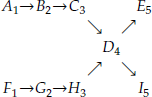
| time |
Figure 9.3: Parallel processes and indivisibilities
Leijonhufvud notes that economies are to be gained from judicious horizontal divisions as well. This can result from the indivisibilities that come with prior innovations. So, for example, imagine that one of the stages of production—stage 4—is running at half capacity (a railway car, a telegraph system). Imagine running two parallel production processes as shown in Figure 9.3. There is twice the output of just one process, but the double output comes at the expense of less than twice the inputs, a clear economy of scale of the Lachmann variety. These economies of scale come from organizational change rather than from technology, although the indivisibility that makes it possible may be the result of a technological innovation.
In this example the two “industries” or firms or processes share operation 4. They may not even be the same processes. They may have a common need for operation 4 (like transportation, communication, or electricity) and be quite different in other respects. This is a different type of division of labor. Stage 4 has become a specialized activity on its own. It is clear that these economies of scale depend in a crucial way on the “extent of the market” or on the “throughput” (Lachmann 1996:147–148), that is, on the size of the demand for the services of the various stages that are supplied in indivisible multiples. It is also clear that more complex patterns will most likely emerge—with indivisibilities and crossprocess connections at more than one stage. The degree of returns to scale depends on the amount of excess capacity at each stage. (A similar observation is made by Penrose considering resource combinations within the firm that have to be made up to the “lowest common multiple” (Penrose 1995:72–73)). If the number of stages is held constant, these economies become less and less significant as output is increased and, in this case, approach constant returns to scale in the limit (Leijonhufvud 1986:214). However, an aspect of economic progress is an increasing number of interrelated activities or stages of production (Lachmann 1978:ch. V; see also Chapter 8). Pursuing this line of reasoning, there is then an unending source of scale economies in the market process.
As Leijonhufvud explains (interpreting Smith and Marx), the process of the division of labor is connected to the process of technological change. “As one subdivides the process of production vertically into a greater and greater number of simpler tasks, some of these tasks become so simple that a machine could do them. . . . [We are led to] the discovery of . . . opportunities for mechanization” (Leijonhufvud 1986:215). If we think of each of the organizational schemes of production such as those discussed above as being one of many possible schemes, then we can easily see the part they could play in an evolutionary process toward greater complexity (a larger and larger number of interdependent productive activities and stages). In effect (paradoxically), greater complexity in production leads to the achievement of greater simplicity and convenience in consumption. (The more complex the central processing unit of the computer, the more user friendly it can be made.)
So, returning to Langlois’s dynamic theory of the firm, changes in organizational structure lead (directly and indirectly) in a plausible way to changes in production costs. In the move from craft production to a factory this implies a form of vertical integration, as did the kind of changes required in the Second Industrial Revolution. Integration is favored in situations where changes are systemic and require large-scale entrepreneurial reorganization of existing capabilities and where new required capabilities are not easily available from the market. But more generally, for example in the case of indivisible shared resources, it is not so clear that change leads to integration and may lead in the opposite direction to disintegration or “spinoffs.” In many cases the innovations may be local or decomposable. Perhaps the most important examples occur in modular systems, like personal computers, stereo sound systems, telephone systems, and the like. “For present purposes, the key feature of a modular system is that the connections of ‘interfaces’ among components of an otherwise systemic product are fixed and publicly known. Such standardization creates what we might call external economies of scope” (Langlois 1992:253). This is a phenomenon of complementarities in consumption (household production) that both Richardson and Penrose noted. It allows component manufacturers to specialize their capabilities independently but confident of a sufficient market (cf. Richardson 1990).
As economies develop, the capabilities needed for innovation are more likely to be found in the market, and Chandler-type integration may be unnecessary. Even if at first the firm may find it necessary to develop its own marketing and distribution networks and specialized production capabilities, over time, with the growth of knowledge, outside specialists may develop. So integration may be a phase that becomes superseded by disintegration (as happened, for example, in the case of Ford Motor Company). In addition, some of the obsolete existing capabilities may already exist inside the firm and require excision, as in the case of “downsizing” caused by technological restructuring. On the other hand, this situation may account for an element of inertia in some corporations, making it more difficult for them to adapt. As in the computer industry and the illustrative case of IBM, “economic change has in many circumstances come from small innovative firms relying on the capabilities available in the market rather than existing firms with ill-adapted internal capabilities” (Langlois 1995:253).19
According to Langlois, the boundaries of the firm are thus not only a matter of transactions costs and moral hazard, but must be seen within a changing environment as a form of strategic adaptation. In the absence of change, knowledge of prices, products, abilities, reputations, and anything else that is important to the (unchanging) production process becomes general, and the need for the firm as an organizing device progressively disappears. (Opportunistic behavior, for example, is less profitable when the same game is repeated many times (Langlois 1992)). But in a dynamic world the capital structure evolves within an evolving institutional and organizational structure.
Implications and Conclusion
As discussed, Langlois’s work provides a framework for interpreting the trend toward large-scale integration of industrial structures that occurred at the turn of the century, as well as the opposite sort of trend toward disintegration or divestment as companies move towards concentration on their “core competencies.” Some of the specific insights that emerge from this dynamic transaction cost framework are as follows:
1. Organization matters for production. The discussion of the article by Leijonhufvud above shows clearly how a simple reorganization of the same inputs can sometimes lead to increases in output.
2. Indivisibilities that result from systemic innovations imply external economies of scale and scope. This resonates with Lachmann’s (1978) analysis of the evolution of the capital structure. These indivisibilities also explain the emergence of specialized industries, like power, communications, and computing.
3. When innovations occur which render existing capabilities obsolete or redundant, the response will be either (a) retraining or reorientation, if possible, or (more likely) (b) “downsizing” or (c) inertia and failure, or some combination of the three.
4. Product life cycles are often accompanied by organizational-type life cycles. For example, at the start of the implementation of an innovation a firm may need to develop its own supporting capabilities, sometimes to overcome inertial vested interests, like the production of spare parts or technical support. As the innovation and its implications are diffused and, over time, the knowledge spreads and output grows, these capabilities come to be found in specialists in the market (outside the firm). So the organization first internalizes and then spins off these particular capabilities.
5. The nature of the organization is influenced by the type of knowledge embodied in the capabilities required and by the nature and type of innovations that it faces. Examples at two extremes are the hierarchical organization where information flows mainly from the top downwards (requiring that supervisors have as much or more knowledge than their subordinates of what the subordinates need to do) and the participatory organization (where information flows in all directions because team members are highly specialized and use highly specialized knowledge, the usefulness of which depends on the willing contributions of all team members).
In summary: in this chapter we have seen that the neoclassical firm as a “black box production function” bears very little resemblance to that dynamic, enigmatic, ever changing business organization that we know from our everyday experience as the firm. Instead we have learnt from a number of theorists to view it in a different light, as a remarkable organizational device for the achievement of productive activity. The firm, in this view, is “a device for the coordination and use of particular kinds of knowledge, including the coordination of knowledge generation, by the imposition of an interpretive framework” (Loasby 1991:59). It is an important example of the coexistence of equilibrium and change discussed in Chapter 3. As a system of (sometimes tacit) rules, routines, procedures and cues, it evolves over time, but it does so sufficiently slowly, if it is to succeed, to provide a stable, under-standable environment within which decision-makers can act, can conjecture about product types, methods of production, types of inputs, the meanings of market signals, and the like. Each firm, based on its experience (the experience of its members) “acquires a unique character as an interpretive system, construing events and acting on the basis of its interpretations” (Loasby 1991:60). The decision outcomes are thus the results of idiosyncratic interpretation combined with commonly observed information, like market prices, in a generally understood decision-making process that we can characterize as the ongoing calculation of capital value.
The same evolved capabilities that have served some firms in good stead in favoring it to adapt to particular circumstances, may, in other circumstances, prove to be its undoing. Firms used to a particular “way of doing things” may exhibit a degree and type of inertia or narrowness of approach that may render it unsuitable for particular environments. In such situations we get radical organizational change. And this may occur at the market level, where those organizations that happen to have the right configuration and approach will be favored, and at the firm level where those firms that are able to adapt survive. An example might be the emergence of the M-form structure of corporation (Williamson 1985), or the move toward nonhierarchical organizations (Minkler 1993).20 Often the crucial factor in these shifts is the changing nature of the knowledge utilized by business organizations.
Knowledge is a key concept in analyzing all productive activity and its organization. This harks back to our discussion of knowledge types in Chapter 2 and suggests a closer look at the meaning and role of productive knowledge in relation to capital,21 which we consider in Chapter 11 on human capital.
_________________
22The invocation of Marshall’s name is related not to his “neoclassical” theory of costs and supply, but rather to his insistence that biology and evolution are more enlightening in the business environment than are mechanics and physics, and to his many discussions of the role of institutional factors (like trade practices and agreements) in the “ordinary business of life.”
23It is closely related to, and often overlaps with, contributions in “managerial economics” and corporate strategy and is sometimes referred to as the “resource-based view” of the firm. See, for example, Collis and Montgomery (1998). For an important pioneering article see Teece (1982).
24The term “capabilities” in this context was invented by Richardson.
25It seems that the common denominator is Hayek (1937a).
26Activities are complementary “in the sense that their combined profitability when undertaken simultaneously, exceeds the sum of the profits to be obtained from each of them if undertaken by itself” (Richardson 1990:72).
27“An entrepreneur will have to recognize that the profitability of his own investment will depend on the terms on which he can obtain inputs, and therefore indirectly on the volume of the investment which has been, or will be, undertaken elsewhere. Thus the same kind of complementarity which exists between the application of different resources within the firm, exists also between the application of resources by different firms. In the former case coordination, designed to ensure the best combination of complementary factors, is brought about directly by the entrepreneur in control; in the latter, it has to be achieved by different means” (Richardson 1990:73, italics added). And in considering the interdependence as well as the cost structures of different firms, he notes, “The whole economy one may presume, is united by bonds of this kind, the strength of which will vary widely according to circumstances” (ibid.:74).
28As I have suggested repeatedly, and shall have occasion to repeat again, these evolved devices are made necessary by the dynamic nature of the world in which investment decisions are taken. In a world in which no significant changes were taking place they would be (or would become) unnecessary. And indeed, in such a world, cartel and price fixing/market sharing agreements might indeed be a concern for eager policy-makers. But a world of persistent technological change invites and requires persistent organizational change and, in any case, is not conducive to such “anticompetitive” agreements enduring over time.
29It is interesting to note that in the neoclassical literature the production function does “double duty,” serving as a tool of analysis for both the economy as a whole and for the individual firm. Given the assumption of CRS in readily identifiable inputs, this is not surprising, since there is nothing to limit the size of firm. In an important sense the economy is simply “the firm writ large.”
30It is difficult to avoid the use of anthropomorphic language that suggests the firm possesses some sort of collective consciousness. I affirm strongly, however, that it is ultimately the individuals in the firm, at any point in time, in their various capacities that are the decision-makers and the perceivers of information and in whom the capabilities “of the firm” must ultimately reside. I hope to make clear in what way the organization (the firm) may manifest these capabilities in different individuals at any point of time yet provide for their carrying forward through time and across individuals.
31We note again the caveat about using language that suggests that the firm per se “chooses.”
32Penrose refers to these as “competencies.”
33Joseph Salerno points out (following Mises) that, given that production takes time, it is natural that “capital” employs “labor” as it is the capitalist that saves and advances the resources with which labor must work. So property rights considerations can also be seen to be implied by the temporal nature of production. But surely this would be the case only in a world of uncertainty. In a world where everything was accurately foreseen, complete contracts could be written for the advancement and use of the capitalists’ savings. No hierarchical relationship need be implied. An “employment” relationship seems to be the result of the need to adapt to open-ended futures, in which discretionary command (in order to adapt to unexpectable contingencies) must reside with one or other party, as discussed below in the text.
34The dimension along which the boundaries of the firm are drawn may be an issue. The usual one is ownership. This is a legal distinction (Masten 1991). But it is not the only one. Another is control. For example, the owner of the firm does not own the labor that it employs. In what sense are the employees working “within” the firm? The usual answer is that there exist long-term contracts that effectively give the owner of the firm ownership over the outputs of the labor employed and control over their inputs. However, they do not always go together. Along the control dimension, control over resources may exist even in the absence of ownership, as in the case of joint ventures between two separate legal entities. Alternatively, divisions within firms may behave with a great deal of autonomy, effectively like separate firms. We shall retain the familiar dimension of ownership, realizing that the dividing line between the market and the firm is in many ways quite fuzzy.
35Of course, as I point out, an important aspect of using the firm to organize production is that marginal products are not easy to determine. Still, where an asset is specific in nature it is clear to all those involved in the production process that the value of its marginal contribution is substantially above its opportunity cost, even if a degree of arbitrariness attaches to the measurement of these values.
36In relation to the question of the boundaries and existence of the firm, and the general discussion found in this section, I have been asked whether I thought uncertainty was a necessary and sufficient condition for the existence of the firm. While I cannot attempt a complete answer here, it seems to me that while it may not be sufficient, it is surely necessary. For, as indicated above, in a world of perfect certainty there would be no need for the firm.
37As Peter Boettke points out, time, jointness, and multiple specificity are all necessary to explain the four indeterminacies (and the implied need for organizational devices to cope with them). If resources were completely homogeneous, no combination problem would exist; similarly, if resources were completely specific, there would be no choices involving variations in the components of combinations. Where resources are heterogeneous and multiply specific, my conclusions follow.
38From a “God’s eye” perspective or from a public choice perspective the organic/pragmatic dimension might collapse. “[O]ne might easily portray the entire Public Choice theory of politics as undermining a conception of government as a pragmatic institution” (Langlois 1992:169).
39In this sense the innovation is capital saving rather than requiring capital of larger scale. Also, it is possible that the new process may need less “goods in process” inventory. In crafts production, workers may leave goods unfinished as they move from one operation to another, working on a few goods at a time. In team production this does not happen (Leijonhufvud 1986:210).
40The “make or buy” decision may also be influenced by the regulatory structure in the face of competition and change as, for example, in the case of the decision to “outsource” to non-union specialist manufacturers.
41Minkler provides an interesting analysis of organizations with “knowledgeable workers,” that is to say workers who possess not only a degree of “know-how” but moreover the capacity to make decisions in hitherto unencountered situations—“initiative.” Such organizations would, under most situations, tend to be participatory rather than hierarchical. So as the nature of productive knowledge changes, so must the nature of the organization. See also Drucker (1993) and (Nonaka and Takeuchi 1995).
42This chapter neglects the important relationship between capital and knowledge that emerges when we consider capital goods as embodying the knowledge of how to do certain specific and specialized things. With some justification, capital can be viewed as embodying productive knowledge in the same way as human capital embodies productive knowledge. This leads to a “capital-based” view of the firm. For further explanation and investigation of the important implications of this view, see Lewin and Baetjer (2011).
- 1A shorter version of some of the material in this part appears in Lewin (1997c).
- 2[The market] cannot make bulls and bears change their expectations but it nevertheless can coordinate these. To coordinate bullish and bearish expectations is, . . . the economic function of the Stock Exchange and of asset markets in general. This is achieved because in such markets the price will move until the whole market is divided into equal halves of bulls and bears. In this way divergent expectations are cast into a coherent pattern and a measure of coordination is accomplished . . . asset markets are inherently ‘restless,’ and equilibrium prices established in them reflect nothing but the daily balance of expectations. (Lachmann 1976b:237–238, italics added)
- 3Becker (and others using the ‘Chicago approach’) have used this type of reasoning to explain regulation-busting behavior (bribes, black markets, etc.) where individuals are seen as weighing all of the costs and benefits involved in violating regulations, etc. (Becker 1971:106ff.)
- 4It is possible to conceive of a situation of “statistical” equilibrium where mutually offsetting individual errors are such as to leave the price unchanged. In such a situation, although individual plans are not mutually compatible, we have equilibrium as a kind of balance of forces. Individuals are right “on average.” Hayek discusses this case in passing (Hayek 1937b:43n.) In a way this anticipates aspects of the rational expectations literature developed since the 1970s. As we shall be concerned with equilibrium in terms of its implications for individual perceptions, we shall not consider this case in any more detail. A sufficient, though not necessary, condition for price stability in the partial equilibrium static (non-growth) case, is the compatibility of plans to buy and sell.
- 5Machlup identifies four basic steps in equilibrium analysis:
- 6This phrase is from O’Driscoll and Rizzo (1996:24). See generally Machlup (1958).
- 7See also the discussions in Rizzo (1990, 1992).
- 8I will use this designation to distinguish in general a higher level than individual equilibrium, whether it be the entire economic system or a subsystem of it (for example, an isolated market). As will become clear from the text, the crucial distinction is between equilibrium as it applies to an individual mind and as it applies to the interaction between two or more minds.
- 9See also (Hicks 1965:24).
- 10Once in equilibrium, will the system remain there (stability); and starting from any arbitrary point, will it converge to equilibrium?
- 11In particular, Lachmann’s analysis of equilibrium appears in its most uncompromising version. It is probably from here, more than from any other time and place, that Lachmann’s reputation as a “radical subjectivist” gained momentum and has since tended to dominate in evaluations of his work.
- 12For a recent statement see Kirzner (1992). Since the first edition of this book was published in 1999, Kirzner has continued to explain and refine his ideas as they have gained in exposure and popularity especially in the field of management studies. See Kirzner (2009).
- 13Lewin (1994:236). “According to a well-known Austrian axiom, ‘Time cannot elapse without the state of knowledge changing’ ” (Lachmann 1986:95).
- 14For an in-depth examination of this debate, see Karen Vaughn (1992; 1994:ch. 7). The debate continues, though in muted terms since Lachmann’s death in 1990. Kirzner has attempted to restate and refine his position (1992) and Mario Rizzo has provided a further critique (Rizzo 1996). For a summary of Kirzner’s position, see Kirzner (1997). For a more recent summary, see Kirzner (2009).
- 15See the appendix to this chapter.
- 16Originally published soon after O’Driscoll and Rizzo (1996, first edition 1985) in the Market Process Newsletter. For references to some of the contributions to this debate see Boettke, Prychitko, and Horwitz (1994).
- 17From a “God’s eye” perspective or from a public choice perspective the organic/pragmatic dimension might collapse. “[O]ne might easily portray the entire Public Choice theory of politics as undermining a conception of government as a pragmatic institution” (Langlois 1992:169).
- 18In this sense the innovation is capital saving rather than requiring capital of larger scale. Also, it is possible that the new process may need less “goods in process” inventory. In crafts production, workers may leave goods unfinished as they move from one operation to another, working on a few goods at a time. In team production this does not happen (Leijonhufvud 1986:210).
- 19The “make or buy” decision may also be influenced by the regulatory structure in the face of competition and change as, for example, in the case of the decision to “outsource” to non-union specialist manufacturers.
- 20Minkler provides an interesting analysis of organizations with “knowledgeable workers,” that is to say workers who possess not only a degree of “know-how” but moreover the capacity to make decisions in hitherto unencountered situations—“initiative.” Such organizations would, under most situations, tend to be participatory rather than hierarchical. So as the nature of productive knowledge changes, so must the nature of the organization. See also Drucker (1993) and (Nonaka and Takeuchi 1995).
- 21This chapter neglects the important relationship between capital and knowledge that emerges when we consider capital goods as embodying the knowledge of how to do certain specific and specialized things. With some justification, capital can be viewed as embodying productive knowledge in the same way as human capital embodies productive knowledge. This leads to a “capital-based” view of the firm. For further explanation and investigation of the important implications of this view, see Lewin and Baetjer (2011).
- 22This first part of this work consists of two chapters (2 and 3). In Chapter 2 I summarize briefly some issues connected with the meaning and existence of equilibrium. This controversial area has been made difficult by the fact that the term “equilibrium” is often used in an inconsistent manner, either by a single theorist in different places and times or as between different theorists. So I try first to clarify what is meant (or what should be meant) by equilibrium. I adopt the Hayekian definition—the mutual consistency of individual plans. From this point of view I examine a current debate, one that is specific to modern Austrian (market process) economics, but is relevant to and, in many ways, reflective of, economics in general. This is the debate about the presence or absence (and, indeed, meaning) of equilibrating tendencies in the economy. The chief (friendly) protagonists in this discussion are Ludwig Lachmann and Israel Kirzner. The legacy of this debate is still with us.
- 23Examining this further, we note that equilibrium as a balance of forces (as the word implies) in some sense is at the base of all other equilibrium concepts. And if “change” (and its absence) is defined appropriately, definitions 1 and 2 are seen to be equivalent. So, for example, the traditional supply and demand equilibrium is a balance of forces that acts to keep prices stable (at rest). In the case of the price of an asset, we may say that if the price is stable, the bulls balance the bears. In the case of a perishable good, those forces (whatever they are: technology, price expectations, etc.) which tend to influence the amounts offered for sale and purchase at various prices in a way that tends to push the price up are balanced by those that tend to push it down. This is one way to think of stable prices. If neither supply nor demand change, price (once in equilibrium) will not change. It is also an optimum (definition 5) of sorts in the well-understood sense that, given the fundamental conditions of supply and demand, buyers and sellers are doing the best they can. From another perspective, it is a constrained maximum (definition 4) in that buyers and sellers maximize the perceived opportunities to buy and sell, and thereby achieve a maximum of “satisfaction” as determined by their preferences in relation to the (perceived) opportunities. It may not be an optimum, however, if there are opportunities of which the economic agents are unaware (see Kirzner 1990), or if their actions affect opportunities in other markets adversely. Also, it is possible to see how momentary equilibrium can be generalized to a situation of uniform change (definition 3)—for example, where demand and supply increase proportionately.
- 24So while, in an appropriate sense, equilibrium as a balance of forces is also a state of rest (or a situation of uniform change) and a constrained maximum, it may not be an optimum. Also, in each case it is possible to conceive of situations that are not in equilibrium. Some theorists have found it helpful, however, to define the constraints so broadly as to conceive of individuals as being always in equilibrium (see Shmanske 1994). So, again using the example of simple supply and demand, a situation of non-price rationing, not allowing the price to rise and clear the market, can be seen as an equilibrium situation if we include in all individual decisions the costs imposed by rationing—like waiting in line. Indeed, using this approach, one may predict that the lines at the checkout counter of a supermarket would tend to an “equilibrium” size that equalizes waiting time. Thus the supply curve becomes vertical at the fixed price below the market-clearing price. In effect, the money price has been reduced, but the real price (including waiting cost) has gone up because of a “shift” in the supply curve to the left (from an upward slope to a vertical one). So demand always equals supply if we are careful to include all relevant factors. While it is clear that this approach may prove enlightening in some cases, when extended to the level of all agents for the entire economy it can involve disturbing and paradoxical implications. Thus, considering all possible costs and benefits, the world is at all times in a Pareto optimal equilibrium, a Panglosian “best of all possible worlds” given the relevant constraints. Things are what they are because we understand how individuals had to act the way they acted in order to maximize, given the constraints that existed and were perceived by them (again see Shmanske 1994 for a complete discussion). This approach uses equilibrium to characterize rational action (definition 6) where “rational” is understood to refer to the system as a whole and not just to individuals. For normative (policy) purposes this is obviously not very helpful. The policy-maker is, after all, subject to the same, universally perceived, constraints. We shall see that the difficulty arises because of the lack of a distinction between individual and system equilibrium.
- 25In a lecture delivered in 1936, Hayek defined equilibrium as a situation in which “the different plans which the individuals composing [a society] have made for action in time are mutually compatible” (Hayek 1937b:41). This is my definition 7. As this is the definition that we shall adopt in the rest of this work, it is worth examining in some detail. An important aspect is the move away from the purely physical dimensions of equilibrium as a state of rest or balance of forces, to one firmly based in the human mind. Equilibrium is here conceived as a situation in which individual knowledge and expectations, and the actions based on these, are compatible with the “data,” where the “data” for one individual include the actions of other individuals. Scratching the surface of any of the definitions offered above indeed reveals that it is impossible to think of equilibrium in economics without bringing in the perceptions of individuals. After all, we are dealing with human actions and these are determined by the perceptions of the actors. So, in the case of the supply and demand of a single well-defined market, for example, the price will not be observed to change when all individuals are fulfilling their mutually related plans to buy and sell; and where such plans are not fulfilled we may expect these plans to be revised.
- 26It will be immediately apparent that equilibrium thus defined is an extremely unlikely event. It is patently unrealistic. One might wonder at its widespread acceptance as a standard of reference. This raises the important question of the function of equilibrium constructs in economic theory. Obviously, theoretical constructs are, to a greater or lesser extent, unrealistic. They all abstract from reality in order to illuminate it. For example, one common use to which equilibrium constructs are put is the tracing of the (ultimate) consequences of any change while imagining all other possible relevant changes to be absent. In this way a general idea of cause and effect can be built up by isolating the effects of different causes. The crucial question is: what are permissible abstractions, and what abstractions render a theoretical construct useless? When is the usefulness of the model compromised so that its results (the cause-effect connections that it suggests) are no longer reliable guides to reality? This is an involved question that we shall not be able to answer here in any detail. I shall contend, however, and hopefully motivate in the course of our discussion, that theoretical constructs that abstract completely from the implications for human action of the passage of time and its implications for changes in knowledge are not likely to be very helpful in understanding economic processes. While it is true that equilibrium “is in the model and not in the world,” I want to build a bridge between the “model” and the “world” and maintain that timeless models cannot do this. This is most clearly seen in discussing the stability of equilibrium.
- 27It will be immediately apparent that equilibrium thus defined is an extremely unlikely event. It is patently unrealistic. One might wonder at its widespread acceptance as a standard of reference. This raises the important question of the function of equilibrium constructs in economic theory. Obviously, theoretical constructs are, to a greater or lesser extent, unrealistic. They all abstract from reality in order to illuminate it. For example, one common use to which equilibrium constructs are put is the tracing of the (ultimate) consequences of any change while imagining all other possible relevant changes to be absent. In this way a general idea of cause and effect can be built up by isolating the effects of different causes. The crucial question is: what are permissible abstractions, and what abstractions render a theoretical construct useless? When is the usefulness of the model compromised so that its results (the cause-effect connections that it suggests) are no longer reliable guides to reality? This is an involved question that we shall not be able to answer here in any detail. I shall contend, however, and hopefully motivate in the course of our discussion, that theoretical constructs that abstract completely from the implications for human action of the passage of time and its implications for changes in knowledge are not likely to be very helpful in understanding economic processes. While it is true that equilibrium “is in the model and not in the world,” I want to build a bridge between the “model” and the “world” and maintain that timeless models cannot do this. This is most clearly seen in discussing the stability of equilibrium.
- 28It will be immediately apparent that equilibrium thus defined is an extremely unlikely event. It is patently unrealistic. One might wonder at its widespread acceptance as a standard of reference. This raises the important question of the function of equilibrium constructs in economic theory. Obviously, theoretical constructs are, to a greater or lesser extent, unrealistic. They all abstract from reality in order to illuminate it. For example, one common use to which equilibrium constructs are put is the tracing of the (ultimate) consequences of any change while imagining all other possible relevant changes to be absent. In this way a general idea of cause and effect can be built up by isolating the effects of different causes. The crucial question is: what are permissible abstractions, and what abstractions render a theoretical construct useless? When is the usefulness of the model compromised so that its results (the cause-effect connections that it suggests) are no longer reliable guides to reality? This is an involved question that we shall not be able to answer here in any detail. I shall contend, however, and hopefully motivate in the course of our discussion, that theoretical constructs that abstract completely from the implications for human action of the passage of time and its implications for changes in knowledge are not likely to be very helpful in understanding economic processes. While it is true that equilibrium “is in the model and not in the world,” I want to build a bridge between the “model” and the “world” and maintain that timeless models cannot do this. This is most clearly seen in discussing the stability of equilibrium.
- 29Before turning to this, however, we should pause to note some other aspects of equilibrium, understood as the mutual compatibility of individual plans, including the relationship between micro and macro equilibrium, or between individual and system equilibrium. Hayek makes an important distinction between these:
- 30So equilibrium is not only a relationship between individuals at a point of time, it is necessarily also a relationship between actions over time. For equilibrium to exist during a period of time it must exist at every point of time within that period. If equilibrium exists at a point of time, then individuals’ plans are consistent with each other and with the technical facts of the world such that each plan can be successfully implemented. This means that in the absence of any change (meaning the arrival of new knowledge) equilibrium will exist at every point of time. This definition of equilibrium thus implies intertemporal equilibrium.
- 31In the history of the development of the equilibrium concept economists have been concerned with certain basic properties that equilibria may or may not exhibit. The most basic is the question of existence—whether or not an equilibrium can be shown logically to exist. According to our definition this involves showing that a situation exists (logically) such that all plans can be implemented. In the voluminous mathematical literature on general equilibrium such a proof was ultimately discovered, but at the expense of the imposition of a set of heroic restrictions on knowledge, preferences and technology. It was also possible to show that under certain even more restrictive conditions such an equilibrium was unique (Ingrao and Israel 1990). It is clear, however, that the importance that these properties assumed is directly related to the formal, technical, mechanistic nature of the conception of equilibrium that tended to dominate this literature (and still does). For Hayek, equilibrium was never understood as a state that could ever actually be said to exist, although its logical existence is clearly implied. He was more concerned with the question of whether or not it could be shown or argued that a tendency toward equilibrium (“a greater degree of plan coordination”) characterized the actual market process. This is related to the questions of stability and/or convergence that the mathematical economists have been unable to answer satisfactorily. But for Hayek (and those who followed his lead) it was not a theoretical matter. As this will be quite important, I will quote at some length from Hayek:
- 32The revival of the Austrian research program, in its market process variety, since the 1970s, has seen a return to this issue of equilibrating tendencies in a more energetic fashion. In particular, it has emerged as a defining issue within the Austrian School of economics in a way that was clearly foreshadowed during some historical moments in June 1974 in South Royalton, Vermont, at a conference marking the start of this revival (Dolan 1976). At that conference two papers in particular outlined the two key perspectives that have appeared to be in conflict ever since—by Ludwig Lachmann and Israel Kirzner (Lachmann 1976a; Kirzner 1976). In these two papers (and some others by the same authors in the conference volume) we find a clear, concise articulation of the issues. Both Kirzner and Lachmann regard the market as a process in time, out of equilibrium. Both regard the question of equilibrating tendencies to be problematic. But for Kirzner the problem is resolved by the actions of the entrepreneur in noticing disequilibrium situations and profiting by their removal, thus providing a reason to believe in, and an explanation of, a tendency in markets towards equilibrium.
- 33This approach can be generalized to equilibrium in contexts other than the isolated market. The problem of explaining convergence to equilibrium is a problem of explaining how individuals out of equilibrium obtain the information necessary for them to have knowledge of, and incentives to make, the appropriate adjustments. In the process of developing the solution Kirzner reaffirms the Hayekian definition of (dis)equilibrium. “Disequilibrium is a situation in which not all plans can be carried out together; it reflects mistakes in the price information on which individual plans were made” (ibid.:118). It is the Kirznerian entrepreneur who notices these mistakes and is able to take advantage of them. Kirzner’s well-known, and justly admired, theory of entrepreneurial action in the removal of all manner of price discrepancies will not be summarized here. Suffice it to say that the entrepreneur is “an all-purpose arbitrageur” (my term) who is alert to profit opportunities that exist as a result of price differences at a point of time, price differences between two points in time (after accounting for interest and holding costs), or price and cost differences (that is the price of a finished product and the cost of all the resources, including interest, necessary to produce it). By exploiting these generalized price discrepancies the entrepreneur tends to remove them, thus providing the answer to the original uncomfortable question. The tendency to equilibrium is supplied by entrepreneurial action. Kirzner then states clearly the issue that we are investigating:
- 34Lachmann makes it clear that he does not believe in a “determinate market process.” While he is readily prepared to endorse the notion of individual equilibrium, he has no use for general equilibrium (and, as is clear from the context, any equilibrium other than that of the individual) or tendencies toward it. “The notion of general equilibrium is to be abandoned, but that of individual equilibrium is to be retained at all costs, It is simply tantamount to rational action. Without it we should lose our ‘sense of direction’” (Lachmann 1976a:131). The reason for his rejection of market equilibrium is his understanding of the implications for action of the passage of time. Once again, as with Kirzner, I shall not stop to summarize in any detail Lachmann’s well-known views in this regard. I merely note some implications. He considers it axiomatic that the passage of time cannot occur without the arrival of new knowledge. Each moment in time is unique and time is irreversible. “As soon as we permit time to elapse, we must permit knowledge to change” (ibid.: 127–128, italics removed). I have referred to this as Lachmann’s axiom.
- 35There is thus no way to know which of the “opportunities” perceived by the Kirznerian entrepreneurs are “real” and which are (perhaps inconsistent) figments of their disparate expectations. In this way Lachmann departed company from Kirzner and Hayek and was not prepared to assert the existence of any tendency toward equilibrium. “What emerges from our reflections is an image of the market as a particular kind of process, a continuous process without beginning or end, propelled by the interaction between the forces of equilibrium and the forces of change” (Lachmann 1976b:61).
- 36The issue of convergence, of a tendency toward equilibrium, thus remains a contentious issue in which a lot is perceived to be at stake. From Lachmann’s lead, further investigations of the meaning and implications of Lachmann’s axiom have followed, the most elaborate of which is the in-depth examination by O’Driscoll and Rizzo (1996). The varying reactions to this book bear testimony to the depth of the rift within the subjectivist Austrian family. This is well captured in the two reviews by Kirzner (1994a) and Lachmann (1994). Although intrafamily disputes are often the most vociferous, where there is so much agreement on everything else of significance it is perhaps surprising. Yet it appears to be fundamental.
- 37The issue of convergence, of a tendency toward equilibrium, thus remains a contentious issue in which a lot is perceived to be at stake. From Lachmann’s lead, further investigations of the meaning and implications of Lachmann’s axiom have followed, the most elaborate of which is the in-depth examination by O’Driscoll and Rizzo (1996). The varying reactions to this book bear testimony to the depth of the rift within the subjectivist Austrian family. This is well captured in the two reviews by Kirzner (1994a) and Lachmann (1994). Although intrafamily disputes are often the most vociferous, where there is so much agreement on everything else of significance it is perhaps surprising. Yet it appears to be fundamental.
- 38Both parts of the term spontaneous order are of interest. What makes a system of rules spontaneous rather than planned is, in effect, a question of origin . . . . Unlike an organic system of rules, a pragmatic structure is one set in motion by conscious intention, and thus, in a sense . . . is a creature of planning. At the same time, a system of rules in Hayek’s theory can be either an order or an organization. In an order, the rules that guide behavior are abstract and independent of purpose; in an organization, those rules guide behavior toward more or less concrete ends.
- 39Now suppose that we simply rearrange the work as depicted in Figure 9.2. Work previously done in parallel now proceeds in series. Worker A specializes in performing operation 1, worker B in performing operation 2, and so on. We have introduced joint or team production. Each individual now has to work at the pace of the team, making supervision easier. It is important to note, however, that the engineering parameters of the production process have not been changed. The tools are the same in kind (although each worker no longer needs a complete set) and the workers are the same people. Yet we may expect an increase in product. Production is not simply a matter of identifying and combining the inputs (in an unspecified way), unless we broaden what we mean by “input” so as to empty it of all analytical power. As Leijonhufvud pertinently notes, this “sequencing of operations is not captured by the usual production function representation of productive activities; nor is the degree to which individual agents specialize. . . . Smith’s division of labor—the core of his theory of production—slips through modern production theory as a ghostly technological-change coefficient or as an equally ill-understood economies-of-scale property of the function” (Leijonhufvud 1986:209).
- 40As economies develop, the capabilities needed for innovation are more likely to be found in the market, and Chandler-type integration may be unnecessary. Even if at first the firm may find it necessary to develop its own marketing and distribution networks and specialized production capabilities, over time, with the growth of knowledge, outside specialists may develop. So integration may be a phase that becomes superseded by disintegration (as happened, for example, in the case of Ford Motor Company). In addition, some of the obsolete existing capabilities may already exist inside the firm and require excision, as in the case of “downsizing” caused by technological restructuring. On the other hand, this situation may account for an element of inertia in some corporations, making it more difficult for them to adapt. As in the computer industry and the illustrative case of IBM, “economic change has in many circumstances come from small innovative firms relying on the capabilities available in the market rather than existing firms with ill-adapted internal capabilities” (Langlois 1995:253).
- 41The same evolved capabilities that have served some firms in good stead in favoring it to adapt to particular circumstances, may, in other circumstances, prove to be its undoing. Firms used to a particular “way of doing things” may exhibit a degree and type of inertia or narrowness of approach that may render it unsuitable for particular environments. In such situations we get radical organizational change. And this may occur at the market level, where those organizations that happen to have the right configuration and approach will be favored, and at the firm level where those firms that are able to adapt survive. An example might be the emergence of the M-form structure of corporation (Williamson 1985), or the move toward nonhierarchical organizations (Minkler 1993). Often the crucial factor in these shifts is the changing nature of the knowledge utilized by business organizations.
- 42Knowledge is a key concept in analyzing all productive activity and its organization. This harks back to our discussion of knowledge types in Chapter 2 and suggests a closer look at the meaning and role of productive knowledge in relation to capital, which we consider in Chapter 11 on human capital.

