
Capital and Interest
Chapter I: The Eclectics
CHAPTER I
THE ECLECTICS
THE difficulties which the interest problem presented to the science of political economy are reflected, perhaps, nowhere more significantly than in the fact, that most economic writers of our century did not form any definite opinion on the subject.
This indefiniteness took a different shape somewhere about the year 1830. Before that date those who were undecided—and at that time there were many such—simply avoided entering on the interest problem. They come under that category which I have called the Colourless school. Later on, when the problem had become a common subject of scientific discussion, this was no longer possible. Economists were obliged to own to an opinion, and those who could not come to a decision of their own became eclectics. Interest theories were put forward in abundance. Writers who neither could nor would make one for themselves, nor decide exclusively on one of those already made, would choose from two or three or more heterogeneous theories the parts that suited them, and weave them into what generally proved a rather badly connected whole. Or, without even trying to obtain the appearance of a whole, they would in the course of their writings employ sometimes one, sometimes another theory, as suited best for the purposes they might happen to have in view.
It need not be said that an eclecticism on which the cardinal duty of the theorist, logical consistency, sat so lightly, does not indicate any very high degree of theoretical excellence. Still, here also, as with the Colourless theorists, among many men of secondary importance we meet with a few writers of the first rank. Nor is this to be wondered at. The development of the theory had been so peculiar that, for capable writers especially, the temptation to become eclectic must have been almost overpowering. There were so many heterogeneous theories in existence that one might be pardoned for thinking it impossible that there should be any more. A critical mind, indeed, could not find any one of them entirely satisfactory. But neither could the fact be ignored that in many of them there was at least a kernel of truth. The Productivity theory as a whole, for instance, was certainly unsatisfactory, but no unprejudiced person could help feeling that the existence of interest must have something to do with the greater return obtained by capitalist production, or, as it was generally called, the productivity of capital. Or, granted that a complete explanation of interest was not to be found in the “ abstinence of the capitalist,” it could scarcely be denied that the privation which saving usually costs is not a thing altogether without influence on the fact and on the amount of interest. In such circumstances nothing was more natural than that economists should try to piece together the fragments of truth from different theories. This tendency was strengthened by the fact that the social and political question of interest, as well as the theoretical, was now before the public; and many a writer, in his eagerness to justify the existence of interest, preferred to give up the unity of his theory rather than cease heaping together arguments in its favour. As might be expected, the fragments of truth thus collected remained, at the hands of the eclectics, nothing but fragments, their rough edges grating against each other and stubbornly resisting all attempts to work them into a homogeneous whole.
There are many ways in which eclecticism has combined the various interest theories. The greatest preference has been shown towards a combination of those two theories that came nearest the truth, the Productivity and the Abstinence theory. Among the numerous writers who follow this direction Rossi deserves to be mentioned at some length; partly because his rendering of the Productivity theory is not without a certain originality; partly because he may serve as a type of the illogical method usual among the eclectics.
In his Cours d’Economie Politique,1 Rossi makes use of the Productivity and the Abstinence theories alternately, without making any attempt to weld the two into one organic theory. On the whole, on those occasions when he makes general mention of the phenomenon of interest and its origin, he follows the Abstinence theory; while in details, particularly in the inquiry as to the rate of interest, he prefers to follow the Productivity theory. To prove this I may put down in the order of their statement the most important passages, without taking more pains than the author has done to make them consistent with each other.
In the traditionary way Rossi recognises capital as a factor in production by the side of labour and land. In return for its co-operation it requires a compensation—profit. To the question why this is so, the answer is given provisionally in the mystic words, which seem to point rather to the Productivity theory, “ on the same grounds and by the same title as labour “ (p. 93). More definitely, and here distinctly according to the Abstinence theory, Rossi expresses himself in the summary to the third lecture of the third volume: “ The capitalist demands the compensation due to the privation which he imposes on himself” (iii. p. 32). In the course of the following lecture he develops this idea more carefully. First of all, he blames Malthus for putting profit, which certainly is not an expense but an income of the capitalist, among the costs of production,—a criticism, however, which he might have first taken to himself, since in the sixth lecture of the first volume he has formally, and in the most explicit manner, enumerated the profit of capital among the costs of production.2 The true constituent of cost which he puts in the place of profit is, “ capitalised saving” (l’épargne capitalisée), the non-consumption and the productive employment of goods over which the capitalist has command. Later too we find repeated allusions (e.g. iii. pp. 261, 291) to the capitalist’s renunciation of enjoyment as a factor in the origination of profit.
If up to this point Rossi has shown himself for the most part an Abstinence theorist, from the second half of the third volume onwards we come upon expressions, at first occasionally and then frequently, which show that Eossi had also come under the influence of the popular Productivity theory. He begins in somewhat vague terms by bringing profit into connection with the circumstance that “ capitals contribute to production” (iii. p. 258). A little later (p. 340) he says quite distinctly, “ Profit is the compensation due to productive power”—no longer, be it observed, to privation. Finally, the rate of interest is explained at great length by the productivity of capital. He regards it as “natural” that the capitalist should receive for his share in the product as much as his capital has produced in it, and that will be much if the productive power of capital is great, little if the productive power of capital is little. Thus Rossi arrives at the law that the natural height of profit is in proportion to the productive power of capital. He develops this law first in the case where production requires capital alone in its operations, the factor labour being left out of account as vanishingly small and only the use value of the product being taken into consideration. Under these assumptions he finds it evident that if, for instance, the employment of a spade on a definite piece of ground, after replacing the capital laid out, procures twenty bushels of grain as profit, the employment of a more efficient capital, say a plough, on the same piece of land, after fully replacing the capital, will bring in more profit, say sixty bushels, “ because a capital of greater productive power has been employed.” But the same natural principle obtains in the complicated relations of our actual economic life. There also it is “natural” that the capitalist should share the product with the labourers in the ratio of the productive power of his capital to the productive power of the labourers. If, in a production that has hitherto employed a hundred workers, a machine is introduced which replaces the power of fifty workers, the capitalist has a natural claim to one-half the total product, or the wage of fifty labourers.
This natural relation is only disturbed by one thing; that the capitalist plays a double rôle. Not only does he contribute his capital to the common co-operation, but he connects with that a second business, the buying of labour. In virtue of the former, he would always receive the natural profit that corresponds to the productive power of capital, and that alone. But in buying labour sometimes cheap, sometimes dear, he may either increase his natural profit at the expense of the natural wage of labour, or may give up a portion of his profit to the advantage of the labourers. Thus if the fifty workers displaced by the machine compete with those left in employment and depress the wages of labour, it may be that the capitalist buys the labour of the fifty still employed for a less share of the total return than would naturally fall to them according to the ratio of their productive power to the productive power of capital. Say that he buys their labour for 40 per cent instead of 50 per cent of the total product, a profit of 10 per cent is added to the natural profit on capital. But this, although usually classed with profit on capital, is in its nature entirely foreign to it, and should be looked on as a profit made by the buying of labour. It is not the natural profit on capital, but this foreign addition that causes an antagonism between capital and labour, and it is only in the case of this addition that the principle of wages falling as profits increase and vice versâ has any validity. The natural and true profit on capital leaves wages untouched, and depends altogether on the productive power of capital (lecture iii. pp. 21, 22).
After all that has been said in former chapters on the Productivity theories, we may well dispense with any thorough and detailed criticism of such views. I shall merely point out one monstrous conclusion that follows logically from Rossi’s theory. According to him all the surplus returns obtained by the introduction and improvement of machinery, or from the development of capital in general, must to all eternity wholly and entirely flow into the pockets of the capitalists, without the labourer getting any share whatever in the advantages of these improvements; for those surplus returns are due to the increased productive power of capital, and their result forms the “natural” share of the capitalist !3
On the same lines as Rossi, and contributing nothing new, we meet among French writers Molinari4 and LeroyBeaulieu,5 and among Germans Roscher, with his followers Schüz and Max Wirth.6
Among Italian economists who follow the same eclectic lines may be mentioned Cossa. Unfortunately this admirable writer, in his monograph on the conception of capital,7 has not extended his researches to the question of interest, and we have to go by the very scanty hints that occur in his well-known Elementi di Economia Politica.8 From it one would judge Cossa to be an eclectic; yet his way of speaking, as if interpreting the ordinary doctrines, appears to me evidently to betray that he has some critical scruples about them. Thus while looking on interest as compensation for the “ productive service” of capital (p. 119), he refuses to recognise this service as a primary factor in production, and only allows it the place of a secondary or derivative instrument.9 Again, like the Abstinence theorists, he puts “privations” among the costs of production (p. 65), but in the theory of interest he adopts a tone which seems to imply that this did not express his own conviction, but only that of other people.10
The most interesting of those eclectic systems that combine the Abstinence and the Productivity conceptions I consider to be that of Jevons, with which I shall finish consideration of this group.11
Jevons begins by giving a very clear statement of the economic function of capital, in which he steers clear of the mysticism of any particular “ productive power.” The function of capital he finds simply in this, that it enables us to expend labour in advance. It assists men to surmount the difficulty caused by the time that elapses between the beginning and the end of a work. It makes possible an infinite number of improvements in the production of those goods the manufacture of which necessarily depends upon the lengthening of the interval between the moment when labour is exerted and the moment when the work is finished. All such improvements are limited by the use of capital, and in making these improvements possible lies the great and almost the only use of capital.12
This being the foundation, Jevons explains interest as follows. He assumes that every extension of time between employment of labour and enjoyment of result makes it possible to obtain a greater product with the same amount of labour. The difference between the product that would have been obtained in the shorter period, and the greater product that may be obtained when the time is extended, forms the profit of that capital by the investing of which the lengthening of the interval has been made possible. If we call the shorter interval t, and the longer interval made possible by an additional investment of capital t + Δt, and further, the product obtainable by a definite quantity of labour in the shorter interval Ft, then by hypothesis the product obtainable in the longer interval will be correspondingly greater; that is F(t+Δt). The difference of these two quantities F(t+Δt)—Ft is profit.
To ascertain the rate of interest represented by this amount of profit we must calculate the profit on that amount of capital by which the extension of the time was made possible. If Ft is the invested capital, then this is the amount of produce that could have been obtained on the expiry of t, without any additional investment. The duration of the additional investment is Δt. The whole amount of the additional investment is therefore represented in the product = (Ft. Δt). Dividing the above increment of produce by the latter amount, the rate of interest appears thus—
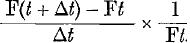
The more abundantly a country is supplied with capital, the greater is the product Fi obtainable without any new investment of capital; the greater also is the capital on which the profit made by additional extension of time is calculated, and the less is the rate of interest corresponding to that profit. Hence the tendency of interest to fall with advancing prosperity. Since, further, all capitals tend to receive a similar rate of interest, they must all be content to take that lowest rate obtained by the additional capital last invested. Thus the advantage conferred on production by the last addition of capital determines the height of the usual rate of interest in the country.
The resemblance of this line of thought to that of the German Thünen is obvious. It presents the same weak points to criticism. Like Thünen, Jevons too lightly identifies the “ surplus in products “ with the “ surplus in value.” What his statement seems actually, to point to is an “ increment of produce “ due to the assistance of the last increment of capital. But that this surplus in produce indicates at the same time a surplus in value over the capital consumed in the investment, Jevons has nowhere proved. To illustrate by a concrete case. It is easy to understand that a man employing imperfect, but quickly made machinery, may produce in a year’s time 1000 pieces of a particular class of goods, and by employing machinery which is more perfect, but takes longer to make, may produce in the same time 1200 pieces of the goods. But there is nothing here to show that the difference of 200 pieces must be a net surplus in value. Two things might prevent its being so. (1) It might be that the more perfect machinery to which the increment of 200 pieces is due should obtain so high a value on account of this capability that the increment of 200 pieces is absorbed by the amount set aside for depreciation. (2) It is conceivable that the new method of production, which gives these good results, might be employed so extensively that the increased supply of products would press down the value of the present 1200 pieces to the same level as the former 1000 pieces. In neither case would there be any surplus value. Jevons, therefore, has here fallen into the old error of the Productivity theorists, and mechanically translated the surplus in products, which everybody would grant, into a surplus in value.
Of course in his system there are attempts at explanation of this difference of value. But he has not brought these attempts into connection with his Productivity theory; they do not complete that theory, but traverse it.
One of these attempts is where he accepts parts of the Abstinence theory. Jevons quotes Senior with approval; he explains what Senior called “abstinence” as that “ temporary sacrifice of enjoyment that is essential to the existence of capital,” or as the capitalist’s “ endurance of want ”; and he gives formulæ for calculating the amount of the sacrifice of abstinence (p. 253, etc.) He reckons this abstinence—sometimes indeed, writing loosely, he reckons even interest—among the costs of production; and in one place he expressly speaks of the capitalist’s income as “ compensation for abstinence and risk” (p. 295).
Jevons has some very interesting remarks on the effect of time on the valuation of needs and satisfactions. He points out that we anticipate future pleasures and pains, the prospect of future pleasure being already felt as anticipated pleasure. But the intensity of the anticipated pleasure is always less than that of the future pleasure itself, and depends on two factors—the intensity of the pleasure anticipated, and the time that intervenes before the emergence of the pleasure (p. 36, etc.) Somewhat strangely Jevons holds that the distinction we thus make in immediate valuation between a present and a future enjoyment is, rightly considered, unjustifiable. It rests only, he says, on an intellectual error, or an error of natural disposition; and, properly speaking, time should have no such influence. All the same, on account of the imperfection of human nature, it is a fact that “ a future feeling is always less influential than a present one “ (p. 7 8).
Now Jevons is quite correct in saying that this power of anticipation must exert a far-reaching influence in economics, for, among other things, all accumulation of capital depends upon it (p. 37). But, unfortunately, he is satisfied with throwing out suggestions of the most general description, and applying them quite fragmentary.14 He fails to develop the idea, or to give it any fruitful application to the theory of income and value. This omission is the more surprising that there are some features in his interest theory which strongly suggested the possibility of making a very good use of the element of time in the explanation of interest. With more emphasis than any one before him, he had asserted the role played by time in the function of capital. The next step evidently would have been to inquire whether the difference of time might not also exert an immediate influence on the valuation of the product of capital, of such a kind that the difference of value, on which interest is founded, might be explained by it. Instead of this Jevons, as we have seen, persists in the old method of explaining interest simply by the difference in the quantity of the product.
Still more obvious, probably, would it have been to connect his other conception of “abstinence” with the difference that we make in. the estimation of present and future enjoyments, and to account for the sacrifice that lies in the postponement of enjoyment by that lesser valuation of the future utility. But Jevons gives no positive expression to this. Indeed, indirectly, he even excludes it; for, as we have seen, on the one hand he pronounces the lesser valuation to be a simple error caused by the imperfection of our nature, and, on the other hand, he pronounces the abstinence to be a real and true sacrifice, viz. the continuance in the (painful) state of need.
Thus there is no reciprocal fructification between the many interesting and acute ideas that Jevons throws out regarding our subject; and Jevons himself remains an eclectic of genius perhaps, but still an eclectic.
A second group of eclectics add on ideas taken from the Labour theory in one or other of its varieties. First may be mentioned Read,15 whose work, appearing as it did at the period when English economic literature on the subject of interest was most confused, shows a peculiarly inconsistent heaping together of opinions. He begins by laying the greatest emphasis on the independent productive power of capital, regarding the existence of which power he has no doubt. “How absurd,” he exclaims on one occasion (p. 83), “must it appear to contend that labour produces all, and is the only source of wealth, as if capital produced nothing, and was not a real and distinct source of wealth also ! “ And a little farther on he finishes an exposition of what capital does in certain branches of production by saying, quite in the spirit of the Productivity theory, that everything remaining over, after payment of the workers who co-operate in the work, “ may fairly be claimed as the produce and reward of capital.”
Later still, however, he sees the matter in an essentially different light. He now puts in the foreground the fact that capital itself comes into existence through labour and saving, and builds on that an explanation of interest, half in the spirit of James Mill’s Labour theory, and half in that of Senior’s Abstinence theory. “ The person who has laboured before, and not consumed but saved the produce of his labour, and which produce is now applied to assist another labourer in the work of production, is entitled to his profit or interest (which is the reward for labour that is past, and for saving and preserving the fruits of that labour) as much as the present labourer is entitled to his wages, which is the reward for his more recent labour” (p. 310). That eclectic hesitation of this kind must result in all sorts of contradictions goes without saying. Thus In this latter passage Read himself resolves capital into previous labour, although earlier he had protested against this in the most stubborn way.16 Thus too he explains profit to be wage for previous labour, while in a previous passage17 he had blamed M‘Culloch most severely for effacing the distinction between the conception of profit and that of wage.
With Read may be appropriately classed the German economist Gerstner. The “familiar question” whether capital by itself, and independently of the other two sources of goods, is productive, he answers in the affirmative. He believes that the part played in the production of the total product by the instrument of production we call capital, can be determined with mathematical exactitude, and without more ado looks upon this share as the “ rent in the total profit that is due to capital.” 18 With this frank and concise Productivity theory, however, Gerstner combines certain points of agreement with James Mill’s Labour theory; as when (p. 20) he defines the instruments of production as “a kind of anticipation of labour,” and on that basis calls “ the rent of capital that falls to the instruments of production the supplementary wage for previously performed labour” (p. 23). But, like Read, he gives no thought to the question that naturally suggests itself, whether in that case the previously performed labour has not previously received its wages from the capital value of the capital, and why, over and above that, it still gets an eternal contribution in the shape of interest.
To the same division of the eclectics belong the French economists Cauwes19 and Joseph Garnier.
I have already pointed out20 how Cauwes, with some reservation, shows himself an adherent of Courcelle Seneuil’s Labour theory. But at the same time he puts forward a number of views that have their origin in the Productivity theory. Arguing against the socialists he ascribes to capital an independent “active rôle” in production by the side of labour (i. p. 235). In the “productivity of capital” he finds what determines the current rate of loan interest.21 Finally, he derives the existence of “surplus value “ from the productivity of capital in a passage, where he bases the explanation of interest on the fact that we are indebted to the productive employment of capital for a “ certain surplus value.”22
In Joseph Gamier23 we find the elements of no less than three different theories ecleetically combined. The basis of his views is Say’s Productivity theory, from which he even revived and adopted the feature long ago rejected by criticism; that of reckoning interest among the costs of production.24 Then, in imitation of Bastiat, he calls the “privation” which the lender of the capital suffers through the alienation of it, the justification of interest. Finally, he declares that interest invites and compensates the “ labour of saving.” 25
All the eclectics hitherto mentioned combine a number of theories which, if they do not agree in the character of their arguments, at least agree in the practical results at which these arguments arrive. That is to say, they combine theories which are favourable to interest. But, strangely enough, there are some writers who, with one or more theories favourable to interest, combine elements of the theory hostile to it, the Exploitation theory.
Thus J. G. Hoffmann lays down a peculiar theory that, on one side, is favourable to interest, and explains it as the remuneration of certain labours in the public service performed by the capitalists.26 But, on the other side, he distinctly rejects the Productivity theory, which was then fashionable, speaking of it as a delusion to think “that in the dead mass of capital or land there dwell forces of acquisition” (p. 588); and in blunt terms declares that in taking interest the capitalist takes to himself the fruit of other people’s labour. “ Capital,” he says, “ can be employed for the promotion of one’s own labour, or for the promotion of other people’s. In the latter case a hire is due the owner for it, and this hire can only be paid from the fruit of labour. This hire, this interest, has so far the nature of land-rent that, like it, it comes to the receiver from the fruit of other people’s labour” (p. 576).
Still more striking is the combination of opposed opinions in J. S. Mill. It has often been remarked that Mill takes a middle position between two very strongly diverging tendencies of political economy—the so-called Manchester school on the one side, and Socialism on the other. It is easy to understand that such a compromise cannot, as a rule, be favourable to the construction of a complete and organic system—least of all in that sphere where the chief struggle of socialism and capitalism is being fought out, the theory of interest. The fact is that Mill’s theory of interest has got into such a tangle that it would be a serious wrong to this distinguished thinker were we to determine his scientific position in political economy by this very unsuccessful part of his work.
As Mill constructed his system in the main on the economical views of Ricardo, he adopted, among others, the principle that labour is the chief source of all value. But this principle is traversed by the actual existence of interest. Mill consequently modified it in the way of making the value of goods determined by their costs of production, instead of by labour in general. Among these costs of production, besides labour which constitutes “ so much the principal element as to be very nearly the whole,” he finds room for profit, and gives it an independent position. Profit with him is the second constant element in costs.27
That Mill should have fallen into the old mistake of Malthus, and described a surplus as a sacrifice, is all the more wonderful that in English political economy it had already been criticised, severely and forcibly, both by Torrens and Senior.
But whence comes profit? Instead of one, Mill gives three inconsistent answers to this question.
In these the Productivity theory has the smallest share, and it is only in isolated passages, and with all manner of reservations, that Mill tends in this direction. First, he explains with a certain hesitation that capital is the third independent factor in production. Of course capital itself is the product of labour; its efficiency in production is therefore that of labour in an indirect shape. . Nevertheless he finds that it “ requires to be specified separately.” 28 In no less involved terms does he express himself on the kindred question whether capital possesses independent productivity. “ We often speak of the ‘ productive powers of capital.’ This expression is not literally correct. The only productive powers are those of labour and natural agents; or if any portion of capital can by a stretch of language be said to have a productive power of its own, it is only tools and machinery which, like wind and water, may be said to co-operate with labour. The food of labourers and the materials of production have no productive power.” 29 Thus tools are really productive, while raw materials are not—a distinction as startling as it is untenable.
Much more decisive is his profession of Senior’s Abstinence theory. It forms, as it were, Mill’s official theory on interest. It appears explicitly and completely in the chapter devoted to profit, and is often appealed to afterwards in the course of the work. “ As the wages of the labourer are the remuneration of labour,” says Mill in the fifteenth chapter of the second book of his Principles, “ so the profits of the capitalist are properly, according to Mr. Senior’s well-chosen expression, the remuneration of abstinence. They are what he gains by forbearing to consume his capital for his own uses, and allowing it to be consumed by productive labourers for their uses. For this forbearance he requires a recompense.” And as distinctly in another place: “ In our analysis of the requisites of production we found that there is another necessary element in it besides labour. There is also capital; and this being the result of abstinence, the produce or its value must be sufficient to remunerate not only all the labour required, but the abstinence of all the persons by whom the remuneration of the different classes of labourers was advanced. The return for abstinence is profit.”30
But besides this, in the same chapter, under the heading of profit, Mill brings forward yet a third theory: “ The cause of profit,” he says in the fifth paragraph, “is that labour produces more than is required for its support. The reason why agricultural capital yields a profit is because human beings can grow more food than is necessary to feed them while it is being grown, including the time occupied in constructing the tools, and making all other needful preparations; from which it is a consequence that if a capitalist undertakes to feed the labourers on condition of receiving the produce, he has some of it remaining for himself after replacing his advances. To vary the form of the theorem: the reason why capital yields a profit is because food, clothing, materials, and tools last longer than the time which was required to produce them; so that if a capitalist supplies a party of labourers with these things, on condition of receiving all they produce, they will, in addition to reproducing their own necessaries and instruments, have a portion of their time remaining to work for the capitalist.” Here the cause of profit is found, not in a productive power of capital, nor in the necessity of compensating the capitalist’s abstinence as a special sacrifice, but simply in this, that “labour produces more than is required for its support “; that “ the workers have a portion of their time remaining to work for the capitalist “: in a word, profit is explained according to the Exploitation theory, as an appropriation by the capitalist of the surplus value created by labour.
A similar middle course, on the boundary line between Capitalism and Socialism, is taken by the German Katheder Socialists. The result in this case also is not seldom an eclecticism, but it is an eclecticism which ends more in agreement with the Exploitation theory than was the case with Mill. I shall only mention here the Katheder Socialist whom we have already met repeatedly in the course of this work, Schäffle.
In those writings of Schäffle where he treats of our subject three clear and distinct currents of thought may be traced. In the first Schäffle follows Hermann’s Use theory, which he weakens as a theory by the subjective colouring he gives to the conception of Use—so bringing it nearer to the second of his theories. The first current predominates in the Gesellschaftliche System, der menschlichen Wirihschaft, and has left evident traces even in the Bau und Lehen).31 The second current takes the direction of making interest a kind of professional income, an income which is drawn by the capitalist for certain services he renders. This conception, which had already appeared in the Gesellschaftliche System, is explicitly confirmed in the Bau und Lehen?32 But, finally, by the side of this in the Bau und Leben there appear numerous approximations to the socialist Exploitation theory. The chief of these is the resolution of all the costs of production into labour. While in the Gesellschaftliche System33 Schäffle had still recognised the uses of wealth as an independent and elementary factor in cost besides labour, he now says: “ Costs have two constituents: expenditure of personal goods through the putting forth of labour, and expenditure of capital. But the latter costs also can be traced back to labour costs, for the productive expenditure of real goods may be reduced to a sum of labours expended at earlier periods; all costs, therefore, may be considered as costs of labour.”34
If thus the labour which the production of goods costs is the only economic sacrifice that requires to be considered, it is but a step farther to claim the whole result of production for those who have made this sacrifice. Thus Schäffle repeatedly gives us to understand (e.g. iii. p. 313, etc.) that he considers the ideal economic distribution of goods to be the division to the members of the community according to work done. In the present day of course the realisation of this ideal is still prevented by all kinds of hindrances; among others, by the fact that wealth as capital serves as an instrument of appropriation—partly an illegal and immoral appropriation, partly a legal and moral appropriation of the product of labour.35 This appropriation of surplus value by the capitalists Schäffle does not condemn unconditionally; he would let it continue as a temporary and artificial arrangement so long as we are not able to replace the “ economic service of private capital by a more perfect public organisation, established by law, and less ‘greedy of surplus value.’ ” 36
But notwithstanding this opportunist toleration, Schäffle often brings forward in blunt terms the dogma of the Exploitation theory, that interest is a robbery of the product of other people’s labour. Thus, in immediate continuation of these words, he says: “ All the same the speculative, individualistic organisation of business is not the non plus ultra of the history of economies. It serves a social purpose only indirectly. It is immediately directed, not to the highest net utility of the whole, but to the greatest acquisition of the means of production by private owners, and towards procuring for the families of the capitalists the highest life of enjoyment. The possession of the means of production, movable and immovable, is made use of to appropriate from the produce of the national labour as much as possible. Proudhon has already put it in full critical evidence that capital forestalls labour in a hundred different forms. The only share of which the wage labourer is assured is the share that an upright beast of burden, endowed with reason, and therefore incapable of being reduced to simple animal wants, finds necessary to sustain him in the condition of life in which he has been placed by circumstances that are historical—this condition itself being necessary to allow of the capitalist’s competition.”
37 Fourth edition, Paris, 1865.
38 “The costs of production are made up of (1) the recompense to the workers; (2) the profits of the capitalist,” etc. (p. 93)
39 See also the sharp hut most pertinent criticism of Pierstorff, Lehre vom Unternehmergewinn, p. 93, etc.
40 Cours d’Economie Politique, second edition, Paris, 1863. His Productivity theory is similar to that of Say (e.g. “interest is a compensation for the productive service of capital,” i. p. 302). His Abstinence theory (1,289,293,300) is particularly unsatisfactory on account of the peculiar meaning he gives to the conception of “privation.” He means by it what the capitalist may surfer on account of the capital sunk in production not being available for the satisfaction of pressing wants which may possibly arise in the meantime. Surely a very unsuitable foundation for a universal theory of interest !
41 Essai sur la Répartition des Richesses, second edition, Paris, 1885. See particularly pp. 236 (Abstinence theory), 233, 238 (Productivity theory); see also above, p. 131.
42 On Roscher, see above, p. 129, Schüz, Grundsätze der National-Oekonomie, Tübingen, 1843; particularly pp. 70, 285, 296, etc. Max Wirth, Grundzüge der National-Oekonomie, third edition, i. p. 324; fifth edition, i. 327. See further Huhn, Allgemeine Volkswirtschaftslehre, Leipzig, 1862, p. 204; H. Bischof, Grundzüge eines Systems der National-Oekonomik, Graz, 1876, p. 459, and particularly note on p. 465; Schülze - Delitzseh, Kapitel zu einem deutschen Arbeiterkatechismus, pp. 23, 27, 28, etc.
43 La Noziane del Capitale, in the Saggi di Economia Politica, Mailand, 1878, p. 155.
44 Sixth edition, 1883.
45 P. 34, and more at length in the Saggi.
46 “The elemeuts of interest are two: first, compensation for the non-use of capital, or, as some say, for its formation, and for its productive service” (p. 119).
47 Theory of Political Economy, second edition, London, 1879.
48 P. 243.
49 P. 266. Jevons puts the same formula in other ways that need not be specified here.
50 Thus, on one occasion, he says that, under the influence of this element of time, in the case of the distribution of a stock of goods in the present and in the future, “less commodity will be consigned to future days in some proportion to the intervening time “ (p. 79).
51 An Inquiry into the Natural Grounds of Might to Vendible Property or Wealth, Edinburgh, 1829.
52 P. 131, and generally all through the argument against Godwin, and the anonymous tract “ Labour Defended.”
53 Note to p. 247.
54 Beitrag zur Lehre vom Kapital, Erlangen, 1857, pp. 16, 22, etc.
55 Precis d’Economie Politique, second edition, Paris, 1881.
56 See above, p. 304.
57 “ The principle then is that the rate of interest is a direct consequence of the productivity of capital “ (ii. p. 110).
58 “ We saw that the real value of interest depended on the productive employment given to capital; since a certain surplus value is due to capital, interest is one part of that surplus value presumably fixée à forfait (without consideration of gain or loss) which the lender receives for the service rendered by him “ (ii. p. 189).
59 Traité d’Economie Politique, eighth edition, Paris, 1880.
60 P. 47.
61 P. 522.
62 Kleine Schriften staatswirthschaftlichen Inhalts, Berlin, 1843, p. 566. See above, p. 312.
63 Principles, book iii. chap. iv. §§ 1, 4, 6; chap. vi. § 1, No. 8, etc.
64 Book i. chap. vii. § 1.
65 Book v. § 1.
66 Book iii. chap. iv. § 4.
67 See above, p. 206.
68 See above, p. 306.
69 i. pp. 258, 268, 271, etc.
70 Sau und Leben, iii. p. 273, etc.
71 iii. p. 266, etc.
72 iii. p. 423. See also iii. pp. 330, 386, 428, etc.
- 1Handbuch der Staatswirthschaft, Berlin, 1796, particularly §§ 8 and 23. Even his later Abhandlungen die Elemente des Nationalreichthums und die Staatswirthschaft betreffend (Göttingen, 1806) does not take an independent view of our subject.
- 2Ueber Nationalindxistrie und Staatswirthschaft, 1800-1804 particularly pp. 82, 142.
- 3Die National - Oekonomie, Leipzig, 1805-1808. I quote from a reprint published in Vienna, 1815.
- 4Grundsätze der National-Oekonomie, Halle, 1805; third edition, Halle, 1825. I quote from the latter.
- 5In Lotz’s former work, the Revision der Grundbegriffe, 1811-14, there are some rather interesting remarks on our subject, although they are full of inconsistency; among others, an acute refutation of the productivity theories (vol. iii. p. 100, etc. ), an explanation of interest as “an arbitrary addition to the necessary costs of production,” and as a “tax which the selfishness of the capitalist forces from the consumer” (p. 338). This tax is found, not necessary indeed, but “very fair.” At p. 339 and at p. 323 Lötz considers it a direct cheating of the capitalist by the labourer if the former does not receive in interest as much as “he may be justified in claiming as the effect of those tools used up by the worker on his activity and on its gross return.” It is very striking that in the second last of the passages quoted Lötz puts interest to the account of the consumer, and in the last of them to the account of the labourer; he thus exactly repeats Adam Smith’s indecision on the same point.
- 6Grundsätze der ökonomisch-politischen oder Kameralwissenschaften, second edition, Tübingen, 1820.
- 7Staatswirthschaft, Auerswald’s edition, 1808-11, particularly vol. i. pp. 24, 150; and the very naive expressions, vol. iii. p. 126.
- 8Neue Grundlegung, Vienna, 1815, p. 221.
- 9Die National-Oekonomie, Ulm, 1823, p. 145. See also p. 164, where the causal connection is reversed and natural interest deduced from loan interest.
- 10Staatswissenschaften im Lichte unserer Zeit, part ii. Leipzig, 1823, p. 90. Here Pölitz only takes the trouble to show that profit, assumed as already existing, must fall to the owner of capital.
- 11Theorie des Handels, Göttingen, 1831.
- 12§§ 211, 711, 765, particularly marked in § 769.
- 13Volksivirthschaflslehre, vol. i. § 222. Similarly, but more generally, vol. i. § 138.
- 14London, 1817, third edition, 1821. I quote from M‘Culloch’s edition. John Murray, 1886.
- 15Ricardo puts the same causal relation very strongly in chap. i. § 4, when he gives the height of the “value of labour” as a secondary cause of the value of goods, in addition to the quantity of labour expended in the production,—having in his eye the influence exerted on the value of goods by the capitalist’s claims to profit. The height of profit is to him only a dependent, secondary cause, in place of which he prefers to put the final cause of the whole relation, and this final cause he finds in the varying height of wages.
- 16The most complete of these runs thus: “For no one accumulates but with a view to make his accumulation productive, and it is only when so employed that it operates on profits. Without a motive there could be no accumulation, and consequently such a state of prices” (as show no profit to the capitalist) “could never take place. The farmer and manufacturer can no more live without profit than the labourer without wages. Their motive for accumulation will dimmish with every diminution of profit, and will cease altogether when their profits are so low as not to afford them an adequate compensation for their trouble, and the risk which they must necessarily encounter in employing their capital productively” (chap. vi. p. 68; similarly p. 67; chap. xxi. p. 175, and other places).
- 17Die Lehre von der Volkswirtschaft, Halle, 1843.
- 18Chap. vi. p. 67 and passion.
- 19Chap. i. §§ 4, 5.
- 20“But it is quite obvious that if any commodity were brought to market and exchanged for a greater amount, either of other commodities or of money, than was required to defray the cost of its production, including in that cost the common and average rate of net profit at the time,” etc. (first edition, p. 249; fifth edition, p. 250).
- 21First edition, p. 298; fifth edition, p. 283.
- 22Elements, p. 145.
- 23Chap. vi. towards end, p. 70.
- 24An Essay on the Production of Wealth, London, 1821.
- 25Elements of Political Economy, London, 1858; Principles of Economical Philosophy, second edition, London, 1872.
- 26Economical Philosophy, i. p. 638.
- 27The careful reader will easily convince himself that the result remains the same, if we vary the form of the question, and look at the value instead of the amount of the product and wages. In that case, indeed, the value of the return remains fixed (see p. 90), while wages are an elastic quantity, and the proposition expressed in the text, changed only in expression, not in reality, will run thus: cultivation must call a halt at that point where the wages of labour, increased by the increasing costs of cultivation, leaves over to the capitalist from the value of the product no more than enough to satisfy his claims on profit.
- 28“The cost of producing commodities is, as will be afterwards shown, identical with the quantity of labour required to produce them and bring them to market” (first edition, p. 250). Almost in the same words in fifth edition, p. 250: “The cost or real value of commodities is, as already seen, determined by the quantity of labour,” etc.
- 29Chap. i. § 1.
- 30First edition, p. 319; second edition, p. 354; fifth edition, pp. 294, 295.
- 31So also Bernhardi, Kritik der Gründe, etc., 1849, p. 310, etc.
- 32Ibid. p. 62.
- 33Principles of Political Economy, first edition, Edinburgh, 1825; fifth edition 1864.
- 34Principles of Economical Philosophy, ii. p. 66.
- 35Ibid. p. 216.
- 36iii. p. 423. See also iii. pp. 330, 386, 428, etc.
- 37Any one familiar with the character of German political economy at the end of the past, and at the beginning of the present century, will not be astonished to meet in it a singularly large number of colourless writers. Their indifference to the subject is not without a certain variety. Some who remain faithful to Adam Smith copy also his vague suggestions about interest almost literally; in particular his Remark that, if there were no interest, the capitalist would have no inducement to spend his capital productively. Thus Sartorius, Lueder, and Kraus. Some take the same fundamental idea, but treat it more freely, as Hufeland and Seuter. Others assume that interest requires no explanation, and say nothing about it, as Pölitz, and, somewhat later, Murhard. Others, again, give reasons for it that are certainly peculiar, but these so superficial and trifling that they can scarcely lay claim to the honourable name of theories. Thus Schmalz, who argues in a circle and explains the existence of natural interest by the possibility of lending capital to others at interest.
- 38Any one familiar with the character of German political economy at the end of the past, and at the beginning of the present century, will not be astonished to meet in it a singularly large number of colourless writers. Their indifference to the subject is not without a certain variety. Some who remain faithful to Adam Smith copy also his vague suggestions about interest almost literally; in particular his Remark that, if there were no interest, the capitalist would have no inducement to spend his capital productively. Thus Sartorius, Lueder, and Kraus. Some take the same fundamental idea, but treat it more freely, as Hufeland and Seuter. Others assume that interest requires no explanation, and say nothing about it, as Pölitz, and, somewhat later, Murhard. Others, again, give reasons for it that are certainly peculiar, but these so superficial and trifling that they can scarcely lay claim to the honourable name of theories. Thus Schmalz, who argues in a circle and explains the existence of natural interest by the possibility of lending capital to others at interest.
- 39One of these writers, Count Soden, sharply contrasts capital, as simple material on which “productive power” works, with the productive power itself. He traces profit to the fact that the owner of “capital-material” is able to “put the power of others in motion for himself, and therefore to share the profit on this power with the isolated producer, the wage-earner” (vol. i. p. 65). That some such sharing does take place Soden regards as a self-evident result of the relations of competition. Without giving himself the trouble of a formal explanation, the expression repeatedly escapes him that the small number of the capitalists, as compared with the great numbers of the wage-earners, must always make it possible for the capitalist to buy wage-labour at a price which leaves him a “rent” (pp. 61, 138). He thinks this quite fair (e.g. p. 65, onwards), and consequently gives his advice against attempting to raise wages by legal regulation. “For if, in the price thus regulated, the owner of the material comes to find that he gets no profit from the power of others, all material which he cannot himself work up he will leave dead” (p. 140). Soden, however, wishes that the “price” of wages should be brought up to their “true value.” What level of wage it is that corresponds to this true value remains very obscure, in spite of the thorough discussion which the author devotes to the question of the value of the productive power (p. 132). The only thing certain is that, in his opinion, even when the productive power is compensated at its full value, there must still remain a rent to the capitalist.
- 40In this group we find Jakob, who at times recognises as the ultimate source of all useful things only nature and industrial activity (§ 49), and traces the profit of capital to a capability on the part of labour to produce a surplus product (§§ 275, 280); but at other times points to profit as that “which is produced by a capital over its own value” (§27 7), designates capital by Say’s term of “productive instrument” (§ 770), and often speaks of the owners of capital as immediate producers, who are called to take part in the original division of the product in virtue of the direct share which they have taken in the production of goods by contributing their capital. Then we have Fulda, who looks upon capital as a special though derived source of wealth, and, moreover, likens it to a machine which when properly employed not only pays for its own upkeep, but makes something more in addition; he does not attempt, however, to give any explanation of this (p. 135). Then comes Eiselen, whose want of clearness at once comes out in his first recognising only two ultimate sources of wealth, nature and labour (p. 11), and then later looking upon nature, labour, and capital as “fundamental powers of production,” from the co-operation of which the value of all products proceeds (§ 372). Eiselen, moreover, finds that the function of capital is to increase the return to labour and natural powers (§ 497 and other places); but in the end he can find nothing better to say in explanation of interest than that interest is necessary as an incentive to the accumulation of capital (§491; similarly §§ 517, 555, etc.)
- 41It is easy to see that the contrast here between the starting-point and the conclusion is even more striking than it is with Soden, and that the argument relied on to explain and connect the two does not carry much more weight. At bottom it says nothing else than that the capitalist would like to get interest, and that the workers may consent to its deduction. But how far this “explanation” is from being really a theory of interest is forcibly illustrated if we put a parallel case in regard to the land-rent problem. Lotz’s explanation does for the problem of interest exactly what would be done for the problem of rent, if one were to say that landowners must obtain a rent, because otherwise they would prefer to leave their ground uncultivated; and that it is a fair thing for the agricultural labourers to consent to the deduction of rent, because without the co-operation of the soil they could not get any return to divide, or could not get so good a return. Lotz, however, evidently never suspected that the essence of the problem is not even touched by any such explanation.
- 42In this group we find Jakob, who at times recognises as the ultimate source of all useful things only nature and industrial activity (§ 49), and traces the profit of capital to a capability on the part of labour to produce a surplus product (§§ 275, 280); but at other times points to profit as that “which is produced by a capital over its own value” (§27 7), designates capital by Say’s term of “productive instrument” (§ 770), and often speaks of the owners of capital as immediate producers, who are called to take part in the original division of the product in virtue of the direct share which they have taken in the production of goods by contributing their capital. Then we have Fulda, who looks upon capital as a special though derived source of wealth, and, moreover, likens it to a machine which when properly employed not only pays for its own upkeep, but makes something more in addition; he does not attempt, however, to give any explanation of this (p. 135). Then comes Eiselen, whose want of clearness at once comes out in his first recognising only two ultimate sources of wealth, nature and labour (p. 11), and then later looking upon nature, labour, and capital as “fundamental powers of production,” from the co-operation of which the value of all products proceeds (§ 372). Eiselen, moreover, finds that the function of capital is to increase the return to labour and natural powers (§ 497 and other places); but in the end he can find nothing better to say in explanation of interest than that interest is necessary as an incentive to the accumulation of capital (§491; similarly §§ 517, 555, etc.)
- 43Any one familiar with the character of German political economy at the end of the past, and at the beginning of the present century, will not be astonished to meet in it a singularly large number of colourless writers. Their indifference to the subject is not without a certain variety. Some who remain faithful to Adam Smith copy also his vague suggestions about interest almost literally; in particular his Remark that, if there were no interest, the capitalist would have no inducement to spend his capital productively. Thus Sartorius, Lueder, and Kraus. Some take the same fundamental idea, but treat it more freely, as Hufeland and Seuter. Others assume that interest requires no explanation, and say nothing about it, as Pölitz, and, somewhat later, Murhard. Others, again, give reasons for it that are certainly peculiar, but these so superficial and trifling that they can scarcely lay claim to the honourable name of theories. Thus Schmalz, who argues in a circle and explains the existence of natural interest by the possibility of lending capital to others at interest.
- 44Any one familiar with the character of German political economy at the end of the past, and at the beginning of the present century, will not be astonished to meet in it a singularly large number of colourless writers. Their indifference to the subject is not without a certain variety. Some who remain faithful to Adam Smith copy also his vague suggestions about interest almost literally; in particular his Remark that, if there were no interest, the capitalist would have no inducement to spend his capital productively. Thus Sartorius, Lueder, and Kraus. Some take the same fundamental idea, but treat it more freely, as Hufeland and Seuter. Others assume that interest requires no explanation, and say nothing about it, as Pölitz, and, somewhat later, Murhard. Others, again, give reasons for it that are certainly peculiar, but these so superficial and trifling that they can scarcely lay claim to the honourable name of theories. Thus Schmalz, who argues in a circle and explains the existence of natural interest by the possibility of lending capital to others at interest.
- 45Any one familiar with the character of German political economy at the end of the past, and at the beginning of the present century, will not be astonished to meet in it a singularly large number of colourless writers. Their indifference to the subject is not without a certain variety. Some who remain faithful to Adam Smith copy also his vague suggestions about interest almost literally; in particular his Remark that, if there were no interest, the capitalist would have no inducement to spend his capital productively. Thus Sartorius, Lueder, and Kraus. Some take the same fundamental idea, but treat it more freely, as Hufeland and Seuter. Others assume that interest requires no explanation, and say nothing about it, as Pölitz, and, somewhat later, Murhard. Others, again, give reasons for it that are certainly peculiar, but these so superficial and trifling that they can scarcely lay claim to the honourable name of theories. Thus Schmalz, who argues in a circle and explains the existence of natural interest by the possibility of lending capital to others at interest.
- 46Any one familiar with the character of German political economy at the end of the past, and at the beginning of the present century, will not be astonished to meet in it a singularly large number of colourless writers. Their indifference to the subject is not without a certain variety. Some who remain faithful to Adam Smith copy also his vague suggestions about interest almost literally; in particular his Remark that, if there were no interest, the capitalist would have no inducement to spend his capital productively. Thus Sartorius, Lueder, and Kraus. Some take the same fundamental idea, but treat it more freely, as Hufeland and Seuter. Others assume that interest requires no explanation, and say nothing about it, as Pölitz, and, somewhat later, Murhard. Others, again, give reasons for it that are certainly peculiar, but these so superficial and trifling that they can scarcely lay claim to the honourable name of theories. Thus Schmalz, who argues in a circle and explains the existence of natural interest by the possibility of lending capital to others at interest.
- 47Any one familiar with the character of German political economy at the end of the past, and at the beginning of the present century, will not be astonished to meet in it a singularly large number of colourless writers. Their indifference to the subject is not without a certain variety. Some who remain faithful to Adam Smith copy also his vague suggestions about interest almost literally; in particular his Remark that, if there were no interest, the capitalist would have no inducement to spend his capital productively. Thus Sartorius, Lueder, and Kraus. Some take the same fundamental idea, but treat it more freely, as Hufeland and Seuter. Others assume that interest requires no explanation, and say nothing about it, as Pölitz, and, somewhat later, Murhard. Others, again, give reasons for it that are certainly peculiar, but these so superficial and trifling that they can scarcely lay claim to the honourable name of theories. Thus Schmalz, who argues in a circle and explains the existence of natural interest by the possibility of lending capital to others at interest.
- 48In this group we find Jakob, who at times recognises as the ultimate source of all useful things only nature and industrial activity (§ 49), and traces the profit of capital to a capability on the part of labour to produce a surplus product (§§ 275, 280); but at other times points to profit as that “which is produced by a capital over its own value” (§27 7), designates capital by Say’s term of “productive instrument” (§ 770), and often speaks of the owners of capital as immediate producers, who are called to take part in the original division of the product in virtue of the direct share which they have taken in the production of goods by contributing their capital. Then we have Fulda, who looks upon capital as a special though derived source of wealth, and, moreover, likens it to a machine which when properly employed not only pays for its own upkeep, but makes something more in addition; he does not attempt, however, to give any explanation of this (p. 135). Then comes Eiselen, whose want of clearness at once comes out in his first recognising only two ultimate sources of wealth, nature and labour (p. 11), and then later looking upon nature, labour, and capital as “fundamental powers of production,” from the co-operation of which the value of all products proceeds (§ 372). Eiselen, moreover, finds that the function of capital is to increase the return to labour and natural powers (§ 497 and other places); but in the end he can find nothing better to say in explanation of interest than that interest is necessary as an incentive to the accumulation of capital (§491; similarly §§ 517, 555, etc.)
- 49Besides these we meet in the same group the gallant old master in political economy, Rau. It is singular that Rau, to the very end of his long scientific career, ignored the imposing number of distinct theories on interest which he saw springing up, and held by the simple way of explanation that had been customary in the days of his youth. Even in the eighth and last edition of his Volkswirthschaftslehre, which appeared in 1868, he contented himself with touching on the interest problem in a few cursory remarks, containing in substance the old self-interest motive introduced by Adam Smith. “If he (the capitalist) is to resolve to save wealth, accumulate it, and make it into capital, he must get an advantage of another sort; viz. a yearly income lasting as long as his capital lasts. In this way the possession of a capital becomes to individuals . . .the source of an income which is called rent of capital, rent of stock, or interest.”
- 50The passages in which Ricardo makes reference to interest are very numerous. Apart from scattered observations, they are to be found principally in chapters i. vi. vii. and xxi. of his Principles of Political Economy and Taxation. The contents of these passages, so far as they refer to our subject, may best be ascertained if we divide them into three groups. In the first group I shall place Ricardo’s direct observations on the origin of interest; in the second, his views on the causes that determine its amount; in the third, his views on the connection of interest with the value of goods. It should be premised, however, that Ricardo, like the majority of English writers, makes no distinction between interest on capital and undertaker’s profit, but groups both under the word Profit.
- 51If we take the substance of this theory we find that Ricardo explains the rate of profit from the rate of wages; the rate of wages is the cause, the rate of profit the effect.
- 52(1) The first group is very thinly represented. It contains a few passing remarks to the effect that there must be interest, because otherwise capitalists would have no inducement to accumulate capital. These remarks have an evident connection with the analogous expressions of Adam Smith, with which we are familiar, and come under the same criticism. There is some warrant for seeing in them the primary germs from which the Abstinence theory has since been developed, but in themselves they do not represent a theory.
- 53In this group we find Jakob, who at times recognises as the ultimate source of all useful things only nature and industrial activity (§ 49), and traces the profit of capital to a capability on the part of labour to produce a surplus product (§§ 275, 280); but at other times points to profit as that “which is produced by a capital over its own value” (§27 7), designates capital by Say’s term of “productive instrument” (§ 770), and often speaks of the owners of capital as immediate producers, who are called to take part in the original division of the product in virtue of the direct share which they have taken in the production of goods by contributing their capital. Then we have Fulda, who looks upon capital as a special though derived source of wealth, and, moreover, likens it to a machine which when properly employed not only pays for its own upkeep, but makes something more in addition; he does not attempt, however, to give any explanation of this (p. 135). Then comes Eiselen, whose want of clearness at once comes out in his first recognising only two ultimate sources of wealth, nature and labour (p. 11), and then later looking upon nature, labour, and capital as “fundamental powers of production,” from the co-operation of which the value of all products proceeds (§ 372). Eiselen, moreover, finds that the function of capital is to increase the return to labour and natural powers (§ 497 and other places); but in the end he can find nothing better to say in explanation of interest than that interest is necessary as an incentive to the accumulation of capital (§491; similarly §§ 517, 555, etc.)
- 54Only once does he notice the existence of any such grounds, when he remarks that profit can never sink to zero, because, if it did so, the motive for the accumulation of capital, and with it the accumulation of capital itself, would come to an end. But this thought, which, logically expanded, might have afforded material for a really original theory of interest, he does not follow up. He continues to look for the circumstances that determine the rate of profit exclusively in the field of the competing factors; and he assiduously points out, as its decisive causes, sometimes the rate of wages, sometimes the degree of productivity of the most unproductive labour, sometimes even—in a way that breathes of the physiocrat, but still is in harmony with the whole doctrine just expounded—the natural fruitfulness of the soil.
- 55He distinguishes between two different epochs of history. In the first, the primitive epoch—when there is very little capital and no private property in land—the exchange value of goods is exclusively determined by the quantity of labour expended on them. In the second epoch, to which modern economy belongs, there emerges a modification through the employment of capital. The undertaker-capitalists ask, for the capital employed by them in production, the usual rate of profit, calculated according to the amount of the capital and the length of time during which it is employed. But the amount of capital and the duration of its employment are different in the different branches of production, and the claims of profit differ with them. One branch requires more circulating capital, which quickly reproduces itself in the value of the product; another requires more fixed capital, and this again of greater or less durability,—the rapidity of the reproduction in the value of the products being in inverse ratio to the durability. Now the various claims of profit are equalised by the fact that those goods the production of which has required a comparatively greater share in capital, obtain a relatively higher exchange value.
- 56But only a few lines before this definition of costs as “identical with the quantity of labour,” M‘Culloch has included profit, as well as labour, among the costs; and almost immediately after he has said that the quantity of labour alone determines value, he shows how a rise in the wages of labour, associated with a fall in profit, alters the exchange value of goods,—raising the value of those goods in the production of which capital of less than average durability is employed, and reducing the value of those goods in the production of which capital of more than average durability is employed.
- 57But only a few lines before this definition of costs as “identical with the quantity of labour,” M‘Culloch has included profit, as well as labour, among the costs; and almost immediately after he has said that the quantity of labour alone determines value, he shows how a rise in the wages of labour, associated with a fall in profit, alters the exchange value of goods,—raising the value of those goods in the production of which capital of less than average durability is employed, and reducing the value of those goods in the production of which capital of more than average durability is employed.
- 58At the same time M‘Leod plays the severe critic on other interest theories. He rejects the doctrine that profit is a constituent of the costs of production. He controverts Ricardo’s statement that the height of profit is limited by the height of wages. He condemns alike M‘Culloch’s strange Labour theory and Senior’s acute Abstinence theory. And yet these critical attacks never seem to have suggested to him one single view which might be put in place of the opinions he rejects.
- 59Only once does he notice the existence of any such grounds, when he remarks that profit can never sink to zero, because, if it did so, the motive for the accumulation of capital, and with it the accumulation of capital itself, would come to an end. But this thought, which, logically expanded, might have afforded material for a really original theory of interest, he does not follow up. He continues to look for the circumstances that determine the rate of profit exclusively in the field of the competing factors; and he assiduously points out, as its decisive causes, sometimes the rate of wages, sometimes the degree of productivity of the most unproductive labour, sometimes even—in a way that breathes of the physiocrat, but still is in harmony with the whole doctrine just expounded—the natural fruitfulness of the soil.
- 60The epithet colourless applies, however, with peculiar appropriateness to Torrens. This diffuse and short-sighted writer brings forward his views on the subject of interest for the most part in the course of an argument against the theory which Malthus had promulgated shortly before, that profit forms a constituent portion of the costs of production, and therefore of the natural price of goods. In opposition to this Torrens, with perfect correctness, but at intolerable length, points out that profit represents a surplus over costs, not a part of costs. He himself, however, has nothing better to put in place of Malthus’s theory.
- 61Passing by another set of writers like Whately, Jones, and Chalmers, who contribute nothing of great consequence to our subject, we come to M‘Leod.
- 62At the same time M‘Leod plays the severe critic on other interest theories. He rejects the doctrine that profit is a constituent of the costs of production. He controverts Ricardo’s statement that the height of profit is limited by the height of wages. He condemns alike M‘Culloch’s strange Labour theory and Senior’s acute Abstinence theory. And yet these critical attacks never seem to have suggested to him one single view which might be put in place of the opinions he rejects.
- 63This objection, which is conceivable, will not, however, stand examination. For, to keep entirely to Ricardo’s line of thought, the return which the least productive labour yields is not fixed but elastic, and is capable of being affected by any peremptory claims of capital and of labour. Just as effectually as the claims of the worker may and do prevent cultivation being extended to a point at which labour does not obtain even its own costs of subsistence, may the claims of capital prevent an excessive extension of the limits of cultivation, and actually do prevent it. For instance, suppose that these motives to which interest, generally speaking, owes its origin, and which Ricardo unfortunately does so little to explain, demand for a capital of definite amount a profit of 30 quarters, and that the workers employed by this capital need for their subsistence in all 80 quarters; then cultivation will require to call a halt at that point where the labour of so many men as can live on 80 quarters produces 110 quarters. Were the “motives of accumulation” to demand only a profit of 10 quarters, then cultivation could he extended till such time as the least productive labour would produce 90 quarters. But the cultivation of land less productive than this will always be economically impossible, and at the same time the limit to the further increase of population will be for the moment reached.
- 64M‘Culloch starts with the proposition that labour is the only source of wealth. The value of goods is determined by the quantity of labour required for their production. This he considers true not only of primitive conditions, but also of modern economic life, where capital, as well as direct labour, is employed in production; for capital itself is nothing else than the product of previous labour. It is only necessary to add to the labour which is embedded in the capital the labour immediately expended, and the sum of these determines the value of all products. Consequently it is labour alone, even in modern economic life, which constitutes the entire cost of production.
- 65He distinguishes between two different epochs of history. In the first, the primitive epoch—when there is very little capital and no private property in land—the exchange value of goods is exclusively determined by the quantity of labour expended on them. In the second epoch, to which modern economy belongs, there emerges a modification through the employment of capital. The undertaker-capitalists ask, for the capital employed by them in production, the usual rate of profit, calculated according to the amount of the capital and the length of time during which it is employed. But the amount of capital and the duration of its employment are different in the different branches of production, and the claims of profit differ with them. One branch requires more circulating capital, which quickly reproduces itself in the value of the product; another requires more fixed capital, and this again of greater or less durability,—the rapidity of the reproduction in the value of the products being in inverse ratio to the durability. Now the various claims of profit are equalised by the fact that those goods the production of which has required a comparatively greater share in capital, obtain a relatively higher exchange value.
- 66To add to the chaos of his incoherent opinions, in one place he takes Adam Smith’s old self-interest argument, and as if not content with the confusion prevailing in his theory of interest, and anxious to throw his tolerably clear theory of wages into the same confusion, he pronounces the labourer himself to be a capital, a machine, and calls his wages a profit of capital in addition to a sum for wear and tear of the “machine called man!”
- 67In this passage one can see that Ricardo decidedly inclines to the view that interest arises out of a special surplus value. But the impression we get that Ricardo held this decided opinion is not a little weakened by certain other passages; partly by the numerous passages where Ricardo brings profit and wages into connection, and makes the increase of one factor come out of the loss or curtailment of the other; partly by the previous pure “labour principle” of the primitive epoch of industry, which is inconsistent with that view. It must be said too that he is much more interested and cordial in his exposition of this latter principle than in that of its capitalist modification; a circumstance which cannot but arouse the suspicion that he considered the original state of things the natural one. In fact, the later socialist writers have represented the “labour principle” as Ricardo’s real opinion, and the capitalist modification which he conceded as simply an illogical conclusion.
- 68If on one occasion M‘Leod describes the origin of loan interest, the immediate circumstances of the illustration in which he does so are selected in such a way that the obtaining of an “increase” from the capital lent admits of being represented as a natural self-intelligible thing, requiring no explanation. He makes the capitalist lend seed and sheep, but even where the capital lent is one that does not consist of naturally fruitful objects, he considers the emergence of an increase as equally self-explanatory. That any one should think otherwise—that any one should even doubt the justifiability of profit, he appears, in spite of the wide dissemination of socialistic ideas in his time, to have no suspicion. To him it is perfectly clear that “when a man employs his own capital in trade he is entitled to retain for his own use all the profit resulting from such operations, whether these profits be 20 per cent, 100 per cent, or 1000 per cent; and if any one of superior powers of invention were to employ his capital in producing a machine, he might realise immense profits and accumulate a splendid fortune, and no one in the ordinary possession of their senses would grudge it him.”
- 69But no member of the English school has been so unhappy in his treatment of the subject, and has done such ill service to the theory of interest, as M‘Culloch. He comes near quite a number of diverging opinions, but only gets deep enough in them to fall into flagrant self-contradiction; he does not expand any one of them sufficiently to form a theory that even approaches consistency. We find only one exception to this; but the theory which is there advanced is the most absurd that could possibly occur to any thinker. Even this, however, in later editions of his work he abandons, although not without allowing traces of it to remain and contrast equally with facts and with the context. Thus M‘Culloch’s utterances on the subject are one great collection of incompleteness, irrationality, and inconsistency.
- 70This appears to me due to two peculiarities of his doctrine. The first of these lies in the extraordinary vagueness of his conception of capital. Capital, in its original and primary sense, he takes to mean “circulating power.” It is only in a “secondary and metaphorical sense “· that it is applied to commodities. But when so applied it embraces things so incongruous as tools and commodities, skill, capacities, education, land, and good character,—a collection which, we must admit, makes it difficult to class the incomes that flow from all those different kinds of things under one category, and explain them by one definite theory. The second of these peculiarities is the exaggerated opinion he entertains of the theoretical value of the formula of supply and demand to explain the various phenomena of price. When he has succeeded in tracing back any phenomenon of value whatever to the relation of supply and demand,—or, as he likes to express it in his own terminology, to the relation between “the intensity of the service performed and the power of the buyer over the seller,”—he thinks that he has done enough. And thus, perhaps, he really thought it sufficient to say of interest on capital: “All value arises exclusively from demand, and all profit originates in the value of a commodity exceeding its costs of production.”
- 71If on one occasion M‘Leod describes the origin of loan interest, the immediate circumstances of the illustration in which he does so are selected in such a way that the obtaining of an “increase” from the capital lent admits of being represented as a natural self-intelligible thing, requiring no explanation. He makes the capitalist lend seed and sheep, but even where the capital lent is one that does not consist of naturally fruitful objects, he considers the emergence of an increase as equally self-explanatory. That any one should think otherwise—that any one should even doubt the justifiability of profit, he appears, in spite of the wide dissemination of socialistic ideas in his time, to have no suspicion. To him it is perfectly clear that “when a man employs his own capital in trade he is entitled to retain for his own use all the profit resulting from such operations, whether these profits be 20 per cent, 100 per cent, or 1000 per cent; and if any one of superior powers of invention were to employ his capital in producing a machine, he might realise immense profits and accumulate a splendid fortune, and no one in the ordinary possession of their senses would grudge it him.”
- 72If thus the labour which the production of goods costs is the only economic sacrifice that requires to be considered, it is but a step farther to claim the whole result of production for those who have made this sacrifice. Thus Schäffle repeatedly gives us to understand (e.g. iii. p. 313, etc.) that he considers the ideal economic distribution of goods to be the division to the members of the community according to work done. In the present day of course the realisation of this ideal is still prevented by all kinds of hindrances; among others, by the fact that wealth as capital serves as an instrument of appropriation—partly an illegal and immoral appropriation, partly a legal and moral appropriation of the product of labour. This appropriation of surplus value by the capitalists Schäffle does not condemn unconditionally; he would let it continue as a temporary and artificial arrangement so long as we are not able to replace the “ economic service of private capital by a more perfect public organisation, established by law, and less ‘greedy of surplus value.’ ”

