
Aspects of the Pathology of Money
4. Post-War European Inflations, World War I A Study of Selected Cases (1943-44)
IGeneral Statement of Findings
The present inquiry examines the connexions between the war financing of certain European countries in World War I and the spectacular inflations that followed in the wake of that war.2 The countries under consideration have been selected because their experiences are significant in themselves, and because they present distinct contrasts and thus offer an insight into the character of the problems of the time. How far can these post-war inflations be attributed to methods that had been adopted during the war to finance the greatly increased volume of public expenditures? How far were they the result of post-war developments and not connected with war finance? What were the leading factors connected with the post-war inflations? Could the inflationary forces inherited from the war have been checked by public policy, or were the post-war inflations unavoidable? This paper undertakes to give answers to these questions.
During the war years, the course of European inflation followed a very similar pattern in all of the countries, belligerent and neutral alike. After the war monetary developments became varied and diversified and several groups of experiences became clearly distinguishable. To illustrate these experiences in belligerent countries, Great Britain, France, and Germany have been selected. These countries were chosen for two reasons: first, the difference of their positions in the war; and, second, the great diversity of their developments in the post-war period. In the war, Great Britain and France of course were allies, but France alone was invaded and had a significant part of her territory occupied by the enemy; while Germany was in the enemy camp. These divergent circumstances did not affect, to any considerable extent, the wartime monetary developments in these countries—but they had a good deal of influence on post-war conditions.
After the war inflations continued for another two years or so. These were post-armistice inflations and were the result of the ‘momentum of motion’ acquired during the war itself in the different national economies; post-armistice events added new factors which stimulated inflation beyond the level it had reached by the end of the war.
Then during 1920 a wave of deflation interrupted the inflationary processes. In Great Britain this provided an opportunity to put a definitive end to inflation, as it did in neutral countries. In France (Belgium and Italy, as well) a second inflation set in after the post-war recession was overcome and it was not until later that the inflationary processes in these countries were brought under control. The German case is a very particular one wherein a run-away inflation developed which was by no means unavoidable.
Finally, there is a group of countries which are not dealt with in this study—Austria, Hungary, Poland, Bulgaria, Soviet Russia, etc.—where revolution, defeat, continued fighting, or major difficulties of reorganization led either to a breakdown or to a stalemate in public administration. This stalemate is gauged, for purposes of this inquiry, by the ability or inability of the administration to collect revenues and to control the monetary situation and the operation of markets. In the above-mentioned countries (and certain others, too) the administrative ‘breakdown’ paved the way for uncontrolled inflation.
In all of the European countries the war imposed heavy financial burdens upon the several national treasuries. These burdens were met through an expansion in the country’s monetary circulation rather than through taxation, while public borrowing was done largely on a ‘floating debt’ basis and was accompanied by a rapid increase in the means of payment, notes or deposits, according to the monetary habits of the individual countries.
These developments were ‘organic’. When the first world war broke out one did not expect it would have the duration and the technological scope that it later proved to have, nor that it would affect every single branch of economic life. Treasury requirements were not adequately gauged and it was necessary to resort to financing the ‘exceptional’ war expenditures by borrowing rather than by taxation. Later taxes were increased in some countries, especially in Great Britain, but it did not appear possible to balance the war budgets with tax proceeds. This experience has repeated itself in World War II where, with much more actual awareness of the scope of fiscal problems than existed in the first world war, and with a much greater effort to raise public revenue, deficit war financing has remained an important feature of the wartime economy.
The financing of the budgetary deficit by ‘floating rather than by long-term funded debt, and by the creation of new monetary purchasing power, was also probably inevitable and has also been repeated, though to a lesser extent, in the second world war. A government must pay its bills and as these grow in scope, it must secure an adequate (and expanding) flow of money into the treasury. Taxation and long-term borrowing of people’s savings are relatively slow methods of obtaining purchasing power and cannot be relied upon to produce enough money to meet the exceptional needs of the treasury. The alternative in World War I, namely the growth of the floating debt, proved an important inflationary factor. The additional means of payment created for the benefit of the treasury entered into general circulation as the treasury paid its bills, thus swelling the purchasing power of the public. On the income side, war economies resulted in an expansion of economic activity, of profits, salaries, and wages. At the same time there developed serious scarcities of consumers’ goods and, in various instances, of raw materials, and relative scarcities of all goods needed for war. The former resulted from the diversion of resources from civilian uses to military uses as well as from the serious interruptions of international trade caused by submarine warfare, blockade, and counter-blockade. The latter came from the military needs for goods which are usually plentiful: armies must have large reserves of weapons, food and clothing and other supplies, and the more the better.
Thus while monetary expansion connected with fiscal developments (and at times with the increased credit requirements incident to an expanding volume of output) was taking place, commodity scarcities were becoming more acute. Both factors combined to raise prices. As the war progressed, price increases were somewhat restricted through rationing and direct price controls. Both, but especially the latter, were less fully developed in World War I than in the second war. Another stabilizing factor was the ‘pegging’ of foreign exchange rates which was resorted to soon after the outbreak of the war. Thus the war-induced disorganization of balances of payments was prevented from finding expression in wide foreign exchange fluctuations, and a disturbing influence upon price movements in various warring countries was temporarily eliminated.
Controls were more or less successful in checking price increases while hostilities lasted. However, there remained the underlying maladjustments in the market between effective demand for and supply of goods; many price changes would have resulted had markets remained free. As soon as controls were dropped, the effects of these maladjustments appeared. Behind wartime controls, reserves of purchasing power were being built up. We lack statistical evidence of the size of these ‘inflationary potentials’, but post-armistice developments indicate that in some instances the potential was very considerable. The case of Germany is especially striking. In that country price controls and rationing were particularly strict during the war. While money in circulation increased during that period by 1,300 per cent, prices rose only 150 per cent. During the two years following the end of 1918, the percentages were respectively 100 and 500.
At the end of hostilities, inflation acquired a substantial momentum throughout Europe. Nowhere, however, did any breakdown of confidence in the national currency occur immediately. During the war, the psychological factors which were to become very important later were of a minor significance; the financial mechanics alone accounted for the wartime inflations.
The ‘momentum’ of inflation was the product of deficit and inflationary war finance and of commodity scarcities. These factors remained active into the post-armistice period, in fact into 1920. Only then was the ‘momentum’ spent, and in certain of the leading economies, at least, a collapse of prices followed. For certain countries this marked the definitive end of inflation; for others, merely an interruption. Finally, there was a group of countries, mentioned before, where inflation continued, unchecked, reaching the spectacular proportions of a ‘hyperinflation’. With the exception of Germany these were the countries where internal administration had broken down.
In the case of Germany the inflation was temporarily interrupted after the middle of 1920. Presently it was started again by specific causes which can be summed up under three headings: the will to inflation on the part of politically important industrial interests which desired to sabotage reparations; the lack of energy on the part of the government to oppose these wilful parties; and the failure of central banking and treasury leadership to diagnose the situation properly.
In contrast to Germany, France was able to avoid a hyperinflation at the eleventh hour as a result largely of the will of the public not to have it happen and of the appointment of a firm and determined government endowed with powers to carry out a programme of financial reconstruction. More than any other single case, the French experience showed the importance of mass psychology in inflationary processes. What is important in an economy undergoing a rapid expansion of the means of payment is not only how much money people have and how many goods there are to be purchased; it is what people decide to do with their money. It would appear that when confidence in the circulating medium is weakened and people prefer goods and property titles to cash balances, the velocity of circulation of money goes up and effective demand expands accordingly. Since monetary authorities can do nothing to influence velocity of circulation directly, the actions of the public determine the course of monetary events. In its final phases, a ‘flight from the currency’ leads to a pyramiding of prices, as in Germany and Eastern Europe after World War I. As we have seen, a great and protracted scarcity of goods aggravates such developments. This may be witnessed at present in China. Such scarcity of goods is attributable to two sets of factors: on the one hand, there is deterioration of the productive system during the war, depletion of plants, stockpiles, of transportation facilities, etc., possibly the reduction in the supply of technically trained men; on the other hand, and partly as a result of the foregoing, after the end of the war the productive system may not be quickly reconverted to the manufacture of needed civilian goods. Thus scarcities may outlive active hostilities.
The last war has shown that the treasury’s refunding operations, connected with the structure of the public debt, may hinge on the factor of public confidence. The major monetary crisis in France which brought that country to the brink of run-away inflation in 1925–6 had its immediate cause in the inability of the treasury to obtain from the money market funds for refunding its floating debt. (The budget was then nearly balanced.) It resorted, therefore, to Bank of France advances and a sharp expansion in the issue of bank notes followed, which greatly alarmed the public. Capital flights developed and the increase in rates of foreign exchange in terms of the French franc accentuated sharply the rise of certain domestic prices. If the immediate cause of the crisis was to be looked for in the condition of confidence, what, in turn, produced that condition? In France the crisis of confidence seems principally to have been the result of general political conditions and of the apparent inability of successive governments to produce a workmanlike financial reorganization. The fact that certain European countries had already undergone internal destruction of their currencies through monetary inflations made the public particularly wary of developments leading in that direction.
Important lessons can be learned from these past European experiences. Confidence proved to be a very delicate social condition, one that was easily damaged, especially in generally unstable times, when nerves were frayed and patience exhausted. Nothing was done directly to inspire confidence in the public, and perhaps, under the circumstances, little could have been done.
Lack of confidence seriously affected the money market. As said, there developed flights of capital tending to a depreciation of the currency. Generally speaking, inflation did not react upon the liquidity and solvency of banking institutions since both sides of their balance sheets were influenced by it in approximately the same way. What was affected, however, by the attitudes of the public and, especially, of banks was willingness to purchase government securities. Rates of interest rose even while money in circulation was expanding, in anticipation of continued depreciation of the currency.
Of the post-World War I inflations in Europe, at least one was more serious than it might otherwise have been. This condition can be accounted for by the methods used in introducing a currency in a country liberated from hostile rule, to supplant the previously circulating medium of exchange. In the case of Belgium the Belgian franc was reintroduced to take the place of the occupation mark brought in by the Germans in such a way that the country found itself with a considerably inflated circulation. Thus a head start was given to post-war inflation. By comparison and contrast it is interesting to note that it was possible in Czechoslovakia to substitute a currency successfully and thus to avoid a second inflation.
At the beginning of this chapter the connexion between war finance and the inflationary excesses of the post-war period was suggested by a set of questions. Having now surveyed the findings of this study, we can advance an answer to these questions. The post-war inflations fall into two groups: those following the armistice, which represent merely the final phase of war inflations, and the ‘second’ inflations which developed after a more or less pronounced interruption occasioned by the post-war business recession.
The first group is primarily the result of the momentum of war inflations, aggravated by the circumstances under which the transition from war to peace economy was carried out. The inflationary forces set in motion during the war did not spend themselves until about two years or so after the armistice. The continuation of wartime methods of public finance and the release of the ‘inflationary potential’ accumulated during the war years added to the amplitude of post-armistice inflations.
The ‘second’ inflations appear to be the outcome less of war finances themselves than of methods used to liquidate the inheritance from the war. The way of treating that inheritance seems to have been more important in this connexion than the inheritance itself.
It follows from the preceding reflections, as indeed from the entire study, that the problem of post-war inflation is not merely a question of this or that monetary technique, of this or that governmental policy. Inflation is like a tidal wave, engulfing a whole economy, in the case of world wars, the whole world economy, and permeating the whole fabric of social and economic life. Proper measures may reduce its amplitude, may check it earlier, may eliminate some of its effects; however, these measures involve actions and attitudes not only of the government but also of the public. Policy must take account of human reactions. The interrelation between material and psychological factors is very real and in the past has been a crucial element in strong inflationary processes. It may be so again in the future.
Run-away inflations seem to be avoidable, provided that the administrative machinery keeps running and public confidence is maintained. That is one of the significant lessons of the aftermath of the first world war. This lesson can be applied in two ways in the years that are ahead. In countries that will have suffered grave internal disorganization as a result of the war, the military government may have to be kept in power until the civilian administration is strong enough to take over and carry on. In other countries it will be important to avoid the ‘scare of hyperinflation’, which, by affecting public confidence, makes more difficult the control and orderly liquidation of inflationary forces generated by war.
IIThe Concept of Inflation
The term inflation has been variously defined, yet the different definitions tend to converge. Except for certain borderline cases, there is usually no doubt in practice as to whether a given economy is or is not the theatre of inflationary developments at a certain time.
For the purposes of this study, inflation will be defined as a generalized and sustained price increase accompanied by a substantial and cumulative expansion of the means of payment in circulation.3
The above definition does not prejudge the direction of causal relationships involved. An autonomous increase in the amount of money in circulation, other things being the same, tends to result in rising prices. In a depressed economy in which there is considerable scope for an expansion of output, monetary expansion may take place without a general rise in prices. If in a depressed economy there exists a widespread crisis of confidence, an increase in monetary circulation may be entirely offset by hoarding. The effect depends, therefore, on the general condition of the economic system and the psychological environment, whether or not a monetary expansion will be associated with an advance in prices. On the other hand, a price rise may originate in factors other than monetary expansion; in such a case the expansion of circulating media would follow price increases.
In an economy organized for peace and confronted with the requirements of a modern war and with the foreign trade disturbances inherent in major military conflicts, there tend to develop scarcities of goods. Certain prices are driven up as a result of the changed market situation. In the absence of any other changes, those increases would be accompanied by falling prices in some other sectors of the economy. However, the financial exigencies of the war tend to result in a monetary expansion. Under the double impact of ‘real’ scarcities and of the increase in the volume of means of payment in circulation, prices are pushed up very strongly. In later phases of inflation, there are additional factors to be considered, of which the following are significant for our purpose: the effects of anticipated future price increases, and the domestic effects of the depreciation of the national currency in terms of foreign currencies. Added to that, there are psychological and political factors which manifest themselves in the state of public confidence towards the monetary system and monetary unit of the country. In economic terms, these psychological developments express themselves in changes in the velocity of circulation of money.
Inflation has been defined as a generalized price increase. This means that it is an economy-wide condition.4 There is no inflation if certain prices go up when others go down, since such fluctuations are characteristic of a price economy at all times. In an inflation, most—if not all—prices go up and, among them, nearly all the strategically important ones. This is why fluctuations in the price-level index are considered as a valid criterion as to whether or not there is an inflation. That criterion, according to our definition, must be accompanied by a second one showing a monetary expansion. Care must be taken in the use of index numbers in periods of great economic disturbances. In the pages that follow, price-level changes will be considered as broad indications of inflationary developments, without attaching undue importance to the exact index figures, and with the price series indicating the order of magnitude of inflationary developments.
As regards the order of magnitude of inflation it is well to make a distinction between limited and run-away inflations; the latter are also referred to as hyperinflations. Judgments will differ on the range each of these classes should embrace; our intention here is, however, merely to indicate a broad and economically meaningful classification rather than a hard-and-fast division into precise categories. A limited inflation is one in which the forces of price advance spend themselves before public confidence in the currency has completely collapsed. This makes it possible to make readjustments in the national economy without a drastic reorganization of the monetary and financial system of the country. The concept of a run-away inflation, on the other hand, is self-explanatory. It is an inflationary process which pursues its course until the monetary system breaks down completely. A drastic monetary reconstruction is then unavoidable. The economic and social impact of a run-away inflation is much heavier than that of a limited inflation and a computation of the damage done is usually impossible.
The term hyperinflation is used to designate a large-scale, cumulative price increase accompanied by an accelerated monetary expansion and by a progressive crisis of confidence. Such statistical evidence as is available indicates that in hyperinflation the velocity of circulation of money rapidly increases.
By ‘cumulative price increase’, we understand a price rise which brings in its wake a further price rise, on account of the anticipations and behaviour of the public. If people expect that prices will continue to rise, they are inclined to speed up their expenditures and hold less cash on hand. This increases effective demand in comparison with the supply of goods. The disequilibrium is further aggravated by the reluctance of sellers to part with goods. A widely held anticipation of rising prices tends, therefore, in an inflationary economy, to bring about its own fulfilment.5
In hyperinflation, as contrasted with limited inflation, the monetary instrument gradually loses most of its traditional functions. First, it ceases to be a ‘store of purchasing power’; then it loses its usefulness as a unit of account; it becomes misleading as a ‘standard for deferred payments’; and, at long last, it ceases even to serve as an accepted instrument of payment. The more violent the hyperinflation is, the more disintegrated the monetary system becomes, until in the end it is necessary to introduce a new monetary system which might enjoy the confidence of the public.
As a matter of fact, even in the case of a moderate inflation, damages develop which are well-nigh impossible to repair. This is the reason why inflation is so frequently looked upon with disfavour, as an undesirable economic phenomenon, in spite of the fact that it constitutes at the same time a stimulus to economic activity.
Actually, there seems to be no doubt that the additions to purchasing power and the continued rising tendency of prices act as strong incentives to production and trade. The wave of rising prices tends to generate profits for anyone who holds inventories of goods and increases existing profits for producers; the expanding purchasing power of the public makes it possible for the market to absorb goods at a higher price. It may be useful in this connexion to distinguish between the effect of inflation in an economy in which there are ‘free resources’ and a ‘fully employed’ economy. In the former, ‘free resources’ are drawn into the productive process as inflation proceeds, whereas in the latter a continued inflation can only affect the structure, not the aggregate volume, of production.
It is where the structure of production is concerned that the effects of inflation appear the most complex. Professor Hayek has offered a theory of how inflation influences the structure of production.6 Developments follow which cannot be sustained once the driving force of inflation is spent, and thus result eventually in a breakdown of economic activity and in a depression. All of that is beyond the scope of the present inquiry and is indicated only in order to emphasize the great importance of the phenomenon of which we can investigate here only the financial aspects.
Effects of inflation on the distribution of income and wealth are also very important. Indeed, after the first world war, it was this social impact of inflation which brought the term itself into disrepute. Inflation has reduced the buying power of fixed incomes and thus not only reduced the ‘real’ income of owners of bonds but also their wealth. It also affected adversely insurance policy holders, white-collar workers and similar social groups whose nominal income is either entirely fixed or rises much more slowly than prices. Hence, the post-war inflations ruined the German and impoverished the French ‘middle classes’, thus laying the foundations for the socially and politically unstable conditions of the twenties and thirties.
It is not our intention here to generalize and to pass a definitive judgment on the complex phenomenon designated by the term inflation; we are merely giving the reasons why these processes came to be regarded with disfavour after World War I in spite of their stimulating effects on production and why it became an object of policy to control and to check inflation.
Price control and rationing in wartime interfere to a larger or lesser degree with price increases that would take place if markets were free. Were price controls devised perfectly and administered efficiently it might be possible to keep prices stable regardless of the expansion in the volume of means of payment in circulation, although at the cost of growing interferences with markets. While under these circumstances effective demand would exceed the available supply of goods, the increasing administrative restrictions would prevent this disequilibrium from affecting prices. Under these conditions, shall we say that there is an inflation in the economy or not? The situation is ambiguous. Forces are in operation which would result in an inflation were it not for restrictions and controls. Other things being equal, once these controls are removed, inflationary forces would be released. In order to describe such a situation adequately, we introduce the term ‘inflationary potential’. This term designates forces in the economic system which would make for an inflation were they not kept in check by special regulations or by special circumstances like a business recession, and which would come back into operation when these regulations or circumstances were changed.
Along with the inflationary potential, on the monetary side, there develops, during the war, also an industrial potential, the effects of which may offset the surplus buying power. Under wartime pressures a considerable acceleration of the rate of technological progress takes place as well as an expansion of the productive capacity of national economies. This additional productive capacity may result in a large enough supply of civilian goods after the war to take up a large part of the additional money supply. Should this be the case, the ‘inflationary potential’ would be liquidated, or, at least, reduced.
IIIThe Mechanics of Wartime Inflation
In order to ascertain the nature of connexions which existed between the methods used in financing World War I and the post-war inflations, it is indispensable to obtain as clear an idea as possible of the effects of war finance upon the inflations which occurred while the war was still going on. Budgetary deficits incident to the war were financed by the various governments through borrowing additionally generated means of payment. These were the mainsprings of the war inflations.
(A)PUBLIC SPENDING DURING THE WAR
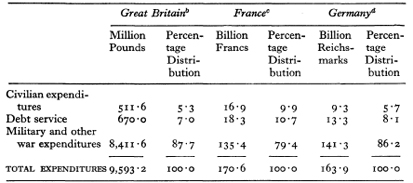
The conduct of war has always been costly and, consequently, a fiscal problem of no mean dimensions had to be faced in the years 1914–18. (See Table 1.) In the three countries examined below, the pattern of wartime inflation was fairly uniform but their different physical and political conditions at the end of the war were greatly to affect the course of their post-war monetary experiences.
Table 1
GOVERNMENTAL EXPENDITURES, TOTAL FOR YEARS 1914-18a
a Data taken from fiscal-year figures which, in the case of Great Britain and Germany, end March 31; consequently nine months of the calendar years and three months of the following years are covered in the case of these two countries.
b Cf. John Parke Young, European Currency and Finance, Commission on Gold and Silver Inquiry, U.S. Senate, 1925, vol. I, p. 302.
c Gaston Jèze and Henri Truchy, The War Finance of France. New Haven, 1927, p. 26.
d Total expenditures from ‘Statistisches Jahrbuch für das Deutsche Reich’, quoted in C. Bresciani-Turroni, Economics of Inflation, London, 1937, p. 47; civilian expenditures from Charles Rist, Les finances de guerre de de l’ Allemagne, Paris, 1921, pp. 109, 116–17.
In France war expenditures exceeded four times civilian expenditures plus the debt service; in Great Britain and Germany, approximately seven times. In all three countries the servicing of the public debt took up between one-half and three-fifths of the ‘non-war’ expenditures; the cost of servicing the public debt increased as the war proceeded on account of the growing volume of indebtedness. If we take into account ‘civilian’ expenditures proper of the government, exclusive of the debt service, we find that they amounted to 10 per cent of the budgetary expenditures in France, 5 per cent in Great Britain, and 6 per cent in Germany.
These figures indicate that profound changes took place during the war in the structure of the several national economies. The great increase in public expenditures affected the nature of demand; in some cases the effect was upon the volume of monetary purchasing power appearing in particular markets. For example, government spending on clothing, food, and the like increased the demand for goods on which civilian existence depended. In other cases, as in the field of armaments, there developed a demand for goods which, in peacetime, were either produced in much smaller quantities or not at all.7 Thus not only was the total volume of demand in existing markets affected but, as a result of shifts in demand, the relative growth of individual industries as well. The extent of the ‘monetary’ influences of wartime expenditures upon the economy of the country was related to the size of the government expenditures and to the method by which these expenditures were financed.
(B)WHERE DID THE GOVERNMENTS’ PURCHASING POWER COME FROM?
In Table 2 below a general idea is given of how Great Britain, France, and Germany financed their large wartime budgets. Taxes provided 28 per cent of expenditures in Great Britain, 15 per cent in France and only 14 in Germany.
Table 2
GOVERNMENTAL EXPENDITURES AND REVENUE, 1914–188
9 Computed from fiscal-year figures.
10 Cf. John Parke Young, op. cit., vol. I, p. 302.
11 Gaston Jèze and Henri Truchy, op. cit., p. 213, and Eleanor L. Dulles, The French Franc, New York, 1929, Table XVI, p. 244.
12 Charles Rist, op. cit., pp. 109–10, 116–17.
13 The increase of the public debt is not identical with the amounts obtained by subtracting ‘total revenue’ from ‘total expenditure’ figures, owing to the fact that these two series are estimates, rather than fully accurate data. This is especially true of France; to quote Professor Jèze, one of the leading students of France’s war economy: ‘the prevailing disorder in public accounts makes it impossible to draw up an accurate record of the state expenditure’, G. Jèze and H. Truchy, op. cit., p. 27. See also Robert M. Haig, The Public Finances of Post-War France, New York 1929, Chapter XX.
In Germany they covered the ‘civilian’ expenses of the government and the current debt service; in France they provided for ‘civilian’ expenditures and, roughly, half of the debt service, while in Great Britain they contributed less than one-third of military expenditures. The position of France’s war finance was the most precarious of the three countries, since she had to borrow in order to meet part of the debt service on the previously contracted debt. The occupation of her territory by enemy troops was one of the main reasons for that precarious position. However, her failure to resort with more energy to higher taxes was characteristic of European finance in general, in the first world war.
Only in Great Britain was a determined effort made to increase the yield of taxation. But even there excess profits taxes were not introduced until 1916. In the fiscal year 1915–16 they brought in £140 thousand; in the following year they produced £140 million, while for the fiscal year 1918–19 they totalled £285 million. Income and property taxes increased their yield from £47 million in 1913–14 to £291 million in 1918–19, while the aggregate annual yield from all forms of taxation increased during these five years from £163 million to £784 million.14 As Table 2 shows, these increases were nevertheless quite inadequate to meet the great demands on the Exchequer resulting from the war.
Consequently the government’s wartime requirements had to be financed to a great extent by borrowing. Over the five fiscal years of the war, Great Britain’s total public debt increased by £6.8 billion. The pre-war funded debt declined by £269 million but an ‘unfunded’ war debt of £7.1 billion was created. The war debt included long- and medium-term issues, as well as a floating debt. The latter consisted of treasury bills sold to the market and of Ways and Means Advances obtained by the government from the Bank of England and various public departments. In the middle of 1919 the floating debt amounted to £1.2 billion.15
In France the total increase in the public debt between December 31, 1913, and December 31, 1918, amounted to 137 billion francs, of which 66 billion were long-term, 0.5 billion short-term, 42 billion floating, and 29 billion foreign debt.16 The floating debt, which was later to become such a source of financial difficulty, was made up of advances to the government by the Bank of France, and of National Defence Bonds (‘Bons de defense nationale’)17 which were first introduced on September 13, 1914. At the end of 1918 the former amounted to 17 billion francs18 and the latter to 22 billion francs.19
Between the outbreak of the war and the signing of the armistice Germany’s public debt increased by 141 billion marks. Of that total 96 billion represents the proceeds of nine war loans; the floating debt amounted to 45 billion marks. The German government issued short-term treasury bills which the commercial banks purchased with their liquid funds, and every six months a portion of these short-term loans was funded through the issue of longer-term government securities.20 In the opinion of Professor Rist, author of one of the leading studies of the German war economy, ‘the principal credit instrument of the Empire was the issue of treasury bills or drafts for terms varying from less than four weeks to a maximum of three months. These bills were first discounted by the Reichsbank at the official rate of 5 per cent. A part of them was then transferred by it to the banks, savings banks, co-operative credit societies and even to large industrial and commercial houses direct.’21
Each country resorts, of course, to methods of financing which are appropriate to its general economic condition, to the habits and attitudes of its population, to the structure of its financial system, etc. In this connexion Professor Truchy draws a comparison between the French and German methods of using short-term government paper to finance the war:22
‘This direct appeal to the public to take up treasury bills was one of the original features of French war finance. There was in this respect a great difference between France and Germany. In the latter, at the outbreak of war, there were heavy withdrawals from the banks; but this movement was soon checked, and from that time money constantly flowed into their coffers, which are the natural reservoirs of the public savings. There was no moratorium in this respect of deposits, nor was any measure of protection applied to the savings banks, and the public confidence in these establishments remained unimpaired. The government was therefore enabled to draw the money that it required for the conduct of the war from the banks themselves.’
(C)MONETARY PURCHASING POWER AND THE WAR
The monetary developments in several European countries during the war were certainly spectacular but in the years following they were even more striking. They are, along with price movements, the outward symptoms of inflation and as such form a central part of this inquiry. Deficit financing was closely connected with the course of development of monetary circulation. The outbreak of the war resulted not only in a need for deficit financing but also in widespread movements of panic on the part of the public. In order to prevent the panic from undermining the internal monetary conditions and thereby adversely affecting the war effort, moratoria on banks were declared almost immediately; they were lifted later when the public became adjusted. Also the gold standard was suspended and various expedients were adopted in the foreign exchange market to assure an ‘artificial’ stability of exchange rates.
It must be realized that the monetary habits of these three countries selected as ‘case studies’ varied considerably at the time of the first world war and, indeed, thereafter, and that these differences affected the form and the mechanism of their respective monetary inflations. In Great Britain the greatest part of current payments was made with the help of bank deposits transferable by cheques, rather than with currency. In France and in Germany currency played a much greater rôle. Therefore the inflationary activities of the central bank were greater in Germany and France than in Great Britain, while the reverse was true of the rôle of commercial banking.
In Great Britain the connexion between government borrowing and monetary expansion occurred through the medium of currency notes, a new means of payment introduced during the war23 and in 1925 absorbed into the regular circulation of Bank of England notes. The Bank of England issued the currency notes to Joint-Stock Banks24 against a corresponding debit in their balance with the Bank, and the Joint-Stock Banks used this additional supply of currency as cash reserves against their expanding credit operations. The Bank of England would simultaneously credit the amount of currency notes issued to a special ‘Currency Notes Redemption Account’ from which the government could borrow by substituting its own bonds for the money in the account. Thus, the Bank of England would borrow from Joint-Stock Banks against an issue of currency notes and re-lend the proceeds to the government against bonds.
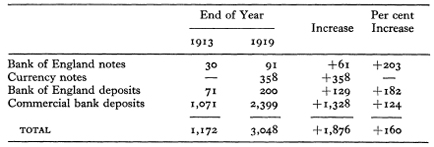
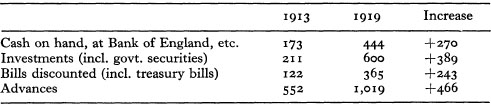
In the process of that somewhat involved transaction the amount of currency in circulation would be increased by the amount of new currency notes. Up to August 4, 1920, the government obtained £336 million in this manner. That amount eventually found its way to the Joint-Stock Banks through the deposits of their cash receipts by the beneficiaries of government spending. (See Table 3 for the wartime changes in Great Britain’s monetary circulation and Table 4 for changes in the assets of Joint-Stock Banks.) While the per cent increase is the largest for Bank of England notes, it is the deposits of commercial banks (Joint-Stock Banks) which have contributed most to the monetary expansion measured in absolute terms. A certain part of the expansion of deposits was the result of the purchase of government bonds and treasury bills by the banks. Advances from banks may also have enabled the public to purchase more government bonds than it would otherwise buy. The increase in the banks’ cash holdings which was necessary to the expansion in their deposits was made possible through the issue of currency notes.
Table 3
CHANGES IN GREAT BRITAIN’S CIRCULATING MEDIA, 1913-19a (£ millions)
a A. W. Kirkaldy, op. cit., p. 57, and John Parke Young, op. cit., vol. I, p. 277.
Table 4
CHANGES IN ASSETS OF BRITISH JOINT-STOCK BANKS, 1913–1925 (£ millions)
26 A. W. Kirkaldy, op. cit., p. 58.
While a currency and credit expansion was stimulated by the methods used to finance war expenditures, the extent of that expansion falls far short of the public borrowing. The war deficit of the British budget was over three times the size of the monetary expansion. The balance of public borrowing must have been financed therefore out of (1) investment of new savings, (2) reinvestment of retired domestic debt and (3) reinvestment in the domestic market of money repaid from abroad on account of Britain’s foreign holdings.
In France the circulation of the Bank of France notes increased from 5.9 billion francs at the end of June 1914, to 30.2 billion francs at the end of December 1918, that is by 24.3 billion francs or 412 per cent. This expansion came from advances by the Bank of France to the government which amounted during that period to 17.1 billion francs. As the government spent that money on budgetary needs, the money penetrated the national economy and joined the supply of purchasing power in the hands of the public. Some of the additional purchasing power was undoubtedly siphoned off through the sale of government securities to the public, some remained in the form of increased private cash balances.
The following data illustrate the ‘private’ credit activity of the French banking system. The total loans made by the Bank of France and the six principal commercial banks27 to the public increased from 9.7 billion francs on June 30, 1914, to 12.3 billion on December 31, 1918. This is a very mild increase, especially if one considers that some of these advances may have been used by borrowers to purchase government securities. Perhaps because of enemy occupation of an important industrial section of the country, advances to the public first fell from 9.7 billion (June 30, 1914) to 8.1 billion a year later.28 Only in 1917 and 1918 did an expansion occur, an expansion far smaller than the fall in the purchasing power of the franc that had taken place in the meantime. In ‘real’ terms there was a deflation rather than an inflation of private credit in France during the war. After the war the situation reversed itself.
In Germany the main centres of monetary expansion were the Reichsbank and the newly founded ‘Darlehenskasse’. The circulation of the notes of the Reichsbank increased from 2.4 billion marks in June 1914, to 22.2 billion in December 1918, while that of certificates of the Darlehenskasse grew from nothing to 10 billion marks.29 At the same time total demand deposits with the Reichsbank increased from 858.3 million marks to 13,280 million. Thus the circulation of the Reichsbank notes increased nine times, while the total monetary circulation increased by fourteen times, which total does not include the expansion in deposits in commercial banks.30
It will be noted that the increase of circulating media by 42.2 billion marks compares with an increase of the Reich’s floating debt of 45 billion. The connexion is clear. Means of payment were created to finance the floating debt, and once the proceeds of that borrowing were spent, the buying power of the public was correspondingly increased. Price controls, etc., prevented that expansion from expressing itself in parallel price increases during the war while after the war it was to manifest itself strongly.
(D)COMMODITY FACTORS
The ‘real’ or commodity factors of the inflationary developments are outside the scope of the present inquiry, important though they are. In broad outline their rôle seems to have been as follows:
The war created widespread scarcities of goods which tended to drive prices up above the level they might otherwise have reached. Scarcity can be traced to two distinct sets of circumstances since the notion itself is not absolute but relative. ‘Scarcity’ means a maladjustment between effective demand for and supply of goods, in which the supply is inadequate to meet the effective demand. Now this may be the result of an increase in demand or of a decrease in supply. Scarcities may arise only in certain markets or affect large sectors of the economic system. Scarcities of particular goods may develop when there are major shifts in demand. On the other hand there may develop absolute scarcities, with no superabundance to match, in a country which is cut off by the war from sources of imports and which formerly had an import surplus. In a country whose territory is partly occupied by the enemy absolute scarcities can similarly develop.
The foregoing considerations are applicable to the historical situations studied here. Scarcities tended to cause a rise in prices in certain markets. In war economies, the goods which tended to be the most scarce were those the government had to buy in large quantities for military purposes. The increase in the price of such goods tended to increase the size of public expenditures and thus budgetary deficits as well. In that way the situation in respect to commodity supply seems to have exercised an important influence upon the previously discussed fiscal and monetary developments.
The first world war has caused major disturbances in international trade as well as in domestic markets. Great Britain found herself faced with declining imports because of submarine warfare; Germany was similarly affected by the Allied blockade. France suffered from submarine warfare and from losses of territory. Thus goods became less abundant at a time when civilian requirements in any event would have had to be curtailed because of military needs. While it is impossible to give any data within the compass of this study, it is important nevertheless to draw the reader’s attention to the non-monetary aspects of the situation. Owing to the fact that the war was financed on a deficit basis and that public borrowing had inflationary implications, very likely scarcities of goods added further impetus to inflationary price movements. An expanding purchasing power failed to be matched by an equivalent expansion in the volume of goods. Price increases that followed reacted upon the position of the treasury and brought forth an intensification of monetary expansion.
(E)FOREIGN EXCHANGE
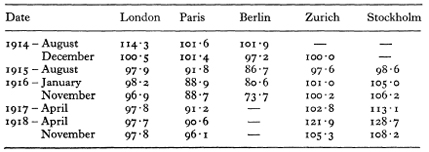
Foreign exchange fluctuations were to become a significant factor in post-war inflation; they were not particularly important during the war, because foreign exchange markets had been placed under rigorous control. Convertibility of paper currency into gold was suspended and then export embargoes declared, in order, first, to avoid panicky hoarding of the metal at home and, second, to forestall its shipment abroad.31 Since the suspension of the gold standard would normally result in wide exchange fluctuations and this, in turn, would react upon domestic prices and thereby aggravate the deficit position of budgets, exchange control was introduced in nearly all countries. In many instances, as in Anglo-American, Anglo-French, and French-American relations, relatively stable rates of exchange were maintained through appropriate market controls and interventions (Table 5). This was the so-called ‘pegging’ of exchanges and when it was abandoned after the end of the war, certain countries, like France, went through periods of more or less acute exchange fluctuations and depreciation. (See Table 10 below.) ‘Pegging’32 and exchange controls prevented foreign exchange fluctuations from increasing the already serious and numerous difficulties of the various countries.
Table 5
EXCHANGE RATES ON NEW YORK, 1914-18
Highest rates on New York during the given months as percentages of pre-war pars:a
a William Adams Brown, Jr., op. cit., vol. I, p. 49, Table I.
(F)WARTIME PRICE INFLATION
In Great Britain the general price level rose slowly, reaching the index figure of 218 (first half of 1914 = 100) by June 1917 and remaining relatively stable thereafter (Table 6). A comparison of the movements of the price levels of the principal categories of goods33 indicates the unequal rise of prices which, of course, is one of the characteristic features of inflation (Table 7). Price controls introduced gradually during the war stabilized certain prices effectively, while others continued to rise. The following quotation from Professor Bowley’s study gives an idea of these controls:
Table 6
WHOLESALE PRICE INDEXES, 1914–18, GREAT BRITAIN, FRANCE AND GERMANY34
| End of December | Great Britain (1914 = 100)35 |
France (1913 = 100) |
Germany (1913 = 100) |
| 1914 | 108 | 100 | 125 |
| 1915 | 140 | 163 | 148 |
| 1916 | 190 | 203 | 151 |
| 1917 | 226 | 304 | 203 |
| 1918 | 235 | 353 | 245 |
36 A. L. Bowley, op. cit.; John Parke Young, op. cit., vol. I. For Great Britain, the index of The Economist is used; for France, the index of the Statistique générale de la France; for Germany, the index of the Statistisches Reichsamt.
The index series should be considered merely as a rough indication of the trend of price developments. Index numbers under wartime conditions are subject to serious limitations owing to (1) changes in character and quality of the commodities priced; (2) changes in the importance of individual commodities in production and trade; (3) price controls, rationing, and black markets.
37 January to June.
In 1917, the Ministry of Food took complete possession or effective control of the whole of the supply and distribution and regulated the prices at every stage. . . . Sugar was owned and distributed by the Government from August 1914. . . . The prices of iron and steel began to come under control in June 1915. That of steel was fixed in November 1917, extra costs being met by a Government subsidy, and this involved the fixing of the price of iron. The subsidy to steel makers was withdrawn in January 1919 and that of pig-iron manufacturers in April of the same year. The price of pig-iron (Cleveland No. 3) immediately jumped from £4 15s. to £8 as compared with £2 11s. 3d. in July 1914, while that of steel (rails) jumped from £10 17s. 6d. to £16, as compared with £6 in July 1914. . . . A further considerable rise took place in 1920 until in July steel rails reached £23 and pig-iron £10 17s. od.’38
Table 7
WHOLESALE PRICE INDEXES, GREAT BRITAIN, 1914–2O39
(January-June 1914= 100)
40 A. L. Bowley, op. cit.
41 ‘. . . the Economist general number for textiles is not of necessity representative during the war period.’ A. L. Bowley, op. cit., p. 29.
42 Economist index numbers with the basis adjusted so that the average January-June 1914 is 100.
43 Fall in cotton price.
In France prices went up faster, reaching the index figure of 355.1 by September 1918, and 352.8 by the end of the year (1913 = 100).44
In Germany the wartime price increase was relatively very moderate. From 99 in July 1914 (1913 = 100) the price level rose to 150 by July 1915, and remained almost stable until the end of 1916. After a rise to around 200 there followed another period of stability from August 1917 until May 1918. In November 1918 the price index stood at 234. This relatively small rise in prices is particularly striking in view of the expansion of German monetary circulation. The discrepancy is explained by the facts that price controls and rationing were much more strictly enforced in Germany than elsewhere and that in the course of the war German currency spread over a large area of occupied territories.
(G)INFLATION IN NEUTRAL COUNTRIES45
Neutral countries showed monetary developments which are not unlike those of the belligerents. They, too, found themselves burdened with additional expenditures and faced budgetary deficits financed through an increasing public debt. Switzerland, for example, which had a surplus of 1 million francs in 1912 and a deficit of 5 million francs in 1913, accumulated during the war years a deficit of 173 million francs. In Sweden the public debt rose from 648 million kronors in 1913 to 1,656 million in 1918. Correspondingly in both countries there was an expansion of monetary circulation. In Sweden the note circulation of the Riksbank increased from 243 million kronors at the end of 1914 to 651 million at the end of 1918, while deposits of private banks passed from 1,212 million kronors to 2,294 million during the same period. In Switzerland, the note circulation of the Swiss National Bank increased from 456 million francs at the end of 1914 to 976 million at the end of 1918, its deposits and current accounts increased from 71 million francs to 184 million, while deposits and current accounts in private banks rose from 1,620 million francs to 3,535 million.
Sweden’s monetary problems were aggravated through a large influx of gold, and her way of dealing with it is one of the very interesting experiences in monetary management.46 Her attempt to prevent a price increase at home failed, and along with Switzerland she shared in a wartime price inflation. In Sweden the price level index stood at 36747 at the time of the armistice, while in Switzerland the ‘retail price index’ of the Consumers’ Co-operative Association (the best index available for that period) stood at 224.6 on June 1, 1918.48
IV Post-Armistice Developments
The inflationary developments which followed upon the end of hostilities fall into two chronological groups, the first of which is an organic sequel to wartime inflations. When the ‘momentum’ of these inflations had been spent, a period of deflation ensued, followed, in the case of certain countries, by a second wave of inflationary processes.
(A)POST-ARMISTICE INFLATION
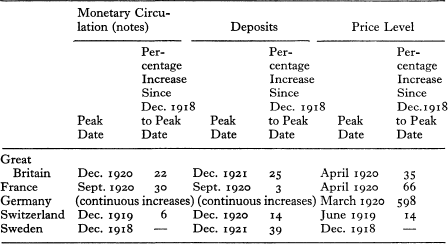
The end of hostilities did not mark the end of inflations in Europe; both monetary expansion and price-inflation continued after the armistice (see Table 8). There is nothing surprising in the fact that exceptional expenditures were still required of national treasuries and fiscal methods were not immediately changed. Since demobilization was necessarily gradual, military expenditure had to be continued after the armistice, and the repatriation of armies was often a costly proposition. The production of war equipment did not stop at once, but tapered off. In certain countries, like France, considerable reconstruction costs had to be shouldered and these were underwritten by the government. Thus budgetary expenditures continued to be heavy. (See Table 9.) To meet these expenditures, revenue was increased, but not to an extent that would eliminate budgetary deficits; the latter declined gradually but it was 1920–21 before the budget was balanced in Great Britain, 1927 in France. In most other countries deficits disappeared somewhere between these two dates.
The financing of these deficits was accomplished largely by methods identical with those practised during the war. A ‘fiscal inertia’ developed after the armistice and it was easier to continue to resort to borrowing than to taxation. In countries where public administration had broken down more or less completely as a result of the war’s aftermath of defeat, or revolution, or protracted ‘secondary’ hostilities, public expenses were met largely through the help of the printing press, and inflations of major proportions followed in the wake of the war. Such were the experiences of Soviet Russia, Poland, Austria, Hungary, Bulgaria, etc. In other countries, inflation continued more moderately, coming to an end or to a lull around 1920, partly as a result of the business recession which developed about that time.
Table 8
EXTENT OF POST-ARMISTICE INFLATIONS49
50 John Parke Young, op. cit., vols. I and II.
Other principal factors in the post-armistice inflation are to be found in the condition of commodities. Scarcities continued to be severe after the end of hostilities. Food imports coming mostly from the United States brought a much-needed relief,51 as did imports of raw materials and of certain finished manufactured goods, but it was some time before more ‘normal’ conditions of supply were established. The transition from war to peace production was effected gradually and with the help of an expanding volume of foreign trade. At first, however, scarcities had a price-lifting effect. In countries like France, the ‘hunger for goods’ was aggravated by the destruction dealt to them during the war; in the case of Great Britain, the great foreign demand for her goods had a similar effect of upsetting the balance between supply and demand.52
Table 9
PUBLIC EXPENDITURES, 1918–2153
(£ millions for Great Britain, billion francs for France)
54 John Parke Young, op. cit., vol. I, pp. 302, 493.
55 Fiscal year for Great Britain ends March 31st, for France ends December 31st.
56 Expenditures on reconstruction.
While goods were scarce, the monetary means of satisfying the demand for them were expanding. These two circumstances combined led to an aggravation of the price rise after the end of 1918. The removal of price controls and the end of rationing allowed the forces of the market to operate freely. In Germany, where controls had been particularly effective and where the price increase had been very moderate compared with the monetary expansion, the post-armistice price increase was especially great. The temporary peak of prices reached in Germany in March 1920 was sixfold the price level at the end of 1918, while the peak, April 1920, in Great Britain was only 35 per cent above the December 1918 level, and in France, where a temporary peak was also reached in April 1920, the corresponding ratio was 66 per cent.
It will be noted from Table 8 that prices rose more rapidly than circulation, which may have been brought about by the effect of released ‘inflationary potentials’. This is particularly striking in the case of Germany whose monetary circulation little more than doubled while prices increased by 600 per cent. As we have seen circulation increased faster than prices in that country during the war; when wartime controls were relinquished the contrast between the monetary expansion and the inadequate supply of goods expressed itself by that large increase in prices.
Table 10
EXCHANGE RATES ON NEW YORK, 1919–2057
58 Monthly averages of daily quotations as percentages of pre-war pars. William Adams Brown, Jr., op. cit., vol. I, p. 215.
59 Calculated on the basis of figures given in John Parke Young, op. cit., vol. I, pp. 531–2.
Another feature of post-armistice developments which affected price movements was the ‘unpegging’ of foreign exchanges. As foreign exchange controls were removed and ‘pegging’ operations were discontinued, there developed a varying degree of depreciation of the various currencies in terms of the United States dollar. This depreciation, illustrated in Table 10, is accounted for by (a) the dislocations that occurred in the balance of payments of the various countries, and (b) the uneven degree of price inflations in the various countries, i.e. of the domestic reduction in the purchasing power of money, which perpetuated and aggravated the balance-of-payments dislocations.60 The depreciation of the several national currencies in terms of the dollar not only was the consequence partially of the price developments of the preceding years but became, in turn, a causal factor of considerable importance in the price formation during the post-war years. Imports from the United States tended to increase in price in terms of domestic currencies, while in several countries the depreciation in terms of the dollar was often considered as the best measure of the depreciation of the currency in general and, thus, as a guide to upward adjustments of domestic prices. The fact that international trade and international financial transactions were still disorganized at the time of freeing foreign exchange markets from wartime controls, increased the pressure on balances of payments and thus became an unstabilizing factor in the post-war monetary developments.
The ‘momentum’ of inflation, inherited from the war, was aggravated after the armistice by the effect of the liquidation of wartime controls, especially the controls over the foreign exchange markets. In the case of countries like France, whose imports were large, the depreciation of the national currency in terms of foreign exchange brought about an accentuation of the domestic price rise. That rise, in turn, increased the pressure on the budget and the size of deficits; to meet deficits a currency or credit expansion was often resorted to, and this increase in monetary circulation affected prices. The rise in domestic prices, by further upsetting the balance of payments, tended to extend the exchange depreciation, and so the ‘vicious spiral’ moved on.
Reference has already been made to the continuation after the armistice of the financial methods inherited from the war. In certain countries, ‘deficit finance’ was gradually liquidated; in others, such as Germany, it continued unabated. In France efforts were made to balance the budget and, as we shall presently see, that objective was nearly reached by 1924. Another aspect of the fiscal methods inherited from the war was the reliance placed on floating as against long- and medium-term debt. These methods too were carried over, in certain countries, into the post-war period. There were good reasons for doing so, yet there were also serious inconveniences attached to the growth of floating debt.
A particular feature of the floating, short-term debt is that it has to be refunded every few months. It is necessary therefore that the treasury should be able to place in the market new issues of short-term paper whenever old ones are falling due.61 To do so the treasury must be in a position to rely on a disciplined money market and on a public whose confidence is well established. In the absence of these the treasury may have to resort to the assistance of the central bank and bring about an inflationary credit expansion.
From both these points of view there is an interesting contrast between the experiences of Great Britain and of France. In the former the money market was well organized and responsive to treasury needs and could be relied upon in emergencies; also the state of public confidence was excellent as a result not only of the customary calm of the British public but also of the determined and successful efforts of the government to put an end to the inflationary inheritance from the war. In France, on the other hand, there was no comparable banking discipline, while economic as well as political difficulties in the post-war period brought about a series of grave crises of confidence.
In a country with France’s institutional arrangements and with difficult times ahead, the accumulation of floating debt was a risky course for the treasury to adopt. Warnings were issued by leading economists, Professor Truchy in 1920,62 Professor Rist in 1924.63 It was thus recognized by experts that changes in the structure of the public debt were necessary and, gradually, they were carried out, though not without giving rise, here and there, to grave difficulties. Right after the armistice, however, public indebtedness continued to grow and the floating debt grew with it.
Post-armistice inflations were interrupted in several countries by the depression of 1920. In countries like Great Britain, Sweden, and Switzerland this marked the real end of inflation. In other countries, like France and Germany, inflationary tendencies came back after a temporary interruption.
(B)THE POST-WAR BUSINESS RECESSION64
The months immediately following the end of hostilities were, after a brief hesitancy, a period of considerable economic activity. As we have seen, war expenditures tapered off, while the dearth of civilian goods, supported by an inflated purchasing power of the public, created a very receptive market for goods. However, this condition did not last. In Great Britain a slump developed in the latter half of 1920 from which there was no full recovery. France’s recession started during the second quarter of 1920 but was very short-lived; towards the end of 1921 improvement started and the recovery was in full swing by the middle of 1922. During the remaining years of the twenties France was prosperous. In Germany, the military collapse of 1918 and the political and social disturbances that followed led to a depression which lasted through 1919 and 1920. A temporary revival came about in 1921 and was brought to an end by the monetary disintegration and political unrest of 1922. After the stabilization of the mark, from 1924 onwards, a recovery set in. In Italy there was a depression from 1920 to 1923, in Sweden from the middle of 1920 until the middle of 1922, in the Netherlands, from the autumn of 1920 until the middle of 1924.
Thus, while the end of the first major post-war depression varied considerably in time, from country to country, its beginning in most instances occurred around the middle of 1920. As determined by the monetary implications of that economic situation the various countries fell into three main classifications:
(a)Countries where inflation came to an end during the slump and was not resumed (e.g. Great Britain, Sweden);
(b)Countries where inflation continued in spite of the depression, occasionally with short interruptions (e.g. Germany);
(c)Countries where inflation was checked, a deflation followed, but inflation came back as soon as the business depression gave way to a new upward tide of activity (e.g. France).
Actually, the post-war business recession was the source of deflationary developments in the monetary field. At the end of the war it was generally considered desirable to bring inflations under control; deflations, however, actually came about as a result of circumstances rather than of policies.65
(C)THE TERMINATION OF INFLATIONS: THE CASE OF GREAT BRITAIN
Great Britain presents an instructive representative case of successful termination of inflation in Europe.66 Professor Rist in his incisive essay on post-war deflations characterizes the British experiment in the following terse statement: ‘The significance of England’s monetary policy consists solely in the re-establishment of budgetary equilibrium and in the beginning of reimbursement of a part of the public debt.’67
The principles of Britain’s post-war policy are laid down in the celebrated ‘Cunliffe Report’ of August 1918.68 That programme included a legal ceiling on the issue of currency notes and their gradual absorption into the monetary circulation of Great Britain, and various other financial and monetary measures culminating in a return to the gold parity of the pound sterling.
On December 15, 1919, a legal limit on the fiduciary issue of currency notes was introduced in pursuance of the recommendations of the Cunliffe Committee. Their issue, not covered by gold or Bank of England notes, was fixed at £320.6 million, which was only very slightly in excess of their actual circulation at that time. That maximum was subsequently lowered and in 1925 currency notes became a part of the Bank of England’s circulation.
Between the end of 1920 and the end of 1922 monetary circulation declined by about 7 per cent, from £3 billion to £2·8 billion, as illustrated in Table 11.69
The significance of these changes lies in their marking the end of inflation rather than in the scope of the currency deflation itself which was rather mild. More striking were the budgetary developments. The fiscal year 1919–20 was the last with a budgetary deficit. While the total expenditures declined from £2.6 billion in 1918–19 and £1.7 billion in 1919–20 to £1.2 billion in 1920–21 reaching £800 million by 1923–24, the budget showed a surplus from 1920–21 onwards. In the four fiscal years 1920–24 the accumulated surplus was £430 million.70
Table 11
CURRENCY AND CREDIT CONTRACTION IN GREAT BRITAIN, 1920–22 (in millions)

The total volume of public indebtedness showed only slight fluctuations between 1920 and 1924, but its composition underwent significant changes as illustrated by Table 12.71
Table 12
GREAT BRITAIN’S PUBLIC DEBT, 1919–24 (in millions)
72 Year ending March 31st.
73 This total includes several minor items not listed separately in this table.
The process of funding the public debt started right after the war, and although by 1923–24 much remained still to be accomplished the direction of fiscal policy was clearly established.
The most striking changes took place in respect to the foreign exchange rates. The sterling-dollar exchange moved as follows:74
| End of the Year | Dollars per Pound |
| 1919 | 3.91 |
| 1920 | 3.49 |
| 1921 | 4.07 |
| 1922 | 4.57 |
| 1923 | 4.39 |
| 1924 | 4.68 |
| 1925 | 4.85 |
Whether this return to the pre-war parity was economically justified and wise is a question with which we need not be concerned in this study. The rise in the foreign valuation of the pound was brought about by a consistent effort on the part of Britain’s monetary authorities; it was made possible by the domestic deflation, by the balancing of the budget, by developments in Britain’s foreign transactions, and most of all by the revival of international confidence in the monetary stability of Great Britain.
V Currency Substitution and its Effect upon Inflation: Belgium and Czechoslovakia
Experiences of World War I clearly indicate that methods of ‘currency substitution’ may have direct, though divergent, effects upon the development of post-war inflations: they can stimulate them or help bring them under control. These divergent effects are illustrated by the inflation in Belgium, where its scope was comparable to that of France, and the inflation in Czechoslovakia, where it was checked. The developments in these two countries may prove extremely important after the present war in connexion with the liberation of territories occupied by Germany and Japan where occupation currencies have been introduced by the invaders.
In Belgium, the franc was reintroduced to take the place of German currency brought into circulation during the war, and the fiscal measures adopted during the transition paved the way for the inflation that followed. In Czechoslovakia, a new national currency, the Czechoslovak crown, was substituted for the disintegrating Austrian crown, and the delicate operation was carried through with a remarkable degree of success; the mild inflation that followed was of short duration and was not connected at all with the change-over of currencies.
(A)BELGIUM75
The problem of substituting the Belgian franc for the German mark was dealt with by the Belgian Government, still operating from Le Havre at the time, in three decrees:76
The first, of October 22, 1918, prohibited the importation into Belgium of money of enemy countries.
The second, a legislative decree of October 24, 1918, empowered the government ‘to determine by royal decree, all measures which the purifying of the monetary circulation might render necessary . . . concerning the introduction, holding, circulation and withdrawal of all metallic and fiduciary money not having legal currency in Belgium’.
The third, of November 9, 1918, declared that redemption of marks in francs should be effected at the pre-war unit ratio of 1.25 franc to 1 mark.77
It will be noted that these decrees were issued even before the armistice, prior, therefore, to the time when any effective administrative action could be taken in this matter. This fact made the first decree ineffective, and the third one very dangerous.
On November 9th, the Belgian Government created the ‘Monetary Restoration Bond’, at 5 per cent interest and with a three-year maturity. Buyers of these bonds could pay three-fourths of the price in German money at the 1 to 1.25 rate. The subscription ended on January 15, 1919. The value of bonds issued was 3.1 billion francs, and 1,545 million marks were retired from circulation.
The mark lost its legal tender character as soon as Belgium was reoccupied and the decree of December 7, 1918, established the following terms of conversion:
(1) All exchanges of less than 1,000 marks were to be made outright by the National Bank and its branches and agencies; (2) for sums larger than 1,000 marks credits were to be established at the National Bank to be drawn upon as needed.
According to Mr Shepherd: ‘. . . Several factors combined to postpone the actual conversion operations. Communication was slow and difficult in the disorganized country, there was a scarcity of paper for bulletins and posters announcing the terms of the conversion, and it was impossible to print all the bank notes necessary in a limited time. Therefore, it was late in December when the work of withdrawing marks (aside from the Monetary Restoration Bond issue) began. The bulk of the marks was exchanged for francs during January 1919.
‘A total of 6,109,000,000 marks was redeemed in the form of National Bank notes, credits in the National Bank, and Monetary Restoration Bonds. The government, however, assumed complete liability for the conversion, the Bank acting in the exchange simply as the agent of the state. The Bank was called upon by the government to advance 5,800,000,000 francs to retire the marks not retired by the bond issue mentioned above. The balance over the amount needed for conversion was placed to the treasury’s account.’78
The National Bank advanced to the state 5.8 billion francs for the redemption of the marks, and by 1926 this obligation was reduced by only 600 million francs. It was expected that Belgium would be reimbursed by Germany but this expectation never materialized.79 The total amount of marks finally redeemed by the National Bank of Belgium was 6,109 million,80 and of that amount an estimated 1 to 2 billion marks was smuggled into Belgium after the announcement of the 1.25 conversion rate.81 This smuggling82 suggests that it was an error to issue the decree of November 9, 1918, so far in advance of actual conversion and to carry out the conversion in such a leisurely manner. Also no adequate safeguards seem to have been taken against the smuggling of marks into the country. A similar situation was handled much more effectively by the Czechoslovak Government.
The second error was made in selecting the rate of conversion. The rate was the same as that adopted by the Germans during the occupation period; strong public opinion demanded that it be maintained in returning the franc to circulation. But by keeping the pre-war parity, Belgium was taking over and making its own the German inflation that had taken place to that date.
The conversion was ordered so precipitately that no reliable estimate of the amount of marks introduced into Belgium during the war had been made in advance of planning the mechanism and the rate of conversion. Consequently, the size of the short- and medium-term debts of the state83 was doubled and an excessively large monetary circulation was generated. (See Table 13.)
Table 13
NOTE CIRCULATION OF THE NATIONAL BANK OF BELGIUM, 1913, 1919–2684
(millions of francs)
| End of December | Note Circulation | Per cent of 1913 Level |
| 913 | 1,067 | 100 |
| 1919 | 4,786 | 448 |
| 1920 | 6,260 | 587 |
| 1921 | 6,415 | 601 |
| 1922 | 6,876 | 644 |
| 1923 | 7,357 | 689 |
| 1924 | 7,873 | 738 |
| 1925 | 7,814 | 732 |
| 1926 | 9,432 | 884 |
85 Henry L. Shepherd, op. cit., p. 87, Table 15.
By 1919 inflation was well under way and grew further in 1920 as the new notes were gradually put in circulation.86 The pattern of the Belgian inflation resembled in later years that of the French inflation; its process was aggravated by fiscal difficulties connected with the large debt inherited from the ‘currency substitution’.
(B)CZECHOSLOVAKIA
As the Czechoslovak state was being organized, the Austrian currency continued the inflationary course upon which it had embarked during the war. Therefore as one of its first concerns the new Czechoslovak National Assembly empowered the finance minister, Dr Alois Rasin,87 to sever the connexion of the currency system of the country from that of Austria. This action was taken on February 25, 1919; it is significant that the law was passed in secret session, and that the public was not informed in advance of the impending currency substitution. This foresightedness undoubtedly saved the country from the unhappy consequences in Belgium of premature publicity.
The Austro-Hungarian Bank had agreed in the first instance not to print more currency without approval from all the succession states. However, the bank failed to keep its word and currency substitution amounted to the simple expedient of stamping the notes it had issued with a Czechoslovak imprint. The value given each note was based on the face value of the note less the depreciation caused by the inflation in Austria. Thus the government authorities attempted to ‘nip in the bud’ any inflationary developments which might have been transplanted into the Czechoslovak economy.
A further feature of this operation was the withholding from circulation of 50 per cent of the bank notes presented by the stamping agencies as an enforced loan to the government. The loan was to pay 1 per cent interest and was intended as security to be held against the anticipated property tax. Similarly, 50 per cent of the current accounts held at branch offices of the Austro-Hungarian Bank in Czechoslovak territory was retained as a governmental loan and the same was done with treasury bills issued by these branch offices.
The stamping of the notes was executed unexpectedly and rapidly. On the very night the law was decreed, the entire frontier was placed under military guard and all frontier traffic was stopped. A moratorium was proclaimed for the period of February 26th to March 9th. Posters were placed on the streets, in railways, and in post offices; all newspapers carried notices of stamping; lectures were given in schools and in churches and, finally, oral proclamations were made. Dr Rasin realized the danger that would result from smuggling of notes into Czechoslovakia from abroad and accordingly had postal connexion with foreign countries suspended for the entire period of the moratorium. From March 1st–9th, 1919, no money remittances were acceptable by post offices nor were deposits allowed in the Post Office Savings Bank.
The actual stamping took place from March 3rd–9th. Holdings of less than 300 crowns were exempt from the compulsory loan on technical grounds. Bank notes in the state offices were not withheld nor was one-fourth of monthly salaries and wages subject to the withholding provisions. Altogether, the loan obtained by withholding half of the bank notes and accounts amounted to 2.8 billion crowns. To pay off the retained portion of monetary circulation, a property tax was introduced.88 The restriction of the total circulation amounted, actually, only to 28.7 per cent of the total circulation, because of the above-mentioned exemptions, or to 29.3 per cent if bank deposits are included. Thus the financial life of Czechoslovakia stood still while the monetary change-over was accomplished, and notes in circulation were reduced nearly 30 per cent. By adroit administrative operations this country succeeded in checking inflation where Belgium failed.
Thus Czechoslovakia avoided being drawn into the inflationary spiral in which all her neighbours were caught. As mentioned before, a moderate inflation followed, induced by the considerable budgetary deficits of the years 1919 and 1920, and by an expansion of commercial loans and discounts. There was also an inflow of foreign exchange and of gold and silver. (See Table 14.) The inflation reached its peak at the end of 1921. The price level (calculated only since January 1922) stood at 1,675 (July 1914 = 100) in January 1922, at 999 in December of that year, and remained around 1,000 thereafter (around 150 in terms of gold prices). The deflation of 1922 caused economic hardships and disturbances; it was too rapid, and insufficient attention was paid its economic and social effects. However, at the price of that deflation, Czechoslovakia avoided the disturbing effects of a protracted inflation.89
Table 14
BANKING OFFICE OF CZECHOSLOVAKIA, 1919–2490
(millions of Czechoslovak crowns)
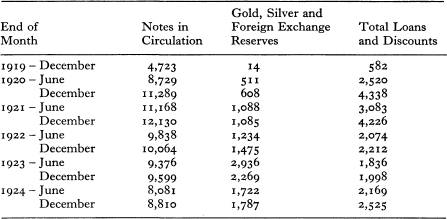
91 John Parke Young, op. cit., vol. II, pp. 305–6.
VI The Second Inflation in France
After World War I there was a second wave of inflations in Europe which was only indirectly connected with war finance. The experiences of the many countries varied considerably, and no two were the same. Since it is not possible to describe each different set of phenomena, two countries have been singled out for analysis because of the contrasting nature of their developments, namely, France and Germany.
Wartime inflation continued in France, as elsewhere, after the armistice, reaching its peak about the middle of 1920, as pointed out earlier in the study. Then the depression set in and prices fell from the peak figure of 588 in April 1920 (1913 = 100) to a low of 306 in February 1922. Subsequently prices started to rise again and a second inflation got under way. This development was just the opposite of the experience in England, for instance, where the business recession marked a definitive end of wartime inflation.
In France budgetary deficits remained in existence longer than in Great Britain because of the heavy costs of reconstruction and the difficulties of increasing taxes adequately. Business recession gave way to a new and protracted prosperity and France experienced a private credit expansion in addition to its governmental inflation. The French floating debt unlike the British continued to increase and serious financial difficulties eventually made their appearance.
(A)PUBLIC EXPENDITURES
Between 1914 and 1926 France’s public expenditures on the reparation of war damages accounted for 42 per cent of the total accumulated budgetary deficit. (See Tables 15 and 16.) From 1922 to 1926 inclusive, the deficit amounted to 57 billion francs, while the war damage expenditures were equal to 62 billion francs. Thus reconstruction expenditures more than account for the budgetary deficits during the ‘second inflation.’
Table 15
FRENCH BUDGETS, 1920–2792
(in billions of francs)
93 Data for 1913–24 quoted from Robert Murray Haig, The Public Finances of Post-War France, op. cit., p. 432; James Harvey Rogers, The Process of Inflation in France, 1914–27, New York, 1929, p. 3 gives the same data; data for 1925–27 are quoted from Eleanor L. Dulles, op. cit., p. 400. All the figures must be considered as approximations.
94 Year ending December 31st.
95 Surplus.
When the French state accepted the responsibility for war damages to private property, it was assumed that the reparation payments from Germany would eventually reimburse the treasury for its outlays. Actually reparations yielded approximately 9.6 billion francs net for the period extending from the end of the war to September 1, 1927.96 This was equal to about 7.4 per cent of this war damage bill.
Actually, had reparations been paid in full the consequence of monetary developments of 1920–26 might not have been influenced to any great extent beyond maintaining public confidence in the ultimate solvency of the country. These payments would not have had an immediate effect, as reparations were to be paid, at best, over a long period of years. Reconstruction costs which were the pressing issue of the time had therefore to be assumed by the French state and financed through the issuance of new government securities, thus adding to the public debt. Over a longer period reparation payments could have been used, however, to amortize a portion of the French debt, thereby reducing the budgetary charges resulting from it, and strengthening the French fiscal position in the thirties.97
Table 16
WAR DAMAGES EXPENDITURES, 1914 –2698
(in billions of francs)
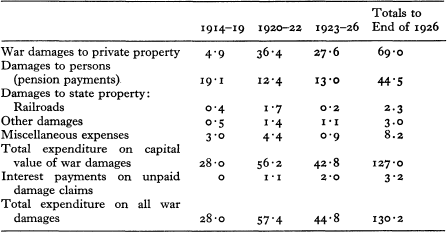
99 Robert Murray Haig, op. cit., pp. 302–3. The figures are rounded; therefore, totals are not exactly equal to the sum of component items.
In order to avoid the budgetary deficits in the post-war years, it would have been necessary for the French Government either not to underwrite the costs of ‘private’ reconstruction (including pensions), or to step up taxes very considerably. The former was politically impossible. The latter course was started in 1919–20, interrupted by the deflation, resumed only in 1923, but political difficulties made it impossible to achieve noteworthy results until 1927.
(B)PUBLIC DEBT, MONETARY CIRCULATION, AND CONFIDENCE FACTORS
From the end of 1919 until the end of 1926, the internal long-term debt of the French Government increased by 55.1 billion francs, the short-term funded debt by 37.9 billion, and the floating debt by 13 billion francs. (See Table 17.) The total internal indebtedness increased by about 106 billion francs, while France’s foreign debt increased by about 3.2 billion francs. The discrepancy between these figures and the deficit figures given above (Table 15) is the result of statistical difficulties in French budgetary returns.100 It is interesting to note that the increase of the public debt during the period 1920–26 is equal to the reconstruction expenditures during the same period. Of that amount, about one-half was financed by long-term and the other half by short-term borrowing.
The floating debt, which stood at 47 billion francs at the end of 1918, reached 93 billion by the end of 1921. It remained near that level until the end of 1924, increased to nearly 100 billion during 1925, then started to decline and in 1927 the decline became significant. While the bulk of the floating debt was accumulated during the war and immediately after it ended, the short-term bond issues were insignificant until 1921. Then they grew rapidly, reaching the peak of 46–6 billion by the end of 1924. They were reduced in the subsequent years by about 8 billion francs in 1925 and 1926, and by 11 billion in the first nine months of 1927. During the years 1920–26 we find the French treasury faced with very important tasks of refunding its paper and the short-term bonds. Hence, the question of confidence comes to the foreground and in 1924, 1925, and 1926 it plays a leading rôle in shaping the monetary conditions of the country.
Table 17
INTERNAL PUBLIC DEBT OF FRANCE, 1919–27101
(in billions of francs)
102 James Harvey Rogers, op. cit., p. 4.
103 From Bank of France and other banks. The advances from the Bank of Algeria and the Russian advances are included.
The floating debt consisted of National Defence Bonds and advances from the Bank of France. The amount of the latter was limited by statute. At the time of the armistice the limit was 21 billion; it was increased to 27 billion in 1919, then reduced gradually, reaching 22 billion on January 1, 1925. This reduction, made at a time when the financial problems of the treasury were by no means solved, was to have serious consequences in 1925. Eventually the limit of advances was increased to 26 billion on April 15, 1925, and reached a peak of 39.5 billion on December 7, 1925.
Owing to the crisis of confidence of 1924 the treasury was unable to refund in full its short-term liabilities. Consequently, about 7 billion francs of the short-term bonds, and 9 billion francs of the National Defence Bonds, had to be repaid in 1925. Thus the only source of funds was the Bank of France, and its advances increased by 13–4 billion during that year.
Monetary circulation increased from the low level of 36 billion francs in June 1922 to the peak of 56 billion in July 1926, of which 14 billion francs were accounted for in the years 1924–6. During these years advances to the government by the Bank of France expanded by 13 billion, thus becoming the principal factor in the monetary expansion of the middle twenties.
The Bank of France ran into serious trouble in the spring of 1925 in satisfying this increasing demand because it was limited by a statutory ‘ceiling’ on the amount it could advance to the government. Larger credits were required to enable the treasury to meet its commitments, and recourse was made to the following stratagem: the treasury obtained an agreement from commercial banks to purchase additional treasury paper on condition that this paper would be immediately rediscounted by the Bank of France (the private banks themselves were unwilling to hold the treasury paper thus purchased). In this way the Bank of France expanded its portfolio but not its advances to the state, while actually the additional money created went to the treasury. This ‘make-believe’ was soon discovered and a great parliamentary scandal ensued which seriously affected public confidence, and deepened the distrust of the finance ministry.
The reluctance of commercial banks to hold treasury paper was attributable to two sets of factors. One was the increased need for cash to finance growing requirements of a prosperous national economy; commercial portfolios expanded while holdings of government securities declined. The other factor was political or psychological, arising from the failure of the treasury to balance the budget and to refund the floating debt, and from the many crises in the finance ministry which resulted in a deterioration of public confidence.
It will be noted that in the years 1924–6 the main problem of the treasury consisted in the refunding of existing debt, rather than in any great additions to the outstanding total of indebtedness. In 1925 the budget was very nearly balanced.
(C)THE MONEY MARKET
This sequence of events had its effect on the money market. On the whole, the movements of the rate of discount of the Bank of France were moderate (Table 18), except for 1924. In that year of financial disturbances the rate was increased by 1½ per cent, not because of any scarcity of funds since inflation was progressing, but because of anticipated currency depreciation. Viewed against that background, the increase in the Bank of France rates was very small, and, as already pointed out, it had scant effect on the later course of inflation.
Table 18
DISCOUNT RATES OF THE BANK OF FRANCE, 1920–27104
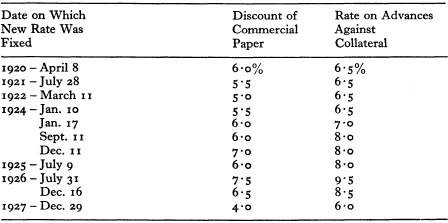
105 Eleanor L. Dulles, op. cit., p. 212.
As was to be expected, prices of bonds, both government and private, declined while prices of industrial shares went up. The war inflation depressed bond prices to between one-half and two-thirds of their pre-war level, whereas shares almost doubled in price; the second inflation of 1924–5 accentuated the fall of the former and the rise of the latter. (See Table 19.)
The crisis of confidence of 1925 led to a spectacular decline in the value of the new private bond issues. From over 3 billion francs floated in 1924 the new issues fell to next to zero in 1925, while at the same time there was a slight increase in the value of shares floated. In 1926 new issues of shares sharply declined, a great recovery following a year later. (See Table 20.)
Table 19
SECURITY VALUES, FRANCE, 1923–6106
(Index figures, 1901–10 = 100)
107 Eleanor L. Dulles, op. cit., pp. 505–8.
108 June 15th figures.
Table 20
VALUE OF FRENCH SECURITIES FLOATED ON THE PARIS BOURSE109
(millions of francs)
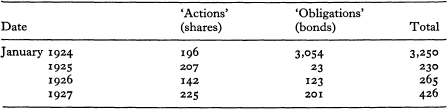
110 Eleanor L. Dulles, op. cit., p. 509.
(D)FOREIGN EXCHANGE, PRICES, AND FURTHER POLITICAL AND PSYCHOLOGICAL FACTORS
The franc–dollar rate was ‘unpegged’ on March 14, 1919. The dollar rose rapidly reaching the level of 17.3 on November 9, 1920. In January 1921 a decline set in, and from then until early autumn of 1922 the dollar exchange was almost stable, fluctuating between 11 and 14 francs. The time was favourable to stabilize the currency, yet the fiscal reform, which would have been needed as a basis on which to build, could not be carried out. In the autumn of 1922 the dollar resumed its rising tendency and continued until March 10 and 11, 1924, when the rate of 27 francs to the dollar was reached; it increased 3 francs in that month alone as the result of an acute wave of bearish speculation. The franc then recovered and by the end of April the rate quoted was 15.5 francs. Depreciation of the franc set in again and the rate fluctuated between 18 and 20 until May 1925. A new acute depreciation developed in the last quarter of 1925 and the dollar reached its peak in the end of July 1926, at which time it stood at 49. On July 27, 1927, Poincaré, who had just taken office, set about on an intensive stabilization programme after receiving an historic vote of confidence in the Chamber of Deputies. By the end of the year the rate was brought down to the neighbourhood of 25 francs to the dollar where it was stabilized.
Table 21
FRANCE: IMPORTED AND DOMESTIC GOODS’ PRICE INDEXES OF THE
Statistique Générale de la France111
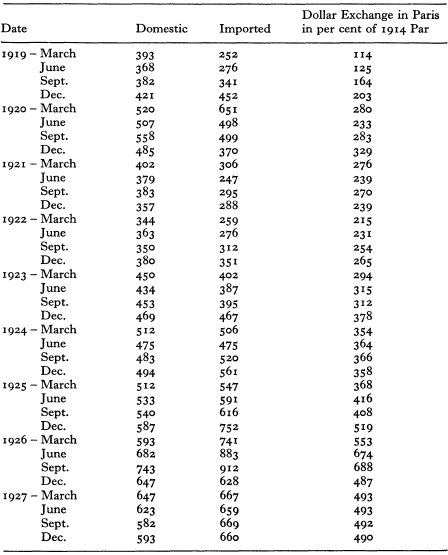
112 James Harvey Rogers, op. cit., pp. 59, 102, 106–7.
The depreciation of the franc in foreign exchange markets aggravated the domestic inflation. Prices of imported goods increased as the franc fell. (See Table 21.) The public came more and more to evaluate the franc in terms of the American dollar as an index of purchasing power and domestic prices were frequently raised in response to an increase in the dollar rate. Foreign opinion was critical of France in these days and this reacted unfavourably for her on dealings in foreign exchange markets, leading to bearish speculation in francs.113 The disappointment in reparations payments as a means of improving the condition of France’s public finances added to the general uncertainty, and speculation against the franc broke out whenever the international or domestic situation of France gave cause for alarm. In November 1923 a wave of speculation against the franc started in Amsterdam and reached its climax in March 1924. ‘The panic of 1924 was due, more than any other episode of the French experience, to the deliberate efforts of financiers and speculators.’114 The ‘bears’ based their expectations on the seriousness of the predicament in which the French treasury found itself, but they overestimated both the difficulties and the extent of the ensuing panic. New tax measures were adopted on March 13th and thus put the Bank of France into a favourable position to negotiate foreign loans in London and New York. The proceeds, $100 million and £4 million, were used for interventions in the foreign exchange market. This ‘trapped’ bear speculators and broke the backbone of the speculation against the franc. As already noted the position of the franc improved greatly in the second half of March and in April 1924. A most dangerous corner was turned, a catastrophe narrowly missed.
The next monetary crisis, in 1925, grew principally out of the political crises which followed one another in rapid succession as the result of the precarious condition of French finances, and out of the fear of heavier taxes. The affair of the ‘manipulated’ balance sheets of the Bank of France added fuel to the fire and as already described the substitution of Bank of France credits for short-term treasury paper in the government’s floating debt resulted in an increased currency expansion and created further apprehension among the public.
The drive to increase taxation precipitated a serious crisis instead of balancing the budget and restoring confidence as was its aim. The reason lay in the struggle that developed over alternative sources of revenue: the business turnover tax became a political issue, and a serious campaign developed in favour of a capital levy. The result was an accelerated flight of capital115 and this, rather than mere bearish speculation, was at the bottom of the collapse of the franc in 1925–6. French capitalists, unlike the German, did not ‘sell their country short’; they were merely seeking security from an administration which they no longer trusted. The failure to have put the financial household in order five or six years after the end of the war, and the rapid changes of finance ministers, were causes of that breakdown of confidence. Another factor of anxiety for the capitalists was the political colouration of the government. Heavy taxes can be successfully introduced only by a government enjoying popular confidence, and especially the confidence of people who would bear the brunt of the taxation. This is why Poincaré succeeded where his predecessors had failed.
Poincaré expressed the intense will of the people to end the disintegration of the currency and the fiscal chaos of the country. Powers which had been refused his predecessors were freely vested in his cabinet, and the course of the franc was halted in time to prevent a run-away inflation.
The mainspring of the second French inflation is to be found in the methods of dealing with the economic and financial inheritance of the war and post-armistice periods. Among the various factors in the causation of the post-war inflation, the following seem to have been the most important:
(1)The failure of France to produce at the outset a government which would obtain public support for a really effective programme of budget-balancing and of consolidating the public debt;
(2)The failure to consolidate the floating debt and to arrest its growth;
(3)The absence of a well-integrated, disciplined money market which made it necessary for the Bank of France to resort eventually to a significant currency expansion;
(4)The failure of the government to secure a trustful and co-operative attitude of the business community; this resulted in flights of capital and in an accelerated depreciation of the franc in foreign exchange markets.
All of these unfavourable consequences might have been avoided in spite of the fact that the war was financed by inflationary methods. There is only an indirect connexion between France’s war finance and its second post-war inflation; the connexion lies in the inherited floating debt and in the acquisition of inflation-breeding fiscal habits.
VII Germany’s Road to Hyperinflation
The inflationary experiences of Germany offer a striking contrast to those of France. Both countries had a second inflation which cannot be attributed directly to methods of war finance; in Germany this followed almost without interruption in the wake of the war inflation, while in France it came after a protracted interlude of deflation. In the latter country the second inflation was brought under control, at the eleventh hour to be sure, but a hyperinflation was avoided. Germany had the same opportunity but missed it, and a run-away inflation ultimately developed which led to a complete collapse of the currency. This result was not undesired in certain influential German circles.
(A)GENERAL SURVEY
At the end of November 1918, the note circulation of the Reichsbank stood at 18.6 billion marks and the wholesale price index at 234 (1913 = 100). The United States dollar was quoted in November (monthly average) at 13.5 cents per mark, as compared with 23.9 cents per mark in July 1914. After the armistice, inflation continued. (See Table 22.) At the end of 1919 the price level was 803, the monetary circulation (Reichsbank) was 35.7 billion marks, and the exchange stood at 2.1 cents per mark. It will be noted that while the monetary circulation did just about double, prices increased 31 times, and the mark fell to less than 16 per cent of its armistice value in New York.
Table 22
GERMANY: CIRCULATION, PRICES AND DOLLAR EXCHANGE, 1919–23116
117 John Parke Young, op. cit., vol. I, pp. 526–31.
118 Statistisches Reichsamt index number.
119 Thousand billions.
120 Millions.
121 Million billions.
122 Billions.
The course of events of 1919 can easily be understood. The currency of a defeated country, facing large financial commitments for reparations,123 with serious internal problems arising from a change in the form of government, could hardly inspire confidence in foreign markets. At home goods continued to be scarce after the armistice, while wartime market controls were rapidly relinquished. It will be recalled that 1919 was a year of rapidly rising prices in other countries as well. It will also be recalled that at the time of the armistice the German price level was considerably lower than might have been expected in view of the currency expansion that had taken place during the war. Budgetary deficits continued after the end of the war and were to remain a very important factor in the post-war monetary situation.
At the end of 1919 and in the early part of 1920 inflation continued. The monetary circulation doubled. The price curve had its ups and downs and, after an increase of over 100 per cent between December 1919 and February 1920 (from 803 to 1,690), it declined gradually and reached 1,310 in May 1921. This was the nearest Germany came to a deflation. The mark quotations in New York dipped to a low level of 1.05 cent per mark in February 1920, rose to 2.19 cents in May, then gradually declined, reaching 0.96 cent in September 1921. The recovery of 1920 coincided with relative price stability at home, and would have greatly assisted a programme of monetary stabilization had one been undertaken, especially since Germany still had gold stock of a little over one billion marks (at the pre-war parity).124
The note circulation increased throughout 1920, reaching 69 billion at the end of that year. The increase was moderate in the last quarter of 1920 and in the first half of 1921. After the middle of 1921 inflation gathered momentum, and a year later a violent inflation set in. After the passage of yet another year, the German currency simply collapsed, in an uncontrolled, run-away inflation which expressed itself in a dramatic sky-rocketing of prices.125
(B)BUDGETARY DEFICITS
Germany’s inflation actually started during the war, caused principally by budgetary deficits, financed through monetary expansion. Various subsequent factors are therefore contributing and intensifying, rather than primary, causes of the post-war inflation.
During times of rapid inflation, it is well-nigh impossible to balance the budget by taxation. The rise in prices which takes place between the assessment of taxes, their collection, and their spending by the government would reduce the purchasing power of the collected revenue, without any corresponding reduction in the scope of expenditures. In other words, the money value of public revenue, in the periods of rapidly rising prices, tends to lag behind the increasing volume of money required to cover the expenditures.
It is for this reason that the months of stable, even falling, prices in 1920 and the first half of 1921 would seem to have been a very propitious time to attempt to eliminate the deficit of the budget which had remained unbalanced. (See Table 23.)126 However, the major fiscal effort that would have been needed was not undertaken, because of the fiscal methods inherited from the war, the reluctance of the government of the new Weimar Republic to adopt unpopular tax measures, and a widespread misunderstanding of the nature of inflation. The inflation was widely believed to be the result primarily of the deficit in the balance of payments;127 hence eyes were riveted to that factor while scant attention was paid to the budget.
Table 23
REVENUE AND EXPENDITURES OF THE REICH, 1919–23128
(millions of gold marks)
129 C. Bresciani-Turroni, op. cit., Appendix, Table I.
130 Year ending March 31st.
Payment of reparations did indeed aggravate the budgetary problem. However, while some writers attached great importance to it, others, like Bresciani-Turroni, gave weighty reasons for considering it merely as one of several complications. The most important arguments for this view are: (1) the fact that reparation expenses for the years 1920–23 amounted only to about one-third of the budgetary deficit for that period,131 and (2) the fact just mentioned that the German Government was reluctant to increase taxes. Professor Bonn, on the other hand, one of the most important academic witnesses of the German inflation, always held the view that the size of the reparation payments made the balancing of the budget impossible and, therefore, the progress of inflation almost inevitable.132 Higher taxation would have meant a lower standard of living, to be sure, but had inflation been stopped, it might also have meant lower money costs of production and encouragement of exports. In any case, the lowering of the standard of living would have resulted in fewer imports, and therefore would have alleviated the disequilibrium in the balance of payments.
In the absence of an adequate upward adjustment of taxes, there developed a gap which could only be closed through monetary expansion. The continued creation of additional circulating media remained the main fuel on which inflation fed. Other factors were of secondary importance in contributing to the inflation.
(C)THE MONEY MARKET
The discount rate of the Reichsbank remained at 5 per cent during the war and the post-armistice period. It was raised to 6 per cent in July 1922, and continued to grow at an increasing pace:
| End of June 1922 – | 5% |
| July | 6 |
| August | 7 |
| September | 8 |
| November | 10 |
| January 1923 | 12 |
| April | 18 |
| August | 30 |
| September | 90 |
After September 1923, the Reichsbank charged a discount rate of 900 per cent a year to both banks and individuals. These figures may seem fantastic, but they are not, viewed in the light of Germany’s inflation during the same period. As Professor Frank D. Graham observes ‘. . . these increases were as nothing when measured alongside the progressive lightening in the burden of a loan during the time for which it ran.133. . . It would have been profitable to pay a so-called interest, in reality an insurance charge, of thousands or even millions of per cent per annum, since the money in which the loan would be repaid was depreciating at a speed which would have left even rates like these far in the rear.’134
Consequently it became very profitable to borrow from banks in general, from the Reichsbank in particular which was the main source of credit and currency expansion. Commercial banks played a rôle mainly to the extent that their speculation in foreign exchange markets aggravated the depreciation of the mark. During the war the ratio of commercial bills to total note circulation of the Reichsbank declined from 42 per cent (average) in 1914 to 1 per cent (average) in 1918. After remaining stationary until July 1922, this ratio began to rise rapidly, reaching 33 per cent at the end of that year, 40 per cent six months later, a level around which it remained, with occasional major fluctuations, until the second half of November. At that time the rate went up to 87 per cent, falling to 65 in December.
Security prices had a lagging tendency during the inflation years, as compared to other prices. As Professor Graham states: ‘Though speculation was active, the funds available for purchases of stock were relatively slim. The mounting commodity prices absorbed so large a proportion of the monetary supply that relatively little was left for the working of the financial markets, and the banks were not inclined to put credits at the disposal of stock speculators.’135
(D)PREVALENT ECONOMIC CONCEPTIONS
In order to check an inflation, it is necessary to adopt bold, determined measures. We have seen that in the most crucial matter of taxation and budgetary deficits no such measures were adopted. Moreover, one must have a clear and correct understanding of the cause of inflation to devise an appropriate programme of anti-inflation policy. The prevalent ideas were, however, neither clear nor correct.
The connexion between the supply of money, the supply of goods, and price movements was never fully understood in those years by German economists and businessmen. The ‘quantity theory of money’ was much less accepted in Germany than in English-speaking countries, and the teachings of Knapp enjoyed a far greater following. It was believed that so long as a monetary instrument was legal tender and had behind it the authority of the state, its intrinsic value could not deteriorate. Of course, one cannot blame the inflation on Knapp—that would be too simple and not accurate enough—but his theories rendered ‘intellectually respectable’ those views which otherwise would have been dismissed as fallacious.
As the German inflation grew in scope, the ‘real’ value of the aggregate monetary circulation declined, while its nominal value steadily increased. This gave rise to another fallacious conception, namely, that there was not enough means of payment to accommodate trade needs! The discount rate of the Reichsbank remained at 5 per cent from 1915 until July 1922, and the management of that institution did not believe that a restrictive credit policy would check inflation; they believed that the root of all the trouble was the ‘passive’ balance of trade. From the end of July 1922, the bank rate was progressively raised, reaching 10 per cent in November 1922, 12 per cent in January 1923, and 18 per cent in April 1923. In view of the rapid and heavy depreciation of the currency these rates were entirely too low to serve as deterrent to borrowing and to credit expansion.
Among the inadequate explanations of the basic causes of inflation, that theory which links it to the balance of payments was most widespread and had a high degree of superficial plausibility. It connects the deficit of the balance of payments with the depreciation of the national currency in foreign exchange markets and thus with the prices of imported goods, and eventually, with prices of all goods. What it does not account for is a general increase of the price level—which could not be maintained were it not for the expansion of the supply of means of payment in circulation. It is true that under conditions of progressive inflation the depreciation of the national currency in terms of foreign currencies aggravates the rise of domestic prices on account of increasing prices of imported goods expressed in terms of the depreciating currency. But the deficit of the balance of payments is, in turn, often the result of capital flights and other factors incident to inflationary developments at home.
(E)FOREIGN EXCHANGE DEPRECIATION
During the war years the increase in note circulation led domestic prices as well as prices of imported goods, leaving the dollar exchange far behind; this situation reversed itself after the war. Domestic prices increased faster during the war than did prices of imported goods, which circumstance might be explained by wartime controls. When controls were relaxed or dropped, the dollar exchange moved up and, from February 1919 onwards, took the lead from commodity prices and note circulation. Prices of imported goods increased sharply after the armistice and remained above the price level of domestic goods. At the end of 1919 the price level of imported goods started to increase even faster than the dollar rate. Then came the improvement in the mark quotation; the dollar fell in June 1920 to 39.5 per cent of the February 1920 level, after which it started rising again. The price level of imported goods fell more slowly at first, though more persistently and stood in May 1921 at 37.5 per cent of the February 1920 level. It was then still above the domestic price level. Subsequently all curves climbed steadily and prices of imported goods generally led the dollar quotations.136
The explanation of this behaviour lies in the factor of anticipations. As soon as it becomes clear that the domestic currency is due for a continued devaluation, domestic prices of imported goods begin increasing faster than the rates of exchange of foreign currencies; they are increased in anticipation of the future depreciation of the domestic currency, rather than to register its past depreciation.
This fact was of great importance in the development of the German monetary situation after the middle of 1921. Domestic prices eventually followed the same pattern. At first they lagged considerably behind the dollar rate and the price level of imported goods. Gradually, after the middle of 1921, the depreciation of the mark at home became equal to its depreciation abroad. In that stage of the inflation confidence in the mark as a measure of value was so reduced that prices were more and more frequently calculated in dollars, then converted into marks at the current rate. Monetary circulation expanded more slowly than prices, owing to the increase in the velocity of its circulation. Thus while currency expansion was the origin of the whole process, the appreciation of the dollar became the leading influence after the war.
This influence brought important political, psychological, and speculative factors into the picture. The rise of the dollar exchange after the signing of the Versailles Treaty can best be accounted for by psychological factors. As Bresciani-Turroni points out, Germany could not have felt the effect of the financial obligations imposed upon her by the peace treaty at that early date, but a psychological crisis might have taken place in certain German circles. That crisis, combined with the threat of revolutionary social movements which were brewing at that time and also with the fear of high post-war taxation, led to ‘flights from the mark’.
It must be observed, in this connexion, that the confidence crisis concerning the future of the German currency developed in Germany earlier than it did abroad, which permitted a large volume of Reichsmarks to be sold abroad by German bankers, speculators and individuals hedging against inflation.
A major rise in the dollar exchange took place in the last quarter of 1921 and another spectacular depreciation of the mark occurred in the summer of 1922. In both instances speculation against the mark was a leading factor. The payment of one billion gold marks in reparations on August 31, 1921, aggravated the crisis and so did the political decisions reached by the League of Nations regarding the division of Upper Silesia between Germany and Poland.137
The violent depreciation of the mark in the third quarter of 1922 must be attributed largely to speculation and capital flight, since reparation payments in foreign exchange were suspended in July of that year. The psychological effects of the assassination of Walter Rathenau, foreign minister of the Reich and leading industrialist, might have aggravated the panicky condition of markets.
(F)REPARATIONS
The necessity of making reparation payments year after year required basic adjustments in the structure of Germany’s foreign trade, an expansion of exports and a curtailment of imports. It was a situation in which strict exchange and import control would have been advisable, at least for the transition period.
In Germany there were two main attitudes towards the payment of reparations. The adherents of the so-called ‘policy of fulfilment’ demanded that a real effort be made to pay reparations, at the same time trying to bring about a reduction in the amount due. They held that by giving proof of good faith, Germany would win the good will of the victorious powers and eventually obtain more favourable terms from them. The other group opposed reparation payments very violently and demanded an immediate moratorium. Their leader, and the most extremist among them, Hugo Stinnes, the industrialist, was quite willing to precipitate a conflict with the Allies and to sabotage the mark in order to demonstrate that reparations could not be paid. It is this group which, according to Dr Bonn, tried to bring about an invasion of the Ruhr in 1921, at the time of the Spa Conference, and finally succeeded in so doing in 1923.
Reparation payments, of course, aggravated the German balance-of-payment difficulties. Bresciani-Turroni offers the following explanation, which appears to be entirely acceptable:138
‘The German government bought foreign exchange with paper money which was not purchasing power collected from German citizens by taxes, but new purchasing power created by the discounting of treasury bills at the Reichsbank, that is by the increase of note-issues. If, on the other hand, the quantity of paper money had not been increased, the depreciation of the mark, caused by the payment of reparations, would not have gone beyond a certain limit, which it is reasonable to suppose would have been quickly reached—given the reactions which would have shown themselves in an elastic demand for foreign exchange and in the export of goods and services, and, moreover, in the sale to foreigners of houses, shares, and other parts of the national wealth of Germany. Hence a more energetic financial policy would at least have lessened the effects of reparation payments on the German exchange.’
No such energetic policy was adopted. Opponents of the ‘policy of fulfilment’ were too powerful and too influential. When at last the invasion of the Ruhr took place, the panic which it induced and the reckless issuing of currency to finance the ‘passive resistance’ to which it led, made for the ultimate catastrophe of the mark. It was the last phase of an evolution which could have been avoided.
(G)SPECULATION AGAINST THE MARK AND OTHER FACTORS
In the absence of effective exchange control, several developments took place which were prejudicial to the stability of the German mark. Exporters accumulated and held foreign balances abroad, instead of selling to the Reichsbank the foreign exchange derived from their operations. This offset the effects of currency depreciation upon foreign trade as far as the German balance of payments was concerned. Until the acute devaluation set in, German exports were stimulated by the devaluation.139 Nevertheless the proceeds could not be applied towards balancing the country’s foreign account because of the accumulation of private holdings abroad.
According to a detailed analysis by Bresciani-Turroni, ‘leakages’ of foreign exchanges resulted, in addition, from the following: (1) proceeds of sales abroad of securities, real estate, etc., were either left abroad or hoarded at home but not presented for sale to the Reichsbank; (2) owing to restrictions on the purchase of foreign exchange, people who had foreign currency in their possession would be reluctant to give it up for fear they might not be able to repurchase it later when they would need it; (3) foreign currency was in great demand as ‘store of purchasing power’ by Germans who had lost confidence in the paper mark; (4) even as circulating medium the mark was frequently replaced by foreign exchange which thus entered into the domestic monetary circulation, at the later stages of inflation; (5) a certain amount of foreign exchange was continually passing from one speculator to another, as speculation grew more intense, and was thus diverted from actual economic uses.140
Bearish speculation against the mark started earliest in Germany itself, while the outside world still maintained a belief in the eventual rehabilitation of that currency. Even after that hope was gone, German bearish speculation remained a leading element; indeed it became one of the most important weapons of the opponents of the ‘policy of fulfilment’. Professor Bonn’s remarks on that subject are particularly important as the view of an eye-witness of great competence:141
‘The heavy industries and their political allies had failed in their direct attempts at invalidating the treaty through sabotaging coal deliveries; they had merely increased the burdens, and destroyed the moral credit of the German government abroad. In the eyes of the French people the republic was ruled by the masters of the Ruhr. Yet like many events in history, inflation in the beginning was not made; it was not the result of deep Machiavellian machinations; it just happened. By and by the shrewder industrialists discovered the political use they could make of it.
‘Inflation was bound to ruin the Reich. While it would wipe out the government’s heavy internal debts and free taxpayers from an unbearable burden, it would raise the weight of the reparation charges; the fall of the mark would continue and finally bankrupt the republic. A bankrupt debtor cannot pay. His creditors must negotiate with him, and in the long run accept a reasonable settlement. When the reparation debt had been wiped out by it, industrialists would stabilize the mark, repatriate their foreign funds, and restore Germany’s economic life. Once this government controlled by the unwise masses was financially exhausted, it could be reduced to harmless impotence and easily be robbed of its few remaining assets, especially the railroads. If one could get hold of them, one could fix remunerative prices for the products of the heavy industries, and organize distribution all over the country by the control of rates. Acquisition of the railroads was Stinnes’s great dream; it very nearly came true.
‘Inflation was wiping out the debts of the producers, into whose hands the government was to fall. It put a premium on exports. Rents, frozen at pre-war rates, had become almost a negligible item in the workers’ cost of living; money wages could remain about 20 per cent below normal standards; in any case they were rising more slowly than prices. Thus at the expense of German house and mortgage owners, German exports to foreign countries were subsidized. Every fall of the mark reduced imports and, for a limited period, stimulated exports. These devaluation profits vanished as soon as internal prices had caught up; they reappeared with the next downward plunge—which could easily be brought about by selling marks. Exchange control was not very strict; it could not be enforced in the occupied areas. The banks shared the blindness of the Reichsbank. They lent marks in ever increasing quantities and at cheap rates to customers who then bought goods, securities, or foreign exchange, and repaid their loans in depreciated marks. Each downward move of the mark made repayment easier. Industrialists borrowed marks in order to sell them, and they sold them in order to depress them. Stabilization would have terminated this highly profitable game. The players might even have been caught “short”.
‘From the industrialists’ point of view, inflation was really a blessing in disguise.’
Speculation against the mark was thus the result of combining special interests with acute nationalism. The German currency was to be wrecked in order to provide profits (and foreign holdings) to ‘bear’ speculators, and at the same time to sabotage reparations.
(H)CONCLUSIONS
In the light of the preceding account of German monetary developments, let us now inquire if it might not have been possible to bring the German inflation under control. It would seem that this question should be answered in the affirmative. Twice during the inflation a bold, determined policy might not only have brought it under control, but indeed put an end to it.
The first of these opportunities, which arose in February 1920, was missed. The Weimar Government, which reflected more Germany’s collapse at the end of the war than a will of the people to adopt democratic institutions, was very weak and was given little support by the public. Important political, industrial, and military circles were eager to sabotage reparations and to pursue a course of defiant nationalism. All this militated against the government’s adoption of a strong anti-inflation programme. What favoured, moreover, a continuance of inflation was the fact that the management of the Reichsbank had, as we know, completely misunderstood the situation, while some of the politically influential industrial groups saw in inflation an opportunity both of defeating reparations and of making a handsome profit for themselves.142
The factor of public opinion deserves special emphasis. Unaware of the dangers of inflation the public viewed the course of events with complacency and apathy. Its complacency towards inflation was emphasized by its hostility towards reparations and by bitterness over the lost war, while its apathy was the result of never having enjoyed the full opportunities and responsibilities of citizenship in a free democratic society. The contrast between the German and French situations is, in that respect, very striking and illuminating: in France, as we have seen, it was the pressure of public opinion which ultimately brought the inflation to a stop through the bold policies of a determined government.
The second opportunity of checking the German inflation came in the autumn of 1922. At that time, Professor Bonn presented to the Chancellor of the Reich a seventeen-point programme of financial reconstruction.143 This programme was never acted upon, and again the chance to stem the tide of inflation was missed.
As we have seen, the causal factors which underlay Germany’s hyperinflation are not easy to disentangle. Some writers seek the basic cause in budgetary deficits and monetary expansion while others see it in reparation payments and in the depreciation of the German mark in foreign exchange markets. Actually, these three factors played a rôle, although others also entered the complex picture of Germany’s post-war monetary developments.
The German inflation did not drift inevitably into a hyperinflation. But no checks or controls were applied when it was possible to apply them with a hope of success. By comparing the German and French cases, we see that in a country in which public administration is fully effective a run-away inflation can be avoided provided there is a strong public will to do so and provided the government is strong and courageous enough to carry through an anti-inflation policy. This is one of the most important lessons taught us by the experiences with the inflations which followed World War I.
144 This monograph was prepared in the years 1943–44 for one of the research institutes in the United States. Circumstances did not allow its publication at the time, although a mimeographed version of my text was circulated to a large body of leading American experts of the day. More recently the institute in question, which wishes to remain unnamed, kindly reverted the copyright to me. May I extend to it my sincere thanks, both for having made the study possible and for having allowed me to publish it now? I should perhaps explain that when this monograph was written, one of the questions which preoccupied American experts a good deal was: how to avoid the inflationary mistakes of the previous post-war period during the years that were to follow the end of World War II. No one of us had the slightest doubt that this end would be victorious.
145 The term ‘inflation’ is used, in this study, to designate a generalized and cumulative increase in prices accompanied by a substantial and progressive expansion in the means of payment in circulation. Cf., p. 103 and following footnote for detailed analysis of the concept of inflation.
146 This definition corresponds fairly closely to that given by Dr Frederick C. Mills in his monograph ‘Prices in a War Economy’, National Bureau of Economic Research, Occasional Paper 12, October 1943. Dr Mills defines inflation as ‘a divergence between volume and value aggregates in a given economy, with value rising more rapidly than volume’. The two definitions differ only for a case of changing productivity. Since it is impossible to obtain for the period and area under consideration any independent measurements of the volume aggregates of transactions, it seemed preferable to bring into our definition the measurable quantities of price changes and of monetary circulation.
147 Mills, op. cit., p. 22.
148 Conversely, in a depressed economy a widespread anticipation of falling prices also tends to press prices further down.
149 Cf. Friedrich A. Hayek, Prices and Production, London, 1934, 2nd ed.
150 The case of new types of armament developed in the course of war.
151 A. W. Kirkaldy, British Finance During and After the War, 1914–21, London, 1921, p. 202.
152 John Parke Young, op. cit., vol. I, p. 303; and A. W. Kirkaldy, op. cit., pp. 160–61.
153 Eleanor L. Dulles, op. cit., p. 244.
154 National defence bonds were short-term treasury bills issued for amounts of 100, 500 and 1,000 francs, payable in three, nine or twelve months. They paid, at first, a flat rate of interest of 5 per cent per annum regardless of the differences in terms, but later graduated rates were introduced. Unlike the ‘regular’ treasury bills, the ‘Bons de defense nationale’ could be subscribed to at post offices and any other government agencies. Officials selling them were paid a commission by the government on the amounts sold. The Bank of France and other credit institutions helped to sell these Bons, the sale of which was also furthered by an extensive advertising campaign. The yield of these notes was tax-exempt. Banks and insurance companies took up large amounts of the Bons as investment for their temporarily idle balances; at times they were subjected to a certain amount of indirect pressure brought to bear on them by the government. Holders of the Bons were granted preferential rights in subscribing to future governmental issues. At the request of the government the Bank of France agreed to discount the bonds if they had no more than three months to run, and to make advances against them, at any time, up to 80 per cent of their value. Thus the ‘Bons de defense nationale’ were made as attractive an investment as possible and their wide use contributed to keeping the direct advances from the Bank of France at a relatively low level. (This footnote is a paraphrase of Gaston Jèze and Henri Truchy, op. cit., pp. 246–9. See also E. L. Dulles, op. cit., p. 94.)
155 G. Jèze and H. Truchy, op. cit., p. 233.
156 E. L. Dulles, op. cit., p. 94.
157 Charles Rist, op. cit., Chapter III.
158 Ibid., p. 86.
159 G. Jèze and H. Truchy, op. cit., p. 250.
160 Established by the Currency and Bank Notes Act of August 6, 1914.
161 The principal Joint-Stock Banks, the celebrated ‘Big Five’, are the following: Midland, Westminster, Lloyds, Barclays, and National Provincial. The so-called ‘London Clearing Banks’ further include: Coutts & Co. (owned by the National Provincial Bank); District Bank; Glynn, Mills & Co.; Martins Bank; National Bank; and Williams Deacon s Bank.
162 Crédit Lyonnais; Société Générale pour le Développement du Commerce et de I Industrie en France; Comptoir National d’Escompte de Paris; Société Générale de Crédit Industriel et Commercial; Banque de Paris et des Pays-Bas; Banque de l’Union Parisienne.
163 H. E. Fisk, French Public Finance, New York, 1922, p. 42.
164 Cf. Statistisches Reichsamt, Zahlen zur Geldentwertung in Deutschland, 1914–23, Berlin, 1925.
165 Which played a relatively small part in Germany’s monetary system.
166 See William Adams Brown, Jr., ‘The International Gold Standard Reinterpreted, 1914–34’, National Bureau of Economic Research, 1940, vol. I, Chapters 1 and 4.
167 Ibid., vol. I, pp. 59–65 and Chapter 4.
168 For further details, see the valuable study of price movements in England by Professor A. L. Bowley, Prices and Wages in the United Kingdom, 1914–1920, Oxford, 1921.
169 A. L. Bowley, op. cit., pp. 29–30, 76, 77.
170 A detailed discussion of wartime price-movement in France will be found in L. March, Mouvement des prix et des salaires pendant la guerre, Paris (around 1921, no date given).
171 J. P. Young, op. cit., vol II.
172 See: Gustav Cassel, Money and Foreign Exchange after 1914, London, 1922, and Eli Heckscher, ‘Sweden: Monetary History from 1914 to 1925’, in Sweden, Norway, Denmark and Iceland in the World War, New Haven, 1930.
173 Base: July 1913 to June 1914 = 100.
174 Base: June 1914 = 100.
175 See two publications of the League of Nations: Relief Deliveries and Relief Loans, 1919–23, and Europe’s Overseas Needs, 1919–20, and How They Were Met, both published in 1943.
176 This can be illustrated with the following figures concerning the value of British net exports. 1919: £799 million, 1920: £1.334 million, 1921: £703 million.
177 W. A. Brown, op. cit., vol. I.
178 Making allowances for long-term issues and for increases in the floating debt, the amounts issued may be smaller or larger than those falling due.
179 Cf. G. Jèze and H. Truchy, op. cit., pp. 251–2. Professor Truchy’s section of this volume was first published in France in 1920.
180 Cf. Charles Rist, La déflation en pratique, Paris, 1924, pp. 35–6.
181 Cf. Willard Long Thorp, ‘Business Annals’, National Bureau of Economic Research, 1926.
182 C. Rist, La déflation en pratique, op. cit.
183 In addition to the study by Rist, the reader may find it useful to consult W. A. Brown, op. cit., Chapters 10–12.
184 C. Rist, La déflation en pratique, op. cit., p. 34.
185 W. A. Brown, op. cit., pp. 166–74, 675–83.
186 C. Rist, La déflation en pratique, op. cit., p. 31.
187 J. P. Young, op. cit., vol. I, p. 302.
188J.P. Young, op. cit., vol. I., p 303.
189 W. A. Brown, op. cit., p. 231, Table 18.
190 Henry L. Shepherd, The Monetary Experience of Belgium, 1914–1936, Princeton, 1936, provides an excellent treatment of the subject of Belgian inflation and stabilization.
191 The following account is based on and partly quoted from Shepherd, op. cit., pp. 18–21.
192 This was also the rate of forced mark circulation during the occupation. Shepherd, op.cit. p. 18.
193 Ibid., pp. 19–20.
194 Ibid., p. 21. ‘The Treaty of Versailles denied Belgium the right to reimbursement as a reparation charge, leaving the matter to be settled by the two countries in a separate accord. . . . It was not until 1929 that an arrangement was finally agreed upon, whereby payment was to be made over a 36-year period.’
195 Shepherd, op. cit., p. 20. The breakdown of this total follows:
| Marks (in millions) | |
| Received in subscriptions for Monetary Restoration Bonds | 1,545 |
| Exchanged directly for National Bank Notes | 2,855 |
| Marks returned by Germany as restitution for seizures | 1,700 |
| Exchanges for prisoners of war | 7 |
| Supplementary redemptions at 1 franc per mark | 2 |
| 6,109 |
196 Ibid., p. 23.
197 The incentive to smuggle marks into Belgium came from the progressive depreciation of the German mark not only in terms of the dollar but also in terms of the Belgian franc itself.
198 Shepherd, op. cit., p. 37: On December 31 1919, the size of the debt was: 12,431 million Belgian francs, 213 million dollars, 7.6 million pounds sterling, 334 million French francs. The ‘Monetary Restoration Bonds’ and the above-mentioned advance from the National Bank accounted for 8,840 million Belgian francs of that debt.
199 Ibid., p. 233: . . . ‘Not all of the new currency issue found its way immediately into circulation; a considerable part of it was deposited in current accounts with the National Bank. These deposits served, however, as a wellspring of inflation when business activity increased and government deficits mounted. Moreover, at the termination of the occupation, and for some time thereafter, the rate of turnover of National Bank notes was abnormally low, due both to hoarding and to the slow adjustment of the Belgian economy to the increase in the means of payment. There was thus a serious redundancy of circulating media in Belgium in 1919, i.e. the velocity of the greatly expanded note issue was then so low that the way was left open to a serious inflation even without further note issues. Velocity of circulation, so sensitive to popular confidence, or the lack of it, became the chief element in the Belgian money-price-exchange picture.’
200 Dr Rasin wrote an account of the methods and procedures used in establishing a Czechoslovak crown as an independent currency in a volume entitled Financial Policy of Czechoslovakia during the First Year of its History, published in the Carnegie Endowment’s Economic and Social History of the World War, Oxford, 1923. The following pages are a paraphrase of the account given by Dr Rasin.
201 Rasin, op. cit., p. 48 et seq.
202 For an account of the monetary condition of Czechoslovakia, see M. A. Heilperin, Le problème monétaire d’après-guerre, Paris, 1931.
203 Robert Murray Haig, op. cit., p. 292.
204 It will be recalled that during the depression French public expenditures were very inelastic because of the heavy item of interest on the public debt.
205 Robert Murray Haig, op. cit., see especially Table 71, p. 432.
206 ‘The fall was resumed . . . as resistance in the occupied zone [the Ruhr] increased and as it was seen that the increase would yield little in the way of actual commodity payments to France. The franc continued during 1923 the decline begun in June 1922. . . . It is surprising . . . that the French did not realize the extent of hostile opinion in other countries.’ E. L. Dulles, op. cit., p. 165.
207 Ibid., p. 171.
208 Ibid., p. 372.
209 The exact amount of which was at that time as yet undetermined.
210 In view of the depreciation of the mark in terms of dollars, this gold stock would correspond to over 20 billion in the spring of 1920, giving about 50 per cent coverage to the note circulation as of that date.
211 It is not our aim in these pages to present the details of Germany’s monetary history in the years 1919–23. The reader may be referred to C. Bresciani-Turroni, op. cit., and Frank D. Graham, Exchanges, Prices and Production in Hyper-Inflations: Germany, 1920–23, Princeton, 1930. Here we shall be concerned only with several selected questions of particular importance for the present inquiry.
212 Owing to the fact that these data are expressed in terms of gold marks, they can only give a general indication of the budgetary disequilibrium. They provide no clear idea of the dynamic effects of the unbalanced budget upon the monetary situation. The progress of devaluation reduced the gold value of public revenues as well as that of expenditures. Deficits, expressed in paper marks, pyramided more and more. The huge increase in 1923 of expenditures may be attributed to the cost of financing passive resistance in the Ruhr.
213 Mr Haverstein, President of the Reichsbank, was a leading exponent of that view, and stubbornly based his policies on it.
214 C. Bresciani-Turroni, op. cit., p. 93. The figures are respectively 18,710 million gold marks and 6,540 million.
215 M. J. Bonn, Wandering Scholar, New York, The John Day Co., 1948, pp. 273 et seq. While writing this monograph I had the privilege both of reading an early draft of Professor Bonn’s memoirs and of conducting long conversations with him. My entire discussion of the German inflation has greatly benefited from Professor Bonn. After the war he wrote his autobiography in German under the title: So macht man Geschichte: Bilanz eines Lebens, Munich, 1953.
216 Owing to the rise in prices that took place in the interim.
217 F. D. Graham, op. cit., p. 65.
218 Ibid., p. 181.
219 C. Bresciani-Turroni, op. cit., pp. 23–41.
220 C. Bresciani-Turroni, op. cit., pp. 95–6.
221 C. Bresciani-Turroni, op. cit., p. 98.
222 Eventually the expansion in quantity of exports was accompanied by a decline in value as measured in gold.
223 C. Bresciani-Turroni, op. cit., pp. 88–9.
224 M. J. Bonn, op. cit., pp. 276–7. The original mimeographed text of this monograph carried several quotations from the first draft of Professor Bonn’s memoirs. These have been replaced now by this single lengthy quotation from the published book. There is no ensuing change in either meaning or implication.
225 Professor Frank D. Graham holds similar views on this subject: ‘The attitude of the Reichsbank was but one aspect of a fairly general complacency towards currency depreciation. The burden of the great internal government debt, piled up during and immediately after the war, meant exceedingly high taxes unless it should be lightened by a decline in the value of the counters in which it was expressed. Though currency depreciation meant confiscation of the property of holders of the government debt it was the line of least resistance for the Treasury and was thus not unwelcome in official circles. The policy of inflation had, in addition, powerful support from influential private quarters. . . . Inflation was therefore combated but half-heartedly at best. Though several of the administrations of the years 1920 to 1923 made valiant attempts to arrest its progress they could not summon the sustained powers necessary to success. All of their efforts came to naught largely through the apathy or active opposition of powerful business groups who were disposed neither to aid their government in imposing regular taxation nor to co-operate with it in carrying out its obligations under the Treaty of Versailles. Whatever might have been possible to a government backed by a people determined to have no further traffic with inflation, the will to establish a stable standard was lacking until the drama had run its course.’ F. D. Graham, op. cit., p. 11.
226 M. J. Bonn, Der neue Plan, Berlin, 1930. Dr Bonn’s memorandum of October 1922 is reproduced in full in that volume.
- 1* This monograph was prepared in the years 1943–44 for one of the research institutes in the United States. Circumstances did not allow its publication at the time, although a mimeographed version of my text was circulated to a large body of leading American experts of the day. More recently the institute in question, which wishes to remain unnamed, kindly reverted the copyright to me. May I extend to it my sincere thanks, both for having made the study possible and for having allowed me to publish it now? I should perhaps explain that when this monograph was written, one of the questions which preoccupied American experts a good deal was: how to avoid the inflationary mistakes of the previous post-war period during the years that were to follow the end of World War II. No one of us had the slightest doubt that this end would be victorious.
- 2To illustrate, see for example the voluminous and penetrating Annual Reports of the Bank for International Settlements.
- 3The IMF takes an entirely neutral attitude towards the Gold Exchange Standard, neither endorsing nor rejecting it.
- 4James W. Angell, ‘Equilibrium in International Payments: the United States, 1919–1925’, in Explorations in Economics, Notes and Essays Contributed in Honor of F. W. Taussig, New York, 1936, p. 14, footnote (2).
- 5Vide infra, p. 28, a bibliographical footnote on inductive studies.
- 6This is an assumption which, in fact, underlies the whole of this book.
- 7Vide infra, pp. 23 et seq.
- 8a Computed from fiscal-year figures.
- 9GOVERNMENTAL EXPENDITURES AND REVENUE, 1914–18a
- 10
- 11
- 12
- 13
- 14In using the term ‘re-equilibrium’ for ‘restoration of equilibrium’, I adopt a term introduced by Professor Aftalion, L’équilibre dans les relations économiques internationales, Paris, 1937.
- 15The reader will find it useful to supplement this very summary statement by the excellent treatment of the subject in Jacob Viner’s Studies in the Theory of International Trade, New York and London, 1937, Chapter VII, pp. 388–436.
- 16James W. Angell, ‘Equilibrium in International Payments’, op. cit., p. 17.
- 17Ibid., p. 14. Of course no such definition can be quite rigorous and one must keep in mind, here, that short-term credit transactions occur also otherwise than in response to disequilibrium in international payments.
- 18See Jacob Viner’s Studies in the Theory of International Trade, op. cit., Chapter VI pp. 290–387.
- 19This qualification is indispensable; whenever there are credit operations the bank-rate policy appears in order to influence their size and direction.
- 20James W. Angell, ‘Equilibrium in International Payments’, op. cit., p. 15.
- 21‘On Some Applications of the Theory of International Trade’, Quarterly Journal of Economics, 1890. Quoted in Iversen, Aspects of the Theory of International Capital Movements, Copenhagen and London, 1936, p. 202.
- 22As Bastable puts it in the article quoted above, the inhabitants of the creditor country ‘having larger money incomes will purchase more at the same price’, and thus bring about the ‘necessary excess of imports over exports’. Iversen, op. cit., p. 203.
- 23See the discussion between Ohlin and Keynes in the Economic Journal for 1929. Ohlin, in fighting Keynes’s argument about the difficulties of transfer, introduces shifts in demand schedules as a factor making the transfer of reparations easier. Cf. Viner, op. cit., PP. 307–11 and 326–38; Bertil Ohlin, Interregional and International Trade, Cambridge, Mass., 1935, particularly Chapter XX; Keynes, A Treatise on Money, London, 1930, vol. I, Chapter XXI.
- 24R. F. Harrod, International Economics, London and Cambridge, 1933, Chapter VI, also The Trade Cycle, Oxford, 1936, pp. 145–58.
- 25a A. W. Kirkaldy, op. cit., p. 58.
- 26CHANGES IN ASSETS OF BRITISH JOINT-STOCK BANKS, 1913–19a (£ millions)
- 27P. B. Whale, ‘The Working of the Pre-War Gold Standard’, Economica, February 1937.
- 28Provided that there are no disturbing time-lags.
- 29Under the gold standard (as opposed to an all-gold currency) this result is obtained by a combination of automatic factors and of appropriate policies.
- 30Vide the following section of this chapter.
- 31Jacob Viner’s Canada’s Balance of International Indebtedness is a ‘classic’ among ‘inductive’ studies relating to this problem. Let us mention also the important studies by: John H. Williams (Argentine International Trade under Inconvertible Paper Money, 1880–1900, Cambridge, Mass., 1920); H. D. White (The French International Accounts, 1880–1913, Cambridge, Mass., 1933); W. E. Beach (British International Gold Movements and Banking Policy, 1881–1913, Cambridge, Mass., 1935); F. D. Graham (‘International Trade under Depreciated Paper. The United States, 1862–79’, Quarterly Journal of Economics, vol. XXXVI, 1922); R. S. Sayers (Bank of England Operations, 1890–1914, London, 1936).
- 32Assuming, as we do, the continued existence of free exchange markets.
- 33Or, more generally, of the commodity used for money or for the monetary standard.
- 34a A. L. Bowley, op. cit.; John Parke Young, op. cit., vol. I. For Great Britain, the index of The Economist is used; for France, the index of the Statistique générale de la France; for Germany, the index of the Statistisches Reichsamt.
- 35b January to June.
- 36WHOLESALE PRICE INDEXES, 1914–18, GREAT BRITAIN, FRANCE AND GERMANYa
- 37Great Britain(1914 = 100)b
- 38Import tariffs imposed by the country in deficit would, of course, help adjustment. But why should countries with a deficit in international payments have a monopoly of protectionism? and would they have it in fact? To the latter question the most likely answer is in the negative. Tariffs imposed by the country in deficit would be likely to provoke retaliatory measures and in the end adjustment would be rendered more difficult rather than easier. Therefore the argument favouring import tariffs as an instrument of readjustment does not appear to be a strong one. Cf. The Macmillan Report (Committee on Finance and Industry Report), London, 1931, H.M.S.O., Cmd. 3897, Addenda I and III.
- 39a A. L. Bowley, op. cit.
- 40WHOLESALE PRICE INDEXES, GREAT BRITAIN, 1914–2Oa
- 41
- 42
- 43
- 44The position of the problem here is different from the position of the transfer problem. It clearly results from the notion of balance of payments that a net capital payment must be made by means of an export surplus in the balance of trade of the paying country and of an import surplus in the balance of trade of the receiving country (unless transfer is deferred through credit transactions). In the problem of transfer (or, as some authors call it, of real transfer) the solution depends upon the mechanism of obtaining an export surplus. For our present problem, however, it is indifferent whether equilibrium in international payments is obtained by the means of a ‘real transfer’ of the balance due on current account or through financial operations.
- 45Vide footnote, p. 32.
- 46A similar attitude is adopted by Professor von Hayek in Monetary Nationalism and International Stability, London, 1937, pp. 23–4.
- 47i.e. whenever there is no exceptional maladjustment of the type to be examined in the next section of this chapter.
- 48A similar thesis is developed at greater length in the two very interesting books anonymously published by a well-known Belgian economist and banker under the title La crise de l’étalon-or, Brussels, 1935, and Révision de valeur, Brussels, 1937.
- 49a John Parke Young, op. cit., vols. I and II.
- 50EXTENT OF POST-ARMISTICE INFLATIONSa
- 51Vide supra, p. 22.
- 52As in a business cycle.
- 53a John Parke Young, op. cit., vol. I, pp. 302, 493.
- 54PUBLIC EXPENDITURES, 1918–21a
- 55
- 56
- 57a Monthly averages of daily quotations as percentages of pre-war pars. William Adams Brown, Jr., op. cit., vol. I, p. 215.
- 58EXCHANGE RATES ON NEW YORK, 1919–20a
- 59
- 60Vide, footnote, p. 31.
- 61It will be noted, as an example of great adaptability of foreign trade to changing conditions, that Germany had in 1927 a surplus of merchandise imports of 2,890 million Reichsmark, while in 1930 there was a surplus of exports of 1,644 million Reichsmark. (League of Nations, Balances of Payments, 1931 and 1932, Geneva, 1933, p. 99.) See the interesting comments on that German experience by Jacques Rueff in his lecture ‘Défense et illustration de l’étalon-or’ published in Les doctrines monétaires à l’épreuve des faits, Paris, 1932, and reprinted in Travaux du Congrès international des Sciences économiques, Paris, 1937, Paris, 1937, vol. I, pp. 275–307.
- 62Op. cit., pp. 228 et seq.
- 63Cf. Professor Bertil Ohlin’s Report in International Economic Reconstruction, published by the Joint Committee of the Carnegie Endowment and the International Chamber of Commerce, Paris, 1936, particularly pp. 78 et seq.
- 64Charles R. Whittlesey, International Monetary Issues, New York and London, 1937. The whole book is devoted to an attack on the gold standard and to an advocacy of ‘flexible exchanges’.
- 65R. F. Harrod, International Economics, London and Cambridge, 1933, Chapter VII; The Trade Cycle, Oxford, 1936, pp. 188 et seq.
- 66Thus e.g. Professor Ohlin writes (op. cit., p. 79): ‘Should it be possible . . . to maintain absolute external stability of the various currencies, it is probable that the only means of so doing is afforded by a policy which would from time to time exercise a strongly depressing influence on the industry of certain countries. Before the war, the adjustment of a national economic system to international conditions was comparatively easy. . . . But even at that time, recourse was had, in certain cases, to credit restrictions resulting in a national depression at a moment when conditions in other countries were relatively favourable. Such national depressions were, however, as a general rule, neither severe nor of a lasting character, as rapid adjustment was at that time possible.’
- 67See e.g. Ch. R. Whittlesey, op. cit., p. 77: ‘No idea is more firmly entrenched in the general and even in the semi-professional economic consciousness than that stable foreign-exchange rates are essential to active foreign trade. Now it may be asked whether the presumption upon which this view apparently rests, namely, that the foreign trade deserves especial guarding against losses, is justified.’
- 68‘If a country is resolutely determined to combat trade depressions by all the means in its power, depreciation of its currency may be the inevitable consequence of the measures it takes’: R. F. Harrod, The Trade Cycle, op. cit., p. 188.
- 69‘. . . freedom of exchange rates should help to insulate a country against the influence of cyclical disturbances or monetary instability originating abroad . . .’: Ch. R. Whittlesey, op. cit., p. 233.
- 70In the passage quoted above (footnote (1) page 67) Professor Ohlin refers to such depressions without, however, mentioning even a single one. May I suggest here that it would be most important for the issue in question if he were to publish evidence to support the statement quoted.
- 71Cf. my criticism of that theory in International Monetary Economics, op. cit., pp. 128 et seq.
- 72
- 73
- 74John H. Williams, ‘The World Monetary Dilemma’, Proceedings of the Academy of Political Science, New York, April 1934, p. 65.
- 75John H. Williams, ‘International Monetary Organization’, in the volume Lessons of Monetary Experience. Essays in Honour of Irving Fisher, New York, 1937, pp. 33–4. The reader of the present report is strongly recommended to read this remarkable essay.
- 76B. Ohlin, op. cit., pp. 82–3.
- 77Op. cit., p. 66.
- 78The suggestions outlined here are very largely analogous to those I submitted to the International Studies Conference on Peaceful Change, held in Paris in June–July 1937. The reader will find the text of these earlier proposals in my pamphlet already quoted on ‘The Monetary Aspect of the Raw Materials Problem and the Revival of International Trade’, Chapter IV, particularly pages 202 et seq. (reprinted in the present volume, pp. 181 et seq.).
- 79Ibid., p. 21. ‘The Treaty of Versailles denied Belgium the right to reimbursement as a reparation charge, leaving the matter to be settled by the two countries in a separate accord. . . . It was not until 1929 that an arrangement was finally agreed upon, whereby payment was to be made over a 36-year period.’
- 80Shepherd, op. cit., p. 20. The breakdown of this total follows:
- 81Ibid., p. 23.
- 82The incentive to smuggle marks into Belgium came from the progressive depreciation of the German mark not only in terms of the dollar but also in terms of the Belgian franc itself.
- 83Shepherd, op. cit., p. 37: On December 31 1919, the size of the debt was: 12,431 million Belgian francs, 213 million dollars, 7.6 million pounds sterling, 334 million French francs. The ‘Monetary Restoration Bonds’ and the above-mentioned advance from the National Bank accounted for 8,840 million Belgian francs of that debt.
- 84a Henry L. Shepherd, op. cit., p. 87, Table 15.
- 85NOTE CIRCULATION OF THE NATIONAL BANK OF BELGIUM, 1913, 1919–26a
- 86Ibid., p. 233: . . . ‘Not all of the new currency issue found its way immediately into circulation; a considerable part of it was deposited in current accounts with the National Bank. These deposits served, however, as a wellspring of inflation when business activity increased and government deficits mounted. Moreover, at the termination of the occupation, and for some time thereafter, the rate of turnover of National Bank notes was abnormally low, due both to hoarding and to the slow adjustment of the Belgian economy to the increase in the means of payment. There was thus a serious redundancy of circulating media in Belgium in 1919, i.e. the velocity of the greatly expanded note issue was then so low that the way was left open to a serious inflation even without further note issues. Velocity of circulation, so sensitive to popular confidence, or the lack of it, became the chief element in the Belgian money-price-exchange picture.’
- 87Dr Rasin wrote an account of the methods and procedures used in establishing a Czechoslovak crown as an independent currency in a volume entitled Financial Policy of Czechoslovakia during the First Year of its History, published in the Carnegie Endowment’s Economic and Social History of the World War, Oxford, 1923. The following pages are a paraphrase of the account given by Dr Rasin.
- 88Rasin, op. cit., p. 48 et seq.
- 89For an account of the monetary condition of Czechoslovakia, see M. A. Heilperin, Le problème monétaire d’après-guerre, Paris, 1931.
- 90a John Parke Young, op. cit., vol. II, pp. 305–6.
- 91BANKING OFFICE OF CZECHOSLOVAKIA, 1919–24a
- 92a Data for 1913–24 quoted from Robert Murray Haig, The Public Finances of Post-War France, op. cit., p. 432; James Harvey Rogers, The Process of Inflation in France, 1914–27, New York, 1929, p. 3 gives the same data; data for 1925–27 are quoted from Eleanor L. Dulles, op. cit., p. 400. All the figures must be considered as approximations.
- 93FRENCH BUDGETS, 1920–27a
- 94
- 95
- 96Robert Murray Haig, op. cit., p. 292.
- 97It will be recalled that during the depression French public expenditures were very inelastic because of the heavy item of interest on the public debt.
- 98a Robert Murray Haig, op. cit., pp. 302–3. The figures are rounded; therefore, totals are not exactly equal to the sum of component items.
- 99WAR DAMAGES EXPENDITURES, 1914 –26a
- 100‘The fall was resumed . . . as resistance in the occupied zone [the Ruhr] increased and as it was seen that the increase would yield little in the way of actual commodity payments to France. The franc continued during 1923 the decline begun in June 1922. . . . It is surprising . . . that the French did not realize the extent of hostile opinion in other countries.’ E. L. Dulles, op. cit., p. 165.
- 101a James Harvey Rogers, op. cit., p. 4.
- 102INTERNAL PUBLIC DEBT OF FRANCE, 1919–27a
- 103
- 104a Eleanor L. Dulles, op. cit., p. 212.
- 105DISCOUNT RATES OF THE BANK OF FRANCE, 1920–27a
- 106a Eleanor L. Dulles, op. cit., pp. 505–8.
- 107SECURITY VALUES, FRANCE, 1923–6a
- 108
- 109a Eleanor L. Dulles, op. cit., p. 509.
- 110VALUE OF FRENCH SECURITIES FLOATED ON THE PARIS BOURSEa
- 111a James Harvey Rogers, op. cit., pp. 59, 102, 106–7.
- 112Statistique Générale de la Francea
- 113Robert Murray Haig, op. cit., see especially Table 71, p. 432.
- 114Ibid., p. 171.
- 115Ibid., p. 372.
- 116a John Parke Young, op. cit., vol. I, pp. 526–31.
- 117GERMANY: CIRCULATION, PRICES AND DOLLAR EXCHANGE, 1919–23a
- 118
- 119
- 120
- 121
- 122
- 123The exact amount of which was at that time as yet undetermined.
- 124In view of the depreciation of the mark in terms of dollars, this gold stock would correspond to over 20 billion in the spring of 1920, giving about 50 per cent coverage to the note circulation as of that date.
- 125It is not our aim in these pages to present the details of Germany’s monetary history in the years 1919–23. The reader may be referred to C. Bresciani-Turroni, op. cit., and Frank D. Graham, Exchanges, Prices and Production in Hyper-Inflations: Germany, 1920–23, Princeton, 1930. Here we shall be concerned only with several selected questions of particular importance for the present inquiry.
- 126Owing to the fact that these data are expressed in terms of gold marks, they can only give a general indication of the budgetary disequilibrium. They provide no clear idea of the dynamic effects of the unbalanced budget upon the monetary situation. The progress of devaluation reduced the gold value of public revenues as well as that of expenditures. Deficits, expressed in paper marks, pyramided more and more. The huge increase in 1923 of expenditures may be attributed to the cost of financing passive resistance in the Ruhr.
- 127Mr Haverstein, President of the Reichsbank, was a leading exponent of that view, and stubbornly based his policies on it.
- 128a C. Bresciani-Turroni, op. cit., Appendix, Table I.
- 129REVENUE AND EXPENDITURES OF THE REICH, 1919–23a
- 130
- 131C. Bresciani-Turroni, op. cit., p. 93. The figures are respectively 18,710 million gold marks and 6,540 million.
- 132M. J. Bonn, Wandering Scholar, New York, The John Day Co., 1948, pp. 273 et seq. While writing this monograph I had the privilege both of reading an early draft of Professor Bonn’s memoirs and of conducting long conversations with him. My entire discussion of the German inflation has greatly benefited from Professor Bonn. After the war he wrote his autobiography in German under the title: So macht man Geschichte: Bilanz eines Lebens, Munich, 1953.
- 133Owing to the rise in prices that took place in the interim.
- 134F. D. Graham, op. cit., p. 65.
- 135Ibid., p. 181.
- 136C. Bresciani-Turroni, op. cit., pp. 23–41.
- 137C. Bresciani-Turroni, op. cit., pp. 95–6.
- 138C. Bresciani-Turroni, op. cit., p. 98.
- 139Eventually the expansion in quantity of exports was accompanied by a decline in value as measured in gold.
- 140C. Bresciani-Turroni, op. cit., pp. 88–9.
- 141M. J. Bonn, op. cit., pp. 276–7. The original mimeographed text of this monograph carried several quotations from the first draft of Professor Bonn’s memoirs. These have been replaced now by this single lengthy quotation from the published book. There is no ensuing change in either meaning or implication.
- 142Professor Frank D. Graham holds similar views on this subject: ‘The attitude of the Reichsbank was but one aspect of a fairly general complacency towards currency depreciation. The burden of the great internal government debt, piled up during and immediately after the war, meant exceedingly high taxes unless it should be lightened by a decline in the value of the counters in which it was expressed. Though currency depreciation meant confiscation of the property of holders of the government debt it was the line of least resistance for the Treasury and was thus not unwelcome in official circles. The policy of inflation had, in addition, powerful support from influential private quarters. . . . Inflation was therefore combated but half-heartedly at best. Though several of the administrations of the years 1920 to 1923 made valiant attempts to arrest its progress they could not summon the sustained powers necessary to success. All of their efforts came to naught largely through the apathy or active opposition of powerful business groups who were disposed neither to aid their government in imposing regular taxation nor to co-operate with it in carrying out its obligations under the Treaty of Versailles. Whatever might have been possible to a government backed by a people determined to have no further traffic with inflation, the will to establish a stable standard was lacking until the drama had run its course.’ F. D. Graham, op. cit., p. 11.
- 143M. J. Bonn, Der neue Plan, Berlin, 1930. Dr Bonn’s memorandum of October 1922 is reproduced in full in that volume.
- 144Post-war European Inflations, World War I A Study of Selected Cases*
- 145The fifties were a period of increasingly obvious recovery, both in world monetary affairs and in the economic life of individual countries. The great opportunities offered during that decade, however, for carrying out a sweeping international monetary reform have not been utilized. True, the European Payments Union had been formed at the beginning of the decade, to be dissolved, due to improved conditions in Europe, towards the end of it. But this was at best an attempt at making inconvertibility more liveable with and at undoing part of its evil effects on intra-European commerce. The International Monetary Fund (established by the Bretton Woods Conference in June 1944) could have blossomed up, but did not do so, during the fifties, whereas what actually did take place was a great revival of the Gold Exchange Standard, amplified into the so-called ‘key currency system’. It should also be noted that the alleged (though never really existing) ‘dollar shortage’, which caused rivers of scholarly ink to flow for many years, has been reversed and a far more real dollar glut took its place at the end of the fifties as a result of the large balance-of-payments deficits which the U.S. started to experience in 1958.
- 146The fifties were a period of increasingly obvious recovery, both in world monetary affairs and in the economic life of individual countries. The great opportunities offered during that decade, however, for carrying out a sweeping international monetary reform have not been utilized. True, the European Payments Union had been formed at the beginning of the decade, to be dissolved, due to improved conditions in Europe, towards the end of it. But this was at best an attempt at making inconvertibility more liveable with and at undoing part of its evil effects on intra-European commerce. The International Monetary Fund (established by the Bretton Woods Conference in June 1944) could have blossomed up, but did not do so, during the fifties, whereas what actually did take place was a great revival of the Gold Exchange Standard, amplified into the so-called ‘key currency system’. It should also be noted that the alleged (though never really existing) ‘dollar shortage’, which caused rivers of scholarly ink to flow for many years, has been reversed and a far more real dollar glut took its place at the end of the fifties as a result of the large balance-of-payments deficits which the U.S. started to experience in 1958.
- 147The problem of maintaining the equilibrium of balances of international payments, and of restoring it once it has been disturbed, is one of the most discussed questions in the field of international economics. The interest attached to it can be accounted for by the national and international difficulties which disequilibrium in international payments brings about if it is sudden and large or protracted and cumulative. It is the frictions caused by deficits in international payments of a country which have brought the problem of balances of payments into the important position it occupies in international relations, and which have provided the incentive for an extensive literature of the subject, which I cannot hope to discuss or even quote in the pages that follow. As has been pointed out by various writers, the problem of international payments acquires an importance which that of interregional payments does not possess, on account of the existence of various national monetary systems and of more or less uncoordinated national monetary and, more generally, economic, policies. This plurality of currencies results in the problem of foreign exchanges, which is an international and not an interregional one and is closely linked with that of balances of payments. We have seen that fluctuations of foreign exchanges are due to changes in international payments; and that these fluctuations tend to equalize the demand and the supply on foreign-exchange markets, and thus equalize payments made and payments received by a country. As Professor Angell rightly points out, ‘if the foreign exchange rates are free to move without limit in either direction, their movement will in itself keep the two current streams of credit and debit payments always equal . . .’. We shall see presently, however, that under flexible exchanges the problem arises of a possible cumulative devaluation of a currency and of its avoidance, and that the exchange fluctuation itself sets in motion forces affecting the size of transactions from which international payments result. The problem of equilibrium in international payments has its fullest significance upon the assumption of stable exchanges. The question can then be formulated in the following way: given stable exchanges, or given the desire to keep exchanges stable, how can equilibrium be restored in international payments once it has been disturbed? The restoration of equilibrium in international payments is thus a means of maintaining monetary parities by rigorously limiting exchange fluctuations. This in turn is inspired by the consideration that wide exchange fluctuations are undesirable, a position that calls for investigation. The limitation of movements of foreign exchanges calls for a ‘mechanism’ for adjusting balances of payments, and one finds that various ‘mechanisms’ can be constructed as abstract models but that only some of them can operate in the actual economic world. Most writings on this subject fall therefore into one of two groups: (1) construction of ‘models’ of ‘mechanisms’ that are conceivable in abstracto and (2) inquiry into the nature of ‘mechanisms’ that actually did operate in given circumstances. The fundamental problem is not complicated: if payments to be made and payments to be received at a particular moment do not cancel out, and if equality is not obtained through a continuous modification of the exchange relation between the respective currency units, then transactions must occur which will compensate the deficit and restore the balance (since over longer periods of time, payments received must be equal to payments made). Let us for the sake of clarity group the various questions that arise in this context and investigate each group separately. Before proceeding to this examination let us first explicitly state an important assumption that underlies all the reasonings to follow. We are going to discuss processes that are taking place in a free economic community, where there are no governmental interferences, other than tariffs, in the economic relations between countries. More precisely, it is assumed that individuals are not interfered with in either the commercial or the financial transactions which they wish to carry out.
- 148The problem of maintaining the equilibrium of balances of international payments, and of restoring it once it has been disturbed, is one of the most discussed questions in the field of international economics. The interest attached to it can be accounted for by the national and international difficulties which disequilibrium in international payments brings about if it is sudden and large or protracted and cumulative. It is the frictions caused by deficits in international payments of a country which have brought the problem of balances of payments into the important position it occupies in international relations, and which have provided the incentive for an extensive literature of the subject, which I cannot hope to discuss or even quote in the pages that follow. As has been pointed out by various writers, the problem of international payments acquires an importance which that of interregional payments does not possess, on account of the existence of various national monetary systems and of more or less uncoordinated national monetary and, more generally, economic, policies. This plurality of currencies results in the problem of foreign exchanges, which is an international and not an interregional one and is closely linked with that of balances of payments. We have seen that fluctuations of foreign exchanges are due to changes in international payments; and that these fluctuations tend to equalize the demand and the supply on foreign-exchange markets, and thus equalize payments made and payments received by a country. As Professor Angell rightly points out, ‘if the foreign exchange rates are free to move without limit in either direction, their movement will in itself keep the two current streams of credit and debit payments always equal . . .’. We shall see presently, however, that under flexible exchanges the problem arises of a possible cumulative devaluation of a currency and of its avoidance, and that the exchange fluctuation itself sets in motion forces affecting the size of transactions from which international payments result. The problem of equilibrium in international payments has its fullest significance upon the assumption of stable exchanges. The question can then be formulated in the following way: given stable exchanges, or given the desire to keep exchanges stable, how can equilibrium be restored in international payments once it has been disturbed? The restoration of equilibrium in international payments is thus a means of maintaining monetary parities by rigorously limiting exchange fluctuations. This in turn is inspired by the consideration that wide exchange fluctuations are undesirable, a position that calls for investigation. The limitation of movements of foreign exchanges calls for a ‘mechanism’ for adjusting balances of payments, and one finds that various ‘mechanisms’ can be constructed as abstract models but that only some of them can operate in the actual economic world. Most writings on this subject fall therefore into one of two groups: (1) construction of ‘models’ of ‘mechanisms’ that are conceivable in abstracto and (2) inquiry into the nature of ‘mechanisms’ that actually did operate in given circumstances. The fundamental problem is not complicated: if payments to be made and payments to be received at a particular moment do not cancel out, and if equality is not obtained through a continuous modification of the exchange relation between the respective currency units, then transactions must occur which will compensate the deficit and restore the balance (since over longer periods of time, payments received must be equal to payments made). Let us for the sake of clarity group the various questions that arise in this context and investigate each group separately. Before proceeding to this examination let us first explicitly state an important assumption that underlies all the reasonings to follow. We are going to discuss processes that are taking place in a free economic community, where there are no governmental interferences, other than tariffs, in the economic relations between countries. More precisely, it is assumed that individuals are not interfered with in either the commercial or the financial transactions which they wish to carry out.
- 149The problem of maintaining the equilibrium of balances of international payments, and of restoring it once it has been disturbed, is one of the most discussed questions in the field of international economics. The interest attached to it can be accounted for by the national and international difficulties which disequilibrium in international payments brings about if it is sudden and large or protracted and cumulative. It is the frictions caused by deficits in international payments of a country which have brought the problem of balances of payments into the important position it occupies in international relations, and which have provided the incentive for an extensive literature of the subject, which I cannot hope to discuss or even quote in the pages that follow. As has been pointed out by various writers, the problem of international payments acquires an importance which that of interregional payments does not possess, on account of the existence of various national monetary systems and of more or less uncoordinated national monetary and, more generally, economic, policies. This plurality of currencies results in the problem of foreign exchanges, which is an international and not an interregional one and is closely linked with that of balances of payments. We have seen that fluctuations of foreign exchanges are due to changes in international payments; and that these fluctuations tend to equalize the demand and the supply on foreign-exchange markets, and thus equalize payments made and payments received by a country. As Professor Angell rightly points out, ‘if the foreign exchange rates are free to move without limit in either direction, their movement will in itself keep the two current streams of credit and debit payments always equal . . .’. We shall see presently, however, that under flexible exchanges the problem arises of a possible cumulative devaluation of a currency and of its avoidance, and that the exchange fluctuation itself sets in motion forces affecting the size of transactions from which international payments result. The problem of equilibrium in international payments has its fullest significance upon the assumption of stable exchanges. The question can then be formulated in the following way: given stable exchanges, or given the desire to keep exchanges stable, how can equilibrium be restored in international payments once it has been disturbed? The restoration of equilibrium in international payments is thus a means of maintaining monetary parities by rigorously limiting exchange fluctuations. This in turn is inspired by the consideration that wide exchange fluctuations are undesirable, a position that calls for investigation. The limitation of movements of foreign exchanges calls for a ‘mechanism’ for adjusting balances of payments, and one finds that various ‘mechanisms’ can be constructed as abstract models but that only some of them can operate in the actual economic world. Most writings on this subject fall therefore into one of two groups: (1) construction of ‘models’ of ‘mechanisms’ that are conceivable in abstracto and (2) inquiry into the nature of ‘mechanisms’ that actually did operate in given circumstances. The fundamental problem is not complicated: if payments to be made and payments to be received at a particular moment do not cancel out, and if equality is not obtained through a continuous modification of the exchange relation between the respective currency units, then transactions must occur which will compensate the deficit and restore the balance (since over longer periods of time, payments received must be equal to payments made). Let us for the sake of clarity group the various questions that arise in this context and investigate each group separately. Before proceeding to this examination let us first explicitly state an important assumption that underlies all the reasonings to follow. We are going to discuss processes that are taking place in a free economic community, where there are no governmental interferences, other than tariffs, in the economic relations between countries. More precisely, it is assumed that individuals are not interfered with in either the commercial or the financial transactions which they wish to carry out.
- 150In this case we assume that gold is the only money in circulation in the various countries; we further assume that no changes will be made anywhere in the price of gold and that, therefore, there are fixed parities (mint-par) between the various gold currencies. Every net payment between countries is made in gold, and results in a reduction of the amount of circulating medium in a country which has a deficit in its balance of payments, and in a net increase in the amount of circulating medium in countries having a surplus in their balances of payments. We shall discuss later the repercussions of these changes upon the various transactions between the countries concerned and the various policies that may be adopted in response to gold movements. Let us merely point out in the present context that should a country have a persistent deficit in her international payments, the deflation caused by losses of circulating medium may become very drastic. By reason of the frictions that this involves, the country which is going through such an experience may be tempted to change its monetary system. If this should be the case and if the country in question should abandon the system of gold currency, international frictions will follow. Thus while payments in gold can always momentarily restore equilibrium in international payments, changes in international economic transactions themselves must take place if a breakdown of the monetary system is to be avoided. As it happens, however, losses of gold may set in motion some ‘mechanism’, which will be discussed presently, and help to obtain an appropriate adjustment of commercial and financial transactions.
- 151As it has been pointed out above, there are two different ways of approaching this question. One is to indicate the mechanism by which policies adopted in response to a break of equilibrium can bring about compensatory operations, and thus durably restore the disturbed equilibrium of the balance of payments. The other approach consists in demonstrating that disequilibrium releases through its very existence forces which tend to bring about the necessary adjustments in international transactions. The one type of approach arrives at a theory of what I propose to call ‘induced re-equilibrium’, while the other arrives at a theory of ‘automatic re-equilibrium’. This terminology will be justified by the discussion that follows. It will become clear too that the two theories are complementary, not alternative, and that one needs them both in order to explain empirically-known phenomena in a completely satisfactory way. It is to be regretted that most writers on the subject so little realize the complementary character of the various approaches to the problem of re-equilibrium in international payments.
- 152The classical ‘mechanism’ realizes all these effects by the single means of changes in the bank rate. Under modern banking conditions additional policies may be called for, since the monetary circulation not covered by gold is only to a small extent backed by commercial paper and to a very large extent by government securities. In order to obtain the reduction in monetary circulation which the ‘classical’ theory demands, ‘open market’ operations must supplement the movements of interest rates. It will be noted that there is, both in the ‘classical’ and in the ‘modern’ version of this mechanism, a considerable amount of judgment to be exercised by the central banking authorities; thus the mechanism in question is by no means an automatic one.
- 153It can be said that long-term equilibrium in international payments exists if short-term credit operations are always sufficient to restore the balance whenever it is disturbed. Thus Professor Angell gives a definition, which in the light of the foregoing analysis appears to be judicious and acceptable, and according to which international payments of a country are in equilibrium if ‘the net balance of the aggregated commodity, service, interest and dividend and long-term capital operations, so far as these operations entail actual payments, is zero’. Or, reciprocally, ‘a country’s international payments are “out of equilibrium” whenever short-term funds are moving to or from it, net (that is, whenever the net balance of all the other international payment items is greater or less than zero)’. In other words, international payments are in durable equilibrium if, in order to maintain that equilibrium, and in the absence of any new disturbances, no changes in the structure of foreign trade or credit operations are required.
- 154It can be said that long-term equilibrium in international payments exists if short-term credit operations are always sufficient to restore the balance whenever it is disturbed. Thus Professor Angell gives a definition, which in the light of the foregoing analysis appears to be judicious and acceptable, and according to which international payments of a country are in equilibrium if ‘the net balance of the aggregated commodity, service, interest and dividend and long-term capital operations, so far as these operations entail actual payments, is zero’. Or, reciprocally, ‘a country’s international payments are “out of equilibrium” whenever short-term funds are moving to or from it, net (that is, whenever the net balance of all the other international payment items is greater or less than zero)’. In other words, international payments are in durable equilibrium if, in order to maintain that equilibrium, and in the absence of any new disturbances, no changes in the structure of foreign trade or credit operations are required.
- 155While induced re-equilibrium is obtained by the means of policies adopted in response to symptoms of disequilibrium, such as gold-flows from country to country, automatic re-equilibrium is a direct consequence of the maladjustment of international payments. There may be two conceptions of this type of adjustment: (1) there are symptoms of maladjustment such as flows of gold, but no policy needs to be adopted since the consequences (or symptoms) of maladjustment bring themselves the cure that is required; (2) the disequilibrium has direct consequences which prevent even the appearance of the symptoms of maladjustment, considered as the ‘normal’ ones. The first case is that of the ‘classical’ mechanism of adjustment working within the monetary system of a ‘simple specie currency’ where there are no credit operations whatever. The second represents the most ‘modern’ tendencies that prevail in investigations of equilibrium in international payments.
- 156While induced re-equilibrium is obtained by the means of policies adopted in response to symptoms of disequilibrium, such as gold-flows from country to country, automatic re-equilibrium is a direct consequence of the maladjustment of international payments. There may be two conceptions of this type of adjustment: (1) there are symptoms of maladjustment such as flows of gold, but no policy needs to be adopted since the consequences (or symptoms) of maladjustment bring themselves the cure that is required; (2) the disequilibrium has direct consequences which prevent even the appearance of the symptoms of maladjustment, considered as the ‘normal’ ones. The first case is that of the ‘classical’ mechanism of adjustment working within the monetary system of a ‘simple specie currency’ where there are no credit operations whatever. The second represents the most ‘modern’ tendencies that prevail in investigations of equilibrium in international payments.
- 157(2) The modern school of thought, representing what has been called here ‘the theory of automatic adjustments’, consists of ‘those who postulate shifts of international demand schedules to right or to left without any necessary intermediation of gold flows’. Iversen traces this point of view to an article written in 1889 by C. F. Bastable, in which, in opposition to John Stuart Mill, the fact is brought out that changes in purchasing power of the respective countries brought forth by the disequilibrium in balances of payments may in themselves, and without the help of any additional policy, effect changes in the volume and direction of trade between these countries. Thus to formulate the problem briefly, the question consists in finding out whether gold movements on the one hand, and price-changes on the other, are indispensable in order to bring international payments into a new equilibrium. According to the theory which we are now discussing, neither of the two elements is absolutely necessary for an equilibrating mechanism to work. This point of view has been brought to the foreground of economic debate in the course of the reparations discussion. More recently Harrod and Whale make an extensive use of the same mechanism. While there are various nuances as between the different presentations, the essential process here involved consists in changes that are supposed to take place in reciprocal demand schedules that exist in each of the countries for the other country’s products. Thus the country whose balance of payments shows a deficit would buy less goods of the other country (assuming two countries in presence) while the latter country would increase her importations from the former. Since these surplus imports will be financed through the spending of sums due by the debtor country, no price-changes are necessary in order to bring about the adjustment.
- 158(2) The modern school of thought, representing what has been called here ‘the theory of automatic adjustments’, consists of ‘those who postulate shifts of international demand schedules to right or to left without any necessary intermediation of gold flows’. Iversen traces this point of view to an article written in 1889 by C. F. Bastable, in which, in opposition to John Stuart Mill, the fact is brought out that changes in purchasing power of the respective countries brought forth by the disequilibrium in balances of payments may in themselves, and without the help of any additional policy, effect changes in the volume and direction of trade between these countries. Thus to formulate the problem briefly, the question consists in finding out whether gold movements on the one hand, and price-changes on the other, are indispensable in order to bring international payments into a new equilibrium. According to the theory which we are now discussing, neither of the two elements is absolutely necessary for an equilibrating mechanism to work. This point of view has been brought to the foreground of economic debate in the course of the reparations discussion. More recently Harrod and Whale make an extensive use of the same mechanism. While there are various nuances as between the different presentations, the essential process here involved consists in changes that are supposed to take place in reciprocal demand schedules that exist in each of the countries for the other country’s products. Thus the country whose balance of payments shows a deficit would buy less goods of the other country (assuming two countries in presence) while the latter country would increase her importations from the former. Since these surplus imports will be financed through the spending of sums due by the debtor country, no price-changes are necessary in order to bring about the adjustment.
- 159(2) The modern school of thought, representing what has been called here ‘the theory of automatic adjustments’, consists of ‘those who postulate shifts of international demand schedules to right or to left without any necessary intermediation of gold flows’. Iversen traces this point of view to an article written in 1889 by C. F. Bastable, in which, in opposition to John Stuart Mill, the fact is brought out that changes in purchasing power of the respective countries brought forth by the disequilibrium in balances of payments may in themselves, and without the help of any additional policy, effect changes in the volume and direction of trade between these countries. Thus to formulate the problem briefly, the question consists in finding out whether gold movements on the one hand, and price-changes on the other, are indispensable in order to bring international payments into a new equilibrium. According to the theory which we are now discussing, neither of the two elements is absolutely necessary for an equilibrating mechanism to work. This point of view has been brought to the foreground of economic debate in the course of the reparations discussion. More recently Harrod and Whale make an extensive use of the same mechanism. While there are various nuances as between the different presentations, the essential process here involved consists in changes that are supposed to take place in reciprocal demand schedules that exist in each of the countries for the other country’s products. Thus the country whose balance of payments shows a deficit would buy less goods of the other country (assuming two countries in presence) while the latter country would increase her importations from the former. Since these surplus imports will be financed through the spending of sums due by the debtor country, no price-changes are necessary in order to bring about the adjustment.
- 160(2) The modern school of thought, representing what has been called here ‘the theory of automatic adjustments’, consists of ‘those who postulate shifts of international demand schedules to right or to left without any necessary intermediation of gold flows’. Iversen traces this point of view to an article written in 1889 by C. F. Bastable, in which, in opposition to John Stuart Mill, the fact is brought out that changes in purchasing power of the respective countries brought forth by the disequilibrium in balances of payments may in themselves, and without the help of any additional policy, effect changes in the volume and direction of trade between these countries. Thus to formulate the problem briefly, the question consists in finding out whether gold movements on the one hand, and price-changes on the other, are indispensable in order to bring international payments into a new equilibrium. According to the theory which we are now discussing, neither of the two elements is absolutely necessary for an equilibrating mechanism to work. This point of view has been brought to the foreground of economic debate in the course of the reparations discussion. More recently Harrod and Whale make an extensive use of the same mechanism. While there are various nuances as between the different presentations, the essential process here involved consists in changes that are supposed to take place in reciprocal demand schedules that exist in each of the countries for the other country’s products. Thus the country whose balance of payments shows a deficit would buy less goods of the other country (assuming two countries in presence) while the latter country would increase her importations from the former. Since these surplus imports will be financed through the spending of sums due by the debtor country, no price-changes are necessary in order to bring about the adjustment.
- 161(2) The modern school of thought, representing what has been called here ‘the theory of automatic adjustments’, consists of ‘those who postulate shifts of international demand schedules to right or to left without any necessary intermediation of gold flows’. Iversen traces this point of view to an article written in 1889 by C. F. Bastable, in which, in opposition to John Stuart Mill, the fact is brought out that changes in purchasing power of the respective countries brought forth by the disequilibrium in balances of payments may in themselves, and without the help of any additional policy, effect changes in the volume and direction of trade between these countries. Thus to formulate the problem briefly, the question consists in finding out whether gold movements on the one hand, and price-changes on the other, are indispensable in order to bring international payments into a new equilibrium. According to the theory which we are now discussing, neither of the two elements is absolutely necessary for an equilibrating mechanism to work. This point of view has been brought to the foreground of economic debate in the course of the reparations discussion. More recently Harrod and Whale make an extensive use of the same mechanism. While there are various nuances as between the different presentations, the essential process here involved consists in changes that are supposed to take place in reciprocal demand schedules that exist in each of the countries for the other country’s products. Thus the country whose balance of payments shows a deficit would buy less goods of the other country (assuming two countries in presence) while the latter country would increase her importations from the former. Since these surplus imports will be financed through the spending of sums due by the debtor country, no price-changes are necessary in order to bring about the adjustment.
- 162(2) The modern school of thought, representing what has been called here ‘the theory of automatic adjustments’, consists of ‘those who postulate shifts of international demand schedules to right or to left without any necessary intermediation of gold flows’. Iversen traces this point of view to an article written in 1889 by C. F. Bastable, in which, in opposition to John Stuart Mill, the fact is brought out that changes in purchasing power of the respective countries brought forth by the disequilibrium in balances of payments may in themselves, and without the help of any additional policy, effect changes in the volume and direction of trade between these countries. Thus to formulate the problem briefly, the question consists in finding out whether gold movements on the one hand, and price-changes on the other, are indispensable in order to bring international payments into a new equilibrium. According to the theory which we are now discussing, neither of the two elements is absolutely necessary for an equilibrating mechanism to work. This point of view has been brought to the foreground of economic debate in the course of the reparations discussion. More recently Harrod and Whale make an extensive use of the same mechanism. While there are various nuances as between the different presentations, the essential process here involved consists in changes that are supposed to take place in reciprocal demand schedules that exist in each of the countries for the other country’s products. Thus the country whose balance of payments shows a deficit would buy less goods of the other country (assuming two countries in presence) while the latter country would increase her importations from the former. Since these surplus imports will be financed through the spending of sums due by the debtor country, no price-changes are necessary in order to bring about the adjustment.
- 163It is certainly conceivable that the net payment will be made by the means of an appropriate change in the balance of trade brought forth by shifts in demand schedules, without either gold movements or price changes, but is it likely to happen? It will be observed that changes in the structure of trade require time, while gold shipments in response to a certain situation in the foreign-exchange market take place on a very short notice; it is therefore likely that gold movements will take place even before changes in the structure of trade could occur. Inasmuch as gold movements affect the supply of money in the countries concerned, price movements are thus likely to take place with a more or less considerable time-lag. Is it possible that these changes in the supply of money should affect the volume and direction of trade between the particular countries without first causing price-changes? This will depend upon the particular shape of the various demand curves. If the increased demand by the ‘creditor’ country for foreign goods offsets the decrease of internal demand on the markets of the ‘debtor’ country; and if the increased internal demand on the markets of the ‘creditor’ country offsets the fall in exports formerly bought by the ‘debtor’ country; then the price structure will remain intact in both countries. The off-setting would have to take place, however, not only in total values, but in each individual market as well. That this might happen is just conceivable but the probability of its happening is very small. In the contrary case changes in price structures are inevitable. It seems reasonable to conclude that: (1) changes in national price structures are practically unavoidable if equilibrium is to be realized through adjustments of the balance of trade; (2) the fact of net payments from country to country may affect the size and direction of trade between the countries concerned even in the absence of major price movements; changes in the structure of prices would then take place in each country as a consequence of changes in demand schedules; (3) the need of price movements is considerably reduced when the mechanism of re-equilibrium works primarily through credit operations (but in this case it ceases to be automatic).
- 164Thus far the process described has been ‘automatic’; it can be supplemented, however, by appropriate monetary policies. Thus the monetary authorities of the country having a deficit in its international payments may adopt a restrictive credit policy at home and cause a fall in nominal prices; similarly the monetary authorities of the country having a surplus in its balance of payments may adopt a more liberal credit policy and cause a rising price-tendency at home. In acting this way the respective policies would achieve voluntarily what is obtained automatically under a simple specie currency and would speed up the process of adjustment described above.
- 165If we complete the picture by introducing international financial operations, the adoption of certain appropriate policies becomes imperative. As we have seen, a system of freely fluctuating exchanges does not eliminate the possibility of a long-run stability (as distinct from fixity) of exchange rates. If this is the object of policy we find ourselves in a position which is not vitally different from the one described in the preceding section of this chapter. It is quite conceivable that the fluctuation of exchanges around an equilibrium position should (by keeping international payments balanced) be itself an instrument of maintaining a long-run exchange stability. This conception of exchange fluctuations as a mechanism of re-equilibrium is very important, since it conflicts with the view according to which exchange chaos is the only alternative to fixed parities. Now for various reasons fixed parities may appear to be preferable to a long-run stability of fluctuating exchanges; this latter possibility must, however, not be overlooked since it represents an interesting intermediate solution. If it is adopted as a declared objective of policy, capital and money movements may continue on the basis of anticipated long-term exchange stability; in the contrary case the anticipated instability will disorganize financial operations and thus become a real instability. Thus the real opposition is that of organized versus disorganized international monetary relations, not that of one method or organization versus another method (that is of one monetary system versus another system). The choice of methods must then depend on various other considerations, not on that of a long-run stability of foreign exchanges.
- 166In the preceding two sections I have endeavoured to give a brief outline of the principal ‘mechanisms’ through which international payments are or can be equilibrated once their balance has been disturbed. As has been pointed out above, the various mechanisms that operate under conditions of fixed parities can work together; what actually happens in any particular situation can be ascertained only by means of empirical inquiries. While some such investigations have been carried out, very much remains still to be done. This is indeed a fitting subject for institutional research: in order to make the results of such inquiries readily comparable they ought to be carried out by a group of scholars in agreement amongst themselves on the methods to be used and on the problems to be investigated. In the absence of more and better knowledge of actual processes, most detailed discussions of the ‘mechanism’ of re-equilibrium remain in the sphere of the intellectually conceivable; they are precious tools of thought for inductive research. The most that can be said is that actual situations represent variously set-up compounds of these multiple hypothetical methods of adjustment. It is only when our empirical knowledge is more developed that really significant results will be obtained through applying and testing the various abstract ‘models’. In the present study I should like to bring out certain fundamental similarities between the various ‘mechanisms’, in particular the analogies which exist between ‘mechanisms’ moving on the basis of fixed parities and those which work through exchange fluctuations. Some elements of this comparison have been already mentioned in section D of this chapter and in the light of these observations there appears a possibility of formulating a theory of re-equilibrium which would apply to any monetary system. This is what I shall now attempt very briefly to do.
- 167Symptoms of disequilibrium in international payments can be only one of two kinds: (a) flows of gold (under the gold standard); (b) depreciation of one currency in terms of the other. If deficits and surpluses are cumulative, then (a) losses of gold2 by the country in deficit will go on until this particular monetary system breaks down, or (b) the depreciation of the currency of the country in deficit will continue without limitation and monetary instability will set in. It will be noted that even if one starts from the situation (a) one ultimately lands in the situation (b) provided that the cumulative character of the maladjustments lasts long enough. Now currency depreciation, to which there is no known limitation, destroys all regularity in flows of capital and introduces into the economic process more or less wide and erratic movements of short-term funds. The destruction of confidence brings an end to financial and monetary stability; considerations of safety and not considerations of returns guide financial operations henceforth.
- 168Symptoms of disequilibrium in international payments can be only one of two kinds: (a) flows of gold (under the gold standard); (b) depreciation of one currency in terms of the other. If deficits and surpluses are cumulative, then (a) losses of gold2 by the country in deficit will go on until this particular monetary system breaks down, or (b) the depreciation of the currency of the country in deficit will continue without limitation and monetary instability will set in. It will be noted that even if one starts from the situation (a) one ultimately lands in the situation (b) provided that the cumulative character of the maladjustments lasts long enough. Now currency depreciation, to which there is no known limitation, destroys all regularity in flows of capital and introduces into the economic process more or less wide and erratic movements of short-term funds. The destruction of confidence brings an end to financial and monetary stability; considerations of safety and not considerations of returns guide financial operations henceforth.
- 169Most of the ‘mechanisms’ described in the economic literature, and summed up above, work on the assumption that international trade is the principal source of payments that take place from country to country. This easily leads to confusing the balance of trade with the balance of payments and to reducing the disequilibrium in the latter to that in the former. Whenever this is done, conclusions obtained cannot be applied, without more or less serious qualifications, to cases where financial transactions are an important source of international payments. In the assumption that no financial transactions whatever are taking place, the whole readjustment in international payments has to be obtained through export surpluses realized by the country in deficit. If the adjustment is to be made under a system of simple specie currency, the deficit of the balance of payments causes a change in the supply of money in the countries concerned and thus affects trade, (a) directly via shifts in demand schedules brought about by changes in the supply of money; and (b) indirectly through price changes resulting from movements of specie from country to country. The greater the price adjustment, the quicker will the necessary alteration in the balance of trade be obtained. It will be observed that the necessary price adjustment will be smallest when trade is free and that progressive protectionism may seriously interfere with the process of re-equilibrium.
- 170The time has now come to drop the assumption which consisted in limiting international economic relations to commercial transactions. Under modern economic conditions capital movements and short-term credit operations play too important a part to be left out of consideration. On the contrary, they ought to be introduced into the problem of international settlements with a far greater emphasis than is generally the case. If financial transactions are important components of international economic relations, then trade adjustments cannot be regarded any longer as the only, or even as the principal, factor in the process of re-equilibrium.
- 171Let us now ascertain whether this interest-rate policy is indispensable for obtaining re-equilibrium or whether, on the contrary, a mechanism is conceivable which leaves the rate of interest quite outside the process of adjustment. Should the interest rate become dissociated from the mechanism of re-equilibrium, then, under normal conditions of confidence, international credit operations would cease to operate as an instrument helping to bring about equilibrium of international payments. As far as I can see it, there is no means of attracting to a country short-term balances other than offering them a sufficiently high reward, and this can be achieved only by means of an appropriate bank-rate policy. If now, international credit operations cease to take place, the whole load of adjustment is thrown upon the balance of trade. Important consequences follow. Credit operations of the type which we are considering here reduce the net deficit (and surplus) in international payments and reduce in consequence the size of net balances which have to be settled and the volume of ‘real transfer’ which has to carry out the final settlement. The suppression of compensatory credit transactions has the contrary effect. Now it is clear that the greater is the size of adjustments to be brought about by trade items, the greater will be the need for changes in the supply of money on the respective national markets and for differential price movements. These changes in the supply of money may be carried out through open-market operations under conditions which were specified above. Whenever this method can be applied the bank rate need not be changed as soon as the mechanism of re-equilibrium begins to work. It will, however, be noticed that the change of rates is thus merely postponed. Relative changes in the supply of money call sooner or later for changes in short-term interest rates; these cannot be indefinitely avoided if re-equilibrium is to be obtained. Movements in interest rates can only be avoided if one adopts measures the final effect of which is to make the functioning of the mechanism of adjustment impossible. It is hardly necessary, after all the foregoing analysis, to emphasize further the fact that international payments are not likely to be brought into equilibrium if neither short-term credit operations, nor changes in the supply of money and in national prices, are allowed to take place.
- 172There is in the same context another misapprehension which ought to be dispelled. It is usually claimed by those who advocate the system of ‘flexible exchanges’ in opposition to that of fixed parities, that the latter imposes upon countries which are practising it the strains of repeated deflations, or rather of an alternation of inflations and of deflations. This strikes me as a rather fanciful representation under normal conditions. Price movements which enter into a process of adjustment of international payments are not likely to be of an amplitude which would seriously disturb economic activity and amount to a deflation (or inflation). If we had the necessary quantitative information about the pre-war times, we could settle the matter conclusively. While waiting for an adequate documentation to be produced we must depend on the logic of the economic system and be very careful not to exaggerate what probably consisted of relatively minor price movements; very likely the greatest part of current adjustments was carried out (as I pointed out before) by credit operations. The underestimation of the part played by international movements of short-term balances had led to an exaggeration of the rôle of price movements and of their size. A further source of confusion is the lack of differentiation between current adjustments of transactions carried out with a view to maintaining long-run equilibrium in international payments, and adjustments to violent breaks of equilibrium due to special causes and to exceptional circumstances. Under ‘normal’ conditions there is no need to choose between stable prices and stable exchanges. Not only can both be stable at the same time, but it clearly follows from all the foregoing analysis that they must be stable simultaneously, if equilibrium is to be preserved.
- 173There is in the same context another misapprehension which ought to be dispelled. It is usually claimed by those who advocate the system of ‘flexible exchanges’ in opposition to that of fixed parities, that the latter imposes upon countries which are practising it the strains of repeated deflations, or rather of an alternation of inflations and of deflations. This strikes me as a rather fanciful representation under normal conditions. Price movements which enter into a process of adjustment of international payments are not likely to be of an amplitude which would seriously disturb economic activity and amount to a deflation (or inflation). If we had the necessary quantitative information about the pre-war times, we could settle the matter conclusively. While waiting for an adequate documentation to be produced we must depend on the logic of the economic system and be very careful not to exaggerate what probably consisted of relatively minor price movements; very likely the greatest part of current adjustments was carried out (as I pointed out before) by credit operations. The underestimation of the part played by international movements of short-term balances had led to an exaggeration of the rôle of price movements and of their size. A further source of confusion is the lack of differentiation between current adjustments of transactions carried out with a view to maintaining long-run equilibrium in international payments, and adjustments to violent breaks of equilibrium due to special causes and to exceptional circumstances. Under ‘normal’ conditions there is no need to choose between stable prices and stable exchanges. Not only can both be stable at the same time, but it clearly follows from all the foregoing analysis that they must be stable simultaneously, if equilibrium is to be preserved.
- 174There is in the same context another misapprehension which ought to be dispelled. It is usually claimed by those who advocate the system of ‘flexible exchanges’ in opposition to that of fixed parities, that the latter imposes upon countries which are practising it the strains of repeated deflations, or rather of an alternation of inflations and of deflations. This strikes me as a rather fanciful representation under normal conditions. Price movements which enter into a process of adjustment of international payments are not likely to be of an amplitude which would seriously disturb economic activity and amount to a deflation (or inflation). If we had the necessary quantitative information about the pre-war times, we could settle the matter conclusively. While waiting for an adequate documentation to be produced we must depend on the logic of the economic system and be very careful not to exaggerate what probably consisted of relatively minor price movements; very likely the greatest part of current adjustments was carried out (as I pointed out before) by credit operations. The underestimation of the part played by international movements of short-term balances had led to an exaggeration of the rôle of price movements and of their size. A further source of confusion is the lack of differentiation between current adjustments of transactions carried out with a view to maintaining long-run equilibrium in international payments, and adjustments to violent breaks of equilibrium due to special causes and to exceptional circumstances. Under ‘normal’ conditions there is no need to choose between stable prices and stable exchanges. Not only can both be stable at the same time, but it clearly follows from all the foregoing analysis that they must be stable simultaneously, if equilibrium is to be preserved.
- 175(a) If price movements in different countries take place quite independently of one another and we then get ever further away from an ‘international price equilibrium’, cumulative changes in balances of trade are due to take place. This must not, and is not likely to, happen when price movements take place but are internationally co-ordinated. I am not speaking of price fluctuations which are a part of a process of adjustment and bring about equilibrating changes in balances of trade; the price movements referred to in the present context are not fluctuations of a minor amplitude but cumulative tendencies of prices to rise or to fall over longer periods of time. Thus if two countries practise in the downward phase of the cycle, the one an expansionist policy, the other a deflationary policy, frictions are likely to occur, since prices in the former country will rise in relation to prices in the latter: which is bound to affect trade between them. Unless other transactions compensate this development of balances of trade, the strain on foreign exchanges may become considerable. It will be noted that to pursue such divergent price policies is possible in the long run only when the individual countries in question disregard the rules governing mechanisms of adjustment and adopt policies which are in contradiction with those rules. The characteristic feature of the ‘rules of adjustment’ is that they demand the adoption of policies which go counter to the disturbing tendencies; policies which, on the contrary, strengthen these tendencies, such as inflationary or deflationary ones, make the functioning of mechanisms of re-equilibrium difficult or impossible while they accentuate the causes of disequilibrium. The situation is, of course, different when all the countries adopt an expansionist, or when they all adopt a deflationary, business cycle policy. Here the problem of re-equilibrium meets that of business cycle theory as a basis of policy. The divergencies existing between leading theories thus become real causes of disequilibria in international payments and of instability in international economic relations, inasmuch as some of these theories become the guide to action in some countries and others in other countries.
- 176(a) If price movements in different countries take place quite independently of one another and we then get ever further away from an ‘international price equilibrium’, cumulative changes in balances of trade are due to take place. This must not, and is not likely to, happen when price movements take place but are internationally co-ordinated. I am not speaking of price fluctuations which are a part of a process of adjustment and bring about equilibrating changes in balances of trade; the price movements referred to in the present context are not fluctuations of a minor amplitude but cumulative tendencies of prices to rise or to fall over longer periods of time. Thus if two countries practise in the downward phase of the cycle, the one an expansionist policy, the other a deflationary policy, frictions are likely to occur, since prices in the former country will rise in relation to prices in the latter: which is bound to affect trade between them. Unless other transactions compensate this development of balances of trade, the strain on foreign exchanges may become considerable. It will be noted that to pursue such divergent price policies is possible in the long run only when the individual countries in question disregard the rules governing mechanisms of adjustment and adopt policies which are in contradiction with those rules. The characteristic feature of the ‘rules of adjustment’ is that they demand the adoption of policies which go counter to the disturbing tendencies; policies which, on the contrary, strengthen these tendencies, such as inflationary or deflationary ones, make the functioning of mechanisms of re-equilibrium difficult or impossible while they accentuate the causes of disequilibrium. The situation is, of course, different when all the countries adopt an expansionist, or when they all adopt a deflationary, business cycle policy. Here the problem of re-equilibrium meets that of business cycle theory as a basis of policy. The divergencies existing between leading theories thus become real causes of disequilibria in international payments and of instability in international economic relations, inasmuch as some of these theories become the guide to action in some countries and others in other countries.
- 177Adjustment to changes in capital movements must be made through changes in trade balances, since short-term credit can, by definition, provide only temporary relief. Moreover, the reasons which bring about changes in capital movements are likely to affect short-term credit operations as well, in such a way that the maladjustment in international payments will be increased rather than diminished. Adjustment through international trade can be most easily obtained if the disequilibrium is relatively small in comparison to the value of trade transactions; and again, the fewer the obstacles that are put in the way of international trade, the easier it will be. The larger is the relative size of the maladjustment and the more drastic and active is protectionism, the less easily can the adjustment be obtained. Much will also depend upon the nature of exports and imports of the country in deficit and on the respective elasticities of demand for various goods in question. Should a country be unable to obtain the necessary adjustment then only two courses remain open: either financial assistance by means of international action, or else a cumulative loss of gold in the case of a gold-standard country and cumulative exchange depreciation in a country forced off the gold standard or in a country with a system of inconvertible currency. We shall see presently how exchange control comes to be adopted in consequence of a continuing situation of the second type.
- 178Adjustment to changes in capital movements must be made through changes in trade balances, since short-term credit can, by definition, provide only temporary relief. Moreover, the reasons which bring about changes in capital movements are likely to affect short-term credit operations as well, in such a way that the maladjustment in international payments will be increased rather than diminished. Adjustment through international trade can be most easily obtained if the disequilibrium is relatively small in comparison to the value of trade transactions; and again, the fewer the obstacles that are put in the way of international trade, the easier it will be. The larger is the relative size of the maladjustment and the more drastic and active is protectionism, the less easily can the adjustment be obtained. Much will also depend upon the nature of exports and imports of the country in deficit and on the respective elasticities of demand for various goods in question. Should a country be unable to obtain the necessary adjustment then only two courses remain open: either financial assistance by means of international action, or else a cumulative loss of gold in the case of a gold-standard country and cumulative exchange depreciation in a country forced off the gold standard or in a country with a system of inconvertible currency. We shall see presently how exchange control comes to be adopted in consequence of a continuing situation of the second type.
- 179Various arguments are advanced to support this point of view. It would exceed the scope of this report to analyse them in detail. Mr J. M. Keynes’ arguments advanced in 1923 and in 1930 are at the basis of the modern literature on the subject; I have discussed and attempted to refute them in my recent book on International Monetary Economics. Similar views can be found in the writings of Professors Ohlin, Whittlesey, Harrod, etc. All these arguments involve the following elements:
- 180Various arguments are advanced to support this point of view. It would exceed the scope of this report to analyse them in detail. Mr J. M. Keynes’ arguments advanced in 1923 and in 1930 are at the basis of the modern literature on the subject; I have discussed and attempted to refute them in my recent book on International Monetary Economics. Similar views can be found in the writings of Professors Ohlin, Whittlesey, Harrod, etc. All these arguments involve the following elements:
- 181Various arguments are advanced to support this point of view. It would exceed the scope of this report to analyse them in detail. Mr J. M. Keynes’ arguments advanced in 1923 and in 1930 are at the basis of the modern literature on the subject; I have discussed and attempted to refute them in my recent book on International Monetary Economics. Similar views can be found in the writings of Professors Ohlin, Whittlesey, Harrod, etc. All these arguments involve the following elements:
- 182Various arguments are advanced to support this point of view. It would exceed the scope of this report to analyse them in detail. Mr J. M. Keynes’ arguments advanced in 1923 and in 1930 are at the basis of the modern literature on the subject; I have discussed and attempted to refute them in my recent book on International Monetary Economics. Similar views can be found in the writings of Professors Ohlin, Whittlesey, Harrod, etc. All these arguments involve the following elements:
- 183The maintenance of stable exchanges between various currencies involves or may involve hardships for some amongst them; the gold standard sacrificed the internal stability of a country’s economic life to the maintenance of fixed parities.
- 184International trade is not so important as to minimize risks involved in it by means of stabilizing foreign exchanges.
- 185It is necessary for a country to have freedom of action in the conduct of its economic policy and a means of avoiding disturbing influences of foreign economic developments.
- 186It is necessary for a country to have freedom of action in the conduct of its economic policy and a means of avoiding disturbing influences of foreign economic developments.
- 187Now it must be noted that price adjustments are necessary only if divergent and cumulative price changes have taken place in one of the countries as compared with price movements elsewhere. There is, as far as I know, no instance of a trade depression caused before the world war by the operation of the gold-standard mechanism of equilibrating balances of payments. It is true that under an international standard, economic fluctuations will tend to spread throughout the world—which leads to a synchronization of the upward and of the downward phases of the ‘cycle’ in various countries and makes it possible to adopt a common business-cycle policy. That there was not enough co-operation in the late twenties and early thirties to evolve such a common policy is surely not to be blamed on the international standard. Its collapse was largely due to an absence of such collaboration; and so was the severity of the depression. It might be argued, though I cannot do so here, that an ‘international business cycle’ could be more easily attenuated by co-operative policies, than an insulated ‘national cycle’ could be by purely national and independent policies. The matter is surely worth looking into more carefully than has hitherto been the case!
- 188The opposition of stability of prices to stability of parities is largely based on the purchasing power-parity theory; it is argued that every change of price levels abroad must affect either the domestic price level of the country or the rate of exchange between the two currencies. Let us, however, observe that substantial movements of particular prices can take place in every country without this affecting the parities between national currencies. The theory of purchasing power parities is based on oversimplified assumptions and errs also by using price levels instead of price structures. It can well be said in this connexion that the opposition between internal and external monetary stability ‘is more apparent than real, and that it arises very largely out of a too-literal acceptance of the abstractions of the gold-standard theory’.
- 189The opposition of stability of prices to stability of parities is largely based on the purchasing power-parity theory; it is argued that every change of price levels abroad must affect either the domestic price level of the country or the rate of exchange between the two currencies. Let us, however, observe that substantial movements of particular prices can take place in every country without this affecting the parities between national currencies. The theory of purchasing power parities is based on oversimplified assumptions and errs also by using price levels instead of price structures. It can well be said in this connexion that the opposition between internal and external monetary stability ‘is more apparent than real, and that it arises very largely out of a too-literal acceptance of the abstractions of the gold-standard theory’.
- 190The following judicious observations by Professor John H. Williams are well worth quoting:
- 191(3) The view according to which international trade is not important enough to be made easier by the maintenance of stable exchanges is implicit or explicit in most arguments about flexible exchanges. A compromise view is held by Professor Ohlin in the following statement:
- 192Monetary internationalism is a matter of the past; there is not much scope for it in a world torn by conflicting nationalisms and oppressed by the shadow of war. Is it also, however, a matter for the future? The answer depends very largely on the future developments of political relations. If organized peace should be realized, it will involve the revival of economic internationalism; and in monetary organization also the course of international co-operation would be resumed. Monetary stability is necessary for furthering the international division of labour and a swifter international circulation of goods, services, and capital. The greatest foe of economic interdependence, which results from an international division of labour, is war and the preparation for it, and, basically, aggressive nationalism. This has been discussed in some of the preceding pages. There is a correlation between economic interdependence and peace and between both of them and increasing welfare. Hence monetary internationalism is a corollary of a policy of peace. This does not mean, of course, that monetary policy or even economic policy can bring about peace. As Professor Rappard rightly remarks in a recent study of the Post-war Efforts for Freer Trade:
- 193Thus the monetary convention would be so extended as to become a general monetary, financial, and commercial pact of co-operation.
- 194The National Bank advanced to the state 5.8 billion francs for the redemption of the marks, and by 1926 this obligation was reduced by only 600 million francs. It was expected that Belgium would be reimbursed by Germany but this expectation never materialized. The total amount of marks finally redeemed by the National Bank of Belgium was 6,109 million, and of that amount an estimated 1 to 2 billion marks was smuggled into Belgium after the announcement of the 1.25 conversion rate. This smuggling suggests that it was an error to issue the decree of November 9, 1918, so far in advance of actual conversion and to carry out the conversion in such a leisurely manner. Also no adequate safeguards seem to have been taken against the smuggling of marks into the country. A similar situation was handled much more effectively by the Czechoslovak Government.
- 195The National Bank advanced to the state 5.8 billion francs for the redemption of the marks, and by 1926 this obligation was reduced by only 600 million francs. It was expected that Belgium would be reimbursed by Germany but this expectation never materialized. The total amount of marks finally redeemed by the National Bank of Belgium was 6,109 million, and of that amount an estimated 1 to 2 billion marks was smuggled into Belgium after the announcement of the 1.25 conversion rate. This smuggling suggests that it was an error to issue the decree of November 9, 1918, so far in advance of actual conversion and to carry out the conversion in such a leisurely manner. Also no adequate safeguards seem to have been taken against the smuggling of marks into the country. A similar situation was handled much more effectively by the Czechoslovak Government.
- 196The National Bank advanced to the state 5.8 billion francs for the redemption of the marks, and by 1926 this obligation was reduced by only 600 million francs. It was expected that Belgium would be reimbursed by Germany but this expectation never materialized. The total amount of marks finally redeemed by the National Bank of Belgium was 6,109 million, and of that amount an estimated 1 to 2 billion marks was smuggled into Belgium after the announcement of the 1.25 conversion rate. This smuggling suggests that it was an error to issue the decree of November 9, 1918, so far in advance of actual conversion and to carry out the conversion in such a leisurely manner. Also no adequate safeguards seem to have been taken against the smuggling of marks into the country. A similar situation was handled much more effectively by the Czechoslovak Government.
- 197The National Bank advanced to the state 5.8 billion francs for the redemption of the marks, and by 1926 this obligation was reduced by only 600 million francs. It was expected that Belgium would be reimbursed by Germany but this expectation never materialized. The total amount of marks finally redeemed by the National Bank of Belgium was 6,109 million, and of that amount an estimated 1 to 2 billion marks was smuggled into Belgium after the announcement of the 1.25 conversion rate. This smuggling suggests that it was an error to issue the decree of November 9, 1918, so far in advance of actual conversion and to carry out the conversion in such a leisurely manner. Also no adequate safeguards seem to have been taken against the smuggling of marks into the country. A similar situation was handled much more effectively by the Czechoslovak Government.
- 198The conversion was ordered so precipitately that no reliable estimate of the amount of marks introduced into Belgium during the war had been made in advance of planning the mechanism and the rate of conversion. Consequently, the size of the short- and medium-term debts of the state was doubled and an excessively large monetary circulation was generated. (See Table 13.)
- 199By 1919 inflation was well under way and grew further in 1920 as the new notes were gradually put in circulation. The pattern of the Belgian inflation resembled in later years that of the French inflation; its process was aggravated by fiscal difficulties connected with the large debt inherited from the ‘currency substitution’.
- 200As the Czechoslovak state was being organized, the Austrian currency continued the inflationary course upon which it had embarked during the war. Therefore as one of its first concerns the new Czechoslovak National Assembly empowered the finance minister, Dr Alois Rasin, to sever the connexion of the currency system of the country from that of Austria. This action was taken on February 25, 1919; it is significant that the law was passed in secret session, and that the public was not informed in advance of the impending currency substitution. This foresightedness undoubtedly saved the country from the unhappy consequences in Belgium of premature publicity.
- 201The actual stamping took place from March 3rd–9th. Holdings of less than 300 crowns were exempt from the compulsory loan on technical grounds. Bank notes in the state offices were not withheld nor was one-fourth of monthly salaries and wages subject to the withholding provisions. Altogether, the loan obtained by withholding half of the bank notes and accounts amounted to 2.8 billion crowns. To pay off the retained portion of monetary circulation, a property tax was introduced. The restriction of the total circulation amounted, actually, only to 28.7 per cent of the total circulation, because of the above-mentioned exemptions, or to 29.3 per cent if bank deposits are included. Thus the financial life of Czechoslovakia stood still while the monetary change-over was accomplished, and notes in circulation were reduced nearly 30 per cent. By adroit administrative operations this country succeeded in checking inflation where Belgium failed.
- 202Thus Czechoslovakia avoided being drawn into the inflationary spiral in which all her neighbours were caught. As mentioned before, a moderate inflation followed, induced by the considerable budgetary deficits of the years 1919 and 1920, and by an expansion of commercial loans and discounts. There was also an inflow of foreign exchange and of gold and silver. (See Table 14.) The inflation reached its peak at the end of 1921. The price level (calculated only since January 1922) stood at 1,675 (July 1914 = 100) in January 1922, at 999 in December of that year, and remained around 1,000 thereafter (around 150 in terms of gold prices). The deflation of 1922 caused economic hardships and disturbances; it was too rapid, and insufficient attention was paid its economic and social effects. However, at the price of that deflation, Czechoslovakia avoided the disturbing effects of a protracted inflation.
- 203When the French state accepted the responsibility for war damages to private property, it was assumed that the reparation payments from Germany would eventually reimburse the treasury for its outlays. Actually reparations yielded approximately 9.6 billion francs net for the period extending from the end of the war to September 1, 1927. This was equal to about 7.4 per cent of this war damage bill.
- 204Actually, had reparations been paid in full the consequence of monetary developments of 1920–26 might not have been influenced to any great extent beyond maintaining public confidence in the ultimate solvency of the country. These payments would not have had an immediate effect, as reparations were to be paid, at best, over a long period of years. Reconstruction costs which were the pressing issue of the time had therefore to be assumed by the French state and financed through the issuance of new government securities, thus adding to the public debt. Over a longer period reparation payments could have been used, however, to amortize a portion of the French debt, thereby reducing the budgetary charges resulting from it, and strengthening the French fiscal position in the thirties.
- 205From the end of 1919 until the end of 1926, the internal long-term debt of the French Government increased by 55.1 billion francs, the short-term funded debt by 37.9 billion, and the floating debt by 13 billion francs. (See Table 17.) The total internal indebtedness increased by about 106 billion francs, while France’s foreign debt increased by about 3.2 billion francs. The discrepancy between these figures and the deficit figures given above (Table 15) is the result of statistical difficulties in French budgetary returns. It is interesting to note that the increase of the public debt during the period 1920–26 is equal to the reconstruction expenditures during the same period. Of that amount, about one-half was financed by long-term and the other half by short-term borrowing.
- 206The depreciation of the franc in foreign exchange markets aggravated the domestic inflation. Prices of imported goods increased as the franc fell. (See Table 21.) The public came more and more to evaluate the franc in terms of the American dollar as an index of purchasing power and domestic prices were frequently raised in response to an increase in the dollar rate. Foreign opinion was critical of France in these days and this reacted unfavourably for her on dealings in foreign exchange markets, leading to bearish speculation in francs. The disappointment in reparations payments as a means of improving the condition of France’s public finances added to the general uncertainty, and speculation against the franc broke out whenever the international or domestic situation of France gave cause for alarm. In November 1923 a wave of speculation against the franc started in Amsterdam and reached its climax in March 1924. ‘The panic of 1924 was due, more than any other episode of the French experience, to the deliberate efforts of financiers and speculators.’ The ‘bears’ based their expectations on the seriousness of the predicament in which the French treasury found itself, but they overestimated both the difficulties and the extent of the ensuing panic. New tax measures were adopted on March 13th and thus put the Bank of France into a favourable position to negotiate foreign loans in London and New York. The proceeds, $100 million and £4 million, were used for interventions in the foreign exchange market. This ‘trapped’ bear speculators and broke the backbone of the speculation against the franc. As already noted the position of the franc improved greatly in the second half of March and in April 1924. A most dangerous corner was turned, a catastrophe narrowly missed.
- 207The depreciation of the franc in foreign exchange markets aggravated the domestic inflation. Prices of imported goods increased as the franc fell. (See Table 21.) The public came more and more to evaluate the franc in terms of the American dollar as an index of purchasing power and domestic prices were frequently raised in response to an increase in the dollar rate. Foreign opinion was critical of France in these days and this reacted unfavourably for her on dealings in foreign exchange markets, leading to bearish speculation in francs. The disappointment in reparations payments as a means of improving the condition of France’s public finances added to the general uncertainty, and speculation against the franc broke out whenever the international or domestic situation of France gave cause for alarm. In November 1923 a wave of speculation against the franc started in Amsterdam and reached its climax in March 1924. ‘The panic of 1924 was due, more than any other episode of the French experience, to the deliberate efforts of financiers and speculators.’ The ‘bears’ based their expectations on the seriousness of the predicament in which the French treasury found itself, but they overestimated both the difficulties and the extent of the ensuing panic. New tax measures were adopted on March 13th and thus put the Bank of France into a favourable position to negotiate foreign loans in London and New York. The proceeds, $100 million and £4 million, were used for interventions in the foreign exchange market. This ‘trapped’ bear speculators and broke the backbone of the speculation against the franc. As already noted the position of the franc improved greatly in the second half of March and in April 1924. A most dangerous corner was turned, a catastrophe narrowly missed.
- 208The drive to increase taxation precipitated a serious crisis instead of balancing the budget and restoring confidence as was its aim. The reason lay in the struggle that developed over alternative sources of revenue: the business turnover tax became a political issue, and a serious campaign developed in favour of a capital levy. The result was an accelerated flight of capital and this, rather than mere bearish speculation, was at the bottom of the collapse of the franc in 1925–6. French capitalists, unlike the German, did not ‘sell their country short’; they were merely seeking security from an administration which they no longer trusted. The failure to have put the financial household in order five or six years after the end of the war, and the rapid changes of finance ministers, were causes of that breakdown of confidence. Another factor of anxiety for the capitalists was the political colouration of the government. Heavy taxes can be successfully introduced only by a government enjoying popular confidence, and especially the confidence of people who would bear the brunt of the taxation. This is why Poincaré succeeded where his predecessors had failed.
- 209The course of events of 1919 can easily be understood. The currency of a defeated country, facing large financial commitments for reparations, with serious internal problems arising from a change in the form of government, could hardly inspire confidence in foreign markets. At home goods continued to be scarce after the armistice, while wartime market controls were rapidly relinquished. It will be recalled that 1919 was a year of rapidly rising prices in other countries as well. It will also be recalled that at the time of the armistice the German price level was considerably lower than might have been expected in view of the currency expansion that had taken place during the war. Budgetary deficits continued after the end of the war and were to remain a very important factor in the post-war monetary situation.
- 210At the end of 1919 and in the early part of 1920 inflation continued. The monetary circulation doubled. The price curve had its ups and downs and, after an increase of over 100 per cent between December 1919 and February 1920 (from 803 to 1,690), it declined gradually and reached 1,310 in May 1921. This was the nearest Germany came to a deflation. The mark quotations in New York dipped to a low level of 1.05 cent per mark in February 1920, rose to 2.19 cents in May, then gradually declined, reaching 0.96 cent in September 1921. The recovery of 1920 coincided with relative price stability at home, and would have greatly assisted a programme of monetary stabilization had one been undertaken, especially since Germany still had gold stock of a little over one billion marks (at the pre-war parity).
- 211The note circulation increased throughout 1920, reaching 69 billion at the end of that year. The increase was moderate in the last quarter of 1920 and in the first half of 1921. After the middle of 1921 inflation gathered momentum, and a year later a violent inflation set in. After the passage of yet another year, the German currency simply collapsed, in an uncontrolled, run-away inflation which expressed itself in a dramatic sky-rocketing of prices.
- 212It is for this reason that the months of stable, even falling, prices in 1920 and the first half of 1921 would seem to have been a very propitious time to attempt to eliminate the deficit of the budget which had remained unbalanced. (See Table 23.) However, the major fiscal effort that would have been needed was not undertaken, because of the fiscal methods inherited from the war, the reluctance of the government of the new Weimar Republic to adopt unpopular tax measures, and a widespread misunderstanding of the nature of inflation. The inflation was widely believed to be the result primarily of the deficit in the balance of payments; hence eyes were riveted to that factor while scant attention was paid to the budget.
- 213It is for this reason that the months of stable, even falling, prices in 1920 and the first half of 1921 would seem to have been a very propitious time to attempt to eliminate the deficit of the budget which had remained unbalanced. (See Table 23.) However, the major fiscal effort that would have been needed was not undertaken, because of the fiscal methods inherited from the war, the reluctance of the government of the new Weimar Republic to adopt unpopular tax measures, and a widespread misunderstanding of the nature of inflation. The inflation was widely believed to be the result primarily of the deficit in the balance of payments; hence eyes were riveted to that factor while scant attention was paid to the budget.
- 214Payment of reparations did indeed aggravate the budgetary problem. However, while some writers attached great importance to it, others, like Bresciani-Turroni, gave weighty reasons for considering it merely as one of several complications. The most important arguments for this view are: (1) the fact that reparation expenses for the years 1920–23 amounted only to about one-third of the budgetary deficit for that period, and (2) the fact just mentioned that the German Government was reluctant to increase taxes. Professor Bonn, on the other hand, one of the most important academic witnesses of the German inflation, always held the view that the size of the reparation payments made the balancing of the budget impossible and, therefore, the progress of inflation almost inevitable. Higher taxation would have meant a lower standard of living, to be sure, but had inflation been stopped, it might also have meant lower money costs of production and encouragement of exports. In any case, the lowering of the standard of living would have resulted in fewer imports, and therefore would have alleviated the disequilibrium in the balance of payments.
- 215Payment of reparations did indeed aggravate the budgetary problem. However, while some writers attached great importance to it, others, like Bresciani-Turroni, gave weighty reasons for considering it merely as one of several complications. The most important arguments for this view are: (1) the fact that reparation expenses for the years 1920–23 amounted only to about one-third of the budgetary deficit for that period, and (2) the fact just mentioned that the German Government was reluctant to increase taxes. Professor Bonn, on the other hand, one of the most important academic witnesses of the German inflation, always held the view that the size of the reparation payments made the balancing of the budget impossible and, therefore, the progress of inflation almost inevitable. Higher taxation would have meant a lower standard of living, to be sure, but had inflation been stopped, it might also have meant lower money costs of production and encouragement of exports. In any case, the lowering of the standard of living would have resulted in fewer imports, and therefore would have alleviated the disequilibrium in the balance of payments.
- 216After September 1923, the Reichsbank charged a discount rate of 900 per cent a year to both banks and individuals. These figures may seem fantastic, but they are not, viewed in the light of Germany’s inflation during the same period. As Professor Frank D. Graham observes ‘. . . these increases were as nothing when measured alongside the progressive lightening in the burden of a loan during the time for which it ran.. . . It would have been profitable to pay a so-called interest, in reality an insurance charge, of thousands or even millions of per cent per annum, since the money in which the loan would be repaid was depreciating at a speed which would have left even rates like these far in the rear.’
- 217After September 1923, the Reichsbank charged a discount rate of 900 per cent a year to both banks and individuals. These figures may seem fantastic, but they are not, viewed in the light of Germany’s inflation during the same period. As Professor Frank D. Graham observes ‘. . . these increases were as nothing when measured alongside the progressive lightening in the burden of a loan during the time for which it ran.. . . It would have been profitable to pay a so-called interest, in reality an insurance charge, of thousands or even millions of per cent per annum, since the money in which the loan would be repaid was depreciating at a speed which would have left even rates like these far in the rear.’
- 218Security prices had a lagging tendency during the inflation years, as compared to other prices. As Professor Graham states: ‘Though speculation was active, the funds available for purchases of stock were relatively slim. The mounting commodity prices absorbed so large a proportion of the monetary supply that relatively little was left for the working of the financial markets, and the banks were not inclined to put credits at the disposal of stock speculators.’
- 219During the war years the increase in note circulation led domestic prices as well as prices of imported goods, leaving the dollar exchange far behind; this situation reversed itself after the war. Domestic prices increased faster during the war than did prices of imported goods, which circumstance might be explained by wartime controls. When controls were relaxed or dropped, the dollar exchange moved up and, from February 1919 onwards, took the lead from commodity prices and note circulation. Prices of imported goods increased sharply after the armistice and remained above the price level of domestic goods. At the end of 1919 the price level of imported goods started to increase even faster than the dollar rate. Then came the improvement in the mark quotation; the dollar fell in June 1920 to 39.5 per cent of the February 1920 level, after which it started rising again. The price level of imported goods fell more slowly at first, though more persistently and stood in May 1921 at 37.5 per cent of the February 1920 level. It was then still above the domestic price level. Subsequently all curves climbed steadily and prices of imported goods generally led the dollar quotations.
- 220A major rise in the dollar exchange took place in the last quarter of 1921 and another spectacular depreciation of the mark occurred in the summer of 1922. In both instances speculation against the mark was a leading factor. The payment of one billion gold marks in reparations on August 31, 1921, aggravated the crisis and so did the political decisions reached by the League of Nations regarding the division of Upper Silesia between Germany and Poland.
- 221Reparation payments, of course, aggravated the German balance-of-payment difficulties. Bresciani-Turroni offers the following explanation, which appears to be entirely acceptable:
- 222In the absence of effective exchange control, several developments took place which were prejudicial to the stability of the German mark. Exporters accumulated and held foreign balances abroad, instead of selling to the Reichsbank the foreign exchange derived from their operations. This offset the effects of currency depreciation upon foreign trade as far as the German balance of payments was concerned. Until the acute devaluation set in, German exports were stimulated by the devaluation. Nevertheless the proceeds could not be applied towards balancing the country’s foreign account because of the accumulation of private holdings abroad.
- 223According to a detailed analysis by Bresciani-Turroni, ‘leakages’ of foreign exchanges resulted, in addition, from the following: (1) proceeds of sales abroad of securities, real estate, etc., were either left abroad or hoarded at home but not presented for sale to the Reichsbank; (2) owing to restrictions on the purchase of foreign exchange, people who had foreign currency in their possession would be reluctant to give it up for fear they might not be able to repurchase it later when they would need it; (3) foreign currency was in great demand as ‘store of purchasing power’ by Germans who had lost confidence in the paper mark; (4) even as circulating medium the mark was frequently replaced by foreign exchange which thus entered into the domestic monetary circulation, at the later stages of inflation; (5) a certain amount of foreign exchange was continually passing from one speculator to another, as speculation grew more intense, and was thus diverted from actual economic uses.
- 224Bearish speculation against the mark started earliest in Germany itself, while the outside world still maintained a belief in the eventual rehabilitation of that currency. Even after that hope was gone, German bearish speculation remained a leading element; indeed it became one of the most important weapons of the opponents of the ‘policy of fulfilment’. Professor Bonn’s remarks on that subject are particularly important as the view of an eye-witness of great competence:
- 225The first of these opportunities, which arose in February 1920, was missed. The Weimar Government, which reflected more Germany’s collapse at the end of the war than a will of the people to adopt democratic institutions, was very weak and was given little support by the public. Important political, industrial, and military circles were eager to sabotage reparations and to pursue a course of defiant nationalism. All this militated against the government’s adoption of a strong anti-inflation programme. What favoured, moreover, a continuance of inflation was the fact that the management of the Reichsbank had, as we know, completely misunderstood the situation, while some of the politically influential industrial groups saw in inflation an opportunity both of defeating reparations and of making a handsome profit for themselves.
- 226The second opportunity of checking the German inflation came in the autumn of 1922. At that time, Professor Bonn presented to the Chancellor of the Reich a seventeen-point programme of financial reconstruction. This programme was never acted upon, and again the chance to stem the tide of inflation was missed.

