
Anything That’s Peaceful
18. In Pursuit of Excellence
• CHAPTER 18 •
IN PURSUIT OF EXCELLENCE
THE IDEAL OF FREEDOM is to let anyone do anything he pleases, as long as his behavior is peaceful, with government empowered to keep the peace—and nothing more. An ideal objective, true, but one that must be pursued if we would halt the continuing descent of our society from bad to worse. Nothing short of this will suffice. And unless we fully understand the ideal—and what makes for its attainment—we’ll tend to settle for powerless, futile little pushes and shoves that yield no more than a false sense of something done.
To grasp the difficulty of the problem as I see it, refer to what the statisticians call a Normal Curve—fat at the middle and thin at either end. Now, represent the adult population of the U.S.A. by vertical bands on this curve. Let the thin band at the extreme left (A) symbolize the few articulate, effective protagonists of authoritarianism in its numerous forms. Let the thin band at the extreme right (C) symbolize the few articulate protagonists of individual liberty, the free market economy and its related legal, ethical, and spiritual institutions. Between these two opposed types of intellectuals are the many millions (B), more or less indifferent to this particular problem, as uninterested in understanding the nature of society and its economic and political institutions as are most people in understanding the composition of a symphony. These millions, at best, are only listeners or followers of one intellectual camp or the other. Dr. Ludwig von Mises poses the problem precisely as I see it:
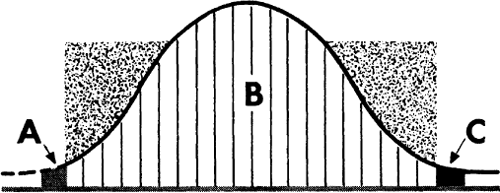
The masses, the hosts of common men [B], do not conceive any ideas, sound or unsound. They only choose between the ideologies developed by the intellectual leaders of mankind [A or C]. But their choice is final and determines the course of events. If they prefer bad doctrines [A], nothing can prevent disaster.1
But, first, who are “the hosts of common men”? Rarely does an individual think of himself as included—only others belong to the masses! There is a great deal of such inaccurate self-appraisal. As related to the problem here in question, any person—be he wealthy or poor, a Ph.D. or unschooled, a political big-wig or voter, a captain of industry or an unskilled worker—qualifies as a member of the masses if he does “not conceive ideas, sound or unsound.” Conversely, wealth or educational or occupational status is not a controlling factor in determining “the intellectual leaders of mankind.” These leaders are the ones who conceive ideas, sound or unsound, and they come from all stations in life. These facts are important to what follows.
Today, the masses (B) are listening to and following the intellectual leaders at the left (A). The reason is that the intellectuals at the right (C) have not done and are not now doing their homework; indeed, most of them have little inkling of either the need for or the nature of such homework.
The Spiritual Qualify
Many of us who think, write, and speak for freedom—myself included—have thought that our mission could best be served by teaching free market economics along with consistent governmental theory; that is, the disciplines which have to do with how man acts in response to given situations in society. But this, we are discovering, is not the whole story. For example, a man lacking in high moral and spiritual standards can have the libertarian philosophy “down pat” in the realm of political economy; he can grade 100 per cent in any test but may, nevertheless, throw his influence behind collectivism! In such an instance we have nothing whatsoever to show for our educational pains —nothing but little pushes and shoves that yield no more than a false sense of something done.
I know of a top labor official who, like some others, has learned and can explain the free enterprise philosophy as skillfully as anyone can. But this man, weak in moral disciplines, disregards his knowledge as he grasps for personal power. The rest of us would be as well off were he an economic illiterate.
The above observation is not to deprecate teachings in the social sciences; far from it! These teachings are a requisite to understanding. Yet, to pin our hopes for a good society on these teachings alone is but to delude ourselves. What is the moral and spiritual quality of the man who is learning? This, we are discovering, is the real question; indeed, it is the primary question we must answer, and answer satisfactorily.
I feel that the foregoing is a necessary preface to further probing in an area seldom explored by individuals devoted to economic education. Education in economics and government is important, but this alone will not solve our problem. There is a further need, yes, a necessity, for what Jefferson called “a natural aristocracy among men, founded on virtue and talents.” Without this—so will run my argument—economic expertness or sound organizational theories of society will avail us nothing. This is a hard confession for one who has long thought that our country’s disastrous trend could be reversed by little more than a return to economic sanity.
Hard to Focus on the Problem
The need for a natural aristocracy is not generally recognized. Why? It may be that most of us are unaware of the relatively undeveloped state in which we as humans now exist. Our unawareness, such as it is, may stem from a failure to put ourselves in proper long-range perspective. In no small measure, this would seem to account for a great deal of unwarranted self-esteem, for thinking of ourselves as the ultimate in perfection, for our egocentricity. Our natural tendency is to regard the universe as something which revolves around each little “me.”
No person in such a state of self-satisfaction is in any shape to recognize his incompleteness, let alone to improve, to emerge, to continue the hatching process, to soar into what Jefferson meant by a natural aristocracy. A person who regards himself as a complete specimen of humanity can hardly acquire more virtue and talents. If a natural aristocracy is a requirement, then it follows that most of us need a keener appreciation of our past and present status relative to what we might become.
A slight beginning toward an improved perspective might be gained by comparing the time span of what we call humanity with the time span of that infinitesimal speck in the universe we call earth.2 For instance, let a 10,000-foot jet runway represent the time span of this planet—perhaps 2,500,000,000 years. So far as the records reveal, Cro-Magnon man put in his appearance 40,000 years ago, less than the last two inches of the 10,000-foot runway! Man—from Cro-Magnon to us—is no more than a Johnny-come-lately!
In what condition did these relatively recent ancestors of ours find themselves? Of knowledge, as we use the term, it is doubtful if they had any. Science? Philosophy? Art? Religion? We wonder if they knew where they were or who they were. How could they have known the past without any history or tradition? Could they have had any capital, that is, any material or spiritual wealth? Or any inheritance, that is, from the toil of past generations? They must have been without tools, without precedents, without guiding maxims, without speech as we know it, with little if any light of human experience. Their ignorance, as we understand the term, must have been nearly absolute.3
The above would seem to be a fair picture of where we were only a few moments ago in long-range time. But where are we now in relation to our destiny? Using human destiny as a yardstick, we have barely moved. According to the scientists, most species require a million years to develop. Should this rule of nature apply to humans, then we have 95 per cent of the way to go in civilizing ourselves—an occasion for humility as well as hope.
Numerous Oversouls
Of course, it is absurd to believe that human beings will upgrade more evenly in the coming eons than in the past 40,000 years. Every species, including the human species, has its throwbacks and its great masses of mediocrity. But, encouragingly, the record is punctuated with numerous oversouls, “the spirit which inspires and motivates all living things.” While many among us show little if any advancement over the original specimens, there have been and are a few who, in some respects, serve as lodestars, as guiding ideals, as models of excellence, as exemplars of the human potential, and thus qualify for what is meant by a natural aristocracy. Further, if the human species makes the grade, instead of falling by the wayside, the unevenness we have noted—the mass of mediocrities and the few oversouls—probably will continue throughout the millennia of man’s hoped-for emergence in consciousness, awareness, perception, reason; in man’s power to choose and to accomplish what he wills.
The careful observer can hardly help noting certain “breakthroughs” which demonstrate the potential in mankind. Reflect on Jesus of Nazareth. Bear in mind such high specimens of humanness as Hammurabi, Ikhnaton, Ashoka, Guatama Buddha, Lao-tse, Confucius, Moses, Socrates, and, a moment closer to our own time, Beethoven, Milton, Leonardo da Vinci, Goethe, Rembrandt, and so on. Edison, Pasteur, Poincare, Einstein have, in their ways, soared above most of us and given us light. The performances of these uncommon and remarkable persons are but prophecies of what potentially is within the reach of our species.
Whether or not our species will move on toward its destiny or, more to the immediate point, whether or not we, the living, and our children will be able to play our role in and benefit from a human emergence, would seem to depend on what elements in the population predominate. Will those who are failures in the emerging process rise to political power, forming an inhibiting kakistocracy—a government by the worst men—and thus retard or destroy the process?4 Or will our course be determined by a natural aristocracy founded on virtue and talents? We, in our times, may well be living in one of the great moments of decision.
One thing seems crystal clear: The worst elements in each one of us will predominate in any moment of time when the aristocratic spirit in each one of us is not “in the pink of condition”; the slightest letdown in its moral, intellectual, and spiritual virility must inevitably witness disaster. This is true in nature: the weeds, pests, fungi, viruses, parasites take over whenever their natural enemies experience a letdown. Virtue and talents, the natural enemies of ignorance, knavery, foolishness, malevolence, must be perpetually flowering to hold these evils in check. This is to suggest that our species will not make the grade in the absence of those emerged spirits which inspire and motivate the human race toward its destiny. Man alone, of all creatures, has been granted the freedom to participate in his own creation.
Conceding the need for a natural aristocracy is one thing, perhaps a first step in right thinking. But more is required than the mere repetition of the virtue and talents of those who have gone before us. If nothing more than carbon copies were required, it then follows that we of our generation would exhibit no improvement over Cro-Magnon man. We would have no language, no knowledge; the ignorance that was his would be adequate. No, the human situation is not meant to be static; it has no stopping place, no “this is it!” Instead, it is a dynamic process, the essential requirement of which is perpetual hatching in virtue and talents, an eternal improvement in consciousness, awareness, perceptivity.
Developing Consciousness
No doubt the scientists are correct in claiming that most species take a million years to develop. Humanness, however, is geared not to the finite but to the Infinite and thus, I believe, what applies to other species does not necessarily apply to man. True, man cannot conceive of infinity, even in the case of time and space. But he can become aware of infinity by the simple acknowledgment that he cannot comprehend finite time or space—a point in time or space beyond which there is no more time or space. By the same token, man cannot conceive of infinite consciousness, consciousness being the singular, distinguishing characteristic of humanness, but he can become aware of it by admitting that he cannot conceive a level of consciousness beyond which there could be no further refinement of consciousness.
The human situation, it seems, by reason of this peculiar quality of consciousness, is linked to eternity; its design includes no point of retirement; it admits of no Shangri-La implications whatsoever; perpetual struggle and the overcoming of endless confrontations is of its essence. How else can man emerge in consciousness except as he succeeds in overcoming obstacles? Difficulties, problems, hardships do, indeed, have their deep purpose.
This, however, is not to deny that individuals are free to retire, to resign from the climb, to get out of life, to surrender self-responsibility, to think short-range, to “live it up” here and now; they can and do exercise their freedom in this respect, and on the grand scale! And these who acquire so little of that which is distinctly human are assuredly among the many who can and will take over in the absence of a first-rate aristocracy.
It may very well be that a purpose is served by these dropouts from the struggle, among whom are numbered many of the famous, the wealthy, the “educated,” and “leaders” in business, church, and state, along with hosts of the nondescript. It is the threat of their take-over, the danger of their dominance of the human situation, that triggers the aristocratic spirit into existence; their actions bring on reactions; their devolution is the genesis of evolution; these agents of disaster are meant to create an antiagency of survival. Without them, the emerging process would cease; for man cannot become except as he overcomes. A strong position rests on strong opposition.5 At work here is the tension of the opposites or the law of polarity. In short, the unfortunate quitters serve as springboards to those who pioneer progress.
A Responsibility to Create
If every action has its reaction, as observation affirms, some people will conclude that we then have nothing to fret about; in other words, let nature take its course while we spin our own little webs. What is overlooked in such a conclusion is that the human situation is peculiarly distinguished by consciousness, a quality not found in other life forms. And as consciousness emerges, there comes with it a responsibility to share in the creative process. An expansion of the individual’s consciousness toward a harmony with Infinite Consciousness demands of the individual that he take on, commensurately, other characteristics of his Creator. It is absurd to believe that there can be any growth in that direction without a corresponding emergence of creativity in man.
True, every action has a reaction but, unless there is a conscious effort—unnatural effort or, better yet, above the natural—to exercise the new creativity born of added consciousness, the reaction to the dominance of ignorance, knavery, and foolishness will take only the form of displeasure, hate, vengeance, cynicism, satire, political bickering, snobbery, name-calling. Clearly, there is no emergent power in this type of reaction, none whatsoever. No natural aristocracy can be born of this. Such reactions are at the same low level as the ignorant, knavish, foolish actions. And, with nothing more than this, ignorance, knavery, foolishness will continue to dominate society.
To summarize the foregoing: It is my belief that those qualities of character which have sufficed to bring progress in the past will prove inadequate from here on; indeed, the mere duplication of past virtue and talents will not stand us in good stead right now. We need, at this juncture in man’s emergence, a natural aristocracy of higher quality than has heretofore existed. Looking at the human situation with an emerging perspective permits no other conclusion! The natural aristocracy must be a more distinguished body than ever before, because today’s crisis is that much greater. Extraordinary effort must be put forth as a necessary condition to human emergence, or even for survival!
Our Prime Objective
If the above observations are valid, it follows that the establishment of a natural aristocracy should be our prime objective; the teaching of economics or other disciplines of the social sciences can be meaningful only if individuals of virtue and talents are presupposed. What, then, are the qualifications for membership?
Unless careful, we are likely to think of membership in the natural aristocracy as consisting of a set of persons, for such, indeed, has been the case in various so-called aristocracies, composed, as they have been, of privileged minorities possessed of great wealth or social position. Aristocracy, in common usage, has been correctly interpreted as consisting of persons of a certain lineage or legal standing.
But the natural aristocracy, such as we have in mind, is even more exclusive; its membership is distinguished by manifested virtue and talents. It is not based on law or a given parentage; it must be regarded as more than an order of persons because there is no individual who is absolutely virtuous and talented, nor anyone wholly lacking some virtue and talents.
Now and then there is a person who manifests extraordinary virtue and talents, relative, at any rate, to the rest of us. Observing this, we are led into the error of following a fallible individual rather than emulating the virtue and talents he possesses, these being the bench marks of a natural aristocracy. The error is serious. To become a Confucius or a Goethe is impossible, but the virtue of the one and the talents of the other are to some degree attainable and, perhaps by a few, surpassable.
How, then, is the individual to seek identification with the natural aristocracy among men? Strict instruction, I am certain, would deny to anyone the privilege of saying, “I am now a member of the natural aristocracy.” Glory and fame for the man would not be permissible, only glory and fame for the virtues and talents—the characteristics rather than the characters!
The individual himself, insofar as he might have any association with this type of aristocracy, would be now in and now out, as virtue and talents showed forth through his actions or were obscured by them. Perhaps we could say that no individual would have any identification with the aristocracy whatsoever except during those moments when he might be in an improving state. In this state—such would be the concentration—he would not himself be aware of his own status. Indeed, any feeling of what-a-good-boy-am-I would be a sure sign of exclusion from the aristocracy.
A natural aristocracy, then, does not consist of “aristocrats” as commonly interpreted but, instead, is an aristocratic spirit which might show forth or manifest itself in any serious and determined person. What persons? Hanford Henderson answered the question in this manner:
He may be a day laborer, an artisan, a shopkeeper, a professional man, a writer, a statesman. It is not a matter of birth, or occupation, or education. It is an attitude of mind carried into daily action, that is to say, a religion. It [the aristocratic spirit] is the disinterested, passionate love of excellence … everywhere and in everything; the aristocrat, to deserve the name, must love it in himself, in his own alert mind, in his own illuminated spirit, and he must love it in others; must love it in all human relations and occupations and activities; in all things in earth or sea or sky.6
Henderson’s statement pretty well stakes out the dimensions of the aristocratic spirit, in essence, the love of excellence which, of course, includes the love of righteousness. And by “disinterested” Henderson meant that this attitude of mind should be for its own sake, without thought of reward in the here or the hereafter.
The love of excellence for its own sake! This is the attitude of mind which, when acquired, witnesses man’s sharing in Creation. He becomes, in a sense, his own man.
Indeed, the man who acquires the aristocratic spirit will, quite naturally, have the same viewpoint of economics as does Henry Hazlitt:
The art of economics consists in looking not merely at the immediate but at the longer effects of any act or policy; it consists in tracing the consequences of that policy not merely for one group but for all groups [universality].
The man with the aristocratic spirit will, along with Immanuel Kant, consider a maxim as good only if this same principle of universality can rationally be applied to it;7 he will no more be guided by the fear of opprobrium on the part of his fallible fellows than he will by the desire for their approbation. He acts, thinks, and lives in long-range terms, for he has linked himself with eternity by his love of and devotion to excellence.
Imagine, if we can, the enormous difference between the thoughts and actions of laborers, artisans, shopkeepers, professional men, writers, statesmen, as we commonly observe them, and the thoughts and actions of these selfsame people were they imbued with the aristocratic spirit!
Suggested Procedures
Let us return now to the Normal Curve, displayed at the beginning of this chapter, and contemplate the task of the few at the right (C). Only through unprecedented excellence on their part can disaster be averted. In our search for an excellence that might attract the millions (B) away from authoritarian leadership (A), I would offer two simple suggestions.
The first concerns humility: Neither we nor anyone else can design or draft or organize a good society. No one person nor any committee can make even a pencil; a good society is more complex than that! A pencil or a good society or whatever is but a benefit or dividend which flows as a consequence of antecedent attention to one’s own emergence toward excellence. This thought, a realization of one’s limitations, eliminates useless endeavors; it steers one toward the aristocratic spirit; it is the way to qualify.
The second is but a detail that may help in making qualification less difficult: Regardless of the benefit we would have bestowed, always strive for a related goal over and beyond the benefit. The method or principle I have in mind is not new; it was known by the ancients: “But seek ye first the kingdom of God, and his righteousness; and all these things shall be added unto you.” This principle of seeking something higher than the benefit was meant as well for general, day-to-day, earthly application. It is a right principle and, therefore, must work at all levels of endeavor.
For instance, if one desires admiration, do not seek admiration but strive for a behavior that can be admired. If we would be rid of poverty, then offer not handouts but liberty to all. In short, if one’s ideal is no higher than the benefit, the pursuit of that ideal, paradoxically, will have no reward in store. A by-product never has its origin in itself, but always in something superior to itself. Capital is the antecedent to a dividend.
If we would have a good society then look not to it, but to excellence in all things—and above all to virtue and integrity in our every deed and thought. The dividend will be as good a society as we deserve.
The ups and downs in society are guided by the rise and fall of the aristocratic spirit, by the unremitting pursuit of excellence. It is utter folly to look for social felicity when this spirit is in the doldrums, and no maneuver less than the passionate pursuit of excellence will matter one whit. The good society, with its open opportunity for individual development—let me repeat—is a dividend we receive when virtue and talents are flowering, when the love of excellence in all things is riding high—even in economics.
I can try to qualify. So can you. This is the way every trend gets its start. Who knows? We might start a trend!
________________

