
The American Story
4. Book Four
BOOK FOUR

I
Mr. Wilson’s Crusade
WOODROW WILSON WAS A GAUNT MAN WITH A JUTTING jaw, a Scotch Presbyterian, a teacher of American history, an idealist who dwelt alone on a misty peak whence from time to time he descended with graven tablets in his hand. He made Democracy a capital word and yet by temperament he was undemocratic. His love of humanity was not a love of people. His horror of war was both mental and physical. For a short time his sayings made him the moral leader of the world. The common man in Europe burned candles before his lithographed portrait. Unrealism defeated him. He was deserted by his own people and all his monuments in Europe are now forlorn.
When the European holocaust began the belligerents were Germany and Austria in the middle, against Russia on one side and Great Britain and France on the other. Smaller nations were dragged in. But it was American intervention that made it World War I.
The Americans won the day on the fields of France and then at the peace table lost everything they thought they had been fighting for. As if that were not enough, the meaning of America was forever changed and mankind turned back on the road to military despotism.
When it began in 1914 Mr. Wilson called on the American people to be neutral in thought and deed. It was no concern of theirs. There can be no doubt that at that moment he expressed the feeling that ruled the American mind. The people were isolationist. They could not imagine being drawn into a European war. They were in fact cynical about it. What was it but just another quarrel among the powers of the Old World? Let them fight it out. Even Theodore Roosevelt, who was then in retirement, said: “It is certainly eminently desirable that we should remain entirely neutral. Nothing but urgent need would warrant breaking our neutrality in taking sides one way or the other.”
What followed was a fateful evolution of feeling, partly natural and partly wrought.
Both sides made shameless use of a wicked new war weapon which we have since learned to call propaganda. Every media of mass communication was jammed with books, pamphlets, sermons, lectures, and grossly distorted evidence, including faked photographs.
The British had the advantage. There was first the fact of a common language; secondly, the fact that the British controlled the cables, which meant that the war news as Americans read it was always a little slanted, and, thirdly, the British understood the Americans to be an emotional people, whereas the Germans mistook them to be rational.
Lord Bryce, British historian, author of “The American Commonwealth,” was a man whose word had long been par in the United States. The British government put him at the head of a commission to investigate stories of systematic German atrocities in Belgium. His report said they were true. Germany’s violation of Belgium’s neutrality and her cynical reference to her treaty with the Belgians as a scrap of paper had prepared the American mind to believe the worst. The effect of the Bryce report was what the British intended. It created in the American imagination the image of a German monster.
After the war Lord Bryce repudiated his own work. The Germans made war in a frightful manner; they did not cut off the hands of little children and the breasts of women. And later still, when it seemed to be a matter of academic interest, Gen. J. V. Charteris, who had been Chief of the Intelligence Division of the British Army during the war, speaking to the National Arts Club in New York, described the technique of manufacturing horrible evidence against your enemy—the same technique the Chinese Communists employed a generation afterward to prove that the Americans had been guilty of germ warfare in Korea.
Great Britain’s superior naval power enabled her to throw a blockade around Germany. That was to cut the Germans off from their overseas sources of food and munitions, especially the American source. More than that, all neutral ships approaching Europe were required to stop in British ports, where anything that could be called contraband was confiscated and where their mail was examined. It riled an American to see the British hoist United States mail bags out of the hold of a ship, haul them away to be searched for valuables and information, and return them many hours later with not so much as sorry or by your leave. The American government protested, but not too bitterly, and ended by leaving our bruised neutral rights in the lurch, because, for one reason, American exports to Great Britain and her allies were booming and extremely profitable.
Germany then demanded that the American government forbid its citizens to sell war goods to any belligerent in Europe; if she could not buy them neither should her enemies be able to buy them. President Wilson firmly rejected the idea, on the grounds that as a neutral nation we had a right to sell to whom we pleased; that Great Britain’s superiority at sea was Germany’s misfortune and none of our business, and that if we tried to save Germany from the consequences by putting an embargo on war goods to her enemies we should be taking sides. A perfectly sound legal position.
Germany’s naval strength lay in her submarines. Now she resolved to use them in a ruthless manner to cut off her enemies from their overseas sources of supply. First she declared all the waters surrounding the British Isles to be a war zone. Then she announced that in that zone she would sink on sight and without notice any enemy merchant ship; that owing to the nature of the submarine she could not undertake to save the lives of passengers or crew, and that neutral ships in that zone would be lucky to escape the same fate. Mr. Wilson addressed an anxious note to the German government, saying it would be held strictly to account for any loss of American life. The German government was silent.
Several weeks later the great British Cunard liner Lusitania was leaving New York for the return voyage. The German Embassy inserted in the newspapers an obscure notice, warning people not to sail on her. Nobody was alarmed. The Germans were only trying to scare the Cunard Company’s customers. How silly.
Off the coast of Ireland the Lusitania was hit by two torpedoes from a German submarine and sank in less than half an hour. More than eleven hundred lives were lost, passengers and crew, and among the lost were 124 Americans, men, women and children.
This dreadful German deed threw the country into a fighting mood from which it never recovered. If the President had been willing it might have gone to war then; but the President’s mind was far from ready.
Three days later, and before any word had been addressed to the German government, he made a speech in which occurred the two most disastrous phrases ever uttered by an American President. There was such a thing, he said, “as a man being too proud to fight;” and such a thing as a nation so right “that it does not need to convince others by force that it is right.”
The first terribly humilated the American spirit. The two together convinced Germany that she had been right in the first place—the Americans had become a nation of pacifists and might safely be treated with contempt.
Six days after the sinking of the Lusitania the President sent a note to Germany, demanding a disavowal of the deed and a promise not to do it again.
This was the first of the celebrated Wilson notes. They went on and on until the sound of the typewriter on which he composed them was hateful in the ears of the people. Ostensibly he was writing to Germany. Really he was writing to the world, to the American people and to himself—especially himself.
His trouble was this. He so hated war that he could not reconcile himself to the thought of it unless somehow it could be made to seem a crusade for mankind. Neither neutral rights at sea—the oldest and fightingest American tradition—nor the loss of American lives was enough to go to war about. But for humanity—yes. No matter how much you hated war, still you could fight for humanity; and that was the theme of his notes.
In the first Lusitania note he said we were contending for “nothing less high and sacred than the rights of humanity.” Again: “America will have forgotten her traditions whenever upon any occasion she fights merely for herself, under such conditions as will show that she has forgotten to fight for all mankind.” And again: “The only excuse that America can ever have for the assertion of her physical force is that she asserts it in behalf of humanity.”
The notes that may be called the Lusitania series began in May and ended in September, when the German government promised not again to sink a liner without notice, provided the liner did not resist or try to get away. Mr. Wilson regarded this as a diplomatic triumph. He had, temporarily at least, written his country out of war.
Three days later German submarines sank a merchant ship without warning and one American life was lost; soon another one, and several American lives were lost. It was evident that the Germans meant to be very dim about what a liner was. In any case they went on with their submarine work until within a year Mr. Wilson stood before Congress with a bill of bad faith and suggested that diplomatic relations with Germany be broken off unless she agreed to abandon her “present methods of warfare against passenger and freight carrying vessels.” And again he was speaking “not so much for the legal rights of the United States as in behalf of the moral rights of all humanity.”
At this the Germans made another promise. No more sinkings without warning and without trying to save human lives, and yet reserving complete liberty of action if Great Britain continued her “illegal” blockade. Another diplomatic victory.
The Germans had a positive genius for stupidity. They were sure the Americans were a supine people, and they got the idea of destroying at the source the American war goods they could not sink at sea. In a letter that was intercepted, the Austrian Ambassador wrote to the Germans: “It is my opinion that we can disorganize and hold up for months, if not entirely prevent, the manufacture of munitions in Bethlehem and the middle west.” So they resorted to direct action against American industry. They bought their tools with German gold, and the tools were such as bribery, plottings, sabotage, subterfuge, bombs, arson and high explosives.
As the incredible facts came to light, some by accident but most of them through the brilliant work of the Secret Service and the Army and Navy intelligence bureaus, the anti-war party was overwhelmed.
The elements of the anti-war party were the German-Americans, the Irish, William Jennings Bryan who resigned as Secretary of State in protest against a rising war spirit, and a little group of western Senators, called the willful men, who could not entertain the thought of war on any account. They were always in the minority and their strength steadily declined. One of the late discoveries to complete their dismay was that the German government had opened negotiations with Mexico for an alliance in the event of war with the United States and had promised her Texas, New Mexico and Arizona as her share of the spoils.
When at last the Germans, saying “If the Americans will fight let’s see,” suddenly cancelled all their promises to limit submarine warfare, when they announced that they would sink on sight any merchant ship in the waters surrounding the British Isles, and when they had insultingly offered to pass two American ships a week on certain days and under very strict conditions,—after that the least the President could do was to lay his defeat before Congress and ask that diplomatic relations with Germany be broken off. The German Ambassador was handed his passport; the American Ambassador was recalled from Berlin.
That still was not war.
The President said to Congress: “I refuse to believe it. Only actual overt acts on their part can make me believe it even now.”
His mind had been changing, slowly, painfully. He had reconciled himself to a war for humanity. He was not sure the world understood him, nor could he decide where humanity’s loyal battalions were hiding, waiting only for his call to rise. On both sides, perhaps.
Only a few weeks before the break in diplomatic relations with Germany he had addressed an identical note to both Germany and Great Britain asking them to state their war aims more clearly, for to many people it seemed that they were “virtually the same, as stated in general terms to their own people and to the world.” Which of them would say they were fighting not for themselves but to bring to mankind a new order of just and permanent peace?
Germany’s answer gave him no comfort. Great Britain’s was sympathetic to his ideas in principle, and tactful, concealing the resentment she felt at having been put on a moral level with Germany. Neither one was what he wanted.
His next step was to announce, in a speech to the world from the Senate chamber, what the American people would fight for, if they did fight. They would fight a war to end war, wanting nothing for themselves, wanting only to see peace organized as the major force of mankind—and that meant not a peace to be dictated by the victors, but “a peace without victory.”
And now after all, since the rupture of diplomatic relations, it was in the hands of Germany. If she committed those overt acts which the President said would be unpardonable, we should be obliged to go in at once, on the side of Great Britain and her allies, and let humanity wait.
Having just disposed of the Russians, the Germans were reckless. With two more terrific exertions, one by land and one by sea, they were sure they could win. So they provided the overt acts. Their underseas cobras began to strike without mercy. American ships were sunk at the rate of one a week, with no regard whatever for human life.
On April 2, 1917, President Wilson appeared before Congress and asked for a declaration of war. Yet peace was the theme of his war message. “We must put excited feeling away,” he said. “Our motive will not be revenge or the victorious assertion of the physical might of the nation. Our object is to vindicate the principles of peace and justice in the life of the world . . . to set up among the really free and self-governed peoples of the world such a concert of purpose and action as will henceforth ensure the observance of those principles.” Only democratic nations could do it; autocratic nations could not be trusted. Therefore: “The world must be made safe for democracy.”
So World War I began, with American intervention. Otherwise it would have been only another European war, with the conventional sequel—a temporary realignment of powers and a peace treaty fraught with forethought of the next time.
Only those who understand the miraculous nature of American confusion can comprehend what happened next.
The problem to begin with was one that was big enough to extend the country’s power—and there had not been a problem like that since gianthood. It had three aspects, namely, the Wilsonian, the physical and the military.
You have to remember that the President had just been reelected by a very narrow margin over Charles Evans Hughes, on the slogan, “He kept us out of war.” He was not war-minded. As Commander-in-Chief of the Armed Forces he was not thinking of victory; he was thinking of peace without victory. His secret ambition was to be peace bringer to mankind.
That made him the despair of the Army, the Navy, some members of his own Cabinet and all who were for getting into the war by hot impulse. He became the more or less passive center of a whirling turmoil. The people were furious with impatience. War commissions were created and recreated, the same men shuffled around with no authority; and it was as if the principles of action were paralyzed.
There was no program. The Secretary of War was Newton D. Baker, a pacifist, who said: “The reason why there is no program is that the view is continually changing. We think one day, this is the line, and the next day, no, here it is.”
The most exasperating fact of all was that the President was inaccessible. He was loath to delegate power, especially to men he did not already know; resented criticism as a kind of lese-majesty, and repelled suggestions. The saying was current in Washington: “You must not importune the President.” Louis D. Brandeis, a war-minded member of the Supreme court, collaborated with the editor of The New York Tribune in a series of articles on a design for war, which were printed on the editorial page, with the idea that Mr. Brandeis could somehow bring them to the notice of the President. Nothing came of that.
What was the President doing? He was composing the Fourteen Points—his design for peace.
Week after week a little group of New York editors went to Washington to make the rounds, asking: “Is there any change?” Week after week the heavy answer was: “None.” Then one week Franklin K. Lane, Secretary of the Interior, the most impatient member of the Cabinet, said to them: “Go home and get some sleep.” They asked him what had happened. He said: “You will know tomorrow. All I can tell you now is that the Old Man at last has made up his mind to put his fist in the war.”
That night came the Baltimore speech, in which the President said: “There is therefore but one response possible from us. Force. Force to the utmost. Force without stint or limit, the righteous, triumphant force which shall make right the law of the world.”
At last he was in the war; at last that time had come which he imagined when he said: “Valor withholds itself from all small implications and entanglements and waits for the great opportunity when the sword will flash as if it carried the light of Heaven upon its blade.”
The effect was as if a dam had broken; as if America’s physical power had been piling up and up behind a monolithic obstruction, unable to spend itself, and then suddenly the obstruction gave way and the flood came.
Although this country had been the great supplier of war materials, for a war of its own it was in a state of appalling unpreparedness.
It had only symptoms of an army. Somewhat to everyone’s amazement the President had immediately and very firmly insisted on a draft law, euphemistically called the Selective Service Act, and got it from a reluctant Congress, which preferred the volunteer method. It was easy enough then to call up two or three million men, especially as the draft was actually popular; but where were the barracks for them, and the training camps and the uniforms and equipment, and how long would it take? Evidently the President thought they were going to stay in this country as a kind of reserve. If you thought of an expeditionary force, where were the ships? Owing to the destruction of ships by the German submarines and to the fact also that Great Britain and her allies had laid hands on every ship they could find, ships were very scarce.
As for American industry the case was this. It had been running in high gear to produce war goods for Great Britain and her allies, but only such things as they could not produce enough of for themselves, specific things. Thus industry was not prepared to produce the whole range of things the country would need completely to equip a large army of its own.
There was, moreover, a miscalculation for which industry was not to blame. The government’s first idea was that America’s contribution to the war, at least for a while, would be money, food and war goods of the kind Great Britain and her allies had been buying here, only more, much more, with no longer any worry about money, for now they would borrow it direct from the United States Treasury, any amount of it, instead of having to borrow it from bankers in Wall Street. In the meantime the military establishment in collaboration with industry could be building a war machine. The military people were expecting the war to last at least two more years, maybe three. In that time the unique American art of mass production could be brought to bear upon ships, guns, planes and all the tools of mechanized warfare.
Before the end of the first year this calculation went all to pieces. Great Britain and France were going to lose the war not for want of money, food or guns; they were going to lose it for want of manpower. Their lines were breaking. What they desperately needed was soldiers to mend them with. But our soldiers were not equipped. No matter. France had a surplus of guns.
From then on until the end getting soldiers to France, with or without guns, was the business of top priority.
Fortunately by that time there was an effective war administration at Washington able to command and canalize the country’s power. Through the confusion the right men had been coming through.
There was Bernard M. Baruch at the head of the War Industries Board, who, with the power of an economic dictator, the wisdom of a serpent and the manners of an innocent, geared all industry to the war and made it sound like one sweet engine.
There was Herbert Hoover at the head of the Food Administration, who drew food from a bottomless cruse until it was plenty and gave it around impartially with the air of a scowling cherub.
At the head of shipbuilding was Charles M. Schwab, who could turn a swamp into a mighty shipyard while your back was turned. There yesterday was a piece of waste land on the water. There, as if today, is Hog Island Shipyard already making three ships a week. Shipbuilding was an art we had almost lost. Now shipyards appeared everywhere. In all of them on one day ninety-five ships were launched. At that rate the seas would have been littered with Liberty Ships in another year.
Where to put the soldiers if you called them up too fast? Barrack cities appeared as if they had fallen from the sky, complete with water supply, sleeping quarters, mess halls, sewage systems, hospitals, electric lighting, even libraries. Three months after the first draft call there were sixteen of them; in the next three months this capacity was increased ten-fold.
At the same time American engineers with American labor were making over three ports in France, with docks a mile long, besides building enormous supply bases, intermediate depots, hundreds of houses, and railroads with American locomotives, American equipment and American crews—all for the American soldiers that were coming in numbers far beyond the facilities of France to receive them. It was the Yankee invasion and it was terrifying.
The military achievement was astounding. Within eighteen months, beginning with nothing, the Army put two million men into France. Never before in military history had there been a troop movement like that. British ships carried more than half of them, and charged us for it of course; American ships did a little less than half. The United States Navy provided eight-tenths of the escort, through waters infested with submarines, and there was not one mishap.
The men were inadequately trained, sometimes learning the manual of arms without the arms, and sometimes so raw when they were shipped that they had to be finished in France; but they had youth and guts, qualities of self-reliance and initiative, and above all intelligence.
The perfect commander-in-chief was the one first tried. He was John J. Pershing, not a hero, but a profane and magnificent soldier, who shocked the high military brass of Europe by saying trench warfare was wrong. It would ruin the morale of the American doughboy, whose virtues were individual valor and skill with the rifle. Open warfare for him.
The disbelieving British and French generals insisted that the American soldiers be incorporated in their weary divisions, and for a while Pershing consented, to meet critical situations of great immediacy; but when at last he was able to create an independent American army, which he did against the frantic protest of the French and British generals, who tried to thwart him by going over his head to Washington—then scepticism gave way to astonishment.
For the American army he chose the hottest and most difficult segment of the front, and there, despite some awkward staff work and a few too costly lessons, the unseasoned doughboy proved the faith of his commander. Living Europeans had never seen fighting like that. The apologetic allies, wept for joy; and the Germans, seeing what they could hardly believe and knowing that behind these fighters were millions more, began to break in their hearts.
The end came suddenly.
Before this, on January 8, 1918, President Wilson had published to the world his design for peace without victory, named the Fourteen Points. The first point called for open covenants of peace openly arrived at and no more secret treaties; the second for freedom of the seas in peace and war, the third for equality of trade conditions among peace-loving nations, the fourth for a reduction of armaments, and then, after some vague generalization about territorial and political adjustments, came the fourteenth point, which called for a general association of nations to guarantee the independence, security and territorial integrity of great and small nations alike. This was to be his League of Nations.
The Germans were unresponsive. They were about to hurl against the Western Front the manpower that had been released from the Russian side. The British and French were cool. It was not the kind of peace they wanted.
It was after the Fourteen Points had fallen flat that the President made the Baltimore speech that broke the dam: “Force. Force to the utmost.” And it was after that that the number of American soldiers arriving in France began to rise and rose until it was 10,000 a day, or at the rate of more than 3,000,000 a year.
What Mr. Wilson could not do the doughboys did.
Eight months after having treated them with contempt, the Germans suddenly asked for an armistice on the basis of the Fourteen Points.
The British and the French were embarrassed. They had never accepted the Fourteen Points; but they were hearing the voice of humanity which now began to be lifted up in all nations demanding a Wilsonian peace. So, taking thought and with some stated reservations, they agreed to discuss an armistice on the terms of the Fourteen Points. On November 11, 1918, an armistice was signed.
World War I was over.
The war of diplomacy began.
The obstacle to the kind of settlement the statesmen of Great Britain, France and Italy wanted was not the Fourteen Points. Words could be juggled. The obstacle was psychic.
For disillusioned people everywhere Woodrow Wilson had become the symbol of a new world. He had imparted his vision. The emotions it invoked, all running to him, had a kind of wild religious intensity. Many millions would have said: “Let him write the peace in the name of mankind.” Moreover, did he not have behind him an incredible nation—a nation that had foresworn beforehand any spoils of war? It wanted nothing for itself—absolutely nothing. What was it now that could not happen? Such a man, such a country, the time—who would say these dead had died in vain.
Well, all of that was going to make it very hard for the cynical Old World statesmen to deal with Mr. Wilson in the peace conference.
II
The Wily Old World
BUT THEY WERE WISE AND THEY MADE A PLOT. IF THEY COULD get Mr. Wilson to come in person to Europe for the Peace Conference (an unheard of thing for a President to do), exhibit him there to his adoring multitudes and then maneuver him into making a few speeches touching some of the treacherous sore spots—if they could do that they might be able to dim out his halo. Lord Northcliffe, owner of The London Times, came over to sell the idea, first to newspaper editors and then to the President, with the subtle argument that European statesmen had always botched the peace and would probably do it again if the moral leader of the world were not there to keep their eyes to the light.
That argument won. The President decided to go.
He put himself at the head of a Peace Commission that could have but one will, and that was his own. In naming the members of it he ignored both the Senate and the Republican Party, which was a fatal error, because many Republicans, including ex-President Taft, were for something like a league of nations and might have turned the Senate for the treaty when the time came. Along with the Peace Commission went a fine body of economic and political advisers, including Bernard M. Baruch and Herbert Hoover.
What the wily Old World statesmen expected did happen, as they intended, and it was tragic.
In Paris the President was received with tremendous enthusiasm—more perhaps than could in any case have been sustained. It followed him to London and Rome and back to Paris. Then his speeches on the realities of peace began to be destructively examined. For one thing, it was soon evident that his formula of self-determination for little nations led to enormous difficulties and that national aspirations were too conflicting to be all satisfied. And why had he refused to visit Belgium and to look at the devastated regions of France? Did justice require him to close his eyes to what the Germans had done?
The cruel treatment was yet to come. On the day the Peace Conference was to have opened the British, the French, and the Italians were not there. For a month they did not come, and sent notes of cool apology; and all that time the President was left to sit alone with his retinue and nothing to do, looking rather ridiculous. Meanwhile the idea was rising that Germany should be made to pay for the war, whereas Mr. Wilson had said no indemnities.
When at last the Peace Conference got to work it was clear that the President’s mind was unalterably fixed on one thing, namely, the Covenant of the League of Nations. If he got that he would yield at many points on the peace treaty itself and justify himself with the thought that his League of Nations could in time correct even an iniquitous peace treaty. The British and the French, on the other side, realized that if they gave him what he most wanted they would be freer to make the kind of peace they wanted.
So at the outset they accepted the Covenant of the League of Nations, and he came home with it in his hands, leaving his associates to see the treaty through.
Here he had to face his own people. He felt sure of them. But he had to face also the Senate. There the Republicans now had control.
A few Republican Senators who were for the League of Nations persuaded him that unless the Covenant were amended in certain particulars the Senate would reject it. He accepted the amendments, went back to Paris with them, and, with certain alterations, got them into a revised Covenant. Thereafter he devoted himself to the one task of so insinuating the Covenant into the body of the peace treaty that it could never be dissected out. Who signed the peace treaty signed also the Covenant and the League of Nations would be saved.
When the Peace Conference surveyed its finished work it had moments of panic. Would the Germans sign? What if they refused? The clock was striking the dead-line hour when they appeared and unwillingly signed, calling upon Heaven to witness that they had been deceived. They had agreed to an armistice on the basis of the Fourteen Points. The Fourteen Points had been forgotten.
So that was the Treaty of Versailles—a tryst in writing with World War II.
Mr. Wilson’s triumph turned to ashes. He was a fallen hero when he arrived home with the treaty. His struggle with the Senate was foretold. He became obstinate. He would accept neither amendments nor reservations. It had to be what it was or nothing. He appealed to the people and went west on a speaking tour, believing still in the power of words; but the magic was gone out of them. Midway of his tour he was stricken dumb and returned to Washington a shattered man, with only a little while to live, knowing he was beaten.
In the end, after a long controversy that divided the country, the Senate killed the treaty.
The outcome was that the United States never joined the League of Nations. It made a separate peace with Germany. The League of Nations nevertheless was set up at Geneva to keep the peace of the world and its revered and acknowledged father was Woodrow Wilson. It lasted until World War II.
For the United States World War I was a total loss.
It was after all a punitive peace, imposed by the victors; the romantic ideal of peace without victory was sunk without trace.
It did not make the world safe for democracy.
The self-determination of little nations created many new problems and solved none.
Freedom of the seas was not established.
Germany was obliged to give a blank check for reparations and then cheated her creditors by going bankrupt and dragging Europe down with her.
The ten billion dollars loaned to Great Britain and her allies out of the United States Treasury were never paid back. On the contrary, this war debt gave rise to extreme bitterness of feeling, through which the United States emerged in the image of Shylock, our debtors taking the position that it had been our war too from the beginning, and that we should sooner think of paying them for what our tardiness had cost them than to expect our dollars back.
More than all of that, our intervention had broken forever the American tradition of non-entanglement in the quarrels of other nations. Never again would it be possible for Europe to settle her own quarrels. Whether we had signed the treaty or not, we had intervened to defeat Germany. We were morally responsible, therefore, for having restored the old balance of power in Europe. If a time came when Germany might think herself strong enough to take revenge, would we be obliged to intervene again? In any case we did.
Marginalia
The author finds among his unpublished papers a piece entitled, “Marginal History,” done in the first person, on what befell the Covenant of the League of Nations. It was written in the fourth year of World War II, when the project of a United Nations Organization was being pressed by Franklin Delano Roosevelt, the next Democratic Party President after Woodrow Wilson. It is inserted here because it puts an oblique light upon a fateful moment in American history; and for the moral too, which is that when people are living with the emotions of war they may be moved to do things which they could afterward regret.
We were to consider ourselves locked up for the night, or until we could make our minds run together,—the editor, the assistant editor, the first and second string editorial writers, and Elihu Root, the magnificent roundhead of his generation. The gaoler was Mrs. Whitelaw Reid, who had that right because she carried the old New York Tribune in her pocket for the benefit of her son Ogden. Her worldly wisdom had a kind of Victorian quality, and along with it she possessed a fine journalistic sense,—more of this, I sometimes thought, than all the rest of us as one. She did not always like the kind of paper we made, and yet seldom did she touch the editorial policy; when she did it was more as a faithful reader in pain than as one who could snap the purse.
But here was crisis. The leading Republican newspaper, descended from the hands of Horace Greeley and Whitelaw Reid, was unable to formulate a policy on the Covenant of the League of Nations. In February, President Wilson had returned from Paris with the first draft of it in his hand. The Peace Conference had accepted it. Nevertheless, he was going back to make sure that nothing happened to it; meanwhile the Peace Conference would be going on with the treaty itself and that might be a work of three or four months more.
Until then, as we knew, the idea of a league to keep the peace of the world, of putting in the hand of right a sword so terrible that no aggressor would dare challenge it, had enthralled the American mind. Under the slogan,—“a war to end war,”—what the people were feeling had the mysterious authority of a religious experience. To Mr. Wilson’s pledge that we wanted nothing else out of the war, and would take nothing else, there was almost nowhere a dissenting voice. Indeed, if it had been put to us, the editors of The Tribune, as an abstract question,—“Shall there be a league of peace keeping nations to forbid wars of aggression forever?”—the answer would have been a unanimous yes.
Yet instantly on reading the draft of the Covenant we began to divide. Why? What had happened? Only this, that now it was in writing; and so far as it had been possible for him to do so, the President had committed his country to that writing. In an ideal world it would have been a perfect moral contract; only, in that kind of world it would have been perhaps unnecessary. In a world with right always on one side and wrong always on the other, a clear line between, it still would have been a grand commitment. But what did we know to be true of the real world?
It was bad enough for the leading Republican paper to be so divided in its mind and without a policy. Even worse was the fact that the Republican party was in a state of like confusion.
After the death of Theodore Roosevelt the three surviving great elders of the Republican party were ex-President Taft, Charles Evans Hughes and Elihu Root. All three were for something that might be called a league of sympathetic nations to keep the peace of the world. Foremost of the three was Taft, who for several years had been leading a movement calling itself The League to Enforce Peace. This was but one of several kindred organizations and first among them in prestige, from the fact that, besides its great zeal for propaganda, it had a definite plan for a world mechanism to impose peace. Mr. Wilson borrowed its principles and simplified them.
Nevertheless, even Taft was uneasy over some parts of the Covenant. Together with Hughes and Root he persuaded the President to accept certain amendments,—one to hold the Monroe Doctrine out of it entirely and another to establish the right of a league member to withdraw.
With these and some minor other amendments in his pocket the President returned to Paris in March. The night before he sailed he made public boast of his confidence, saying to an audience that filled the Metropolitan Opera House in New York City: “When the treaty comes back, gentlemen on this side will find the Covenant not only in it but so many threads of the treaty tied to the Covenant that you cannot dissect the Covenant from the treaty without destroying the whole structure.”
When he arrived in Paris he found his Covenant in the ditch. The Peace Conference, in his absence, had expelled it from the treaty. But in a little while the news was that by a terrific exertion of will he had restored it to its eminent place and that the Peace Conference, moreover, had accepted the amendments. Three months later he returned with the sealed document, treaty and Covenant entwined.
His companions on the homeward voyage remembered a tall and solitary figure standing for hours each day on the deck of the George Washington, gazing at the western horizon. He was sailing from triumph to defeat. Some premonition of this may have occurred to him when he turned to one who had been keeping the silence with him, and said: “I should have to be almost Christ not to fail my people now.”
On July 10 he went himself to the Senate, presented the treaty, and made an earnest plea for its prompt ratification.
By this time the Republican party was split to its roots. Taft was making speeches for the Covenant. He was saying that the Taft-Hughes-Root amendments had been made effective in it and that every objection a reasonable Republican could ever have had against it was thereby removed. The League to Enforce Peace was filling the country with propaganda to the same effect.
On the other side was Henry Cabot Lodge, Chairman of the Senate Committee on Foreign Relations, the President’s most adroit and dangerous antagonist, who was secretly and with cold passion resolved to kill the Covenant if he could, although he would never say so, lest he estrange those who only wanted to change it; and behind him were the irreconcilables led by Johnson of California and Borah of Idaho. Among the irreconcilables were Democrats, too, notably Senator Jim Reed of Missouri, but that had nothing to do with the problem of a Republican paper that was absent from the conflict not because it was afraid, only because it could not make up its mind.
And that was where Mrs. Whitelaw Reid came in. She asked us to dinner at her country house. We were four,—Ogden Reid, Allan Dawson, Geoffrey Parsons and I; and Elihu Root would be there.
All that happened during dinner was that Mrs. Reid gave a very simple account of her private feelings. She hoped the angels had been looking away when the President of the United States and his brave young experts in Paris were on their hands and knees, with maps spread over the floor, fitting new nations into the spaces made by redrawing the boundaries of old ones. Her misgivings about the Covenant were many. Nevertheless, it was the one frail promise of a better world that people could hope to get out of the war. They had put too much suffering and prayer and longing into it now to be satisfied with victory regarded as the customary end in itself. If they could not believe they had done something to overcome the evil of war, then victory alone would seem sterile to them and their disappointment would be terrible.
Instead of leaving us at the table she went with us to the door of the library and paused there only long enough to say, “Now I hope you gentlemen will be able to make up your minds. Good night.”
I see Elihu Root, putting his long body in repose for a night of hard work. His hair was still thick and black; under it was one of the fine brain engines of his time. His mind was adventurous. It would go with you anywhere, if you were serious, but never for an instant was it mistaken about where it was or what it was doing, so that if you were in the clouds and spoke of the earth, he would say, “If it’s the earth you want to talk about, all right, but let’s get back there.”
He opened the session by saying: “I understand that we have several opinions here on the Covenant. Let’s get them all stated so we may look at them.”
Ogden Reid left the statement of his views to Dawson, so that Dawson was double barreled, and it took time. Parsons talked more as if he were writing an editorial. Root sat all the time staring at the ceiling. It was past midnight when they looked at me. I said I had decided to say nothing. The point of all this was to find a policy through compromise, whereas my first objection to the Covenant was beyond compromise and therefore not germane. “All the same,” said Root, “let’s look at it.”
“For all the idealism it represents,” I said, “there is a bad light in which the Covenant appears to be a conspiracy on the part of the superior nations to maintain forever, if they can, that state of the world in which they have the present advantage, and to do this by force. Inferior nations, as we speak of them, are thereby fixed in that status, doomed to it in fact; and these may be nations not inferior really. Who knows what an inferior nation is? It may be only that it must live through its appointed hour on the under side of the time wheel. You can imagine, for example, that the people of India might sometime think of fighting it out with England alone. Now you are going to confront them with a League of Nations.”
Root looked down from the ceiling at his fingers drumming on the arm of his chair, then back at the ceiling, and said: “I agree with that. It is true. There is that light. Yet, happily, as you say, it is not germane. Our business is with here and now.”
With that he got up, stood with his back to the fire, and began to talk. As he talked he was making up his own mind, I thought. Almost you could hear it click.
First, the imperative. That was peace. The world could not go on living under an armistice. Unless it got peace, and got it soon, the consequences might be dreadful, uncontrollable. The suspense was already so intolerable, and beginning to be so dangerous, that almost one would say a bad peace would be better than no peace. He detested the Covenant and the treaty both. He wished the President had said at Paris: “Gentlemen, all we want out of the war is a league to keep the peace. Give us that. Then as for the treaty, concerning Europe, you make it. You have to live with it. Only let it be one that I shall be able to defend when I get home.” But, no. He had done what he threatened to do. He had so wound the Covenant into the treaty that there was no tearing them apart. You had to take the Covenant to get the peace. The problem, then—remembering the imperative,—the problem was how to save the Covenant not for itself but for the sake of the treaty, and, again, the treaty not for itself but for the sake of peace immediately. He thought the Covenant could be saved by certain reservations. These he spelled out then and there. Reservations, unlike amendments, would waste no time. The difference was legal. An amendment to the treaty would have to be ratified by all the signatories separately and that would delay the peace, whereas a reservation had only to be filed with the papers of ratification and required no further action.
He came to the end suddenly and sat down. So far as we knew he had not said any of this before, certainly not in public. We wondered why he hadn’t, in view of the effect it might have in his party’s councils, and his answer was that he had not been sure of it for long; he had arrived at it slowly and not without many misgivings on the way. I said that as one who spent a good deal of time in Washington and had just returned from there I was sure his position was not understood. By his leave, therefore, I should like to make notes of what he just said and take them to Washington. He said, simply: “I wish you would.”
The next afternoon I sat in Senator Lodge’s library, telling him the story more or less as I tell it here, only with much more of Root,—his imperative first premise, his reasoning step by step from there, his reservations in place of amendments. Lodge listened with rigid attention.
When I had come to the end and stopped he said, very coldly: “If Mr. Root wants to read himself out of the Republican party, that is his own business. Tell him we are not interested.”
As I came up for air I heard myself saying: “But I must have done it badly. Let me try again.” I got out my notes and did it all over, this time with pains, and he regarded me steadily with the same icy attention as before. When I was through he said again: “If Mr. Root wants to read himself out of the party there is nothing we can do about it.”
“It’s no use,” I said. “I’ve bungled it.”
“You haven’t,” he said. “You have done it very well, almost too well.”
From there I staggered over to Senator Brandegee’s house, told him everything that had happened, and so concluded: “There is evidently something here that I don’t know.”
“There certainly is,” he said; and then went on to tell me: “When Taft and his minute men began to go up and down the country saying that the amendments Wilson put into the Covenant when he got back to Paris were really the Taft-Hughes-Root amendments we waited for Root to say it wasn’t so. We waited a week, a month, and then we asked him why he was silent. He said he needed time to clarify his mind. We gave him time. After a while we said to him, ‘If you are still in doubt we will prove it to you.’ He said, ‘All right. Prove it to me.’ So we briefed the case. George Wharton Pepper wrote the brief. Then we went to Root’s office. He sat as judge, jury and defendant, and we read to him Pepper’s brief. He was convinced, if that was what he wanted.
“He said, ‘Gentlemen, you have proved it. Taft is wrong.’
“We said, ‘Well, then, when will you make a public statement to that effect?’
“He said, ‘Give me just a little more time.’ That was the last we heard from him. We have been waiting ever since. Now on a sunny afternoon you come toddling in here with the news that for the sake of the treaty he wants to save the Covenant with reservations. How would you expect to be received?”
Will Hays was then Chairman of the Republican National Committee. Before leaving Washington I led the sore elephant around to him. “Anything you can do for it,” I said, “will make it easier to conduct the editorial policy of a great Republican newspaper.” He desired suggestions. One I offered. “Get Root down here,” I said, “and let him just sit there in the Senate chamber for an old-home week. His presence will produce an effect. It will do something to Lodge. Where Lodge now stands Root stood when Lodge regarded him as his mentor.”
All that came of that was that Lodge embraced the idea of reservations in place of amendments. Reservations could be fatal, too.
Senator Jim Reed, a Democrat, was one of the last ditchers. He was not a demagogue, but he possessed the temperament, the high-decibel voice and the quick crowd sense of a rouser. It was he who discovered where to hit the Covenant in a way to do it the most harm, and that was not below the belt but over the heart. Article X was the heart of the Covenant. That was the paragraph binding the members of the League of Nations to guarantee and defend with force one another’s territorial integrity.
One day Reed returned to Washington with a gleeful account of his discovery and how it worked. He had been out in the country tailing Taft. Where Taft had spoken one night and had carried his audience for the Covenant, there Reed would speak the next night, and so far as possible to the same people, inviting them that way as a challenge. Then, paraphrasing Taft, he would ask: “How many of you believe that the peace-loving, Godfearing nations of this earth should form themselves into a league to chain the aggressor down, whoever he may be, and put an end to war? Hold up your hands!”
Nearly all the hands would go up.
Then he would ask: “How many of you are willing to send your sons to the Balkans to defend the boundaries of Czecho-Slovakia in battle? Up with your hands!”
And not another hand would go up.
That was putting it in writing they could read.
After that, Article X was the point upon which all lines of attack converged. The President called this the knife thrust.
Sometime in August he seemed to realize that the fight was going against him, even that the treaty might be defeated. Believing still that the people were with him he resolved to take it to them. In September he set forth on his last speaking tour. He was followed by Johnson and Borah, both members of the Senate Committee on Foreign Relations, who trailed him as Reed had trailed Taft, using more or less the Reed technique,—hitting the Covenant over the heart.
After thirty speeches the President collapsed, from a stroke of partial paralysis, affecting first his power of speech, and returned to Washington a broken hero. For the remainder of the struggle he had only strength enough to resist any compromise.
The vote in the Senate was on a resolution to ratify the treaty, subject to the reservations; and a very curious vote it was, some of the President’s supporters and the last-ditchers voting no together, the former because the President would not have the reservations and the latter because they wanted to kill the Covenant, with or without reservations. The treaty was then returned to the President with formal notice that the Senate had failed to ratify it. The sequel was our separate peace with Germany.
Writers of this history, trying to account for what happened, have generally distributed the cause, the blame and the responsibility all around. Mr. Wilson himself, they say, was partly responsible for the defeat of the treaty because he was obstinate, politically very tactless, and estranged the Senate to begin with by excluding it from the peace table, asking it in the end only to cross the t’s and dot the i’s of his Covenant, and refusing most doggedly to accept anything less. For the rest, it was Lodge, with his deadly parliamentary skill and his devouring hatred of the President; it was that impulse which does sometimes seize a democracy to smash its idol, and, lastly, it was the innocence of the people concerning the profound problems of a world that still seemed to them far away even though they had been fighting in it.
It is a fact, however, that neither in the next election nor in the after course of political events was there ever the slightest sign that in rejecting the treaty the Senate of the United States had mistaken the will of the people.
It is probable that in his Metropolitan Opera House speech, on the night before his second departure for Paris, the President was right. The people then were behind him. It is even more probable that six months later he was wrong. Simply, the American public, taking time to think, had changed its mind. Whether it was right or wrong is another matter.
III
Strange Normalcy
AFTER WOODROW WILSON CAME PRESIDENT WARREN GAMALIEL Harding, a very grand man to look at, much beloved for his amiable frailties. Wicked politicians surrounded him, took advantage of his easy nature, made too free of the public purse, and brought his administration into disrepute.
He had been editor of a small town newspaper in Ohio and his contribution to the ideology of government was to invent the word normalcy. Nobody could say what normalcy meant. It seemed to mean a return to something—to individualism, to limited government, to the native grass of laissez faire, if there was any left, or, as the Wilsonian Democrats said, a return to the flesh pots.
But the nineteen-twenties were far from normal.
As an individual looking back on his life may wish that a certain segment of it, which seems after all not to belong to him, could be blotted out, so the nation, remembering these years, might wish they could be expunged from its history as if they had never been.
The nation was mentally ill. In good psychic health it might not have developed the symptoms of a cleft personality, stretched between emotional extremes of pessimism and optimism.
The pessimism was moral.
National prohibition, that noble experiment that had been written into the Constitution like an alcoholic’s pledge, was defeated by mockery, derision and social disobedience. Efforts to enforce the law against a nation of conscienceless law breakers were absurd. Consumers of alcoholic beverages were not punished; only the purveyors of them. The result was that bootlegging, with public connivance, came to be organized on the lines of big business, attended by the evils of gangsterism, violence and political corruption, all the way up to the enforcement authorities at Washington.
The effect of this universal example on the minds of the young was disastrous. Petted youth, with no place to go, nor wanting to go anywhere, named itself the lost generation and tried to sink its sense of frustration in bootleg liquor and bath tub gin.
Intellectualism turned cynical and destructive. The foundations of belief began to erode; all the admirable myths with which the people had lived happily from the beginning of their national life were submitted to objective treatment, the question being not whether they were good or bad, but whether they were factually true. Heroes back to Washington, the motives of the Founding Fathers, the story of the Constitution, the legends of patriotism, were all alike, as the word was, debunked.
Finally was the devasting fact of disillusionment concerning the meaning of World War I. Historians of the revisionist school were at work. Their revelations were painful and humiliating. Almost nothing was what the people had been persuaded to believe, save only the wonder of America’s physical achievement and the valor of her soldiers.
There could be no doubt that to beat Germany and save themselves, Great Britain and her allies had exploited not only the American crusading spirit, which they dimly understood, but also American prodigality, which they did not understand at all; nor that when Germany was defeated they sabotaged Mr. Wilson’s Fourteen Points, divided the spoils in their own way and wished the Americans to go home and mind their own business again. Even Mr. Wilson before he died became very bitter about it.
Oppositely at the same time the extravagant optimism, besides being as irrational as the pessimism, exhibited American character at its worst. It was inspired entirely by the acquisitive motive, which swelled and swelled until it seemed to have the dimensions of national paranoia. Its vehicle was speculation. Wall Street became the center of a mad world.
President Harding died before his first term was up and was succeeded by Calvin Coolidge, who had been Vice-President. He was a little New Englander, full of old-fashioned sayings, who believed in all the copy book maxims of thrift, and had the rare wisdom to know that a lot of things will solve themselves if you let them alone, and that if you are not sure what to do it is generally better to do nothing.
The areas of speculation widened.
Coolidge was elected for a full term of his own and then did not choose to run again.
He was succeeded by Herbert Hoover, who had the mind of an engineer, the character of a Quaker and the innocence to believe that facts would move mountains. He perfectly understood what was taking place, he could read the signs in shorthand, and he acted upon them with original courage; but his star was in the wrong firmament. A decade earlier or a decade later he would have been known as one of the greater Presidents. His authentic image was cut down by hired assassins; yet for all of that, he lived to become a revered elder statesman.
Wall Street’s inverted pyramid whirled faster and faster.
Month after month prices on the New York Stock Exchange advanced in a perfectly fantastic manner. It was easy to get rich—too easy. Any bootblack could do it, and many a bootblack did. He had only to give his broker a shoe string to hang on the Upas tree, where one grew to be ten and ten to be a hundred—and this of course was bad for the shoeshine business because nobody wanted to work any more.
Everybody was doing it, including the cold-blooded money changers in the temple, who began to believe it themselves—like the Cape Cod fisherman who wanted a place by the stove at the country store and announced that there was a whale on the beach. When someone went out to see he sat down. One by one everybody else went out to see and he sat there alone. Then he heard footsteps outside, all going toward the beach, and at last he said to himself, “Maybe it’s true,” and went out himself in the cold to see.
The magic form of wealth was a credit with your broker. It would build mansions and buy yachts and was inextinguishable. The more you drew upon it the more there was.
At last Wall Street said: “This is the New Economic Era. It can go on forever.”
President Coolidge, the man of thrift, said prices were not too high. They represented the great wealth of the country. The Secretary of the Treasury said prices were high because profits were high and this prosperity might be unlimited.
There was a delusion of stability in it—the stability of a plane that goes higher and higher, the faster the higher, and might go on to infinity if it never had to land.
Eminent economists, using their measuring devices and divining rods, proved that although the speculative value of stocks had doubled again in one year, stocks had never touched what they were really worth; all this inverted whirling pyramid was perfectly safe; the law of gravitation had been superseded by the dynamic law of rotating bodies. Delusion became mania. There had been nothing emotionally like it since John Law’s Mississippi Bubble broke France in the eighteenth century.
The behaviour of the banking world was such that people’s respect for it could perhaps never be wholly restored. The most charitable thing to be said was that it lost its head. It forgot every maxim of solvent banking, it forgot its depositors, it forgot the country. It took money away from business and loaned it out on the gambling counters of Wall Street.
Bank loans to Wall Street brokers is a rough measure of what speculators are drawing out of the country’s common money reservoir. In two years bank loans to Wall Street brokers rose from 3½ to 6½ billions.
The New York banks were the worst offenders. Their example crazed the entire world of banking. What were they thinking? They were under the spell of the fool’s idea that the new Federal Reserve Bank system had made the country panic proof. They said panics were now impossible. Never again could financial panic come to the American people. Why not? Because there would always be plenty of money. The Federal Reserve System would see to it.
One evil genius was Montagu Norman, governor of the Bank of England, who came twice to this country to expound the wonders of a cheap money policy for the only country that had ever made itself free from fear of financial panic. Norman was trying to save England; he wanted cheap dollars. However, the Federal Reserve Board at Washington, which controlled the money supply, was enthralled; and whereas the Federal Reserve Bank System had been an engine of inflation to finance World War I, it now undertook to supply the money to keep the fictitious debt structure created by speculation from breaking down.
The voices of warning were few. The strongest one was the voice of Herbert Hoover, who raised it first from the house top of the Department of Commerce and then became the Jeremiah of Presidents. It made him unpopular and did no good whatever. When at last the Federal Reserve Board saw the abyss and tried to put on the brakes, it was defied by the New York banks, and anyhow it was too late.
So then it was an empty delusion? There was no basis for optimism? Oh, but there was—and all the more tragedy for that reason.
If the bankers had not forgotten their moral responsibilities, if the Federal Reserve Bank System had managed the credit supply with a little wisdom, and if free enterprise had not forsaken its first principle, which is that as a lusty ever-green may smother itself by overgrowth, so great profit may defeat itself unless it is shared with the consumer by a cheapening of the goods that satisfy human wants—if these mistakes had not piled up this country’s experience in the worldwide disaster called the Great Depression might have been much less heart breaking.
Long after it was too late one who spoke for industry said: “We shall never make that blunder again. Instead of permitting our profits to be capitalized in Wall Street we should have put more of them into the pay envelopes.”
That was fallacy still. To share profit with labor alone is a two-way division. The proper division is three-way—to the property its share, to the wage earner his share and to the consumers their share. The consumers receive theirs in the form of lower prices. Thus American industry was built.
In this case the fact was that wages had been rising. Industry had been putting a lot of its profit into the pay envelope. But because this was a two-way division, with the consumer left out, the result was of this character—that as wages increased the wage earner went more and more into debt, pawning his future earnings to buy things on the installment credit plan, thereby tending to hold prices up against the consumer, the consumer being everybody, himself included.
But how came the great profit? This we shall see.
From World War I the country emerged with a very large addition to its industrial capacity; and with better machines, more cunning technology, more power behind the industrial worker and more know-how than it ever had before. Owing to this combination of cause the productivity per hour of labor increased nearly one third in a decade. Therefore the cost of manufacturing goods declined in an extraordinary manner. Given that your selling prices stay up and your costs fall your profits increase. That is how it happened. That is where the great profit came from.
Technically regarded it was another marvel; and as free enterprise could say, “This we have done,” so it thought it was entitled to the harvest.
It was on its own. It had made the transition from war to peace with no help from government. On the news that the Armistice was signed all the business executives who had been working as dollar-a-year men at Washington reached for their hats, slammed their doors and went home.
President Wilson firmly refused to set up any reconversion programme. He said: “Our people do not want to be coached and led. They know their own business. While the war lasted we set up many agencies to direct the industries of the nation. But the moment we knew the Armistice had been signed we took the harness off.”
He was right. Reconversion took place with astonishing ease. There was one bad year and then the most productive industrial machine on earth was in high gear again, on civilian duty. Indeed, the danger was that unless prices fell it would soon overtake the buying power of the people.
The railroads had been operated by the government during the war. They had to be rebuilt when the owners got them back. The automobile had become one of life’s necessary possessions; and for its wheels a vast system of concrete highways had to be built. The radio appeared. There was a serious shortage of dwellings, schools and hotels, because during the war building for civilian uses had been suspended. All of that had to be made up. At the same time the tallest building in the world began to rise on Fifth Avenue and new towers pushed their way through the New York sky line. There was so much to do and so much of it urgent that three million demobolized soldiers were easily absorbed in the civilian economy.
Nevertheless, the productive power of the country now was so immense that it did soon begin to overtake the people’s buying power—at prices current. For a while this fact was obscured by an enormous foreign demand for the American surplus—food, machinery, manufactures and materials.
After World War I this was the principal creditor nation of the world, the only surplus nation, the only nation where the international borrower could find easy capital.
It was a role for which American bankers were ill prepared, wanting both the experience and the judgment for it. Nevertheless they embraced it with avidity. Wall Street syndicates were not content to bring out bond issues for foreign countries that applied for loans; they sent agents abroad to solicit borrowers and urge dollars upon them.
Meanwhile the American public had to be educated. Its happy days of financial illiteracy were gone. It was told that America had now to take the place of Great Britain as the great creditor and banker to the world, and that by restoring the post-war world, especially Germany, with American dollars—at a high rate of interest—we should acquire merit in the memory of mankind. Honor and glitter in one bond. But it was the high rates of interest that made the bonds so easy to sell to individual investors and to the banks, particularly the banks as it turned out, for when the bleakness came bank portfolios big and little were found to be stuffed with them.
At the height of this adventure with creditorship American capital was going abroad at the rate of two billion a year, mostly to Europe and Latin America. When the proceeds of a foreign loan were spent in this country the borrowers were also customers, and our exports went up—as why not, when you are lending your customers the money to buy your goods and calling it foreign trade?
But a great deal of the money was wasted by countries that knew they never could be made to pay it back. Germany, for example, had already made up her mind to beat her creditors by going bankrupt, and yet—or perhaps for that reason—the Germans were the heaviest borrowers. They used the money to build town halls and stadiums and to pay war reparations to Great Britain, France and Italy. They borrowed enough American dollars to pay all the war reparations they ever did pay.
When Germany had deliberately inflated her currency until it was utterly worthless she repudiated it and said to her creditors, “Now what are you going to do about it?” After that American banks loaned her gold to start a new currency in place of the one she had destroyed—on her promise to pay reduced reparations if she could.
Some of the foreign loans were so brazenly bad that Mr Hoover at the Department of Commerce, in collaboration with the State Department, set up a kind of silent censorship, all extra legal. Wall Street bankers were asked to confer with the government before floating a new foreign loan. If it was good the government would say nothing; if it was bad the government might say so publicly, as a warning to investors. But almost nothing came of that. The government had no right to interfere.
So it went on until the boom devoured itself and the reckoning came.
The wanderlust of American capital was a bad timber, but the house did not rest upon it, and the loss might have been charged to experience. The weakest structural member was agriculture. It was in trouble again. During the war grain acreage had been expanded to the utmost to provide food for Europe; and now as Europe’s own agriculture recovered the foreign demand for America’s food surplus slumped, and farm prices began to fall. In the whole economy only farm prices fell and the farmer’s buying power was hurt.
One of the first acts of the Hoover Administration was to shore that timber up with a Federal Farm Board and a fund of half a billion out of the Treasury to help farmers hold their crops for better prices; also a Grain Stabilization Corporation to buy and remove surplus wheat from the market. That was the government’s first direct attempt to uphold agricultural prices for the farmer’s good, and the results were both costly and very disappointing, because, for one reason, it ran at once into terrible economic weather, like everything else.
To take it all in the round, what now appears to be true is that on the eve of the Great Depression the American machine—the machine itself—was essentially sound. What stalled it was not breakage but malfunction. Even the dollar, for all that had been done to it, was still a good gold dollar, the finest and most esteemed piece of money in the whole world. But speculators could ruin a pot of pure gold.
IV
Abyss
AS AT SEA A FREAK WAVE 100 FEET HIGH MAY BE CAUSED BY the accident of several big waves colliding and then running in a train, faster than the wind, so the Great Depression was a series of catastrophes coincident in time, each with its own over-running fury. That is why it was so difficult afterward to isolate the cause. There was no one cause.
One beautiful October day in 1929 the bottom dropped out of the stock market. It was the beginning of panic?
Well, so a panic on the Stock Exchange? Had that not happened many times before?
But this was different. There was never going to be another panic. It was impossible. Wall Street had said so. You couldn’t believe Wall Street. Bankers had said so. You couldn’t always believe bankers, either. But the government had said so. Yet here it was. The broken delusion was like a shattered vase.
It was different in another way. Both the wise and the foolish were caught, the financiers themselves, the broker and his customers together, the artist whose Wall Street friends had made him rich enough to buy a country estate and the bootblack who had given away his shoeshine business. All that magic wealth which was a credit balance with your broker had vanished away. The money wizards, the Rockefellers and the Morgans, spoke to the people. This was nothing serious; they were buying stocks, not selling them, and the public would do well to follow their example. The New York Times said the financial structure was sound. Distinguished economists who had spread the evangel of the New Era said stocks were a bargain.
All these voices died on a fiendish wind. Day after day it went on. The bottom—where was the bottom? Panic was like a live thing. Did they think they had chained it down? Well, now it was free and taking revenge.
One immediate effect was that the torrent of dollars that had been running to Europe suddenly dried up; and that would make trouble in Europe, where ominous clouds had already appeared.
Then the wheels of industry began to slow down and stop, at rates of deceleration that caused many of them to fly apart. The appalling thing that had happened to private fortunes would ruin many markets, as every merchant and manufacturer knew, and they behaved accordingly.
One remembers a dreary week-end at the White House with Mr. Hoover. He had asked the magnates of industry to confer with him on the possibility that with one mighty heave all together they could start the wheels again, and on what the government could do to help. They were coming Monday. The task was to prepare for them what he called a balance sheet—all the favorable factors on one side and all the unfavorable on the other.
Number One on the favorable side was the singular fact that there had been no speculation in commodities. For eight years the commodity price line had been horizontal. Always before, a great speculative rise in the stock market had called forth a speculative rise in commodity prices, too, so that liquidation on the Stock Exchange was bound to be followed by a corresponding liquidation in the commodity markets. But this time no. It was only Stock Exchange prices that had gone up and come down. So for once it was absurd for the managers of industry to say, “We shall have to wait for commodities to come down.” They could start the wheels immediately; what had happened in Wall Street could be written off and forgotten.
All day long Number One stood there like a bronze guardian. And one remembers vividly the dismay when, as a final test, it was stood on its head and turned out to be clay. It went all to pieces.
It was true that there had been no speculation in commodities and that for eight years the line to represent average commodity prices had been horizontal. But that horizontal price line was itself the dam. You could make a diagram to prove it. For look. There was another line. That was a line to represent the cost of manufacturing goods. While the price line had been standing still the cost line had been falling, steeply falling; and the difference between the horizontal price line and the falling cost line represented the extraordinary profits that Wall Street had capitalized in the stock market, thus—
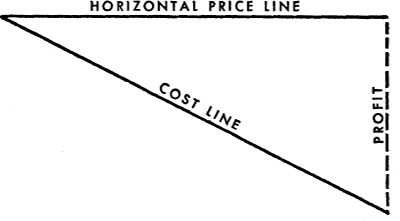
On that horizontal price line the productive power of industry had at last overtaken the buying power of the people. Proof? Before the collapse of the stock market every manufacturer had been complaining of one thing. In every direction he was touching what he called points of saturation. It was harder and harder to sell goods, at prices current. Suppose now you started the wheels at full speed and restored production to what it was before, what would you do with the goods?
“Now we’ve done it,” said Mr. Hoover, as he ruefully picked up the pieces.
Now what was he going to say to the magnates? The price dam had to break. But the government had not the power to break it nor could it command industry to break it. The magnates came, made brave sounds to the reporters on the White House steps, and went away. Henry Ford said his contribution would be to raise wages to $7 a day, which he did; the trouble was he could not sell enough cars to keep his people employed at that wage.
The next wave was the most frightful fall in the price of commodities since the beginning of statistics—copper, tin, rubber, all metals, fibres, leather, chemicals, everything. It shook the whole world and greatly increased the rising economic distress in Europe. Suddenly the value of goods stored in warehouses everywhere and of stocks on the shelves of merchants—the inventory, that is—was reduced one half or more.
Twenty years later Mr. Hoover wrote the authoritative history of the Great Depression.
As he saw it there were six waves—the first one in this country, two in Europe, the last three rising here.
The first was the downfall of the American speculator when his gorgeous bubble burst. That was a price panic; not a bank panic. There is a difference. Under right leadership a terrific deflation of Stock Exchange prices, commodity prices and profits may take place without involving the banks in general ruin. The country really was very rich and could stand a bad hurt.
Almost the first of President Hoover’s acts was to engage the leaders of industry in a general agreement (1) not to cut wages, and (2) to spread the work by a shortening of the work week and a staggering of the days, instead of to work fewer men at full time and cut the others off with no income at all.
This was a new thing. Always before the first way of reducing costs to meet a depression was to cut wages. Now Mr. Hoover was saying: “This time we shall not take it out of the hide of labor.”
And it worked. Industry was responsive. An employer who had tried to save himself by cutting wages would have been ashamed to mention it in his club, whereas formerly he might have boasted of it. Later there was some decline in wages but at no time did they fall faster than the cost of living, and that was the point. To protect its labor force industry as a whole went 3 billion dollars in the red during the next three years.
To prevent additions to a labor force that could not be fully employed the President stopped immigration. The first census of the unemployed was taken, house to house. There was created the President’s Committee for Unemployment Relief, which set up 3,000 volunteer committees through the country to stimulate and overlook state and local relief. To a rising clamor for direct relief out of the United States Treasury the President answered with a pledge that if state and local relief failed, then he would be for it. Locally administered relief did it for a while. During the first and second winters there was much hardship but no hunger. In the springtime of the second year 120 cities could discontinue emergency relief.
A bank panic had been averted and there was a feeling of ground underfoot—when the next wave hit.
Europe was in desperate trouble. By one means or another, such as inflation, sleight of hand monetary practices, borrowing, note kiting and enormous drafts on the United States for dollars, Europe had so far been able to postpone the economic consequences of World War I. Now they were upon her. Austria’s principal bank failed. Hungarian banks were under seige. Germany’s creditors, especially France, were demanding that she pay her IOU’s. President von Hindenburg of the new German Republic appealed to Mr. Hoover, saying the Reichsbank was running out of gold and might have to shut its doors. American banks held very large amounts of the German and Austrian IOU’s.
It was then that Mr. Hoover proposed a one-year moratorium on all international war debts. That meant not only German war reparations to Great Britain, France and Italy, but also their debt to the United States Treasury for money borrowed during the war. Ostensibly he was saving the Reichsbank, which really did not want to be saved; actually he was thinking the American banks might not be able to stand the shock of seeing their German and Austrian IOU’s turn suddenly worthless.
Hardly was the ink dry on the moratorium agreement when, to the dismay of the whole banking world, a belated check-up disclosed that what Germany, Austria and Hungary had borrowed on their kited IOU’s was perhaps ten times more than anybody had guessed. It was something like 10 billion dollars. If the creditors pressed for payment all of Central Europe would be bankrupt. Mr. Hoover then proposed the famous “standstill” agreement under which the creditors should hold their claims on ice, for a period of grace. All the creditors would have to agree or it would not work. Also it would be necessary to create a very large emergency fund, to stand in the vacuum, to provide distress money and to guard the situation generally. That was a job that belonged naturally to the international bankers. They would be only saving themselves. But they balked. What they wanted and what all the creditors wanted was a large loan from the American government to Germany. Dollars to the rescue again. Mr. Hoover would not consider it. At this point in his memoirs, page 78, “The Great Depression,” occurs the following grim paragraph:
“A group of New York bankers informed me that they could not agree to the standstill plan and that the only solution was for the American government to participate in a large international loan to Germany and the other countries. My nerves were perhaps overstrained when I replied that if they did not accept within 24 hours I would expose their banking conduct to the American people. They agreed.”
So the second wave passed and there was a breathing spell. The third was right behind.
After having borrowed 650 million dollars from American banks to support the pound sterling, the Bank of England failed.
The effects were dire, and one of them was that Europeans started a gold run on the United States, thinking that this country alone could not uphold the gold standard. The gold they took away caused the base of American bank credit to shrink. Just then the American Legion demanded a bonus payment of $3,400,000,000 out of the United States Treasury. President Hoover went to their convention and talked them out of it.
There now was real danger of a bank panic. The one idea on which Mr. Hoover acted from this time on was that the time to be daring with credit is when people are in trouble, not when they are riding a boom. He induced private banks to form a National Credit Association, with a capital of half a billion, to stand behind weak banks; he caused the Federal Reserve Bank System to loosen the purse strings, proposed to Congress a system of mortgage discount banks to take up good mortgages on which payment was in default, and gave farmers more help from the Federal Farm Board.
Symptoms of confidence began to appear. The flight of gold to Europe tapered off. Gold hoarding in this country almost stopped. There was another breathing spell.
The next wave was different. You might call it the wave of despond. The great bankers’ credit pool lost its faith and withered out. The government was running at a deficit. Taxes would have to be increased to balance the budget. Unemployment rose to more than 12 million, and at last direct relief had to be provided out of the United States Treasury.
The Congress had gone Democratic and was reluctant to support Republican recovery measures. Gold hoarding was resumed. The gold reserve fell to a dangerous point. Bank failures increased.
Worst of all, Wall Street speculators now had turned around and were selling the country short. It was easier to depress stock market prices than to advance them, and the spectacle of stocks going daily into spasms of weakness, after all that had already happened, was very hard on the country’s morale.
This situation became at length so bad that Mr. Hoover moved for an investigation of the Stock Exchange and its practices. Just then a committee of bankers had been formed in Wall Street to support the bond market, which was extremely and irrationally weak. This committee sent word to Mr. Hoover that it could not get the right people to go along unless he would agree to abandon the investigation. He was dogged and went on with it; and the sordid revelations, involving the heads of Wall Street’s two largest banks (one resigned and one went to jail) were hardly calculated to improve the people’s confidence in the integrity of the country’s financial leadership.
The Democratic Congress at the same time was playing with ideas of fiat money. That made everything worse. Gold hoarding increased. The Reconstruction Finance Corporation was created, with a large revolving fund out of the public purse. Its functions were such as to stand between the railroads and their Wall Street creditors, to help banks out of trouble, to lend money on worthy but risky assets, and to provide money for public works. The next time you lose your breath at the sight of the San Francisco Bay bridge you may like to remember that it was fathered by Mr. Hoover’s Reconstruction Finance Corporation; also the great aqueduct from the Colorado River to Los Angeles, the Mississippi River bridge at New Orleans, and the Jones Beach playground in New York city.
Unfortunately public works alone could not absorb 12 million unemployed, nor could slum clearance or subsidized housing. Only a general revival of activity could do it, and that was what everybody at this point seemed to have dispaired of.
The Great Depression, by Herbert Hoover, Macmillan.
V
A Treacherous Dawn
TRUTH HAS A LOVELY WAY WITH PROVERBS. IN ONE OF THEM it says that darkness deepens just before dawn. So it was.
In retrospect, if you think of the Great Depression as chain phenomena on a world-wide scale, which it was, then it will be clear that by the middle of 1932 the worst had happened. For other countries recovery began there, and continued. It began here, too, but stopped; and for six years more this country was laggard. Why this was will appear.
Moreover, looking back, Americans may well be proud of the way they handled their share of a universal catastrophe, until what should have been for them, as it was for other people, the end of a long black night. The standard of living did fall, of course, and yet it was always higher here than in any other country; and if you look at what the statisticians call the health curve you will see that it did not fall at all. Amazingly, it rose. On January 2, 1932, Surgeon General Cumming, of the Public Health Service, reported as follows:
“Mortality at the beginning of the winter of 1931-32 has continued on a very favorable level, the rate being only 10.7 per 1,000, as compared to 11.5,12.0 and 13.2 in the last quarters of 1930, 1929 and 1928, respectively. Infant mortality was definitely lower, the rate being 55.8 per thousand against 58.1.”
No hunger there. No undernourishment. No malnutrition. Evidently many people on relief had received a better diet and better medical care than they had been wont to provide for themselves in prosperous times. Yet relief had been so managed that the American spirit of self-reliance had been largely unimpaired.
And the dollar—it was a gold dollar still, the only true-ringing piece of money in the whole world.
The next two waves destroyed these values. Neither wave was necessary and both were American made.
Nineteen-thirty-two was an election year. Mr. Hoover was renominated by the Republican Party. The Democratic Party’s candidate was Franklin Delano Roosevelt.
A President whose administration runs into bad times is like a captain who loses his ship. It may not be his fault and yet he will be set down for it. That is a kind of folk law. Therefore it was natural enough that the Democrats should treat the depression as a Hoover sin. They never referred to it but as the “Hoover Depression,” and so distorted the facts as to make them seem morally ugly and sinister.
They hired a Machiavellian journalist named Charles Michelson and set him up in Washington with a staff of highly trained writers; his job was to poison the air with forebodings of worse disaster and to besmirch Mr. Hoover’s motives and character. He did it by writing thousands of speeches, articles and press interviews for the Democratic leaders, who pretended they were speaking for themselves. The effect was wicked. Well, fair or unfair, that was politics. It was not the wave.

Mr. Hoover was magnificent in defeat.
A silhouette of his fame on the screen of history would assume somewhat the shape of an hour glass. The squeeze in the middle is a distortion produced by a conspiracy of disparagement. It represents what the New Deal’s propaganda machine did to him during the Roosevelt-Hoover campaign of 1932. By its mendacity and skill of slander it did astonishingly cut down the Hoover legend; it could not and did not destroy it, for it had a second growth. This is curious. Mr. Hoover’s hold on the esteem and affections of the people was greater as a citizen, both before and after, than as President, owing largely to the tragic circumstances in which his administration was involved and partly to the fickleness of the agglomerate political mind under conditions of popular suffrage.
The charge that hurt him most was that through the Great Depression he was indifferent to the spectacle of human misery and was unwilling to use the powers of government to relieve it—this about a man who during and after World War I had been the Hercules of relief, beginning with the relief of the starving Belgians, which he organized single-handed, and going on from there until he was food bringer to all the distressed people of Europe, with his own flag, his own ships, and a kind of private goverment working independently of war and chaos, issuing its own passports, honored by all belligerents.
The fact is that he did much more, directly and indirectly, to mitigate human distress than any President before him had ever thought of doing in time of extreme depression. He rejected the advice of the grim economists and of men like Andrew Mellon, his Secretary of the Treasury, who said let nature take her course. Let the debt structure fall of its own weight. Let wages be liquidated, and farmers and debtors and commodities and real estate. Let the bankruptcy courts and the sheriff do their work. Then it would soon be over. That would have worked, of course, as everybody knew. It had worked always before. Economists had a name for it. It was the classic medicine.
But it was brutal and Hoover would have none of it. A great deal of liquidation would in fact be necessary. But in the modern case, he believed, it was a proper function of government to cushion the shock of it. This, he thought, it could do without violating any of the ancient principles. For one thing, it could mobolize all the latent resources of self-helpfulness in the people themselves. Thus it was that instead of trying to save wages by law or edict he engaged the leaders of industry in a moral undertaking not to cut wages, at least, in no case faster than the fall in the cost of living; and to spread the payroll by working more men fewer hours a week.
He stood against direct relief by the Federal government except in the last extremity, that is, not until the states, the cities and the local communities had done their utmost—this on the ground that once people as individuals began to be fed and clothed and housed out of the Federal Treasury, or on Federal credit, there would follow a “train of political corruption and waste such as our nation has never witnessed.” Above all, he insisted that the ameliorative powers of the Federal government should be so exercised that “once the emergency is passed, they can and must be demobolized and withdrawn, leaving our governmental, economic and social structure strong and wholesome.”
These were bedside sounds the people did not want to hear. They wanted pain-killing drugs, such as inflation, printing press money, repudiation of debt and the dole; and these drugs they could get by changing doctors.
But unfortunately, and notwithstanding his stern precepts, some of Mr. Hoover’s own remedies were habit forming.
One of them was the Federal Farm Board, which stood in the Chicago wheat pit, with the public purse in its hand, buying grain from all speculators, to keep the price from falling. It fell anyhow.
Another was the Reconstruction Finance Corporation, which loaned public money to private debtors, to bail them out.
Mr. Hoover seemed not to realize that once the farmers and certain debtors had been permitted to crash the Treasury its doors could not be slammed on anybody. Politically, it would not be feasible; physically, it would be impossible without the mangling of many arms reaching through the crack.
The Democratic candidate was Franklin Delano Roosevelt. He gathered around him what came to be known as his brain trust, composed of ardent intellectuals, in hasty pants, all on a glee-ride to political power. They wrote Mr. Roosevelt’s campaign speeches, and very cleverly kept them in tune with the party platform, which was a conservative platform, calling for sound money and a limitation of the powers of government.
It came to be well known, however, that privately they entertained other ideas, especially about money. Mr. Hoover challenged them to repudiate a printing-press money bill that had been passed by the Democrats in the House of Congress, and to say what they meant by “sound” money. Did they mean gold standard money or something just then beginning to be heard of, called managed currency.
For a while they were evasive, and then they put forward Senator Glass to deny that the gold standard was in peril, or ever had been, as Mr. Hoover said. Next came a speech by Mr. Roosevelt, who said:
“Senator Glass made a devastating challenge that no responsible government would have sold to the country securities payable in gold if it knew that the promise—yes, the covenant embodied in these securities, was as dubious as the President of the United States claims it was.”
A masterpiece of subtletly, in view of what the brain trust was intending to do to the dollar. A few months later, aghast at the Roosevelt administration’s repudiation policy, Senator Glass rose in the Senate to say that he had been willfully deceived, and apologized to Mr. Hoover.
As the campaign went on faith in the dollar waned; after the election returns were in anxiety about its future became acute.
Mr. Roosevelt was elected in November. Mr. Hoover’s administration would continue until March.
This awkward interim, dating back to a time when it took Congress many weeks to assemble on horseback, was in this instance heavy with peril. The prestige of the outgoing administration was zero; the policies of the incoming administration were unpredictable.
The possibility that the dollar would be devalued in the European manner caused hoarding to be resumed. In the hands of international speculators there was a mass of refugee gold that for several years had been running a rat race from one country to another, to escape confiscation or entrapment. Its last flight had been from Europe to New York. Now it began to vanish, some of it going back to Europe, some of it into vaults. Thus again a shrinkage of gold reserve in the banks, which was bad for loans, and the difficulties of the banks were thereby increased. Areas of desperate trouble developed. Detroit was one.
The bank panic, which through all the depression had been averted, now was imminent.
Immediately after the election President Hoover asked Mr. Roosevelt to collaborate with him in a joint statement designed to assuage the fear that was rising both here and in Europe—a statement that would commit the new administration both to the International Economic Conference that had been hopefully arranged and to the integrity of the dollar.
They met once. Mr. Roosevelt took the position that he could not assume responsibility for anything that might happen before he took over control of the government. News that the conference had failed had a bad effect. The banking situation grew steadily worse. Again President Hoover importuned Mr. Roosevelt to join with him in making such a statement, asking at last that it be only a statement to say the value of the dollar would be maintained. Mr. Roosevelt made one excuse after another, one being that a letter had been mislaid; and meanwhile it became known that Senator Glass, who was to be Secretary of the Treasury, had refused to take the office because he had discovered that the ideas of Mr. Roosevelt and his brain trust about money were not what they had led him to believe they were.
That was almost the breaking point. Bank depositors everywhere were demanding cash at the teller’s window; the tellers were slamming their windows shut. If faith in the dollar could not be restored the worst bank panic in the nation’s experience was inevitable. Mr. Hoover’s appeals to the President-elect, by telephone and telegraph, became almost frantic; Mr. Roosevelt’s replies became more evasive. Why?
A strange message arrived at the White House from an eminent industrialist. The message was this: “Professor Tug-well, adviser to Franklin D. Roosevelt, had lunch with me. He said they were fully aware of the bank situation and that it would undoubtedly collapse in a few days, which would place the responsibility in the lap of President Hoover.” Professor Rexford G. Tugwell was one of the brain trust.
Another member of the brain trust, who afterward repented, was Raymond Moley. Years later Mr. Hoover asked him why Mr. Roosevelt had refused to cooperate in the banking crisis. Professor Moley replied: “I feel when you asked him on February 18 to cooperate in the banking crisis that he either did not realize how serious the situation was or that he preferred to have conditions deteriorate and gain for himself the entire credit for the rescue operation. In any event, his actions during the period from February 18 to March 3 would conform to any such motive on his part.”
In February, a few weeks before the inauguration of Mr. Roosevelt, the crisis came to a head. The Detroit banks went down. In several states all banks had closed. Mr. Hoover was urged to stop the run by closing all banks everywhere. This he firmly refused to do, on the ground that it was doubtful whether he had the legal power to do it; and on the ground, secondly, that it was the business of solvent banks to stay open.
Generally the banks were solvent. Proof of it was that eventually nearly 99 per cent of the depositors were paid in full. But no bank by itself can stand a run for long. It cannot convert its assets fast enough to pay its depositors all at once in cash. It needs help. Where was the help to come from? They were unable to help one another, so many of them being in the same trouble; only the government could have helped them.
Mr. Hoover had two ideas. One was that each banking region should help itself by pooling its resources and issuing a temporary kind of money called clearing house certificates. That would have worked. It had worked before. But it would have required the cooperation of the Federal Reserve Board, which was not forthcoming. His other idea was that the Federal Government should guarantee deposits in all banks that were found to be solvent, and only short of cash. That also would have worked, only it was too much of an innovation, and Congress would not consent.
On this perfect design for total panic the Administration of Herbert Hoover ended and that of Franklin Delano Roosevelt began.
The next was a long, low wave. It lasted six years and was swallowed up by World War II.
Marginalia
The enmity between business and government is mortal and acts with the certainty of instinct. They are rivals for power.
Business wants two things—to be supreme in its own world and to be let alone. Its ideal of government therefore is one of limited powers—especially limited in the economic sphere.
On the other hand, as if it were a biological law, there is in government an imperious urge to extend its powers; and since in the modern case government cannot enlarge its own sphere without diminishing the free sphere of business, conflict begs only time and occasion.
The decisive moments are not appointed. The struggle has manifold aspects; and it may be that people will not know what the issues were until a long time afterward.
For example, who can say when and how laissez faire died or where it is buried? There were no obsequies and there is no tombstone.
In the same way its nativity was obscure. There was no birth certificate. There never was a time when government said to business: “Now you are free. You will be let alone.” Nor was there ever a time when business rose in revolt, broke its chains and declared itself free. Yet laissez faire ruled the economic world for more than 150 years; while it ruled, the power of business was greater than the power of government.
Laissez faire grew naturally out of the shape of unpremeditated events. When foreign trade was a kind of piracy, when industry was handicrafts under the ancient guild system, when artisanship was low caste and agriculture was peasantry, then business was simple and government understood it. Edicts, rules and regulations were imposed upon it, by trial and error, and there was no theory. There was no book of economics.
Then in rapid succession came machines, factories with their division of labor, credit banking, and Adam Smith, who wrote the first elucidation of a free economy, to show that every man seeking his own selfish ends was bound to promote the general welfare whether he meant to or not. The word business, comprehending all the activities that arise from the production and exchange of wealth, was yet unknown.
The medieval world of guilds, peasantry, the just price and the merchant prince—a way of life it was—sadly and miserably collapsed. The modern world of business began. Its methods and tools, especially its credit banking, were all so strange that government, seeing only that it multiplied wealth in a prodigous manner, was afraid to touch it. That is how business got free. Never did government willingly surrender control of business. It was only that the kind of business it did control withered out of its hands. Business in the new sign ran away with its own world.
Well then, government set out to overtake it. Where before it had studied diplomacy and statescraft, now it began to study economics; it elevated the economist to the rank of priesthood because he could penetrate the sorceries of business. So it began.
The one thing that business lacked, and had never felt the want of, was a philosophy. Its laws were derived from experience; a thing worked or didn’t work and that was that; but as for any social theory of what it was doing, it had none. After a while therefore it was that the academic economists who belonged to government knew more about business than business knew about itself—theoretically. Still they were afraid to touch it, and business held them off for a long time by saying: “All you know you get out of books. Business is business. Let it alone.”
But theory is dangerous. Unerringly government and its economists perceived that the key to the whole complex matter was control of banking and credit—that is to say, money. Let government exercise its sovereign power to seize control of credit and banking, and the rest would be easy; the independence of business could be overcome, its rivalous power could be limited.
It took more than a century-and-a-half to do it; and yet anyone might have foretold the ultimate victory of government because it had always the skill and the means to keep the people on its side. The wealth created by free enterprise belongs ultimately to all of society, but it reaches the people by a process of osmosis; whereas when, in the final act of the struggle, the government sets up the Welfare State, its benefactions are immediate and direct—that is, until there may be nothing left to distribute.
These are generalizations. It had happened everywhere else. Then it happened here.
VI
The Roosevelt Revolution
FRANKLIN DELANO ROOSEVELT WAS AN ARISTOCRAT who broke caste to make friends with the populace. He could begin a homely speech with “My good people,” and make them like it, whereas until then anyone who remembered the log cabin tradition would have said that a country squire manner would be politically fatal. On the radio his voice had a rare hypnotic quality. He made the sound of a benign father.
In middle life, before he was President, he became a polio cripple and walked thereafter in braces. A visitor once said to him: “Mr. President, I marvel that you can make these momentous decisions with such lightness of spirit.” To which he replied: “If you had spent several years of your life in bed trying to wiggle your big toe these decisions might not seem so momentous to you.”
Many believed that his way with public affairs was conditioned by his physical experiences. His experiments were colossal and reckless, as if he might be saying to himself that even if they failed things could be no worse than they had been; and some accounted for the almost superhuman scale of his activities by saying that the energy that was once in his legs had surged upward and expended itself with double zest.
Alice Longworth, who, being the daughter of Theodore, was one of the Roosevelt clan, made this observation: “When Franklin talks of recovery the word does not mean to him what it means to us. He is thinking of the kind of recovery he had in his own legs. He does not expect people to rise and walk as they once did. He would put them in braces; he would build a tank for them to swim in, as he does.”
There never had been a President remotely like him.
Before him no President could be elected for a third term. The tradition against a third term was believed to be insurmountable. He was elected four times.
Power flourished in him, and multiplied itself, until he had more than any other President ever possessed or wanted. Some of it he got from a spell-bound Congress that had lost the soul of the parliamentary principle and for 100 days passed all the laws he sent to it from the White House, without debate, sometimes without even reading them. Some of it he seized, some of it he got by outsmarting the law, and some of it by thinking of things no law had had the forethought to forbid.
And yet you could not say that he had an evil lust for power, like Lenin, Mussolini or Hitler; it sometimes seemed more as if he enormously enjoyed playing with it, just to see what would happen. He was not cruel; he was perhaps too civilized to be sinister.
Many accused him of wanting to be a dictator. He took it naively and answered that he had neither the inclination nor the qualifications to be a successful dictator; and, moreover, he knew too much history.
And then in the third year of his reign he could say such a thing as this: “In 34 months we have built up new instruments of public power. In the hands of a people’s government this power is wholesome and proper.” But, he added, in other hands, “such power would provide shackles for the liberties of the people.”
The classic cliche of the dictator. What he has done to the people is good for them. Did he know better? Did he know what he was doing to the philosophy of American government as it was expounded by the first great democrat? That was Thomas Jefferson, who said: “In questions of power, let no more be said of confidence in man, but bind him down from mischief by the chains of the Constitution.”
But no Constitution that had ever been written could chain this Roosevelt down.
Recovery with a big R was his First Reason. That is to say, the problems he faced in the beginning were economic problems. Yet to this day it may be debated—and debated on the evidence,—whether he was an economic illiterate who had never learned the primer of that subject, or whether his ideas were such as that two times two make five, which may be argued by either an idiot or a savant.
If you hold that he did not know, that he did one thing at a time, experimentally, without seeing the bearing of it, then you are obliged to account for the fact that in the New Deal’s monetary strategy there was a precision of timing, an order of sequence, a forethought of progression and sequel, all tending to socialize money, banking and credit, and all so perfect, that you cannot imagine it was improvised. The design was complex. One piece out of place or one step out of time would have been fatal. This we proceed to see.
Now these are the things that happened to the dollar.
President Roosevelt’s first act, after his inaugural address, was to close all banks by executive decree. That stopped the runs. The same decree forbade, under pain of fine and imprisonment, any dealing in foreign exchange or any transfer of credit from the United States to a foreign country. That slammed the door. Nobody could run out of the country with his wealth. Even the speculators were trapped.
Several days later Congress assembled in special session and found on its desk a law that had come down from the White House to be rubber-stamped. This law, firstly, legalized what the President had already done without a law; secondly, it provided that no bank in the Federal Reserve System should reopen but under license from the government; thirdly, it gave the President absolute power over foreign exchange, and, fourthly, it authorized the President to call upon the private owners of gold to surrender it. That was the second step.
The President then issued a decree requiring all persons and corporations, under penalty of fine and imprisonment, to bring their gold to the Federal Reserve Banks and exchange it for paper money. By this time a plentiful supply of paper money had come from the printing press. The Treasury added a persuasive statement, saying the government needed possession of the gold as it were in trust, that it was the patriotic duty of private owners of gold to give it up, and that anyhow the paper money they would get in exchange for it was equivalent to gold.
The people made no difficulty about parting with their gold. They thought it was for the emergency only and that they would get it back later. There had been as yet no sign that the government intended to debase the dollar. Indeed, at that very time the Treasury was offering small investors a new lot of government bonds, payable principal and interest “in United States gold coin of the present standard of value.” Would it be doing that if it intended to betray the gold standard? Everybody remembered something Mr. Roosevelt had said during the campaign. No responsible government, he said, would sell securities payable in gold if it knew that the promise, yes, the covenant, embodied in those securities was dubious.
Nobody knew, of course, that a law to repudiate the gold covenant was then in writing at the White House. To get physical possession of the gold was a ticklish business, and yet vital to the design, because free gold in the hands of the people might turn out to be very embarrassing. But when at last all of it was locked up in the Federal Reserve Bank vaults, and when it had been made a crime for a private person to have in his possession so much as a five-dollar gold piece, then the planners could sigh with relief, for the third step had been safely executed.
The fourth step revealed part of the design. It took the form of an amendment to a farm relief bill, called the Thomas amendment. The story of it is this.
One evening at a casual meeting of the Brain Trust in the White House the President handed a copy of it to Raymond Moley, saying: “You might like to read this. It will be introduced tomorrow and I am supporting it.” In the words of Professor Moley: “Hell broke loose in the room. Douglas, Warburg and Feis were so horrified that they began to scold Mr. Roosevelt as though he were a perverse and particularly backward schoolboy.”
James Warburg tells it the same way. The President was amused. “Take it home,” he said, “and try your hand at rewriting it if you want to.”
They went to their hotel to struggle with it. The Secretary of the Treasury walked with them, saying: “What are you all so excited about? He knows what he is doing.” They pushed him into his room and then sat down to study the amendment. The night was nearly gone when the Secretary of the Treasury, in his pajamas, burst in on them, saying: “Do you know what this means? It means we are going off the gold standard.” He had just seen it.
They could get him back to bed but they could not rewrite the amendment. It was what it was or nothing.
The outcome was that the amendment was enacted at the tail of the farm relief bill and became law. This is what it did:
It authorized the President (1) to devalue the dollar by reducing its gold content one-half, (2) to go on the open market and buy $3 billion of government bonds with paper money, (3) to issue $3 billion of fiat paper money, secured by nothing, and make it legal tender, (4) to coin an unlimited amount of silver dollars, (5) to issue an unlimited amount of paper silver certificates, and (6) to fix the values of gold and silver in relation to each other.
Thus the power of the President over money was made absolute—or, if not absolute, at least greater than that of any Caesar.
Of its potentialities, Senator Thomas, the author of the amendment, said: “It may transfer from one class to another in these United States value to the extent of almost $200 billion. This value will be transferred first from those who own the bank deposits; secondly, this value will be transferred from those who own bonds and fixed investments. If . . . the powers are exercised in a reasonable degree, it must transfer that $200 billion in the hands of persons who now have it, who did not buy it, who did not earn it, who do not deserve it, who must not retain it, back to the other side, the debtor class of the Republic, the people who owe the mass debts of the nation.”
This at a time when a very sick patient named Confidence was only slightly convalescent.
The fifth step was the act of repudiation. By another law sent down from the White House Congress declared that the gold redemption clause engraved upon government bonds and on the face of United States paper money was void, and that these obligations should be redeemed in any kind of money the government might see fit to provide, paper money of course; and the law went still further to say that the customary gold redemption clause in all private obligations, such as railroad and other corporation bonds,—that also was void, and moreover it would be unlawful thereafter to make a private contract payable in any kind of money other than the paper money current. Thus, the only kind of money left was the irredeemable paper dollar, meaning a paper dollar redeemable in nothing but itself.
Senator Glass, who was to have been Secretary of the Treasury, left a sick bed and rose in the Senate to say: “With nearly 40 per cent of the gold supplies in the world, why are we going off the gold standard? The suggestion that we may devalue the gold dollar fifty per cent means national repudiation. It means dishonor. It is immoral.”
Mr. Roosevelt and his planners evidently thought that when it had been cut loose from gold and made subject to devaluation the dollar would fall headlong of its own weight, and that as the dollar fell prices would rise.
How does the dollar fall? In buying power, simply. If it takes two dollars to buy what one dollar bought before you say the value of the dollar has fallen one-half.
Well, the dollar did fall. It would buy less gold than it did before, or it took more dollars to buy a pound sterling on the foreign exchange market; but it fell slowly, and much less than was expected, because after all it was still the best piece of money in the world. Whereupon the planners decided to club it down; and the club they used was gold.
The President announced that the government would buy, with paper dollars, all the gold the world would sell. Each morning thereafter the United States Treasury published the price it would pay in paper dollars for gold—one day 30 paper dollars for an ounce of gold, the next day 31 paper dollars, the next day 32—and so up to 35 paper dollars for an ounce of gold, which was a rise of more than 14 dollars an ounce from where it started.
The price—the paper dollar price for gold—was fixed each morning with the Secretary of the Treasury in Mr. Roosevelt’s bedroom. It was great fun. One evening the Secretary of the Treasury wrote in his diary: “If anybody ever knew how we really set the gold price through a combination of lucky numbers, etc., I think they would be really frightened.” He was himself frightened at that time. Later, in his published memoris, he wrote:
“F.D.R. was in a grand humor. ‘I have had shackles on my hands for months now,’ he said, ‘and I feel for the first time as though I had thrown them off.’ He rather enjoyed the shock his policy gave to the international bankers. Montagu Norman of the Bank of England, whom F.D.R. called ‘old pink whiskers’, wailed across the ocean: ‘This is the most terrible thing that has happened. The whole world will be put into bankruptcy.’ The President and I looked at each other, picturing foreign bankers with every one of their hairs standing on end with horror. I began to laugh. F.D.R. roared.”
The fun stopped at 35 dollars for an ounce of gold. It stopped there probably because the effects had been disappointing. At that point the theoretical gold content of the dollar had been reduced more than four-tenths—theoretical, because by this time the only money current was an irredeemable paper dollar on which nobody could get any gold at all. So far as the holder of a paper dollar was concerned its gold content was imaginary.
The last step was to confiscate the gold. The government already had possession of it, since it was locked up in the Federal Reserve Bank vaults; but possession was not title. Now came another bill from the White House, which Congress immediately passed, vesting in the government absolute title to all the gold. The government took it and buried it at Fort Knox. That was confiscation, and bad enough; but there was one more trick. The government said: “When the Federal Reserve Banks took possession of this gold it was worth only $20.67 an ounce. Now it is worth $35 an ounce. The difference is profit and it belongs to the United States Treasury.” It was not profit; it was bookkeeping. Nevertheless, the Treasury set it up in its books as profit, converted it into paper dollars, and spent the money. It was a sum of nearly $2 billion.
To reduce the gold dollar to a piece of irredeemable piece of paper took fourteen months. In the process the President got physical possession of the public purse. How?
Seeing that inflation had been adopted as an instrument of public policy, so that the supply of dollars might be infinite, the Congress made enormous appropriations, $3 billion and $4 billion at a time, and put the money in the President’s hands to do with what he would. The ancient pork barrel was rolled into the cellar. States, cities and counties wanting Federal aid went no longer to their Senators and Representatives but direct to the President, who was saying: “Your government has the money. Bring on your projects.”
Seven Years, by Raymond Moley.
The Morgenthau Diaries, by Henry Morgenthau, Jr.
VII
Prolapse
MEANWHILE WHAT OF RECOVERY
You enter now an area of controversy in which opinion rejects evidence and evidence disembowels opinion.
With the President saying that he could not foretell where he would stop the gyrations of the dollar, and with its daily value being published every morning by the United States Treasury like a lottery number, there could be no normal borrowing and lending of money. Senator Glass said: “No one outside of a lunatic asylum will lend his money today on a farm mortgage.” Yet one of the acute problems of the moment was how to save farm mortgages from wholesale foreclosure for want of new lenders.
The effect was this—that when, by its manipulations of the dollar the government had made it absurd for private lenders to lend, it became itself the universal lender. Its money cost it nothing; it did not have to consider risk because the losses could be charged to the taxpayer. At rates of interest with which private lenders could not in any case compete it loaned public money to anybody for almost any purpose—to banks and railroads, to big business and little business, to persons wishing to start in business, to snake farms and beauty parlors, for scenic highways, for turning the Tennessee Valley into a Federal province, to municipalities for 1,643 school houses, 105 airports, 3,000 tennis courts, 3,300 storage dams, 103 golf courses, 5,800 traveling libraries, 1,658 medical and dental clinics, 36,000 miles of rural roads, 1,500 amateur theatrical productions, and so on and on.
Two ideas were running parallel—the idea of Recovery and the idea of Revolution.
“If it is a revolution,” said Mr. Roosevelt, “it is a peaceful one.”
Again: “The almost complete collapse of the American economic system that marked the beginning of my administration called for the tearing down of many unsound structures, the adoption of new methods and a rebuilding from the bottom up.”
Again: “It is to the extreme credit of the American people that this tremendous adjustment of our national life is being accomplished peacefully. . . . They have asked for discipline and direction under leadership. . . . We have demanded of many citizens that they surrender certain licenses to do as they please in their business relationships; but we have asked this in exchange for the protection which the state can give.”
And again: “It was an emergency that went to the roots of our agriculture, our commerce and our industry. . . . It could be cured only by a complete reorganization and a measured control of the economic structure.”
The voice was the voice of Roosevelt. Whether or not these were his own words, or even his own thoughts, the people never knew. He was surrounded by a cabal of intellectual revolutionaries who hated capitalism and named the capitalist the brigand of the skyscrapers. Publicly they talked of expelling the money changers from the temple and rebuilding the American house from the sills up. Privately they spoke of Mr. Roosevelt as the Kerensky of the American revolution.
In “The Revolution Was,” written by this author in the fifth year of the New Deal, you will find the following bit of analytical comment:
“Revolution in the modern case is no longer an uncouth business. The ancient demagogic art, like every other art, has as we say, advanced. It has become in fact a science—a science of political dynamics. And your scientific revolutionary in spectacles regards force in a cold impartial manner. It may or may not be necessary. If not, so much the better; to employ it wantonly, or for the love of it, when it is not necessary, is vulgar, unintelligent and wasteful. Destruction is not the aim. The more you destory the less there is to take over. Always the single end in view is the transfer of power.
“There was a prodigious literature of revolutionary thought concealed only by the respectability of its dress. Americans generally associated dangerous doctrine with bad printing, rude grammar and stealthy distribution. Here was revolutionary doctrine in well printed and well written books, alongside of best sellers at your bookstore or in competition with detectives on your news-dealer’s counter. As such it was all probably harmless, or it was about something that could happen in Europe, not here. A little communism on the newsstand like that might be good for us, in fact, regarded as a twinge of pain in a robust and somewhat reckless social body. One ought to read it, perhaps, just to know. But one had tried, and what dreary stuff it had turned out to be!
“To the revolutionary this same dreary stuff was exciting. It was knowledge that gave him a sense of power. One who mastered the subject to the point of excellence could be fairly sure of a livelihood by teaching and writing, that is, by imparting it to others, and meanwhile dream of passing at a single leap from mean obscurity to the prestige of one who assists in the manipulation of great happenings; while one who mastered it to the point of genius—that one might dream of becoming himself the next Lenin.
“A society so largely founded on material success in a system of free competitive enterprise would be liable to underestimate both the intellectual content of the revolutionary thesis and the quality of the revolutionary mind that was evolving in an envious academic world. At any rate, this society did, and from the revolutionary point of view that was one of the peculiar felicities of the American opportunity.
“The revolutionary mind that did at length evolve was one of really superior intelligence, clothed with academic dignity, always sure of itself, supercilious and at ease in all circumstances. To entertain it became fashionable. You might encounter it anywhere, and nowhere more amusingly than at a banker’s dinner table, discussing the banker’s trade in a manner sometimes very embarrassing to the banker. Which of these brilliant young men in spectacles was of the cult and which was of the cabal—if there was a cabal—one never knew. Indeed, it was possible that they were not sure of it among themselves, a time having come when some of them were only playing with the thought of extremes while others were in deadly earnest, all making the same sounds. This was the beginning of mask and guise.”
For purposes of the Revolution, which altered perhaps forever the relationship between government and citizen—for the creation of what now we call the Welfare State in which the government becomes responsible for people instead of people being responsible for government—everything the New Deal did was right. Never again would it be assumed that the richest, the freest and the most self-resourceful people in the world until then, were able to house and clothe and feed themselves and to provide for their own old age without the aid of the Welfare State.
For Recovery, on the other hand, nearly everything the New Deal did was wrong or self-defeating.
Its three principal aims were (1) to restore prices, (2) to cheapen money for the benefit of debtors, and (3) to redistribute the national wealth in favor of low income people, especially the wage earners.
It is now to look at the means.
First, how to restore prices. The debasement of the dollar and a flood of irredeemable paper money would cause prices to rise, only perhaps not fast enough; but there was another way to do it. That was to limit production and restrain competition.
Over-production and competition were Siamese twins of evil. The New Deal planners were sure of this; it became their fixed idea.
The President said: “We found ourselves faced with more agricultural products than we could possibly consume ourselves and surpluses which other nations did not have the cash to buy from us except at prices ruinously low. . . . We found our factories able to turn out more goods than we could possibly consume and at the same time we were faced with a falling export demand. We found ourselves with more facilities to transport goods and crops than there were goods and crops to be transported. All of this has been caused in large part by a complete lack of planning . . . The people have been erroneously encouraged to believe that they could keep on increasing the output of farm and factory indefinitely and that some magician would find ways and means for that increased output to be consumed with reasonable profit to the producer . . . The cure is not to produce so much.”
Fewer goods and higher prices.
Yet when it came to moving Social Security laws, such as unemployment compensation, old age pensions, old age insurance and general welfare, the President could say that one-third of the people were ill-fed, ill-clothed and ill-housed. That became one of the New Deal’s fighting statements. How the cure for that could be not to produce so much was never explained.
Two great braking mechanisms were invented, each with treadles for the government’s feet; the treadles were permission, coercion, compulsion. One braking mechanism was the Agricultural Adjustment Act, called the AAA; the other was the National Industrial Recovery Act, called the NRA.
The AAA was set up in the Department of Agriculture. The Secretary of Agriculture was Henry Wallace, a fantast from the Corn Belt who lived in a non-existent world, believed every strange thing, and played with the boomerang.
It was already the middle of Spring; too late to stop planting and breeding. The alternative was to destroy growing crops. The AAA paid farmers to plow down as much as one-fourth of their cotton, wheat, corn and tobacco and to slaughter millions of little pigs before they could grow into pork—provided they would sign up to take orders from the government next year.
It was expected of course that this assault upon the nation’s food supply would cause farmers’ prices to rise. The effect was disappointing. For a while nobody could understand why. Then it appeared that there was going to be a surplus anyhow, because farmers all with one impulse cultivated their remaining acres more intensively and used much more fertilizer.
Next, by executive decree, the President created the Commodity Credit Corporation, provided it with $3 billion of capital out of the public purse, and directed it to impound and store the surplus by lending farmers more on their crops than the crops were worth in the open market. If the price went up the farmer could pay off his loan, sell his crops, and keep the profit; if the price went down he laughed and the Commodity Credit Corporation was stuck.
For the next year the program of restriction was planned in time. The AAA determined how many acres should be planted to the basic crops, like cotton and wheat and corn, and allotted to each county in the country its share, according to its crop history. Then in each county was a committee of conforming farmers, acting as paid agents for the AAA, to hand allotments around to individual farmers and to see that nobody cheated. A Federal tax was imposed upon the processors of food and fibers,—the millers and meat packers and cotton ginners,—and out of this tax the farmers were paid for not producing.
The AAA said this was a democratic process because in every county it was done by a majority vote of the farmers themselves. That was true. Yet what happened to the independent farmer who did not conform? He got no check from the United States Treasury for the time he passed in the shade of the apple tree instead of working, and he was denied access to loans from the Commodity Credit Corporation.
On these terms it was difficult for the independent farmer, called the non-signer, to compete with his subsidized neighbor; but if, by working harder than his neighbor he did compete successfully, then he learned that a beneficent government can be ruthless with those who scorn its blessings. A farmer sending cotton to the gin had to prove that it was lawful cotton and within his quota; if he exceeded his quota the excess was taxed at one-half its value and he could be fined and imprisoned. On potato growers, signers and non-signers alike, was imposed a control law that put a prohibitive tax, like a liquor tax, on potatoes exposed anywhere for sale, the trick being that the tax was rebated to farmers who had proper quotas to begin with and did not exceed them.
If only it had worked there would have been that to say for it. But it did not work. Total farm income was increased by the millions of mechanically printed checks that went from the U. S. Treasury to obedient farmers; the farm problem itself was hardly touched.
When a subsidized farmer retired acreage from production, under contract with the AAA, he naturally retired his poor acres. On the better acres he grew more than ever before, and although he might be producing a surplus, that was now all right because if he couldn’t sell it at a profit in the open market the government would buy it at a fair price.
A fair price was one at which the farmer’s buying power would remain constant. For example, if before the depression it took 100 bushels of wheat to buy a piece of farm machinery, then the price of wheat must be such that the same number of bushels would buy the same piece of farm machinery. That was called parity for the farmer; and once the government had undertaken to maintain farm prices at or near parity it never could stop.
The first AAA was overturned by the Supreme Court; a new one rose in place of it. But through all vicissitudes the formula, parity prices for the farmer, sustained by public subsidy, survived as a political imperative—with the result that for the benefit of agriculture food consumers were taxed twice, once on their income tax sheets to provide the money the government lost in its price-supporting operations and again at the grocery store, where they paid the prices.
The AAA created new problems. Big farmers with many acres to juggle fared much better than little farmers with only a few acres. The size of the checks that went to very big farmers was a scandal. Secondly, the planners had ill-considered the fact that taking millions of acres out of production would cause many tenant farmers, share croppers and farm hands to be expelled from the soil.
To take care of these the AAA evolved grand rehabilitation and resettlement schemes. It bought large tracts of land, built on them dwellings and barns and community halls, provided the seed and the tools and the supervision, and thus restored to the soil an uncounted number of farm families who would otherwise have been on the county relief rolls. Many of them were better off than they had ever been before; but the better these schemes worked the worse it was, because what the salvaged families produced was an addition to the agricultural surplus which the AAA was trying to kill.
The other great braking mechanism was the National Industrial Recovery Act—called the NRA. The idea was that if all industry agreed to limit production, restrain competition, advance prices to a level where everybody would make a reasonable profit, abolish child labor, shorten the work week and advance wages faster than prices, the Dragon Depression would lie down and die. Industry alone could not do this, because, first, if prices were going to be fixed by agreement the anti-trust laws would have to be suspended, and, secondly, industry could not trust itself to keep such agreements, even if it were legal, since it had no power to punish those who might break them.
That was what the NRA was for. The government would sanction price-fixing agreements and then police them; so also agreements to limit production, to freeze competition and not to build any new plants without a license. Simply, government would plan the activities of business and industry and control them.
The President said: “. . .in some respects government sits down at a table of partnership with business; but in others it exerts the superior authority of police power, to enforce fairness and justice as they should exist among the various elements in economic life . . . if an industry fails voluntarily to agree within itself, unquestioned power must rest in the government.”
All the consequences were grotesque.
Business embraced the idea with enthusiasm. It was sick; it had been without profit for a long time. All it could see at first was that each industry, each trade, each segment of business, was going to be asked to write its own agreement—to be called a Code—and the government was going to seal it. True, it might be putting itself into a strait garment; at least it would be a garment with pockets in it. Popular demonstrations were organized in the cities. In New York City a quarter of a million people marched to celebrate the obsequies of depression.
To administer the NRA the President appointed Gen. Hugh Johnson, retired—an Oklahoma soldier with a genius for extensive organization, a little law, a little economics, a fury of invective, a passion for hippodrome and a weakness for blowing his fuses. Power was his firewater.
Nearly every business, from steel and motor car makers down to butchers, had some kind of trade association; if not it could get one up in a hurry. Johnson summoned the trade associations to appear before him in Washington, received their genuflections coldly, lectured them, bullied them, rode them hard as they wrote their Codes and knocked their heads together if he caught them trying to put something over on the government; then he sent them home with their Codes in one hand and lithographs of the Blue Eagle in the other. Your Blue Eagle, whoever you were, was to show that you had signed with NRA to do your part, and, above all, that you were not a chisler. A chisler was one who charged less than the Code price; and he was a public enemy.
Suddenly the Blue Eagle was everywhere, like something that happens to the landscape in the night—in every store window, in the barber shop, on the bank door, on office walls, at the factory gate, over the news-dealer’s stand.
Its significance was that of the brass serpent held aloft by Moses. If you looked upon it and believed you were saved from the fiery serpents sent by God to scourge a willful people. The fiery serpents in this case were little bands of NRA workers, with NRA pencils and paper in their hands, going to and fro in the streets and through public places, aggressively demanding that people stop in their tracks and sign a pledge to boycott any place of business that did not display the Blue Eagle. That was Johnson at his worst and best.
He proclaimed: “May Almighty God have mercy on anyone who attempts to trifle with that bird.”
A little tailor in Jersey City did. He pressed a pair of pants for five cents less than the price fixed by the Tailor’s Code. For that he was haled to Court, fined and sent to prison. The storm of derision and ridicule that broke upon the NRA’s head got him out of jail; but he had learned his lesson, and promised thereafter to keep the Code.
Nevertheless, Johnson succeeded in creating a kind of mass hysteria for the Blue Eagle. Those who refused to sign up were denounced as chislers and social hyenas and were boycotted, besides. Very few could withstand the pressure. One who did was Henry Ford, standing alone in the motor industry and alone against his own associates. Another was Senator Carter Glass, who said that sooner than see the Blue Eagle in its window he would happily watch his Virginia newspaper plant burn down.
Organized labor was friendly to the Blue Eagle because, in the first place, the NRA plan was that wages should rise faster than prices, and because, secondly, the National Industrial Recovery Act contained a charter for unionism. That was the famous Section 7a, which had to be included in every Code; and it provided that labor should have the right to bargain collectively through representatives of its own choosing, touching such matters as minimum wages, minimum hours and conditions of work. To administer that part of the law the President created a National Labor Relations Board which was much more sympathetic to the wage earner than to the employer.
Thus the three great divisions of economic life—agriculture, business and labor—had been brought within the sphere of planned benefaction. The AAA was to give the farmers a larger share of the national income. The NRA was to guarantee business a reasonable profit. And this charter for unionism was intended so to strengthen the bargaining power of labor that it would be able, by its own exertions, to increase its share of the national income.
One by one these New Deal measures had to come before the Supreme Court, on one question—were they Constitutional?
The gold cases arrived first. A majority of the Court held that although it was immoral and illegal for the government to repudiate the obligation to redeem its bonds and its money in gold, and conscienceless, still there was nothing to be done about it. The sovereign power had no conscience. Moreover, it was too difficult for any individual to prove his loss.
In a dissenting opinion three Justices said: “The loss of reputation for honorable dealing will bring us unending humiliation; the impending legal and moral chaos is appalling.”
Justice McReynolds read the dissenting opinion and added orally: “This is Nero at his worst. The Constitution is gone.”
By the time NRA came before the Court the Blue Eagle was dying of intestinal obstruction. The Court cut off its head.
Then came the AAA and that was struck down.
The legal objection in both cases was that the powers delegated by Congress were vague and undelimited; underlying them, however, was a deep traditional feeling against Big Government, against extending bureaucratic Federal power over the economic life of the nation, against the encroachment of this power upon the sovereignty of states. Simply, the Court was Conservative.
This was the beginning of a feud between the President and the Supreme Court that rocked the country.
First, Mr. Roosevelt attacked the decisions, saying they belonged to the nation’s horse and buggy days, that they ruined the New Deal, that now the chislers and exploiters of labor would return to the feast, wages would fall, hours of labor would lengthen, and so on and on—none of which happened.
Then he attacked the Court itself, saying its reactionary members had apparently resolved to stay on the bench so long as life continued for the sole purpose of blocking any program of reform; and he went on to invoke against it a bitterness of class feeling that had reverberations all the way down to the striking automobile workers in Detroit, who, having seized physical possession of the plants, sat there day after day derisively chanting: “Nine Old Men. Nine Old Men.”
Mr. Roosevelt had so represented it. Laws for the people which he had promised and which Congress had passed were being nullified by a Court of nine old men.
His argument drew plausibility from the fact that the Supreme Court was itself divided. There was a minority of three, sometimes four, that held for so construing the Constitution as to enable the government directly to intervene more and more in the social and economic concerns of the country; and this minority had again and again denounced the conservative majority for usurping the policy-making power of Congress. How? By deciding first whether a law was good or bad and then construing the Constitution in support of that opinion.
Thus it was that on a bench of nine Justices, if two conservatives, or perhaps only one, could be replaced by a New Deal thinker the mind of the Court might be changed. Since the beginning of his term Mr. Roosevelt had been unable to appoint one Justice. The old ones held on; no one died and no one retired. He had been saying nevertheless that he would find a way out.
The idea was perhaps his own. Suddenly he asked Congress to pass a law providing as follows: That when a Justice reached 70 and refused to retire on full pay the President could appoint an additional Justice, until if necessary there might be a bench of fifteen instead of nine. Four of the Justices were already past 70; therefore he could appoint four at once, and these four of course would be friends of the New Deal.
The reactions to this proposal were all unexpected.
First, nine Justices who had been divided on questions of Constitutional construction united as one to defend the political independence of the Court as a co-equal arm of government.
Secondly, there was a roar of popular disapproval. Even to people who had disliked many of the Court’s decisions the thought of its being packed by the political party that happened to be in power was intolerable. Party lines broke down. After several gloomy conferences with the President his own leaders in Congress told him bluntly that they could not pass his law if they wanted to; they didn’t have the votes.
The President was obstinate and angry. To what extreme he might have pushed his case will never be known, for just then, to everybody’s astonishment, the Supreme Court began to change its way of thinking.
As the nine Justices had presented a solid front against Mr. Roosevelt’s Court packing plan, so now they united to execute a policy of retreat, under the leadership of the Chief Justice, Charles Evans Hughes, who came to be less hopeful that the power of Executive Government could be limited than fearful that the wind that was rising would blow the Court down. It was Mr. Justice Hughes who had said: “The Constitution is what the judges say it is.” Thus, the difference between a liberal and a conservative interpretation of the words of the Constitution might very well alter the nature of government.
For example, the Preamble of the Constitution says the purpose is to “provide for the common defense and promote the general welfare,” etc. Then Section 8 says the Congress shall have the power to levy taxes to “provide for the common defense and the general welfare of the United States,” etc. Which word will you take—promote or provide? If you say that to promote the general welfare is the same as to provide for the general welfare, then you are bound to concede that a Welfare State may rise within the Constitution. But until now these words had never been so construed. The function of government had been to promote the general welfare; not to provide it.
The Court’s first step in retreat was to reverse itself in order to uphold a minimum wage law for women in the State of Washington. Then for four years it did not again declare an act of Congress unconstitutional. One by one it upheld slightly revised versions of the laws it had struck down, including a new AAA and a new Labor Relations law that was much more favorable to organized labor than the one that went down with the NRA. This one made unionism in effect compulsory. To administer it the President appointed a Board that consistently favored the radical Congress of Industrial Organizations over the conservative American Federation of Labor. That was before the C.I.O. had purged itself of unions that were dominated by Communists. One member of the Board turned out later to be a registered agent of Soviet Russia.
Parts of the original NRA law were re-enacted, such as a little NRA for the soft coal industry, and were upheld by the Court.
For the New Deal’s purposes the most useful piece of elastic in the Constitution was the interstate commerce clause, which gave Congress the power “to regulate commerce among the several states.” This the Supreme Court now stretched to give the Federal Government hitherto un-imagined power over the country’s economic life. The government did not have to say to the citizens of the several states that certain things were unlawful and therefore forbidden. It had only to say, “Unless you fulfill certain conditions your goods shall not move in interstate commerce.”
Came then the Fair Labor Standards Act, fixing minimum wages and maximum hours, nationwide; a punitive law called Tax the Wealth Act, in which for the first time taxation was employed not to produce revenue but as an instrument of social policy to redistribute the national wealth; and the Social Security Act, which introduced the principle of compulsory thrift by means of a pay roll tax to provide for unemployment compensation and old age pensions.
The wage earner would no longer find in his pay envelope the full reward of his labor to do with what he would. The government would put its fingers in the pay envelope first to extract a portion of his wage to be saved for his benefit, on the simple ground that he was probably improvident and could not be trusted to do his own saving. The pay roll tax was divided between the employee and the employer, except of course that the employer would add his share of it to the selling price of his goods; the entire proceeds of the tax were payable to the Federal Government, which would hold the money in trust. Actually, as the money came in the government would spend it for general purposes and put in place of it its own IOU’s, to be redeemed when the benefits came due; so that in the reserve fund, which presently amounted to many billions of dollars, there was no money at all but only more government debt—a debt owing to the beneficiaries of the Social Security scheme. To pay that debt ultimately the government would have either to increase taxes or borrow.
Social Security was the New Deal’s most tempting red apple. But as the government held it out to people with one hand it introduced with the other hand the worm that would devour it. The worm was inflation. In any case, it was a specious fruit. The employed would continue to support the unemployed and the young would continue to support the old, as they always had done, since there is no one else to do it; so that all the government was in fact saying was this: “Yes, you have always done it, but you have done it very badly. Now your government will see that you do it well. It will tax you while you work and tax you while you are young, and give you back the money when and as you need it.”
The employer’s contribution to the pay roll tax was illusory because of course he added it to the labor cost of producing goods and passed it on to the consumer. Otherwise wages might have been a little higher or prices a little lower. Thus, after the Social Security system had been set up it was still as it was before. Out of their wages and earnings people continued to provide their own security against the vicissitudes of life, but with these two differences: (1) that thrift now was compulsory, and (2) that their savings passed from their own hands to the hands of government and would be used to support not only the unemployed and the old but to support also a vast administrative bureaucracy.
In all these New Deal laws there was infringement of the individual’s liberty. The employer was no longer free to hire and fire whom he would, nor to buy labor below a certain price; neither side to the labor contract was free. An American boy, with a tear in his eye and adventure in his heart, was no longer free to steal away over the kitchen roof at night and go forth to meet the world; there was no work for him in the world out there because the law said he was child labor and any employer who hired him would be forbidden access to the channels of interstate commerce. The wage earner had to have a union card and a Social Security number. The farmer was no longer free to do what he would with his own ground or his own wheat. No wage earner was any longer free to be so improvident as to consume the whole of his own earnings and forget his old age.
To enforce these laws it was necessary to create new agencies of government. Each new agency issued its own rules and regulations, having the force of law; and in a little while these administrative agencies were passing ten times as many laws as Congress, all binding on the people.
So bureaucratic authority developed and became not only aggressive but indispensable—indispensable, that is, if the hand of government was going to touch every kind of human activity. Congress, the only elective law-making body, could pass only general laws, and then only after long debate; whereas the administrative agencies could pass specific laws, which were sometimes not printed at all but only mimeographed, and often got mislaid at the source. The confusion was unbearable until they were required to publish their laws in a bulletin called the Federal Register. After that anybody who wanted to know what the law was—even a member of Congress—had to read the Federal Register.
And not only did the administrative agency make its own laws—that is, rules and regulations having the force of law—but when it came to the enforcement of them it acted as prosecutor, jury and judge, all three in one, and appeals from its decisions to regular courts of law were, for technical reasons, costly and difficult.
All of this took place in the executive sphere of government, with its axis in the Office of the President. Never before had the executive principle of government been so exalted-over the parliamentary principle, which is the Congress, and the judicial principle, which is the Supreme Court.
But this was a new time. Jealous individualism was waning. These New Deal laws were popular with the people; and the Supreme Court, after having liberalized itself, consistently upheld them. Two of the conservative Justices retired. In their room Mr. Roosevelt appointed men to his own liking. Then Chief Justice Hughes, who apparently thought he had saved the Court from disaster, resigned, and that was the end of the feud. The President had won. As it turned out the Supreme Court did the New Deal no harm at all. It got all the laws it really wanted.
VIII
Unplanned Debacle
AFTER THE ENACTMENT OF THE TAX THE WEALTH ACT—A law that taxed wealth as such and was frankly designed to shave big incomes and bring about “a wider distribution of wealth”—Mr. Roosevelt announced that the New Deal program “has now reached substantial completion,” and that business could have a “breathing spell.” Revolution would nod for a while. Now Recovery, come forth! That was toward the end of the third year.
Owing a little no doubt to this gesture of conciliation, but much more to the inflationary effects of the New Deal’s freedom with the public purse and its deficit spending and all those emergency measures called priming the pump, and owing somewhat also to an aching resilience in the economic system, there was a false recovery. It lasted eighteen months and enabled Mr. Roosevelt to go into the next Presidential campaign with the question, “Are you better off?” and the exulting assertion, “We planned it that way,” and a gleeful book entitled, “On Our Way.” The rate of deficit spending was reduced, there was talk of balancing the budget, the hours of labor were shortened at the pump which had been forcing paper money into the nation’s monetary arteries. It might be that in a little while the pump could be honorably enshrined, or better still, it might be used to mark the grave of laissez faire.
The planners were wonderfully excited. They had done it. Perhaps they had done too much. This might turn into a boom. They didn’t want a boom. Their next job, therefore, might be to demonstrate that as they could cure a depression so they could stop a boom. Their new theme was equilibrium.
Then suddenly everything flattened out. It had been only a little whirlwind of prosperity. It came and danced away. In the fifth year it was bitterly evident not only that the wheels of Recovery had lost their traction and were spinning in the sand, but that depression had returned.
Steel production fell to one-fifth of capacity.
Nearly one-third of the country’s railroad mileage was in receivership.
The New York Stock Exchange had seizures of panic, almost as bad as in 1929.
Commodity prices fell headlong.
Industrial production declined more than one-quarter.
Unemployment rose again, until it was almost as bad as it was at the very worst of the Great Depression.
More than one person in ten through the whole population was on relief.
The Secretary of the Treasury wrote in his dairy:
“Seven million shares changed hands while prices skidded amid an hysteria resembling a mob in a theatre fire . . . The production index started to decline. Panic overcame the business community.”
What was wrong?
For the other principal countries of the world the year 1932 had been the low point of the Great Depression. They had been steadily climbing out of it since—all save France, which had a New Deal of her own, and Canada, which in spite of herself was tied to the American economy.
Why was this country’s national income only three-quarters of what it had been in 1929 while the national income of Great Britain had not only fully recovered but was higher than ever before?
Why was unemployment chronic and irreducible in this country, the richest in the world, while elsewhere it was falling?
Why was the United States the great laggard?
There could be only one answer. Revolution was not the right medicine for Recovery. This the planners would not believe, least of all Mr. Roosevelt, who said big business was wrecking recovery in a spirit of revenge.
James A. Farley tells of a Cabinet meeting at which the President was urged to say or do something that might allay the fear neurosis that controlled the mind of business; to which Mr. Roosevelt said: “I know who is responsible for this situation. Business, particularly the banking industry, has ganged up on me,”
The Secretary of the Treasury tells how on the telephone one night the President, “very excited and disagreeable,” said “a wise old bird” had just told him that “business was deliberately causing the depression in order to hold a pistol at his head and force a retreat from the New Deal.”
Well, but no matter whose fault it was, what were they going to do about it—the planners? There was only one thing they could think of to do—only one thing they knew how to do. That was to start the money pump again at high speed. More deficit spending, more inflation, more debt.
The Congress threw another $5 billion into the public purse, to be spent—for what? For Recovery?
No, not for Recovery any more. The old idea of Recovery had to be reconsidered in the light of a new theory. Solemnly expounded by the New Deal economists, with charts and diagrams and slide rules, and in many tomes of economic dialectic from the Public Printer, the new theory was as follows.
What happened in the dire year 1929 was after all not entirely Mr. Hoover’s fault. The fact was that in that year the expansion of the American economy came to an end. We had arrived at a finished economy. Never again would it be able to provide the people with adequate buying power; never again would there be jobs enough to go around; unemployment was not a temporary evil, calling for emergency measures; it was a permanent disability inherent in a static economy that could not expand any more.
So then what? Well, so then the duty of the government was clear. If the free economy could not provide people with enough buying power, the government would have to do it; if the free economy could not provide enough jobs, the government must create jobs. That would mean, maybe, continuous and unlimited deficit spending by the government, not as an emergency matter but as a matter of settled public policy. It would mean also a progressive increase of the national debt. But what of that? The national debt was only something we owed to ourselves—everybody to everybody else—and it might safely increase to infinity—and, besides, it was never going to be paid.
This was probably the low point of economic intelligence for all time; and in view of what happened in the next twenty years, during which the country increased its industrial power to approximately one-half of that of all the rest of the world together and scattered tens of billions among foreign nations for war and post-war recovery, many eminent economists would like very much to forget it.
On that dirge for a nation that was finished the New Deal came to an end.
It never did restore employment.
It never did restore the national income.
It failed to bring about a recovery comparable to that of other nations.
What saved it from a sequel of total failure, so far as Recovery was concerned, was first a great Defense Program and then World War II.
The Defense Program, moved by fear of Hitler’s Germany, had a kind of miraculous timeliness. Work projects on which to spend government money were being used up. Many communities were refusing schools and stadiums and airports because the cost of supporting them after they were built would be too much for the local taxpayers. But a Defense Program—that was national and unlimited. And that is why at first it was regarded as a vast boondoggling project. The idea was not how to get the most defense for the least money but how to spend the money with inflationary effect and produce the maximum number of jobs.
If the New Deal did not bring about Recovery, what did it do?—what did it buy with its billions? It did what Aristotle was thinking of more than 3,000 years ago when he wrote: “. . . it is by small degrees that one thing takes the place of another; so that the ancient laws will remain, while the power will be in the hands of those who have brought about a revolution in the state.”
Revolution within the form.
Mr. Roosevelt himself said it this way: “It is the first time in our history that the nation as a whole and regardless of party has approved drastic changes in the methods and forms of the functions of government, without destroying the basic principles.”
Revolution within the form. The Constitution was not rewritten; not a line of it was changed. Only the words were reconstrued.
Like a hagfish, the New Deal entered the old form and devoured its meaning from within. The revolutionaries were inside; the defenders were outside. A government that had been supported by the people and so controlled by the people became one that supported the people and so controlled them. Much of it was irreversible. That was true because habits of dependence are much easier to form than to break. Once the government, on grounds of public policy, has assumed the responsibility to provide people with buying power when they are in want of it, according to a minimum proclaimed by the government, it will never be the same again.
In the statement quoted above, from Mr. Roosevelt’s book “On Our Way,” he says the nation approved. It is true that in 1936 he was re-elected by a very large vote; but by that time the beneficiaries of the Welfare State were many millions, whereas the number that had so far been hurt was relatively small. So it will be in the first few years of inflation.
Nevertheless, this approval was after the fact. The people did not vote for a New Deal in the first place, nor anything remotely like it. The Democratic Party platform in 1932 was a conservative platform. First of all it promised a drastic reduction of government. To limit government had been a sacred party tradition—since Thomas Jefferson, who said the ever-present danger was that government would advance and liberty recede, or since Woodrow Wilson, who said: “The history of liberty is a history of the limitation of governmental power, not the increase of it.”
Furthermore, the Democratic Party platform of 1932 promised an end to deficit spending, a balanced budget and sound money.
During the campaign Mr. Roosevelt protested that he accepted this platform not in the cynical manner of many other candidates but literally and as a covenant, and he would have no man in his Cabinet who did not first pledge “absolute loyalty to it.”
That is what people thought they were voting for when they elected Mr. Roosevelt the first time.
What they got was—
(1) A multiplication of the bureaus and agencies of government so fast that the Controller in the Treasury sometimes lost track of them;
(2) An extension of the interventive, punitive and ameliorative powers of government so extraordinary that no citizen could know for sure how to walk within the law—and over it all a doctrine of unlimited government;
(3) Deficits so large as to make the Hoover deficits look like an insolvent piggy bank. Hoover’s deficits were owing to a fall in revenues; the Roosevelt deficits were owing to a prodigal way with the public purse, the defense of it being the doctrine that deficit spending must be a permanent fact of public policy, necessary to keep money in the pockets of the people, and that national solvency was a fetich, and,
(4) In place of sound money, an irredeemable paper currency.
In the words of Professor Walter E. Spahr: “So long as a government has the power over a people that is provided by an irredeemable currency, all efforts to stop a government disposed to lead a people into socialism tend to be, and probably will be, futile. The evidence seems overwhelming that a defender of irredeemable currency is, wittingly or unwittingly, an advocate of socialism or of government dictatorship in some form.”
The Morgenthau Diaries, by Henry Morgenthau, Jr.
Jim Farley’s Story, by James A. Farley.
IX
The Red Snake
WHEN THE CONSERVATIVE PLATFORM CAME BACK TO HAUNT Mr. Roosevelt, he said: “I was able conscientiously to give full assent to this platform and to develop its purposes in campaign speeches. A campaign, however, is apt to partake so much of the character of a debate and the discussion of individual points that the deeper and more permanent philosophy of the whole plan (where one exists) is often lost.”
In his second campaign (1936) the Democratic Party began to split. The defection of its conservative elements, however, was more than made good by the running together of all radicals in his support. No President had ever catered to this radical vote before.
Here are strange lights and shadows. The lights are dim and the shadows run into darkness.
Although it was very strong in the cities—strong enough in New York perhaps to hold the balance of power between the two principal parties—it was never possible to give a precise description of the radical vote. It wore generally a democratic garment over coats of many colors. The Communists provided it with its brains and armed it with the sweet vials of class hatred. Then came the fellow-travelers, the sultry side of labor, the enemies of the capitalistic system, social rebels, disaffected intellectuals, and those calling themselves liberals who had turned the old liberalism upside down and thought the blessings of the Welfare State were more important than liberty.
To many of these—to the Communists especially—Mr. Roosevelt had endeared himself by extending recognition to Soviet Russia—a thing four Presidents before him—Wilson, Harding, Coolidge and Hoover—had refused to do on moral grounds. After that the New Deal presented a porous surface to sinister infiltration by Communists, both native born and aliens, all holding allegiance to a foreign power. They were very intelligent, schooled in intrigue, secretly conspiratorial and organized in cells; and rapidly advanced to policy making levels in every department of government, especially the State Department, the Treasury and the new administrative bureaus and agencies that were being created.
The American people are temperamentally disqualified to comprehend intrigue. For a while they were either blind to what was taking place or unaware of its meaning. Cries of alarm were treated with derision. Was not the Communist Party a legal political party, entitled to its own ticket at election time? It was. The President kept saying that his enemies, who of course were the people’s enemies too, were using Communism as a red herring to harass him. Mrs. Roosevelt was openly entertaining young Communists at the White House.
When the House of Representatives set up the Un-American Activities Committee to explore subversion in high office it was ridiculed by the radicals of course, and also by the entire cult of neo-liberalism; more than that, it was hindered by the government. Evidence existing in executive files was withheld from its examination and some of it was mysteriously destroyed. One day the leaders of a Communist front organization named the American Youth Congress appeared before the Committee. Their chaperon was the President’s wife. They treated the Committee to a show of adolescent insolence, and when they were through Mrs. Roosevelt took them directly to a White House party. The next day in her daily newspaper column she expressed her disesteem for the Committee. Years later she confessed that she had been deceived.
The Un-American Activities Committee went doggedly on. Little by little the evidence was drawn forth. It was so incredible that for a while people could hardly believe it. There were rings within rings of espionage and treason; there was a continuous traffic in secret documents, and the trail of guilt led up and up until high officers of government were involved, in the State Department, in the Treasury, in the Department of Commerce, in the Department of Agriculture, even in the White House. They became men of prestige, who acted upon foreign policy, and had legal access to the secret files.
Before they were suspected they were already so widely and deeply intrenched that they could be self-protecting. As workers for the government they all talked the New Deal language and wrote a great deal of its propaganda; that was their protective coloration; as agents of a foreign power they were invisible in the light. The State Department’s most distinguished career man was the charming Alger Hiss, who wore a perfect mask and defied suspicion. It took several years to expose him and get him into jail, and that was the work of the Un-American Activities Committee, with no assistance whatever from the State Department.
Why these Communists enjoyed for so long a kind of immunity in high places is a question that was not answered at the time, nor at any time since. It is not enough to say that in the New Deal there was a natural sympathy for social rebels, and that it included Communists. No quality of sympathy could cover espionage and treason. Nor would it be much of an answer to say the government might have thought that if it could save the Communists from exposure it would be able to hide the innocent stains on its own garments.
If Mr. Roosevelt had been at heart a Communist, that would explain everything; but the evidence altogether is that he was not. In fact, the strange probability is that he never did comprehend the Marxian thesis and that he had no philosophy of government at all. Nowhere in his speeches or writings will you find it; you will find only discontinuous ideas about government. He was a font of action; not a source of thought. He loved the daring and immediate solution, one problem at a time, like dragon killing. Nevertheless, out of the New Deal’s acts a pattern did emerge—a very definite pattern,—as if there had been a master mind. Yet it could not have been his mind. It was not that kind of instrument.
His true character was a riddle to the end. He surrounded himself with young intellectuals who did his abstract thinking for him. That was his brain trust. They knew him perhaps better than he knew himself. They were brilliant theorists who had nothing to lose, all a little drunk with a sense of power, and all—or nearly all of them—imbued with a thesis of scientific revolution. This was their chance to make a new world.
Now, it is probable that as they handed up to him their solutions, for one problem at a time, he accepted them and understood them only as specific remedies, whereas one who had known more about the science of government would have been able to see that when you put several of them together they had a certain trend, which was toward a dictatorial Welfare State, with great power over people’s lives. There was that trend; there was almost certainly that intention. Did the President know it? It might have been somewhat like the game of tick-tack-toe, where two players alternately make marks, anywhere they choose, in a figure of nine squares, and you win if you can get three marks in a row—in the horizontal, the vertical or the diagonal.
At different times several men—Senator Glass for one and a worried Director of the Budget for another—went to Mr. Roosevelt saying all of them in effect the same thing: “Mr. President, we urge you to open your mind to the possibility that some of the young men around you have a design you are not aware of, and advise you accordingly.”
And to each of them Mr. Roosevelt said the same thing: “Now you! Are you seeing things? Whom do you suspect? Where are these Machiavellian people you speak of? Maybe they are listening. Do you want to look under the bed?”
Marginalia
Coincidence is straw for the bricks of history. Unless you suppose it is ground in the mills of the gods you are lost for an explanation of many historic ruins.
Was it coincidence that when the New Deal was in the slough President Roosevelt turned his mind, and the mind of his country, to foreign affairs? That would be the old, old device of statesmanship.
Therefore, my Harry
Be thy course to busy giddy minds
With foreign quarrels; that action hence born out
May waste the memory of former days.
—Henry IV, SHAKESPEARE.
On the verge of the Civil War, Lincoln’s Secretary of State, William H. Seward, prepared an argument for picking a fight with France and Spain; the distraction of a foreign war, he believed, would unite the North and South in martial fervor and absorb their angry passions.
The motive is classic. Indeed, it is so common in the long story of willful government that historians do not permit themselves to be scandalized by it. Thus, in the “Rise of American Civilization,” by the Beards, you may find this gentle passage: “That a great campaign of education, or a foreign war, or both, was required to allay the distemper of the time was now apparent to persons of conservative inclination.”
Coincidence or not, the fact is that the New Deal was in serious trouble and the planners were in a mood of funk, when on October 5, 1937, in Chicago, Mr. Roosevelt made his ominous Quarantine Speech.
First he drew a terrifying picture of the state of the world. A reign of terror. A haunting fear of calamity. The aggressor abroad on his murderous occasions. It was perhaps as someone else had said, that “we foresee a time when man, exultant in the technique of homicide, will rage so hotly over the world that every precious thing will be in danger . . . all will be lost or wrecked or utterly destroyed.”
Then in his own words Mr. Roosevelt said: “If these things come to pass in other parts of the world, let no one imagine that America will escape; that America may expect mercy, that the Western Hemisphere will not be attacked.” Therefore, peace loving nations must unite to stop world lawlessness; they must join together to quarantine the aggressor.
He could not risk pushing that thought to its logical end; it grew a bit fuzzy and he finished it with these words: “When an epidemic of physical disease starts to spread, the community approves and joins in a quarantine of the patients in order to protect the health of the community against the spread of the disease.”
No appalling thing had suddenly occurred in the world. Hitler was still raging at the Versailles Treaty, Mussolini was trampling the Ethiopians, there was civil war in Spain and Japan was overrunning China—but all of this was already old in the headlines; and to help chain the aggressor down was the most irrelevant thought that could have been presented at that moment to the American people.
They took the Quarantine Speech badly. It scared them. Also, they were confounded, because until then Mr. Roosevelt, by his own words, had been an isolationist. For four years he had been saying so, with such utterances as these:
(1933) “The definite policy of the United States from now on is one opposed to armed intervention.”
(1934) “I have made it clear that the United States cannot take part in political arrangements in Europe.”
(1935, to a graduating class at West Point) “As a nation we have been very fortunate in geographic isolation, which in itself has partially protected our boundless resources.”
(1935) “The American people can speak but one sentiment: despite what happens in continents overseas, the United States of America shall and must remain, as long ago the Father of our country prayed that it might remain,—un-entangled and free.”
(1936, after Hitler had marched into the Rhineland and after the fall of Ethiopia) “We have perhaps a kind of sympathy for their problems. We want to help them all we can: but they have understood very well in these latter years that the help is going to be confined to moral help, and that we are not going to get tangled up with their troubles in the days to come.”
(1936) “We shun political commitments which might entangle us in foreign wars; we avoid connection with the political activities of the League of Nations. We are not isolationists except in so far as we seek to isolate ourselves completely from war.”
The reaction to the Quarantine Speech was at first so hostile that Mr. Roosevelt returned to the theme of peace, but with diminishing accent on absolute neutrality. Peace by all means. Peace if humanly possible. Peace as the one constant aim of “your government,” but with now and then an in-phrased but.
That was true of his broadcast speeches only. In other communications more or less protected, as in briefing sessions with groups of editors or sometimes at a press conference where no direct quotes were permitted, the buts were more frequent and sharper, doubts and misgivings were discovered, the aspect of the aggressor became more and more fearsome, and America’s danger all the time rising.
Later it became known that the first Industrial Mobilization Plan was prepared in the year of the Quarantine Speech.
There began the path to war. It was a tortuous path, in which, for its false and hypnotic twistings, it was easy to lose your sense of direction. There was probably only one man who knew for sure where it would come out, and he was followed by 150 million unwitting people.

