
Chapter XII. Of Banking from 1818–19 to 1819–20
A committee of Congress, which had been appointed on the 30th of November, 1818, to investigate the affairs of the United States’ Bank, arrived in Philadelphia on the 6th of December, and left it on the 26th.
Chapter XIII. Of Banking from 1819–20 to 1820–21
Appended to the report of the committee of the Senate of Pennsylvania, are a number of questions which were propounded to members of the Legislature, together with the answers which were given. From these answers we have formed the following table of the price of the best improved land in Pennsylvania, at three different periods. The second column gives the price the land bore in the height of the speculation, which was in different counties in different years, as the Banks extended their operations into them.
Chapter XIV. Of Banking in the Western States
The first paper issuing institution west of the Alleghany mountains, was the Lexington Insurance Company, which was incorporated in 1802, with a capital of 150,000 dollars, and for which Humphrey Marshall, the historian of Kentucky, says, Banking privileges were surreptitiously obtained. The business being found to be lucrative to those who were engaged in it, the Kentucky Bank was instituted in 1807, with a nominal capital of one million of dollars.
Chapter XV. Of Banking in the Southwestern States
From Mr. Gallatin’s and Mr. Crawford’s tables, there appear to have been three Banks in operation in Louisiana, in 1814, with a capital of $1,432,300; two in Tennessee, with a capital of $212,902; and one in Mississippi, with a capital of $100,000.
Chapter XVI. Of Banking in the Southern States
The Banks of the South found it convenient to suspend specie payments, soon after this measure was resolved on by the Banks of Philadelphia; and an extension of Banking operations in that quarter was the necessary consequence.
Chapter XVII. Of Banking in New England
We have searched the public libraries of Philadelphia for particulars respecting the New England Banks that broke previous to the war, but have been able to find no document of any importance, except the report of the committee of the Legislature of Rhode Island in relation to the affairs of the Farmers’ Bank of Gloucester.
Chapter XVIII. General View of Banking Operations from 1814 to 1820–21
In the tables appended to Mr. Secretary Ingham’s Report on the Gold Coinage, the following is stated to have been the price of specie, at the dates and places below mentioned.
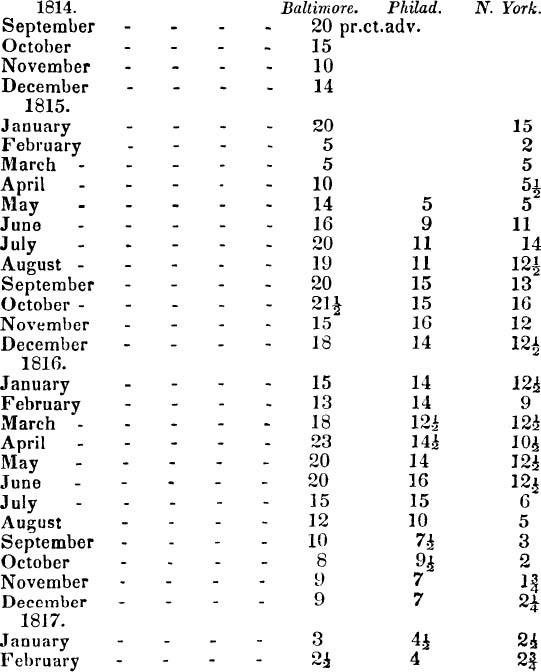
From the rates of exchange on London, in New York and Philadelphia, in the months in which there are blanks
Chapter XIX. Of Banking from 1820–21 to 1825–26.
To tell of all the expansions and contractions that have occurred since the first grand curtailment was made by the United States’ Bank, would require a large volume. Our country is so extensive, and the causes that affect Bank medium are so various, that, while one part of the Union is suffering all the evils of scarcity of money, another may be in the height of that apparent prosperity which is produced by an increasing paper currency.
Chapter XX. Of Banking from 1826–27 to 1828–29
Mr. John F. Watson, the Cashier of the Bank of Germantown, in his “Annals of Philadelphia,” gives the following testimony of an ancient lady, respecting the manner in which commercial affairs were conducted previous to the Revolutionary War. “If a citizen failed in business, it was a cause of general and deep regret. Every man who met his neighbor, spoke of his chagrin. It was a rare occurrence, because honesty and temperance in trade were then universal.”
Chapter XXI. Additional Particulars in the History of Banking from 1824 to 1829
The professors of natural science are able to give satisfactory accounts of the general causes of heat and cold in different latitudes, and of snow and rain in different seasons, but it is in most instances beyond their power to state in what degree each of the general causes known to be in operation, has contributed to the state of the weather at a particular time and particular place. Banking is like the weather. It is affected by a variety of causes, which present themselves in different combinations.
