
The Best Medium of Exchange
The Best Medium of Exchange
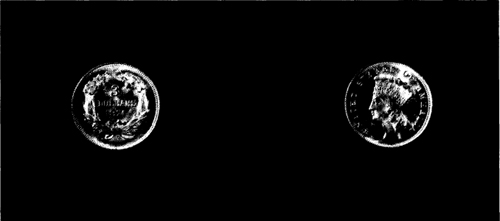
U.S. $3 gold piece of 1874.
During most of the 19th century, we had a functioning gold standard. Combined with classical liberal economic policies and limited government, this set the stage for the greatest economic growth in history.
Cross of Paper
Cross of Paper
“You shall not crucify Mankind upon a cross of gold,” said inflationist William Jennings Bryan. But mankind, especially poorer and more vulnerable people, is oppressed by paper money, not by gold. It was for this reason that Thomas Jefferson and Andrew Jackson—the presidents who were our greatest defenders of the common man—were such unalterable opponents of paper money.
How Our Money Was Ruined
How Our Money Was Ruined
The transition of the United States from a gold coin standard to a managed fiat currency was slow and uneven, but it came about as the result of deliberate Congressional decisions. Most intellectuals over the past half century haven’t challenged the transition; they have promoted it. We have come far from the days of the Founding Fathers, who decreed death—in the Mint Act of 1792—for any officer or employee of the Mint who debased the coinage of the United States.
The Stage Is Set
The Stage Is Set
With the death of the dollar, the time is ripe for the institution of a trustworthy monetary system. The times demand it, and so does the survival of our economic and political order.
Motives of the Inflationists
Motives of the Inflationists
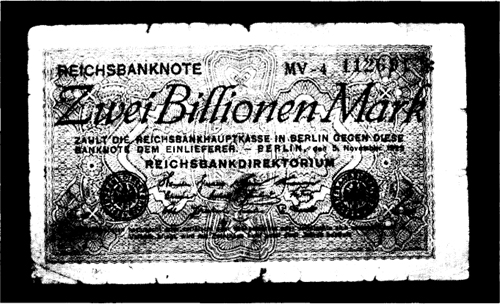
A two-trillion mark note of the great German inflation of the 1920s.
If we expect to reverse the destruction of our economy, we must try to understand the motives of those who promote inflation.
Is Business To Blame?
Is Business To Blame?
Some say business profits are the cause of inflation. But profits—in a voluntary market—are only an indication of efficiency and service to consumers. Legitimate profits have nothing whatsoever to do with inflation.
Are Banks To Blame?
Are Banks To Blame?
Some of the large banks, which have been prominent promoters of fiat currency, have certainly benefitted from inflation. Their “profits” have been enhanced, since somebody has to broker all the new money created by government, and pass it on to the large corporations. The international bankers are delighted to do so.
Are Unions To Blame?
Are Unions To Blame?
Unions are accused of causing inflation. But unions cannot create new money and credit, so they cannot be held directly responsible for inflation. But just as business can exert pressure on government to inflate, so can monopoly wage increases. A good example is the credit the government created to bail-out the Chrysler Corporation, largely to finance a labor contract that pays the employees twice the average industrial wage. But unions, like businesses, can only persuade government to inflate if the inflation mechanism is in place.
Inflation and the Business Cycle
Inflation and the Business Cycle
The business cycle, which Marx maintained is inherent in capitalism, is actually caused by government inflation. “New money is issued by the banking system, under the aegis of government,” says Dr. Murray Rothbard, “and loaned to business. To businessmen, the new funds seem to be genuine investments. But these do not, like free market investments, arise from voluntary savings. The new money is invested by businessmen in various projects, and paid out to workers and other factors as higher wages and prices.
The Guilt of the Economists
The Guilt of the Economists
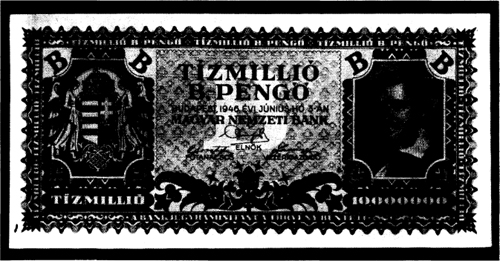
A ten-million pengo inflation note of Hungary.
