Rockefeller, Morgan, and War
Rockefeller, Morgan, and War

The Guatemalan Coup
The Guatemalan Coup
Fresh from its CIA triumph in Iran, the Eisenhower administration next turned its attention to Guatemala, where the left-liberal regime of Jacob Arbenz Guzman had nationalized 234,000 acres of uncultivated land owned by the nation’s largest landholder, the American-owned United Fruit Company, which imported about 60 percent of all bananas coming into the United States.
JFK and the Establishment
JFK and the Establishment
LBJ and the Power Elite
LBJ and the Power Elite
Henry A. Kissinger
Henry A. Kissinger
But of course the dominant foreign policy figure in both the Nixon and Ford administrations was not William Rogers but Henry A. Kissinger, who was named national security adviser and soon became virtually the sole force in foreign policy, officially replacing Rogers as Secretary of State in 1973.
The Trilateral Commission
The Trilateral Commission
In July 1973 a development occurred which was to have a critical impact on U.S. foreign—and domestic—policy. David Rockefeller formed the Trilateral Commission, as a more elite and exclusive organization than the CFR, and containing statesmen, businessmen, and intellectuals from Western Europe and Japan.
Bibliography
Bibliography
Burch, Jr., Philip H. Elites in American History, Volume 2: From the Civil War to the New Deal. New York: Holmes and Meier, 1981.
Chernow, Ron. The House of Morgan: An American Banking Dynasty and the Rise of Modern Finance. New York: Atlantic Monthly Press, 1990.
Domhoff, G. William. The Power Elite and the State: How Power Is Made in America. New York: Aldine de Gruyter, 1990.
Index
Index
______________ A ______________
Acheson, Dean G., 33, 48, 52, 54
Acheson, Katherine, 49
Adams, George Burton, 29
Aerial Coast Patrol, 19
Aldrich, Nelson W., 25
Aldrich, Winthrop W., 37, 55
Allende, Salvador, 57, 58
Altman, Roger C., 63
American Asiatic Association, 10
Principles of Economics
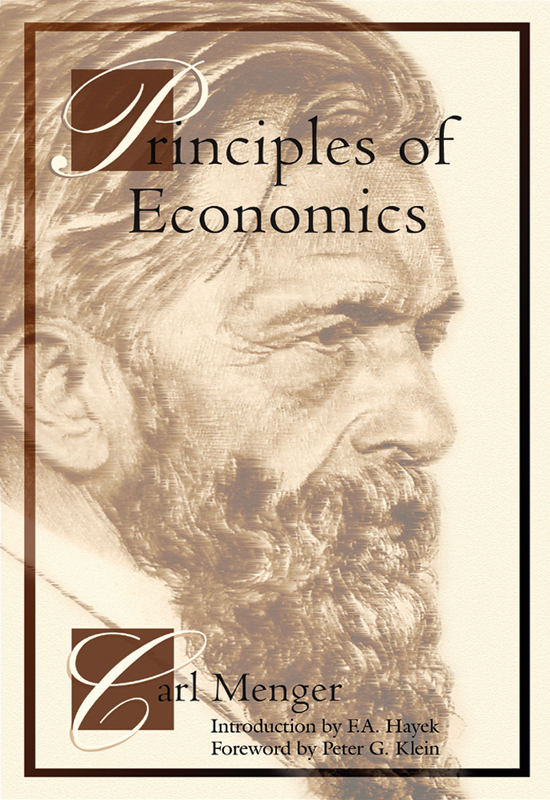
Title Page
PRINCIPLES OF
ECONOMICS
Carl Menger
FOREWORD BY PETER G. KLEIN
INTRODUCTION BY F.A. HAYEK
TRANSLATED BY
JAMES DINGWALL AND BERT F. HOSELITZ