
D. Politics
D. Politics
Chapter 45
Term Limits Make Me Sick; A Hoppean Analysis
If I hear just one more time, from a supposed libertarian, about the greatness of term limits, I think I’m going to be sick.
Yes, yes, I know all the arguments. Kick the bums out. Promote political competition. Incumbency confers Soviet style (99 percent) voting majorities. This way, at least, we’ll get new thieves.
46. Federalism: Is It Libertarian?
Chapter 46
Federalism: Is It Libertarian?
Is France justified in invading New York City to force the latter to get rid of its rent control legislation? Would it be compatible with libertarianism for California to forcibly prevent the U.S. government from imposing a draft on California citizens? The federal government physically attacks Mississippi in 1950 for its Jim Crow legislation; Mississippi resists. Which side does the libertarian root for? The U.S.
Thanks, Mr. Libertarian
Whenever anyone mentions “Austrian economics without You Know Who,” the cognoscenti know exactly who is meant: Ludwig von Mises, of course. This issue arose late in the last century, during a discussion of the phenomenon of the revival of the Austrian School of economics, when it was feared by some that Mises was too radical, too uncompromising. He had to be jettisoned in favor of moderates, such as, for example, Friedrich A. Hayek if the praxeological school was to make any headway, at least in this inside the beltway perspective.
Index
9/11/01, 171
failure of FBI to protect against, 173
and gun control, 172
Abolitionists, 187, 189
Abortion, 181–82
Adams, John, Quincy, 30
Aggression, 22, 24, 103, 160
as distinct from defense, 24–25
Aggressor, 25
nation, 25
Anarcho-libertarian, See Libertarian
Animals. See Private property rights; hunt farms
An Inquiry into the Nature and Causes of the Wealth of Nations (Smith), 53, 56
AIDS, 83, 143, 170
Airport security, 59–62
From Aristocracy to Monarchy to Democracy
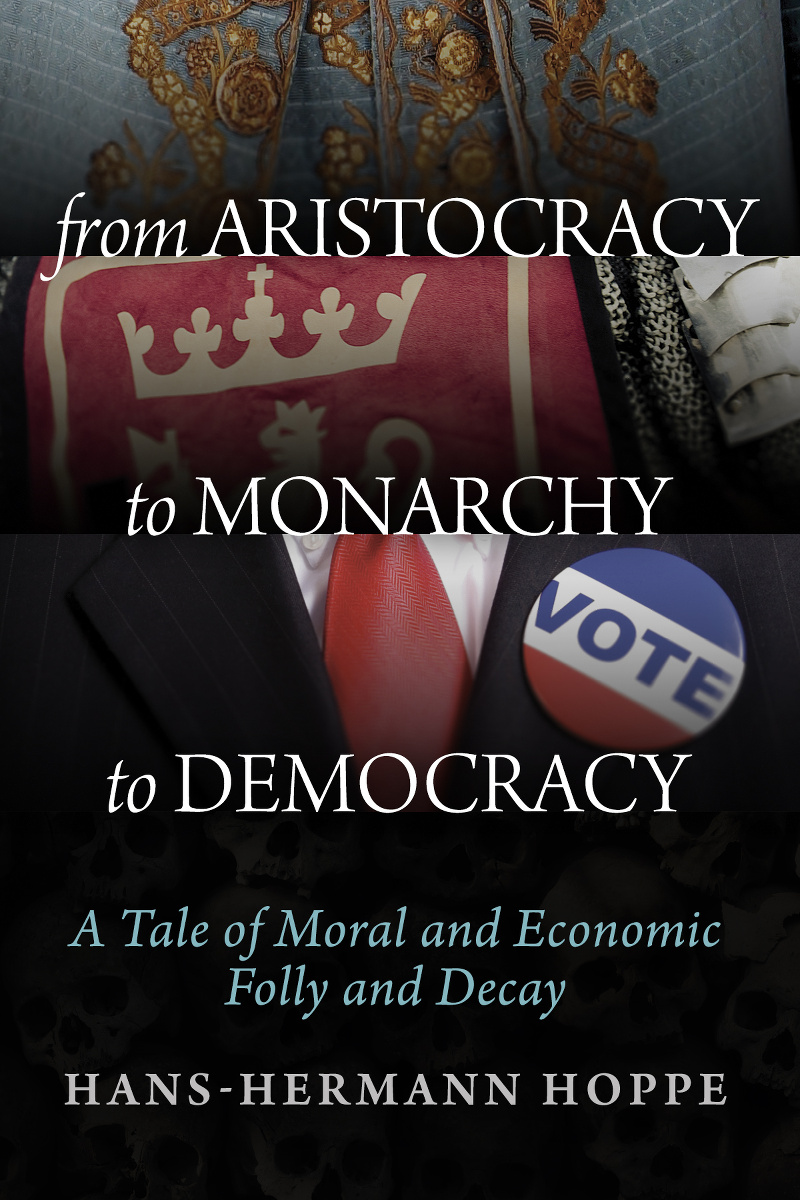
From Aristocracy to Monarchy to Democracy:
A Tale of Moral and Economic Folly and Decay
Hans-Hermann Hoppe
Mises Institute
AUBURN, ALABAMA
LVMI

Dedication
The Mises Institute dedicates this volume to all of its generous donors and wishes to thank these Patrons, in particular:
Adam J. Bagby
Douglas E. French and Deanna L. Forbush
Jing Jin and Wai Chan
Charles and Anne-Lisbeth Sebrell
Elijah Joel Smith
John Tate
Anonymous
John Bartel
Richard Beverly Bleiberg
Herbert Borbe
Jorge Carlos Borlandelli Zeballos
Mary E. Braum
Dietmar Georg
Hunter Hastings
Albert L. Hillman, Jr.
Copyright
Published 2014 by the Mises Institute and published under the Creative Commons Attribution NonCommercial-NoDerivs 4.0 International License. http://creativecommons.org/licenses/by-nc-nd/4.0/
Mises Institute
518 West Magnolia Avenue
Auburn, Ala. 36832
ISBN: 978-1-61016-592-1
eISBN: 978-1-61016-635-5
Introduction
Hans-Hermann Hoppe is a master of theoretical history. He tells us that
it is not my purpose here to engage in standard history, i.e., history as it is written by historians, but to offer a logical or sociological reconstruction of history, informed by actual historical events, but motivated more fundamentally by theoretical — philosophical and economic — concerns.
The work of Carl Menger and Ludwig von Mises on the commodity origin of money is a prime example of what Hoppe has in mind.
