
14. East Wind Rain
Chapter Fourteen
EAST WIND RAIN
THE JAPANESE government had arranged on November 19 that if a secret decision should be made to go to war with the United States, its diplomatic corps throughout the world would be notified by insertion of the false weather report, “east wind rain,” in the middle of the daily Japanese language short-wave news broadcast.
15. “Imprison’d in the Viewless Winds”
Chapter Fifteen
“IMPRISON’D IN THE VIEWLESS WINDS”
THE CHIEF corroborating witness as to the existence of the “winds” message was, until the congressional investigation, Lieut. Comdr. (later Capt.) Alwin D. Kramer, senior language officer for Navy communication intelligence. Excerpts from Kramer’s testimony before the Navy Pearl Harbor Board, which were not made public until February 5, 1946, showed that he had testified before the board in 1944 that he saw a plain language Japanese message in Capt.
16. “Do-Don’t” Warnings
Chapter Sixteen
“DO-DON’T” WARNINGS
WASHINGTON, IN blaming Kimmel and Short for the disaster of December 7, contended that they had been adequately warned of the imminence of war. The first warning which was supposed to have guided the field commanders was a letter from Knox to Stimson on January 24, 1941, in which the Secretary of the Navy said, “If war eventuates with Japan, it is believed easily possible that hostilities would be initiated by a surprise attack upon the fleet or the naval base at Pearl Harbor.”1
17. “Known Impending War”
Chapter Seventeen
“KNOWN IMPENDING WAR”
THE UTILITY of the warnings sent to Hawaii may be judged in the light of how the Hawaiian commanders reacted. Short thought he was being warned against sabotage and subversion. He prepared his defenses against them. Kimmel thought he was being warned to get ready for offensive action against the Marshall Islands under the Navy war plan. He prepared himself for his mission, conserving his long-range reconnaissance planes and their crews for the tasks ahead.
18. The Light that Failed
Chapter Eighteen
THE LIGHT THAT FAILED
THE ARMY Operations Manual in use on December 7, 1941, makes the following pertinent observation:
From adequate and timely military intelligence the commander is able to draw logical conclusions concerning enemy lines of action. Military intelligence is thus an essential factor in the estimate of the situation and in the conduct of operations.1
In his statement to the congressional committee, Gen. Short said,
19. Japan Solves the Dilemma
Chapter Nineteen
JAPAN SOLVES THE DILEMMA
IN THE complex of events from November 25 through December 7, 1941, Japanese policy shaped itself in conformity with the desires of President Roosevelt.
20. Who Was Guilty?
Chapter Twenty
WHO WAS GUILTY?
THE ATTACK by Japan upon Pearl Harbor provided the long-sought incident that put the United States into the World War. The Japanese, however, had exceeded the Roosevelt administration’s specifications that, in firing the first shot, they should not “allow too much danger to ourselves.” Pearl Harbor was more than a mere token act of hostilities. The Japanese had kept on firing until 2,326 Americans were dead and the Pacific fleet was a wreck. Other disasters were accumulating and were foreseeable.
Appendix
APPENDIX
Maps
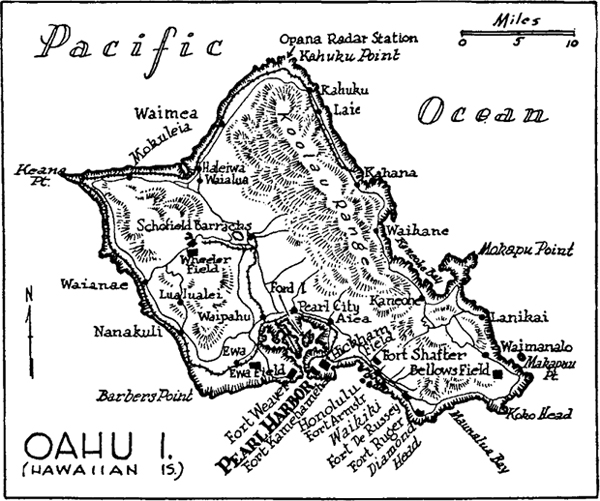
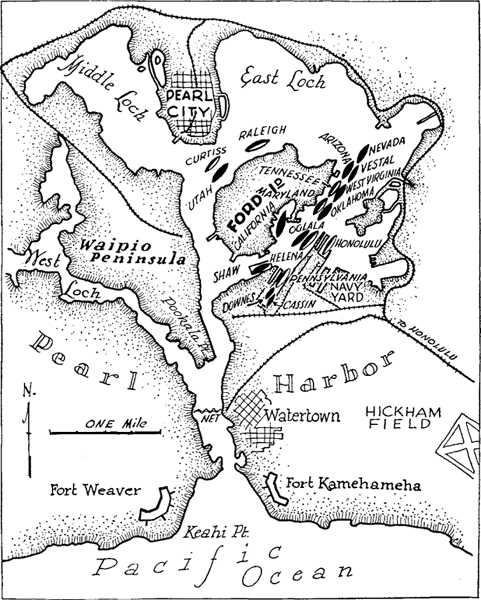
The island of Oahu, Territory of Hawaii, showing objectives of the Japanese attack, of December 7, 1941, which brought the United States into World War II. [This and succeeding maps were drawn by GARY SHEAHAN.]
Witnesses Before Pearl Harbor Investigating Committee
WITNESSES APPEARING BEFORE THE JOINT CONGRESSIONAL COMMITTEE TO INVESTIGATE THE ATTACK ON PEARL HARBOR AND THEIR ASSIGNMENTS AS OF DECEMBER 7, 1941
Beardall, John R., Rear Adm., naval aide to President Roosevelt.
Beatty, Frank E., Rear Adm., aide to Secretary of the Navy Frank Knox.
Bellinger, P. N. L., Vice-Adm., commander Hawaiian naval base air force (commander, patrol wing 2).
Bicknell, George W., Col., assistant chief, military intelligence service, Hawaiian Department.
