
29. Harmony Understood
HARMONY UNDERSTOOD
All discord, harmony not understood.
—ALEXANDER POPE
Index
Prepared by Vernelia A. Crawford
The letter “n” following a number indicates a footnote.
A
Abundance, 113
Addison, Joseph, 96
Adversity, blessings of, 30-35
Amiel, Henri Frederic, 63, 151
Andrews, Donald Hatch, 2n, 3
Apelles, 24, 25, 29
Aristotle, 58
Authority, 152, 154, 162
Authorship, 32
B
Bacon, Francis, 134
Bailey, Gamaliel, 17
Bastiat, Frederic, 112, 113
Beecher, Henry Ward, 36
How Do We Know
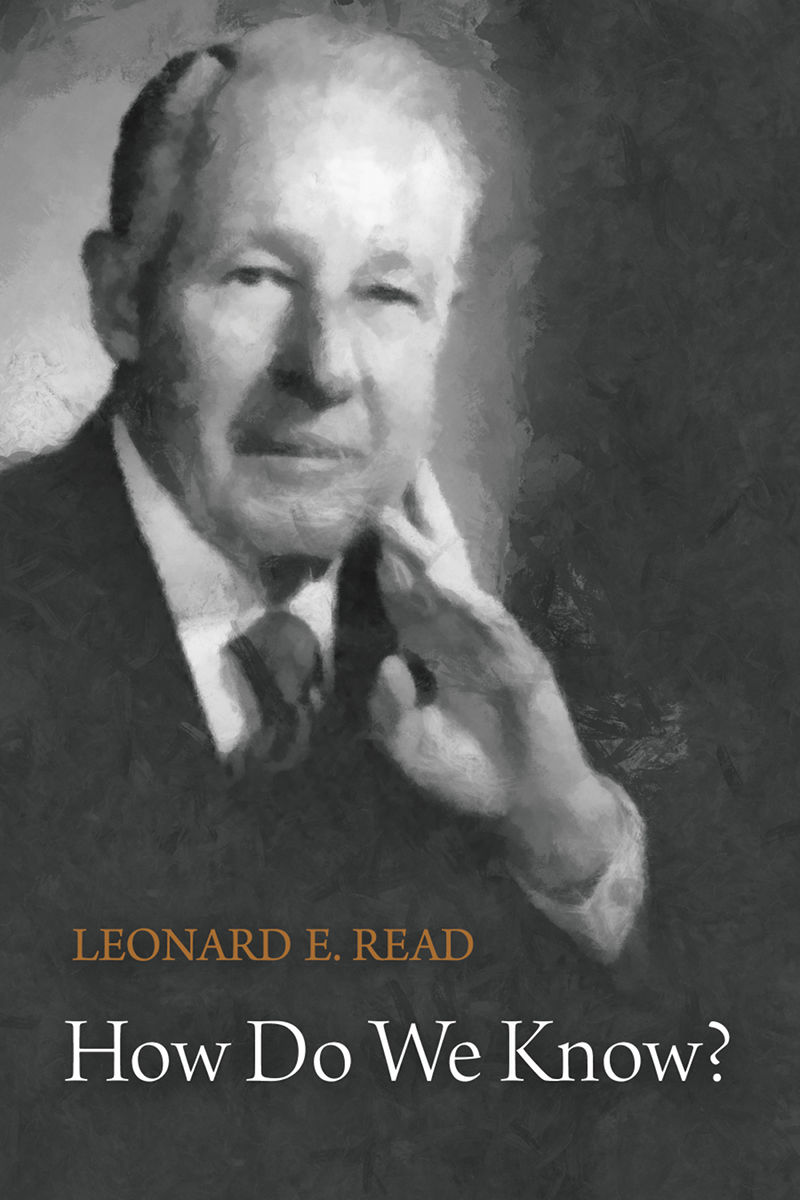
Other Books By Leonard E. Read
Romance of Reality (o.p.)
Pattern for Revolt
Instead of Violence
Outlook for Freedom (o.p.)
Government: An Ideal Concept
Governo Um Concito Ideal
Why Not Try Freedom?
¿Por Que No Ensayar la Libertad?
Elements of Libertarian Leadership
Anything That’s Peaceful
Todo Por la Paz
The Free Market and Its Enemy
El Enemigo del Mercado Libre
Deeper Than You Think
LVMI

The Author And Publisher
Leonard E. Read has been president of The Foundation for Economic Education since it was organized in 1946.
The Foundation is a nonpolitical, nonprofit, educational institution. Its senior staff and numerous writers are students as well as teachers of the free market, private ownership, limited government rationale. Sample copies of the Foundation’s monthly study journal, The Freeman, are available on request.
The Foundation for Economic Education, Inc.(www.fee.org)
Irvington-on-Hudson, New York 10533
1981
1. How Do We Know?
HOW DO WE KNOW?
He who calls in the aid of an equal understanding, doubles his view; and he who profits of a superior understanding, raises his powers to a level with the height of the superior understanding he unites with.
—EDMUND BURKE
Edmund Burke (1729-97) here gives me reason enough for so frequently calling to my aid this great statesman and source of wisdom. He expertly counsels how understanding—knowledge—can be achieved.
2. Read Good Books For Improved Thinking
READ GOOD BOOKS FOR IMPROVED THINKING
To use books rightly, is to go to them for help; to appeal to them when our own knowledge and power fail; to be led by them into wider sight and purer conception than our own; and to receive from them the united sentence of the judges and councils of all time, against our solitary and unstable opinions.
—JOHN RUSKIN
3. The Opponent of Happiness
THE OPPONENT OF HAPPINESS
I have never been able to conceive how any rational being could propose happiness to himself from the exercise of power over others.
—THOMAS JEFFERSON
Reflect on what a great American was Jefferson (1743-1826). My Encyclopedia gives his record:
4. Righteousness Leads to Happiness
RIGHTEOUSNESS LEADS TO HAPPINESS
Happiness consists in the attainment of our desires, and in having only right desires.
—SAINT AUGUSTINE
Saint Augustine, Bishop of Hippo, wrote his autobiography entitled Confessions about 16 centuries ago. I am reliably informed that this gem has been and still is the most widely read autobiography ever written. People respond to excellence in another.
