
References
REFERENCES
1. Isabel Paterson, The God of the Machine (New York: G. P. Putnam’s Sons, 1943), chap. xx.
a. p. 155.
2. Plutarch’s Lives (Chicago: Henry Regnery Co., 1949), pp. 33–34.
3. Rose Wilder Lane, The Discovery of Freedom (New York: The John Day Co., 1943), pp. 7–8.
a. pp. 20–21.
b. pp. 110–111.
c. p. 120.
Bibliography
BIBLIOGRAPHY
The mere mention of books that have been used for reference purposes and as stimulants to thought, can indicate only a small part of one’s obligation to those who have specialized in areas so vast as those touched upon in Mainspring.
As will be noted, the list includes some items that are opposed to the philosophy of individual freedom and which are not recommended – except for antitoxin effects.
Adams, James Truslow. The Living Jefferson. New York: Charles Scribner’s Sons, 1936.
Index
INDEX
A
Abraham, beliefs of, 78
Admiral of the Ocean Sea, 266
Adventures of Ebenezer Fox, in the Revolutionary War, 266
Age of Science, 169
Agis IV, 46
Amendments, Constitutional, 196
America
aid from, 263
attempt at freedom, ch. 12, p. 147
colonial settlements in, 148
see also Freedom, third attempt-American
Backcover
America’s Second Crusade
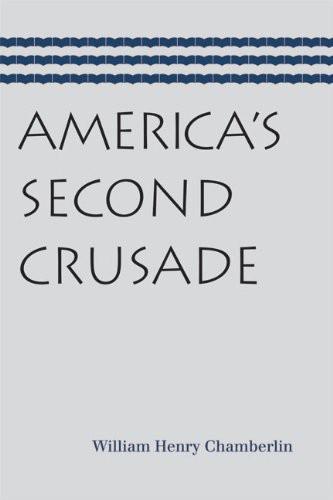
Other Books By William Henry Chamberlin
Russia’s Iron Age (1934)
The Russian Revolution, 1917-1921 (1935)
Collectivism: A False Utopia (1936)
Japan over Asia (1937; rev. ed. 1939)
The Confessions of an Individualist (1940)
The World’s Iron Age (1941)
Canada Today and Tomorrow (1942)
The Russian Enigma: An Interpretation (1943)
The Ukraine: A Submerged Nation (1944)
America: Partner in World Rule (1945)
The European Cockpit (1947)
Copyright 1950 HENRY REGNERY COMPANY Chicago, Illinois

Copyright 1950 HENRY REGNERY COMPANY Chicago, Illinois
Manufactured in the United States of America by American Book-Knickerbocker Press, Inc., New York, N. Y.
Table of Contents
Introduction
1. The First Crusade
2. Communism and Fascism: Offspring of the War
3. The Collapse of Versailles
4. Debacle in the West
5. “Again and Again and Again”
6. Road to War: The Atlantic
7. Road to War: The Pacific
8. The Coalition of the Big Three
9. The Munich Called Yalta: War’s End
10. Wartime Illusions and Delusions
11. Poland: The Great Betrayal
12. Germany Must Be Destroyed
13. No War, But No Peace
Introduction
THERE is an obvious and painful gap between the world of 1950 and the postwar conditions envisaged by American and British wartime leaders. The negative objective of the war, the destruction of the Axis powers, was achieved. But not one of the positive goals set forth in the Atlantic Charter and the Four Freedoms has been realized.
1. The First Crusade
AMERICANS, more than any other people, have been inclined to interpret their involvement in the two great wars of the twentieth century in terms of crusades for righteousness. General Eisenhower calls his memoirs Crusade in Europe, And the mural paintings in the Widener Memorial Library at Harvard University show the American soldiers of World War I as chivalrous knights, fighting for the freedom of wronged peoples. They bear the inscription:
Happy those who with a glowing faith
