
Back Door to War: The Roosevelt Foreign Policy 1933-1941
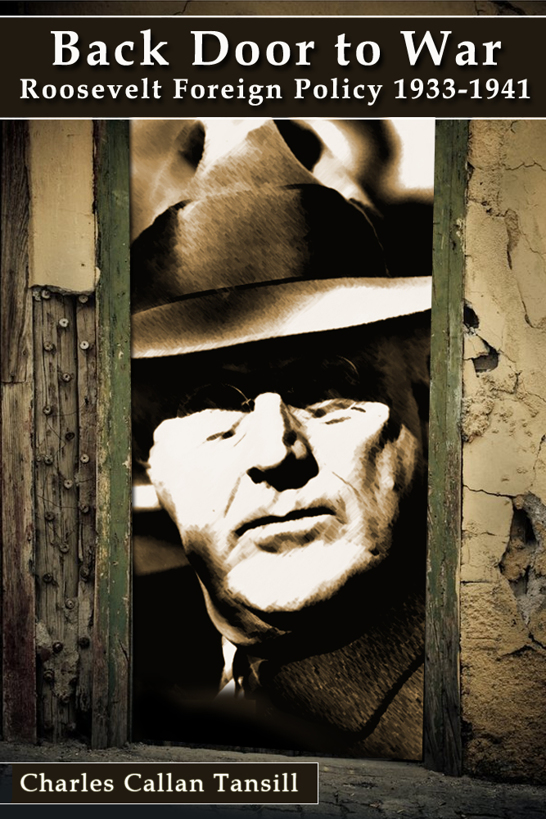
Unknown
Library of Congress Cataloging in Publication Data
Tansill, Charles Callan, 1890-Back door to war.
Reprint of a 1971 issue of the 1st ed. published in 1952 by Regnery, Chicago.
Bibliography: p.
Includes index.
1. United States—Foreign relations—1933-1945.
2. World politics—1933-1945. 3. World War, 1939-1945—Causes. I. Title.
[E806.T3 1975] 327.73 75-1121
ISBN 0-8371-7990-4
Copyright 1952 CHARLES CALLAN TANSILL
Unknown
TO
MY STUDENTS OF
MORE THAN THREE DECADES
Preface
THE armistice of November 11, 1918, put an end to World War I, but it ushered in a battle of the books that continues to the present day. Responsibility for the outbreak of that conflict was glibly placed by Allied historians upon the shoulders of the statesmen of the Central powers. German historians replied with a flood of books and pamphlets that filled the shelves of many libraries, and the so-called “revisionists” in many lands swelled this rising tide by adding monographs that challenged the Allied war-guilt thesis.
Unknown
Back Door to War
Historical Introduction
a. The Rise of Anglo-American Friendship
THE MAIN OBJECTIVE in American foreign policy since 1900 has been the preservation of the British Empire. Intimate ties between Britain and the United States were first forged in 1898 when Britain realized that her policy of isolation had deprived her of any faithful allies upon whom she could depend in the event of war.
I: American Relations with the Weimar Republic
a. America Rejects Trials of War Criminals
IN THE YEARS immediately after the close of the World War the attitude of the American Government towards the Weimar Republic was one of watchful waiting. In the Department of State there was a definite fear that sparks from Soviet Russia might find an easy lodgment in the broken structure of Germany and thus start a fire that would consume all the landmarks of the old German way of life.
II: The Far East in Ferment
a. A Triple Offensive Is Launched against Japan
WHILE the Roosevelt Administration was putting its diplomatic house in order with reference to Nazi Germany, the situation in the Far East constantly threatened to get out of hand. The heritage of the Stimson policy was an unfortunate one. But the policy of pressure upon Japan antedated Stimson some two decades. Dollar diplomacy under Taft challenged Japan’s position in Manchuria, and under Woodrow Wilson a three-pronged offensive was launched against Nippon.
III: Continued Friction with Japan Points towards Inevitable War
a. Congress Enacts an Exclusion Law Which Angers Japan
AS AMERICAN STATESMEN looked from the troubled scenes in China to the quiet landscapes in Japan, it was not with relief but with suspicion that they viewed the placid picture of Old Nippon. The orderly ways of empire grated upon the sensibilities of many Americans who preferred the uneasy atmosphere of democracy to the regulated rhythm of the Mikado’s Government.
IV: Secretary Stimson Produces a Pattern of War
a. American Press Opinion of the Stimson Doctrine
WHEN SECRETARY STIMSON boldly announced on January 7, 1932, his nonrecognition policy, he felt confident that he could rely upon a large section of the American press for support. The old tradition of isolation had been slowly and steadily undermined by ardent one-worlders who were desperately anxious for America to bear a larger share of the burdens that the World War had thrust upon the weakened back of Europe.
