
III. The Law of Machines
THE LAW OF MACHINES
No longer do we speak of machines. They are too numerous and too different. We speak of industrial equipment, which means machine power in general.
IV. Who Mind Them or Starve
WHO MIND THEM OR STARVE
What is it you will fear? That you will be unable to sell away the surplus product of your machines? That industry will be unable to make a profit?
V. The Paradox of Surplus
THE PARADOX OF SURPLUS
What does it mean? Can there be too many desirable and useful things? Can things be too cheap? You would say no. Surely, so long as any human want remains unsatisfied, things cannot be either too plentiful or too cheap. But there is another dimension.
VI. In Peril of Trade
IN PERIL OF TRADE
So now what will happen? From the excessive power already existing to produce industrial commodities, from the continued increase of that power nevertheless for political and national reasons, from the raising of trade barriers by one nation against another because every one fears the effect upon its own industries of receiving cheap goods from another, from this running of people out of the fields to tend more machines, from the amazing growth of urban tissue in the economic body—from all of this what follows?
VII. Dim Vistas New
DIM VISTAS NEW
It must occur to you that what the world requires to find is a new conception of commerce among nations—one that shall be free of the predatory impulse, above the exploiting motive, competitive in some nobler sense. It need not be magnanimous or unselfish—not yet—but only enlightened enough to comprehend the latter meaning of events.
The American Story
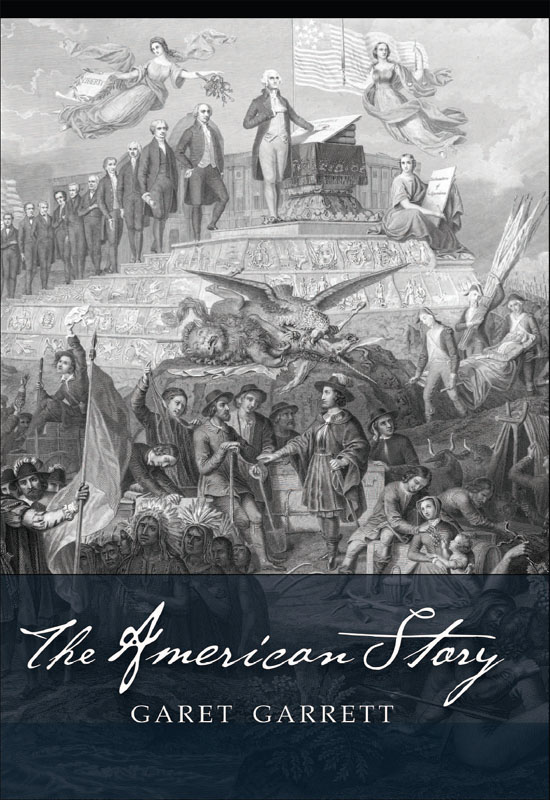
The
The
American
Story
Title Page
The
American
Story
by
Garet
Garrett
Chicago • 1955
Copyright Page

Copyright 1955 by Henry Regnery Company, Chicago, Illinois. Copyright under International Copyright Union. Manufactured in the United States of America. Library of Congress Catalog Card Number: 55–5163
Dedication
DEDICATED
to
DOROTHY
—G.G.
