
7. Book of the Debts
I
“To wipe out all that”
—RAMSAY MACDONALD
PRIME MINISTER OF ENGLAND
On war debts and reparations, in his election speeches, 1931.
“This crude job jocularly called a settlement.”
—LLOYD GEORGE,
Referring to the British agreement with the United States Treasury, in his book entitled, “The Truth About War Debts And Reparations”, 1932.
Back

The Cinder Buggy
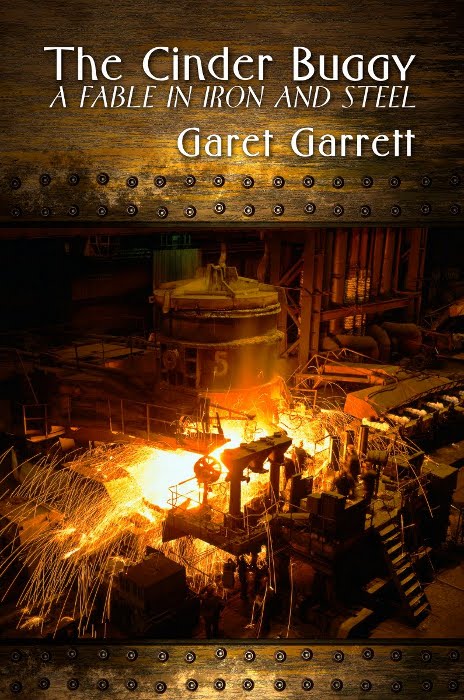
Title Page
A FABLE IN IRON AND STEEL
BY
GARET GARRETT
AUTHOR OF “THE DRIVER,” “THE BLUE WOUND,” FTC

NEW YORK
E. P. DUTTON & COMPANY
681 FIFTH AVENUE
Copyright
Copyright, 1923
By E. P. Dutton & Company
All Rights Reserved
PRINTED IN THE UNITED STATES OF AMERICA
By the Same Author
BY THE SAME AUTHOR
THE DRIVER
“A good, rapidly moving novel of ‘Wall Street’ methods, written by a man who knows.”
—Springfield Republican
“The book is among the most absorbing which we have read recently.”
—Heywood Broun in The World
“I feel as did Mark Sullivan, who said: ‘Garet Garrett has written one of the great novels of the day.’... That is beside the point to one who wants to study man and his work.... The thing that impresses me is its fidelity to life.”
—Bernard M. Baruch.
E. P. DUTTON & COMPANY
Epigraph
A pot-metal body
on two little wheels,
absurdly,
bow-leggedly
walking away to the dump
with the slag, the
purgings of iron, the
villainous drool of the furnace—
that is a cinder buggy.
It is also a sign
that what man refines
beyond
God’s content
with things as he left them
will very soon perish
for want of the dross
from which it is parted.
Why hath each thing its cinder?—
even the sweetest desire?
I
I
A GENERATION has fled since a stranger was seen in the streets of New Damascus on an errand of business.
The town has nothing to sell except the finest wrought iron in the world. As the quality of this iron is historic and the form of it a standard muck bar for use in further manufacture you order it from afar at a price based on what is current in Pittsburgh.
Sellers of merchandise miss New Damascus on purpose. It is a catalogue town. It buys nothing because it is new, nothing it does not need, has no natural pride in waste whatever.
II
II
WHEN in 1879 Gen. Aaron Z. Woolwine founded this place all the best Palestinian names, such as Philadelphia, Lebanon and Bethlehem, were already taken in Pennsylvania, so he called it New Damascus; and this name when he thought of it was perfect. The Damascenes were famous artificers in metal. He imagined even a geographical resemblance,—a plain bounded on one side by a river and on the other three by mountains representing the heights of Anti-Lebanon.
III
III
NOWHERE in the annals of the county nor in those lymphatic biographical histories, quarto, half or full leather, profusely illustrated with steel engravings, which adorn the bookshelves of posterity, is there any mention of General Woolwine’s partner and man of business. This was Christopher Gib, cold, and logical, with a large broad face, dull blue eyes, a long bleak mouth line and a hard apple chin. People feared him instinctively.
